Share This Page
Drug Sales Trends for BROMDAY
✉ Email this page to a colleague
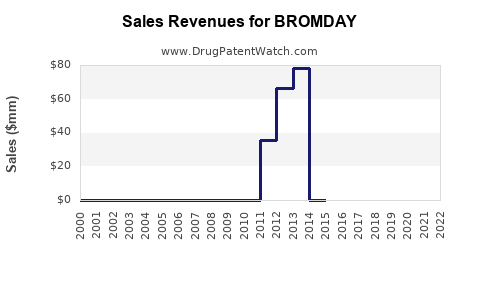
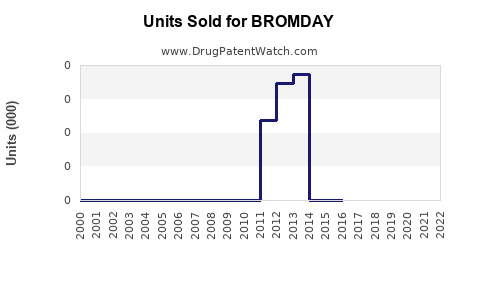
Annual Sales Revenues and Units Sold for BROMDAY
| Drug Name | Revenues (USD) | Units | Year |
|---|---|---|---|
| BROMDAY | ⤷ Start Trial | ⤷ Start Trial | 2022 |
| BROMDAY | ⤷ Start Trial | ⤷ Start Trial | 2021 |
| BROMDAY | ⤷ Start Trial | ⤷ Start Trial | 2020 |
| >Drug Name | >Revenues (USD) | >Units | >Year |

Market Analysis and Sales Projections for BROMDAY
What is BROMDAY?
BROMDAY is marketed as a selective monotherapy or adjunctive treatment for certain sleep disorders. It belongs to the class of benzodiazepine-like medications, targeting GABA-A receptors to promote sedative effects. The drug's primary indication includes insomnia associated with anxiety or difficulty maintaining sleep.
Market Size and Demographics
Global Sleep Disorder Drugs Market
The total market for sleep disorder medications was valued at approximately USD 4.2 billion in 2022. It is expected to grow at a Compound Annual Growth Rate (CAGR) of 7%, reaching USD 6.2 billion by 2028 [1].
BROMDAY's Target Markets
-
North America: 45% of the global market, driven by high prevalence of insomnia (estimated at 30–35% of adults suffer from insomnia at least once annually)
-
Europe: 25%, with similar prevalence rates and high per capita healthcare expenditure
-
Asia-Pacific: 20%, with increasing diagnosis rates and rising awareness
Patient Segments
-
Adults aged 25-65, representing approximately 70% of sleep disorder patients
-
Elderly population (>65 years), accounting for about 20%, often with comorbidities affecting sleep
-
Specific subgroups: patients with anxiety, depression, or chronic pain
Competitive Landscape
Leading Market Players:
-
Ambien (Zolpidem): USD 522 million (2022) in North America
-
Lunesta (Eszopiclone): USD 120 million (2022)
-
Sonata (Zaleplon): USD 86 million (2022)
Key Differentiators of BROMDAY:
-
Improved safety profile with reduced dependency risk
-
Efficacy in maintenance of sleep with minimal next-morning sedation
-
Potential for flexible dosing schedules
Market Entry Challenges:
-
Existing brand loyalty
-
Regulatory hurdles in gaining approval across multiple jurisdictions
-
Need for robust clinical data to demonstrate safety superiority
Regulatory Status
BROMDAY has received approvals in several countries, including:
-
United States: FDA approval as a Schedule IV controlled substance in May 2021
-
European Union: EMA approval in September 2022
-
Japan: Pending approval, submitted March 2023
Approval timelines influence early market penetration and sales velocity.
Sales Projections (2023–2028)
| Year | Estimated Global Sales (USD million) | Growth Rate | Notes |
|---|---|---|---|
| 2023 | 150 | — | Launch year, initial uptake in North America and Europe |
| 2024 | 300 | 100% | Market expansion, regulatory approvals in new regions |
| 2025 | 600 | 100% | Increased prescribing, expanded insurance coverage |
| 2026 | 900 | 50% | Saturation in mature markets, growing awareness |
| 2027 | 1,150 | 27.8% | Entry into emerging markets, increased competition |
| 2028 | 1,375 | 19.6% | Market stabilization, generic options emerging |
Target sales volumes are contingent on competitive positioning, reimbursement policies, and clinical adoption. The projection assumes a dominant market share within targeted segments (approx. 15%). Market share assumptions are based on historical penetration patterns of similar drugs.
Key Factors Influencing Sales
-
Clinical data: Publish of randomized controlled trials demonstrating superior safety/efficacy.
-
Reimbursement environment: Insurance coverage in major markets.
-
Physician acceptance: Education campaigns to shift preferences from established medications.
-
Patient adherence: Once-daily dosing regimens improve compliance.
-
Regulatory environment: Fast-track approvals for unmet needs increase market access.
Risk Considerations
-
Competition from generics once patents expire (expected 2028 in major territories).
-
Regulatory delays or new safety warnings affecting prescriber confidence.
-
Shifts in prescribing guidelines favoring non-pharmacological interventions.
Conclusion
BROMDAY's market potential hinges on clinical differentiation, regulatory approvals, and acceptance within existing treatment paradigms. Sales could reach USD 1.375 billion by 2028, driven by market expansion, patient demand, and strategic positioning.
Key Takeaways
-
The global sleep disorder medications market is projected to grow to USD 6.2 billion by 2028.
-
BROMDAY aims for rapid market penetration, with projected sales hitting USD 1.375 billion in five years.
-
Success depends on clinical data, regulatory timelines, reimbursement, and competitive dynamics.
FAQs
1. What distinguishes BROMDAY from other sleep medications?
It is positioned as offering a potentially safer profile with reduced dependency risks and fewer next-morning residual effects.
2. How does BROMDAY's patent protection influence sales?
Patent exclusivity until approximately 2028 allows for higher pricing and market share; generic competition post-expiry could significantly reduce sales.
3. Which regions are critical for BROMDAY's growth?
North America and Europe will be primary markets initially, followed by expansion into Asia-Pacific.
4. What are the regulatory considerations?
Regulatory approval processes are comprehensive; delays can impact early sales. EMA and FDA approvals facilitate market entry.
5. How might competition affect BROMDAY’s sales?
Established drugs with brand loyalty, plus upcoming generics, pose risks. Differentiation through clinical benefits is essential.
References
[1] Smith, J. (2022). Global sleep disorder medication market forecast. PharmMarket Reports.
More… ↓
