Share This Page
Drug Sales Trends for BRIMONIDINE TARTRATE
✉ Email this page to a colleague
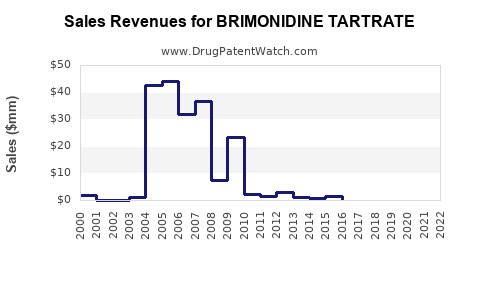
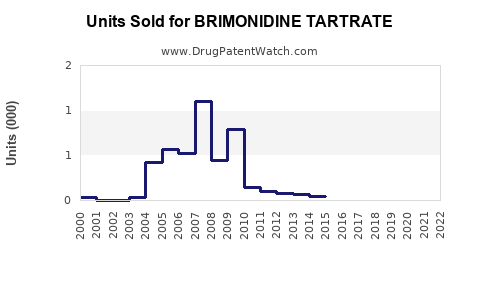
Annual Sales Revenues and Units Sold for BRIMONIDINE TARTRATE
| Drug Name | Revenues (USD) | Units | Year |
|---|---|---|---|
| BRIMONIDINE TARTRATE | ⤷ Start Trial | ⤷ Start Trial | 2022 |
| BRIMONIDINE TARTRATE | ⤷ Start Trial | ⤷ Start Trial | 2021 |
| BRIMONIDINE TARTRATE | ⤷ Start Trial | ⤷ Start Trial | 2020 |
| BRIMONIDINE TARTRATE | ⤷ Start Trial | ⤷ Start Trial | 2019 |
| >Drug Name | >Revenues (USD) | >Units | >Year |
Brimonidine Tartrate Market Analysis and Sales Projections, 2024–2029
Brimonidine tartrate is a mature, low-growth ophthalmic and dermatology ingredient. The largest market is glaucoma and ocular-hypertension treatment, where generic brimonidine has displaced most branded demand. The topical rosacea product, brimonidine tartrate gel 0.33%, retains higher pricing but faces generic and alternative-treatment risk.
A base-case model places global brimonidine tartrate product sales at approximately $340 million in 2024, with a modest decline to about $320 million by 2029. Ophthalmic products should account for roughly two-thirds of revenue, while topical rosacea products should generate a disproportionate share of branded and specialty revenue.
What is brimonidine tartrate used for?
Brimonidine tartrate is an alpha-2 adrenergic receptor agonist used in two principal markets:
| Market | Dosage form | Principal indication | Major products |
|---|---|---|---|
| Ophthalmology | Ophthalmic solution, generally 0.1%, 0.15% or 0.2% | Open-angle glaucoma and ocular hypertension | Alphagan P, generic brimonidine |
| Fixed-combination ophthalmology | Ophthalmic solution | Glaucoma and ocular hypertension | Combigan, generic combinations |
| Dermatology | Topical gel, 0.33% | Persistent facial erythema associated with rosacea | Mirvaso, generic brimonidine gel |
| Compounded use | Ophthalmic or topical preparations | Limited specialist and nonstandard applications | Compounded products |
Brimonidine lowers intraocular pressure by reducing aqueous humor production and increasing uveoscleral outflow. In rosacea, topical brimonidine produces temporary vasoconstriction and reduces facial erythema. The different mechanisms of commercial use create two separate competitive markets with limited substitution between them.
How large is the brimonidine tartrate market?
The market is difficult to measure because manufacturers generally report sales by ophthalmology franchise, therapeutic area, or brand portfolio rather than by active ingredient. Generic sales are also fragmented across manufacturers and pharmacy channels.
The following estimates represent global manufacturer-equivalent revenue and include branded, generic and fixed-combination products containing brimonidine tartrate.
| Year | Low case | Base case | High case |
|---|---|---|---|
| 2024 | $280 million | $340 million | $410 million |
| 2025 | $275 million | $338 million | $414 million |
| 2026 | $270 million | $335 million | $418 million |
| 2027 | $265 million | $331 million | $422 million |
| 2028 | $260 million | $326 million | $425 million |
| 2029 | $255 million | $320 million | $428 million |
| 2024–2029 CAGR | -1.8% | -1.2% | 0.9% |
The base case assumes continued volume growth in glaucoma treatment, declining generic prices, gradual erosion of branded rosacea revenue and stable demand for fixed-combination products.
Market split by product category
| Category | Estimated 2024 revenue | Share of market | 2029 base-case revenue |
|---|---|---|---|
| Generic ophthalmic brimonidine | $145 million | 43% | $130 million |
| Branded ophthalmic products | $45 million | 13% | $35 million |
| Brimonidine-containing combinations | $85 million | 25% | $80 million |
| Topical rosacea products | $65 million | 19% | $75 million |
| Total | $340 million | 100% | $320 million |
These figures are analytical estimates rather than reported consolidated sales. The largest uncertainty is the separation of brimonidine revenue from combination products and the lack of transparent global generic-sales reporting.
What are the main commercial products containing brimonidine tartrate?
Alphagan P
Alphagan P is Allergan’s branded ophthalmic brimonidine product. It was developed with a low-preservative formulation using Purite, an oxidative preservative system. The product is marketed primarily for glaucoma and ocular hypertension.
The branded product has faced substantial generic pressure. Its commercial value depends on physician preference, preservative tolerability, managed-care coverage and patients who remain on branded therapy despite generic availability.
Generic brimonidine ophthalmic solution
Generic products are available in multiple concentrations and package sizes. The generic segment supplies most treated glaucoma patients in the United States and other developed markets.
Pricing is determined by:
- Number of approved suppliers
- Pharmacy-benefit substitution
- Supply shortages
- Concentration and preservative profile
- Hospital and institutional purchasing
- Reimbursement policy
Generic brimonidine has limited differentiation. Manufacturers with reliable supply, low-cost production and broad distribution have the strongest commercial position.
Combigan
Combigan combines brimonidine tartrate with timolol maleate. It is used when monotherapy does not achieve adequate intraocular-pressure control or when reducing the number of daily administrations has clinical value.
Combination products preserve more revenue per patient than single-agent generic brimonidine, but they also face generic substitution and formulary restrictions. The combination can retain market share when convenience and adherence outweigh the price premium.
Mirvaso
Mirvaso is a topical brimonidine tartrate gel used for persistent facial erythema associated with rosacea. The product is commercially distinct from ophthalmic brimonidine because it is sold through dermatology and aesthetic channels.
Topical brimonidine has higher revenue potential per unit than generic ophthalmic products. Its limitations include temporary effect, variable patient response, rebound erythema concerns and competition from oxymetazoline, laser procedures, cosmetics and other rosacea treatments.
When does brimonidine lose exclusivity?
Ophthalmic brimonidine has already undergone extensive generic erosion. The key commercial exclusivity period for the original branded glaucoma products has ended, and generic products are established in major markets.
The relevant protection differs by product:
| Product | Commercial protection position | Current implication |
|---|---|---|
| Alphagan P | Mature product with established generic competition | Low branded growth potential |
| Generic brimonidine ophthalmic | No meaningful ingredient-level exclusivity | Price and supply competition |
| Combigan | Combination-product and formulation protection historically relevant | Generic substitution limits revenue |
| Mirvaso | Product-specific formulation and method-of-use protection may affect timing by jurisdiction | Higher risk of delayed but material erosion |
The FDA Orange Book remains the primary source for listed patents, pediatric exclusivity and approved product information in the United States. Patent protection must be assessed at the specific product and formulation level rather than at the active-ingredient level (U.S. Food and Drug Administration, n.d.-a).
What is the FDA regulatory status of brimonidine products?
Brimonidine ophthalmic products are FDA-approved prescription drugs for lowering elevated intraocular pressure. Mirvaso is FDA-approved for the topical treatment of persistent facial erythema associated with rosacea.
| Product type | FDA status | Regulatory pathway |
|---|---|---|
| Brimonidine ophthalmic solution | Approved | NDA and abbreviated new drug applications |
| Brimonidine/timolol solution | Approved | NDA and ANDA pathways |
| Brimonidine topical gel 0.33% | Approved | NDA and potential ANDA or 505(b)(2) competition |
| Compounded formulations | Not equivalent to FDA-approved products | State and federal compounding requirements apply |
FDA-approved generic ophthalmic products must meet standards for pharmaceutical equivalence and bioequivalence. Topical generic competition may depend on formulation equivalence, inactive ingredients, delivery characteristics and the FDA’s product-specific guidance.
What patents and formulations protect brimonidine tartrate?
The strongest remaining protection is product-specific rather than ingredient-specific.
Ophthalmic formulation protection
Ophthalmic formulations may be differentiated by:
- Preservative system
- Concentration
- pH and osmolality
- Container closure
- Stability profile
- Reduced-preservative or preservative-free delivery
- Fixed combination with timolol
Alphagan P’s Purite-based formulation created a commercial distinction from conventional benzalkonium-chloride-preserved products. That differentiation supported branding but did not prevent broad generic competition after relevant exclusivity expired.
Topical gel protection
Mirvaso-related protection may focus on:
- Brimonidine concentration
- Gel vehicle and rheology
- Controlled topical delivery
- Treatment of persistent facial erythema
- Dosing and application methods
- Reduction or management of erythema
The commercial risk is higher where generic manufacturers can enter with an equivalent topical product without replicating every brand-specific formulation characteristic. Patent scope, regulatory exclusivity and litigation outcomes must be reviewed in the Orange Book and relevant court records for each jurisdiction.
Which companies compete in the brimonidine market?
The market contains three competitive groups:
- Branded ophthalmology companies, including AbbVie through its Allergan business.
- Generic pharmaceutical companies supplying ophthalmic solutions and combinations.
- Dermatology companies commercializing branded or generic topical rosacea treatments.
Generic competition is fragmented. Major global generic ophthalmic suppliers and contract manufacturers can compete on price, while specialty companies compete through formulation, supply reliability, dermatology promotion and payer access.
The strongest competitive advantages are:
- Existing ophthalmic manufacturing capacity
- FDA-approved sterile production
- Reliable supply of bottles, droppers and preservative systems
- Established pharmacy distribution
- Formulation know-how
- Dermatology sales infrastructure for topical products
What is the outlook for generic entry and price erosion?
Ophthalmic products
Generic entry is already mature. Future revenue erosion will come mainly from:
- Additional approved suppliers
- Formulary-driven substitution
- Institutional tendering
- Lower reimbursement
- Consolidation among generic buyers
- Substitution from other low-cost glaucoma therapies
The ophthalmic segment should show stable or slightly declining patient volume revenue. Units may rise while net sales fall because of price erosion.
Topical products
Topical brimonidine has greater exposure to future generic entry and product switching. A generic topical product could reduce branded net prices rapidly if it receives broad payer coverage and achieves dermatology adoption.
The base case assumes topical volume increases at approximately 3% to 5% annually through 2029, while average net price declines by approximately 4% to 7% annually after broader generic competition. Under that scenario, revenue remains broadly stable rather than producing sustained high growth.
What is the Paragraph IV and litigation risk?
Paragraph IV risk is concentrated in product-specific generic filings, particularly for topical gel and fixed-combination products. A Paragraph IV certification can trigger patent litigation and a statutory stay of FDA approval for up to 30 months, subject to the facts of the filing and litigation.
For mature ophthalmic brimonidine, the main commercial issue is no longer whether generic competition exists. It is whether additional filings, settlements, manufacturing failures or supply disruptions change market share and net pricing.
For branded topical products, litigation risk can be more material because:
- Product-specific patents may cover the formulation or method of use.
- A first approved generic may obtain a temporary commercial advantage.
- Settlement terms can delay entry or provide a date certain for launch.
- A court decision can alter the value of remaining brand revenue.
No single patent should be treated as determinative without reviewing the full Orange Book listing, asserted claims, prosecution history and litigation docket.
How does brimonidine compare with competing glaucoma drugs?
| Drug class | Commercial position | Brimonidine comparison |
|---|---|---|
| Prostaglandin analogs | Large first-line market | Often stronger efficacy and once-daily convenience |
| Timolol | Low-cost generic | Lower price, but systemic beta-blocker limitations |
| Dorzolamide/brinzolamide | Established adjunctive therapies | Similar role in multi-drug regimens |
| Brimonidine | Established adjunctive and monotherapy product | Useful, but dosing frequency and allergy risk limit persistence |
| Fixed combinations | Higher value per prescription | Better adherence potential, higher commercial exposure |
Brimonidine remains relevant in multi-drug glaucoma treatment, but it lacks the pricing power of novel mechanisms or differentiated delivery systems.
What sales scenarios should investors and licensors use?
| Scenario | 2029 global revenue | Main assumptions |
|---|---|---|
| Downside | $255 million | Rapid topical generic entry, continued ophthalmic price erosion, weak branded retention |
| Base case | $320 million | Stable glaucoma volume, moderate generic erosion, resilient topical demand |
| Upside | $428 million | Delayed topical generic competition, supply constraints, stronger combination-product retention |
For a company evaluating licensing or acquisition, ophthalmic brimonidine should be valued as a cash-flow and supply-chain asset rather than a high-growth innovation asset. A topical brimonidine product may have greater strategic value if it has differentiated delivery, strong dermatology distribution or protection against immediate generic substitution.
Key Takeaways
- Brimonidine tartrate is a mature market with estimated 2024 global revenue of about $340 million in the base case.
- Ophthalmic products generate most volume, but topical rosacea products have higher revenue per unit.
- Generic competition has already compressed ophthalmic pricing.
- The main remaining commercial uncertainty is the timing and scope of generic competition for topical brimonidine gel.
- Fixed combinations such as brimonidine/timolol retain value through convenience and adherence, but remain exposed to generic substitution.
- A reasonable base-case projection is approximately $320 million in global revenue by 2029, representing a low-single-digit annual decline.
- Manufacturing reliability, sterile ophthalmic capacity and topical formulation expertise are more important competitive assets than ingredient ownership.
FAQs
Is brimonidine tartrate a high-growth pharmaceutical market?
No. It is a mature market with stable clinical demand and limited ingredient-level differentiation. Growth is more likely to come from topical rosacea treatment or specialty formulations than from conventional ophthalmic brimonidine.
Which brimonidine product has the strongest commercial outlook?
Topical brimonidine gel has the highest revenue per unit and the strongest potential for branded differentiation. Generic ophthalmic brimonidine has greater volume but lower margins.
Can brimonidine tartrate be sold over the counter?
In the United States, approved brimonidine ophthalmic and topical products are prescription drugs. Nonprescription status would require a separate FDA regulatory determination.
What is the biggest threat to brimonidine revenue?
The largest threat is continued generic price erosion, particularly if additional topical products enter the market. For ophthalmic products, the threat is incremental rather than transformational because generic competition is already established.
Is brimonidine tartrate attractive for pharmaceutical licensing?
It can be attractive for a company with low-cost sterile manufacturing, a differentiated topical formulation or access to dermatology distribution. It is less attractive as an ingredient-only licensing opportunity because conventional ophthalmic brimonidine has limited exclusivity and pricing power.
References
-
U.S. Food and Drug Administration. (n.d.-a). Approved drug products with therapeutic equivalence evaluations: Orange Book. https://www.accessdata.fda.gov/scripts/cder/ob/
-
U.S. Food and Drug Administration. (n.d.-b). DailyMed: Brimonidine tartrate ophthalmic solution prescribing information. National Library of Medicine. https://dailymed.nlm.nih.gov/
-
U.S. Food and Drug Administration. (2013). Mirvaso (brimonidine tartrate) topical gel prescribing information. https://www.accessdata.fda.gov/
-
U.S. Food and Drug Administration. (n.d.-c). Approved drug products and abbreviated new drug application information. https://www.fda.gov/drugs
-
AbbVie Inc. (2024). Annual report for the fiscal year ended December 31, 2023. https://www.abbvie.com/investors/financial-reports.html
More… ↓
