Share This Page
Drug Sales Trends for BREO ELLIPTA
✉ Email this page to a colleague
Payment Methods and Pharmacy Types for BREO ELLIPTA (2022)
Revenues by Pharmacy Type
Units Sold by Pharmacy Type
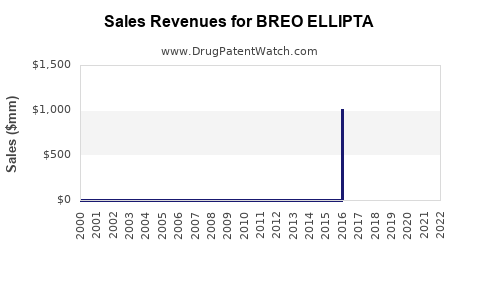
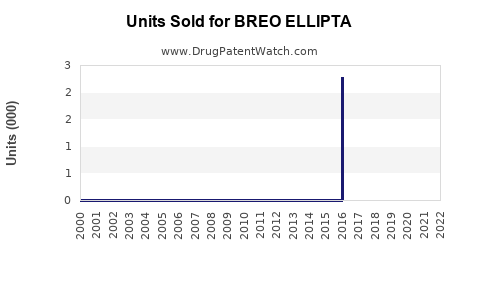
Annual Sales Revenues and Units Sold for BREO ELLIPTA
| Drug Name | Revenues (USD) | Units | Year |
|---|---|---|---|
| BREO ELLIPTA | ⤷ Start Trial | ⤷ Start Trial | 2022 |
| BREO ELLIPTA | ⤷ Start Trial | ⤷ Start Trial | 2021 |
| BREO ELLIPTA | ⤷ Start Trial | ⤷ Start Trial | 2020 |
| >Drug Name | >Revenues (USD) | >Units | >Year |
Breo Ellipta Market Analysis, Patent Outlook, and Sales Projections
Breo Ellipta, marketed as Relvar Ellipta outside the United States, is a once-daily inhaled corticosteroid/long-acting beta2-agonist containing fluticasone furoate and vilanterol. GSK markets the product for asthma and chronic obstructive pulmonary disease. The brand is commercially mature, with sales pressure from Trelegy Ellipta, generic inhaled corticosteroid/long-acting beta2-agonist products, and payer preference for lower-cost alternatives.
GSK reports Breo and Relvar sales as a combined global product line. The combined franchise generated approximately £1.0 billion in annual sales in recent reporting periods, but the company does not separately disclose U.S. Breo revenue from ex-U.S. Relvar revenue. The base-case forecast projects a gradual decline from approximately £1.0 billion in 2023 to about £550 million by 2029, with sharper erosion possible if a substitutable U.S. generic launches.
What is Breo Ellipta and how does it compete?
Breo Ellipta is a once-daily dry-powder inhaler combining:
| Component | Role |
|---|---|
| Fluticasone furoate | Inhaled corticosteroid |
| Vilanterol | Long-acting beta2-adrenergic agonist |
| Ellipta device | GSK inhalation delivery platform |
The U.S. Food and Drug Administration approved Breo Ellipta in 2013 for airflow obstruction treatment and reduction of exacerbations in patients with COPD. FDA later approved an asthma indication. The product is not a rescue inhaler and is not indicated for acute bronchospasm treatment. The approved dosage is generally one inhalation once daily, with strength selected according to indication and patient history (FDA, 2024).
Breo’s commercial position differs by indication:
- In COPD, Breo competes with Advair, generic fluticasone propionate/salmeterol, Symbicort, generic budesonide/formoterol, Dulera, Anoro Ellipta, and Trelegy Ellipta.
- In asthma, Breo competes with Advair, Wixela Inhub, AirDuo Digihaler, Symbicort, Dulera, and other ICS/LABA products.
- In patients requiring escalation to triple therapy, Trelegy Ellipta is the principal GSK alternative.
The Ellipta device supports once-daily dosing and gives GSK a platform advantage across Breo, Anoro and Trelegy. That advantage is weakened by the broad availability of lower-cost inhaled therapies and by pharmacy-benefit substitution.
How much revenue does Breo Ellipta generate?
GSK reports Breo and Relvar together because Relvar is the brand used in many markets outside the United States. The combined product line has remained a material respiratory franchise but has entered a mature phase.
| Metric | Approximate position |
|---|---|
| Global brand names | Breo Ellipta and Relvar Ellipta |
| Primary company | GSK |
| U.S. approval | 2013 |
| Core indications | COPD and asthma |
| Administration | Once daily |
| Recent combined annual sales | Approximately £1.0 billion |
| Principal growth constraint | Trelegy substitution and generic ICS/LABA competition |
| Principal patent risk | Generic or follow-on inhaler entry after listed patent protection weakens |
GSK’s annual reports identify Relvar/Breo as a large respiratory product but do not provide a complete standalone breakdown by country, indication or dosage strength. The company’s stronger respiratory growth has shifted toward Trelegy, which provides triple therapy with an inhaled muscarinic antagonist in addition to the Breo components’ ICS/LABA foundation (GSK, 2024).
This creates a structural cannibalization risk. A patient who would previously have remained on Breo may be moved to Trelegy when symptoms, exacerbations or treatment guidelines support escalation. The switch can increase GSK revenue per treated patient, but it reduces the long-term growth potential of Breo as a standalone product.
What are the sales projections for Breo Ellipta?
The following model uses the combined Breo/Relvar franchise as the revenue base. It assumes no immediate broad U.S. generic launch, continued Trelegy migration, stable global demand in asthma and COPD, and progressive price pressure.
Base-case global sales forecast
| Year | Forecast sales | Year-over-year change |
|---|---|---|
| 2023A | £1.00 billion | N/A |
| 2024E | £0.96 billion | -4% |
| 2025E | £0.90 billion | -6% |
| 2026E | £0.83 billion | -8% |
| 2027E | £0.75 billion | -10% |
| 2028E | £0.65 billion | -13% |
| 2029E | £0.55 billion | -15% |
These projections are analyst estimates based on the reported scale of GSK’s Relvar/Breo business, mature-brand erosion, and the company’s respiratory portfolio strategy. They are not GSK financial guidance.
Scenario analysis
| Scenario | 2029 sales | Main assumptions |
|---|---|---|
| Upside | £700 million | No major U.S. generic, stable pricing, continued ex-U.S. demand |
| Base case | £550 million | Gradual share loss, Trelegy conversion, moderate price erosion |
| Downside | £300 million | Broad generic substitution and accelerated payer pressure |
The downside scenario is more likely to affect the U.S. business than markets where inhaler substitution is controlled through tendering, physician prescribing or device-specific reimbursement rules. The upside case requires continued brand retention despite the availability of cheaper ICS/LABA alternatives.
When does Breo Ellipta lose exclusivity?
Breo’s exclusivity position depends on separate protections for the active ingredients, combination formulation, inhaler device and approved uses. FDA regulatory exclusivity and patent exclusivity are different rights.
The 2013 approval date means any standard five-year new chemical entity exclusivity period has expired. Breo’s current protection therefore depends primarily on listed patents, pediatric exclusivity where applicable, formulation and device claims, and the ability of a generic applicant to obtain approval while designing around or challenging those patents.
U.S. Orange Book status
Breo Ellipta is associated with FDA NDA 021876. The FDA Orange Book identifies patents submitted by the NDA holder and provides the statutory framework used by generic applicants assessing Paragraph IV certification. Patent listings can change as patents are added, removed or delisted.
The relevant commercial questions are:
- Which patents remain listed for each Breo strength?
- Which listed patents expire first?
- Do those patents cover the active combination, the inhaler device, the formulation, or only specific methods of use?
- Has an applicant filed an abbreviated new drug application with a Paragraph IV certification?
- Has GSK sued within the 45-day period after receiving a Paragraph IV notice?
A single headline expiry date is insufficient for Breo because inhaled products can have overlapping protection. A generic may challenge one patent while avoiding another, or may receive approval with a label that omits a patented use.
The commercial protection period is therefore likely to be shorter than the full theoretical term of every patent in the estate. The most important risk is a substitutable product that receives FDA approval and pharmacy-benefit coverage, not merely a patent expiration appearing in the Orange Book.
What patents protect Breo Ellipta?
Breo’s protection is expected to include several patent categories:
Combination-product patents
These cover the use or composition of fluticasone furoate with vilanterol, including specified ratios or dosage ranges. Combination claims can be valuable because they address the marketed therapy directly.
Formulation patents
Formulation claims may cover particle size, carrier systems, excipient composition, blend uniformity and aerosolized or dry-powder performance. These claims can complicate generic development but may be narrower than the commercial product itself.
Ellipta device patents
Device patents can cover the blister arrangement, dose-opening mechanism, airflow path, dose counter and inhalation activation. Device patents are particularly relevant because an ANDA applicant must demonstrate pharmaceutical equivalence and device compatibility.
Method-of-use patents
Method patents may cover treatment of COPD, asthma, exacerbation reduction, once-daily administration or defined patient populations. Their value depends on the approved generic label and whether the generic applicant can use a section viii carve-out.
Manufacturing patents
Manufacturing protection may cover micronization, blending, filling, blister sealing and device assembly. These rights can increase development cost but are less likely to block a generic permanently if the applicant can use a non-infringing process.
Which companies are challenging Breo Ellipta?
Publicly identifiable competitive pressure comes from three groups:
| Competitor group | Examples | Commercial effect |
|---|---|---|
| Generic ICS/LABA inhalers | Wixela Inhub, generic Advair, generic Symbicort | Lowers payer willingness to reimburse branded Breo |
| Branded ICS/LABA inhalers | Dulera, AirDuo, Symbicort | Competes for asthma and COPD prescriptions |
| Triple therapies | Trelegy, Breztri, other LAMA/LABA/ICS products | Pulls patients away from dual therapy |
A verified, commercially launched U.S. generic equivalent of Breo Ellipta should be distinguished from generic products containing different active ingredients. Generic fluticasone propionate/salmeterol is not the same product as fluticasone furoate/vilanterol, and its competitive effect occurs through therapeutic substitution rather than direct pharmaceutical equivalence.
The relevant challenger profile would be a company able to reproduce the fluticasone furoate/vilanterol combination, meet FDA device and performance requirements, and obtain reimbursement for the same or a substitutable indication. Potential participants in respiratory generics include Viatris, Teva, Hikma, Cipla, Lupin and other inhalation specialists, but a company should not be treated as a Breo challenger without an identifiable FDA filing, patent notice or commercial launch.
What is the FDA regulatory status of Breo Ellipta?
Breo Ellipta has full U.S. FDA approval under NDA 021876. Its regulatory profile is established rather than developmental.
Key FDA considerations include:
- It is an inhaled prescription product.
- It is approved for maintenance treatment, not acute symptom relief.
- It carries the class-related risks of inhaled corticosteroids and long-acting beta2 agonists.
- The label includes warnings relating to asthma-related death risk associated with LABA monotherapy, paradoxical bronchospasm, cardiovascular effects, immunosuppression and oral candidiasis.
- Patients with asthma should use Breo with an inhaled corticosteroid component, which Breo contains.
- Dose selection differs between COPD and asthma.
Breo has no biosimilar pathway because it is a small-molecule inhaled combination product. Competitive entry would proceed through the ANDA pathway or, depending on product design, another abbreviated or hybrid regulatory route. Biosimilar risk is therefore not applicable.
How strong is the Breo Ellipta patent estate?
Breo’s patent estate is commercially meaningful but weakening with age.
Strengths
- The product uses a branded inhaler platform with device-specific engineering.
- The formulation combines two active ingredients in a once-daily dry-powder presentation.
- Device and formulation claims may increase the cost and complexity of generic substitution.
- Method-of-use claims can preserve selected indications after composition claims face challenges.
- GSK can migrate patients to Trelegy while retaining the Ellipta platform.
Weaknesses
- The U.S. product has been marketed for more than a decade.
- Standard regulatory exclusivity has expired.
- Generic competitors can target individual components or therapeutic substitutes.
- A generic does not need to replicate GSK’s entire commercial franchise if it can achieve payer-preferred status.
- Trelegy creates internal cannibalization.
- Patent claims limited to one use or strength may not block approval for all marketed indications.
Overall, the estate is best characterized as moderate for near-term defense and weaker for long-term revenue preservation. Device and formulation patents may delay direct substitution, but they are unlikely to eliminate price competition across the respiratory category.
What generic launch risks exist for Breo Ellipta?
The highest-risk launch sequence is:
- A generic applicant files an ANDA.
- The applicant certifies that listed patents are invalid, unenforceable or not infringed.
- GSK files patent litigation within the statutory period.
- FDA approval is delayed by the 30-month stay, unless the case resolves earlier.
- The parties settle, or the generic launches after litigation.
- Pharmacy-benefit managers place the generic on a preferred tier.
The economic effect depends on whether the generic is directly substitutable. A direct fluticasone furoate/vilanterol product could cause rapid gross-to-net deterioration. A different ICS/LABA product would likely produce slower erosion through formulary substitution and physician switching.
A first generic entrant could capture a disproportionate share of the market, while later entrants would intensify price competition. Breo’s once-daily dosing and device familiarity may preserve some branded demand, especially among patients who are stable on therapy and unwilling to change inhalers.
What patent litigation and settlement issues affect Breo?
A patent-litigation review should distinguish:
- ANDA Paragraph IV litigation;
- patent cases involving the Ellipta device;
- cases involving fluticasone furoate or vilanterol separately;
- cases involving Trelegy rather than Breo;
- commercial disputes over licensing or authorized generic supply.
No broad biosimilar litigation framework applies. Any material U.S. generic challenge would normally appear through FDA Orange Book activity, federal district court filings, or GSK disclosures. Settlement terms could include a licensed entry date, supply agreement, authorized generic arrangement or restrictions on the generic label.
GSK’s portfolio incentives favor settlement if it can shift patients to Trelegy and protect total respiratory revenue. A settlement that permits delayed generic entry could still be economically attractive if Trelegy uptake offsets Breo losses.
How does Breo Ellipta compare with Trelegy Ellipta?
| Attribute | Breo Ellipta | Trelegy Ellipta |
|---|---|---|
| Therapy | ICS/LABA | ICS/LAMA/LABA |
| Active ingredients | Fluticasone furoate/vilanterol | Fluticasone furoate/umeclidinium/vilanterol |
| Dosing | Once daily | Once daily |
| Role | Dual maintenance therapy | Triple maintenance therapy |
| Commercial stage | Mature | Growth and expansion product |
| Main risk | Generic and therapeutic substitution | Future loss of exclusivity and pricing pressure |
| GSK strategy | Retain selected patients | Convert appropriate patients from dual therapy |
Trelegy is the more important growth asset. GSK reported strong Trelegy performance in recent annual results and has expanded its role in COPD and asthma treatment. Breo remains useful as an entry or maintenance product for patients who do not require triple therapy, but its strategic value increasingly comes from supporting the Ellipta franchise and feeding eligible patients into higher-value treatment pathways.
What geographic markets support Breo sales?
The product is sold as Breo in the United States and as Relvar in many international markets. Geographic performance varies because:
- U.S. reimbursement is heavily influenced by pharmacy-benefit managers.
- European markets use reference pricing, tenders and national reimbursement controls.
- Emerging markets have lower pricing but may deliver longer product life.
- Inhaler-device substitution is less automatic than tablet substitution.
- Local regulatory approval may cover different indications or strengths.
The United States is likely to carry the highest direct price and litigation exposure. Europe and other regulated markets may generate more gradual erosion but lower net prices. The combined global revenue outlook depends on the balance between U.S. substitution, European tender losses and continued demand in markets where Breo or Relvar retains brand recognition.
What is the investment outlook for Breo Ellipta?
Breo is a declining but still material cash-flow product. Its revenue profile has three defining characteristics:
- High installed-base awareness among prescribers and patients.
- Limited organic growth because the market is mature.
- Strategic displacement by Trelegy and cheaper ICS/LABA alternatives.
The key commercial indicators are GSK’s combined Relvar/Breo sales, Trelegy growth, reported respiratory gross margin, U.S. formulary positioning, FDA Orange Book changes and any Paragraph IV litigation. The product’s value is more defensively oriented than growth oriented.
Key Takeaways
- Breo Ellipta is a mature once-daily fluticasone furoate/vilanterol inhaler marketed by GSK.
- GSK reports Breo and Relvar together, with recent combined sales of approximately £1.0 billion annually.
- Base-case sales are projected to decline to about £550 million by 2029.
- Trelegy Ellipta is the main internal competitive force because it converts appropriate patients from dual to triple therapy.
- Direct biosimilar risk does not apply; generic ANDA competition is the relevant pathway.
- Device, formulation, combination and method-of-use patents provide layered protection, but the estate weakens as the product ages.
- The largest downside risk is a directly substitutable U.S. generic with favorable formulary placement.
- GSK’s ability to migrate patients to Trelegy may reduce the net impact of Breo erosion on the broader respiratory franchise.
FAQs
Is Breo Ellipta the same as Relvar Ellipta?
Yes. Breo Ellipta is the U.S. brand name, while Relvar Ellipta is used in many markets outside the United States. Both contain fluticasone furoate and vilanterol.
Is there a generic version of Breo Ellipta?
Generic ICS/LABA inhalers compete with Breo, but they are not necessarily pharmaceutical equivalents. A direct generic must match the fluticasone furoate/vilanterol combination and satisfy FDA inhaler and performance requirements.
Does Trelegy replace Breo Ellipta?
Trelegy can replace Breo for patients who need triple therapy, but Breo remains appropriate for patients whose disease is controlled with an ICS/LABA regimen and who do not require a LAMA.
Is Breo Ellipta protected by orphan-drug exclusivity?
No. Breo is a broad respiratory product rather than an orphan-drug product. Its protection rests on patents, regulatory approval and commercial factors.
What would cause Breo sales to fall faster than projected?
The main triggers would be a direct U.S. generic launch, a favorable generic patent settlement, loss of preferred formulary placement, rapid Trelegy conversion, or a substantial reduction in reimbursement for branded inhaled therapies.
References
-
GSK. (2024). Annual report 2023. GSK plc.
-
GSK. (2025). Annual report 2024. GSK plc.
-
U.S. Food and Drug Administration. (2024). Breo Ellipta prescribing information. FDA.
-
U.S. Food and Drug Administration. (2024). Approved drug products with therapeutic equivalence evaluations: Orange Book. FDA.
More… ↓
