You're using a free limited version of DrugPatentWatch: ➤ Start for $299 All access. No Commitment.

Last Updated: March 26, 2026

Drug Sales Trends for BENZOYL PEROXIDE


✉ Email this page to a colleague
« Back to Dashboard


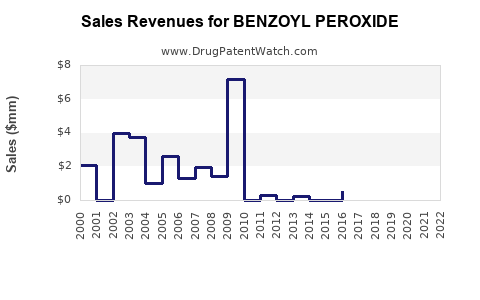
Drug Sales Revenue Trends for BENZOYL PEROXIDE
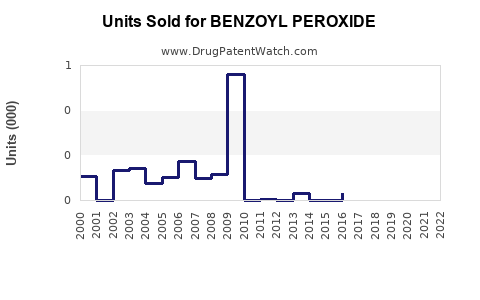
Drug Units Sold Trends for BENZOYL PEROXIDE

Annual Sales Revenues and Units Sold for BENZOYL PEROXIDE

These sales figures are drawn from a US national survey of drug expenditures
Drug Name Revenues (USD) Units Year
BENZOYL PEROXIDE ⤷  Start Trial ⤷  Start Trial 2022
BENZOYL PEROXIDE ⤷  Start Trial ⤷  Start Trial 2021
BENZOYL PEROXIDE ⤷  Start Trial ⤷  Start Trial 2020
BENZOYL PEROXIDE ⤷  Start Trial ⤷  Start Trial 2019
BENZOYL PEROXIDE ⤷  Start Trial ⤷  Start Trial 2018
BENZOYL PEROXIDE ⤷  Start Trial ⤷  Start Trial 2017
BENZOYL PEROXIDE ⤷  Start Trial ⤷  Start Trial 2016
>Drug Name >Revenues (USD) >Units >Year

BENZOYL PEROXIDE Market Analysis and Financial Projection

Last updated: February 13, 2026

What is the Global Market Size and Growth for Benzoyl Peroxide?

Benzoyl peroxide (BPO) is a widely used topical agent for acne treatment. As of 2022, the global market for benzoyl peroxide was valued at approximately $400 million. The compound's demand is driven by its efficacy, over-the-counter availability, and inclusion in combination therapies.

The compound's sales revenue grew at a compound annual growth rate (CAGR) of around 4% from 2017 to 2022. Projections estimate this CAGR will stabilize at roughly 3.5% through 2027, reaching a market size of approximately $520 million.

Key growth drivers include rising acne prevalence in young populations, increased healthcare access, and expanding OTC product availability. Asia-Pacific accounts for the largest regional share (around 40%), followed by North America (35%) and Europe (20%).

How Do Sales Break Down by Geography and Distribution Channel?

Region Market Share (2022) Growth Rate (2022-2027 CAGR)
Asia-Pacific 40% 4.1%
North America 35% 3.2%
Europe 20% 3.4%
Others 5% 3.7%

Distribution channels include:

  • Over-the-counter (OTC) retail stores: 65%
  • E-commerce platforms: 25%
  • Prescription-based sales: 10%

OTC sales dominate due to public perception of benzoyl peroxide as a first-line acne treatment. E-commerce sales are expanding at around 7% annually, driven by online skin care platforms and increased consumer purchasing convenience.

What Are the Key Factors Influencing Market Dynamics?

  1. Consumer Demographics: Increasing acne prevalence among adolescents and young adults sustains demand.

  2. Product Diversification: Introduction of formulations combining benzoyl peroxide with antibiotics or retinoids affects sales positively.

  3. Regulatory Policies: Many markets allow OTC sale, which boosts volume. Stringent regulations elsewhere can hinder growth.

  4. Market Competition: Major players include Johnson & Johnson, GlaxoSmithKline, and local brands. Patent expirations in early 2020s led to the emergence of generics, increasing price competition.

What Are Projected Sales Figures for Key Market Segments (2022-2027)?

Segment 2022 Revenue 2027 Projection CAGR
OTC topical products $260 million $350 million 5%
Prescription formulations $40 million $55 million 6%
Generic vs. branded drugs 70% generics 80% generics 4%

Growth is driven predominantly by OTC products. Prescription segment remains stable but declines in share due to increased consumer access to OTC options.

How Do Competitive Strategies Affect Future Sales?

Major firms focus on:

  • Formulation innovation (e.g., reduced irritation versions)
  • Marketing campaigns targeting youth demographics
  • Expansion into emerging markets
  • Partnerships with online retailers

The success of these strategies remains tied to regulatory environments and consumer preferences.

What Are the Risks and Opportunities?

Risks:

  • Regulatory hurdles in certain markets
  • Increasing competition from alternative acne treatments
  • Consumer concerns over skin irritation

Opportunities:

  • Growth in emerging markets
  • Increasing demand for combination therapies
  • Expansion of e-commerce channels

Key Takeaways

  • The global benzoyl peroxide market is valued at around $400 million, with steady growth forecasts to reach $520 million by 2027.
  • OTC channels dominate sales, but online platforms are gaining prominence.
  • Demand is driven by acne prevalence among young people and product diversification.
  • Price competition increases with the rise of generics post-patent expiry.
  • Future growth depends on regulatory environments and innovation in formulations.

FAQs

1. How does benzoyl peroxide compare to other acne treatments?
It is effective as a first-line topical agent, particularly for moderate to severe acne. It works by reducing bacteria and inflammation but may cause skin irritation. Alternatives include salicylic acid and antibiotics, with choice dependent on severity and patient response.

2. What are the main regulatory considerations?
Most markets classify benzoyl peroxide as an OTC drug. Some countries impose limitations on concentration levels and labeling. The eu have separate regulations for higher concentrations.

3. How does the rise of online sales impact the market?
Online platforms increase consumer access, driving growth, especially in regions with limited pharmacy infrastructure. However, regulation and quality control are concerns.

4. What is the outlook for generics?
Patent expirations led to a significant increase in generic options, lowering prices and expanding access. This intensifies price competition but limits profit margins for brand-name products.

5. What innovation trends are expected?
Formulation improvements reducing skin irritation and combination therapies (e.g., benzoyl peroxide with clindamycin) are anticipated to sustain market competitiveness.


Sources:

  1. Global Market Insights. (2022). Benzoyl peroxide market research report.
  2. MarketsandMarkets. (2023). Acne Treatment Market Analysis.
  3. IBISWorld. (2022). Over-the-counter medication industry report.
  4. Euromonitor. (2022). Skin Care and Acne Market Trends.
  5. U.S. Food and Drug Administration (FDA). (2023). OTC drug classifications.

More… ↓

⤷  Start Trial

Make Better Decisions: Try a trial or see plans & pricing

Drugs may be covered by multiple patents or regulatory protections. All trademarks and applicant names are the property of their respective owners or licensors. Although great care is taken in the proper and correct provision of this service, thinkBiotech LLC does not accept any responsibility for possible consequences of errors or omissions in the provided data. The data presented herein is for information purposes only. There is no warranty that the data contained herein is error free. We do not provide individual investment advice. This service is not registered with any financial regulatory agency. The information we publish is educational only and based on our opinions plus our models. By using DrugPatentWatch you acknowledge that we do not provide personalized recommendations or advice. thinkBiotech performs no independent verification of facts as provided by public sources nor are attempts made to provide legal or investing advice. Any reliance on data provided herein is done solely at the discretion of the user. Users of this service are advised to seek professional advice and independent confirmation before considering acting on any of the provided information. thinkBiotech LLC reserves the right to amend, extend or withdraw any part or all of the offered service without notice.