Share This Page
Drug Sales Trends for BACTROBAN
✉ Email this page to a colleague
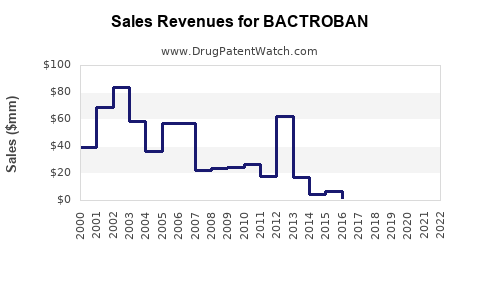
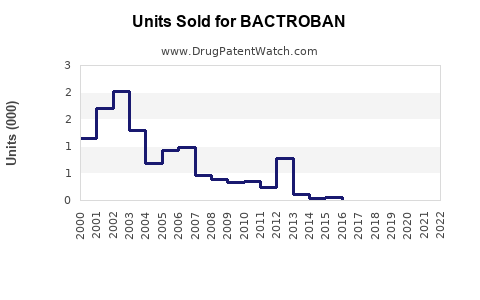
Annual Sales Revenues and Units Sold for BACTROBAN
| Drug Name | Revenues (USD) | Units | Year |
|---|---|---|---|
| BACTROBAN | ⤷ Start Trial | ⤷ Start Trial | 2022 |
| BACTROBAN | ⤷ Start Trial | ⤷ Start Trial | 2021 |
| BACTROBAN | ⤷ Start Trial | ⤷ Start Trial | 2020 |
| BACTROBAN | ⤷ Start Trial | ⤷ Start Trial | 2019 |
| BACTROBAN | ⤷ Start Trial | ⤷ Start Trial | 2018 |
| BACTROBAN | ⤷ Start Trial | ⤷ Start Trial | 2017 |
| >Drug Name | >Revenues (USD) | >Units | >Year |
Bactroban Market Analysis, Sales Projections, Patent Status, and Generic Competition
Bactroban is the branded version of mupirocin, a topical antibiotic used primarily for impetigo and localized bacterial skin infections caused by susceptible strains of Staphylococcus aureus and Streptococcus pyogenes. The product is commercially mature, off-patent, and exposed to extensive generic competition.
The brand has limited standalone growth potential. The commercial market is concentrated in generic mupirocin ointment, cream, and nasal formulations. Future value depends on prescription volume, hospital and institutional contracts, antimicrobial-resistance positioning, supply reliability, and formulation differentiation rather than patent exclusivity.
What is the current market position of Bactroban?
Bactroban has a declining role in the U.S. prescription market because generic mupirocin is widely available and usually priced below the branded product. The active ingredient, mupirocin, remains clinically relevant because it is effective against localized gram-positive skin infections and is used in some decolonization protocols for nasal carriage of S. aureus.
| Product | Active ingredient | Main use | Commercial status |
|---|---|---|---|
| Bactroban ointment | Mupirocin 2% | Impetigo and localized skin infections | Mature branded product |
| Bactroban cream | Mupirocin calcium equivalent to mupirocin 2% | Secondary infected skin lesions | Mature branded product |
| Bactroban nasal ointment | Mupirocin calcium | Nasal decolonization of S. aureus | Limited, institution-focused market |
| Generic mupirocin ointment | Mupirocin 2% | Topical bacterial skin infections | Dominant U.S. volume segment |
| Generic mupirocin cream | Mupirocin calcium | Infected dermatologic lesions | Smaller formulation segment |
The FDA labeling identifies Bactroban ointment for the treatment of impetigo caused by methicillin-susceptible S. aureus and S. pyogenes. The label also warns against ophthalmic use, intravenous use, and prolonged exposure because of irritation, systemic absorption concerns in some settings, and antimicrobial resistance risk (U.S. Food and Drug Administration [FDA], 2024a).
How large is the Bactroban and mupirocin market?
No current, separately reported global revenue figure for Bactroban is publicly disclosed by the brand owner. The relevant commercial market is the broader mupirocin market, which includes branded and generic topical and nasal products.
A practical market model separates three revenue pools:
- U.S. retail prescriptions for mupirocin ointment and cream.
- Institutional and hospital purchasing, including nasal decolonization products.
- International branded and generic sales.
The U.S. market is the most transparent and commercially important market because mupirocin is available by prescription and is used across dermatology, primary care, urgent care, pediatrics, and hospital infection-control programs.
Estimated U.S. market model
The following estimates represent an analyst model based on mature generic pricing, prescription demand, institutional use, and expected price erosion. They are market-value estimates for all mupirocin products, not reported Bactroban sales.
| Year | Low case | Base case | High case |
|---|---|---|---|
| 2025 | $125 million | $185 million | $260 million |
| 2026 | $121 million | $183 million | $266 million |
| 2027 | $117 million | $181 million | $271 million |
| 2028 | $113 million | $180 million | $276 million |
| 2029 | $109 million | $179 million | $282 million |
The base case assumes annual prescription demand remains broadly stable, while generic price competition offsets modest volume growth. The high case assumes stronger institutional use, higher demand for nasal decolonization, and fewer supply disruptions. The low case assumes continued generic price compression and substitution toward alternative antiseptic or decolonization products.
The branded Bactroban portion of this market is likely a small minority of U.S. value. A reasonable commercial range is less than 5% of total U.S. mupirocin value, producing estimated annual brand-equivalent sales below $10 million to $15 million in the base case. That estimate is not a reported company figure.
What are the sales projections for Bactroban through 2029?
Bactroban brand sales are expected to remain flat to declining because the product has no meaningful patent-based protection and generic substitution is established.
| Scenario | 2025 estimated Bactroban sales | 2029 estimated Bactroban sales | 2025-2029 trend |
|---|---|---|---|
| Low case | $3 million | $1 million | Decline from generic substitution |
| Base case | $8 million | $5 million | Moderate erosion |
| High case | $15 million | $13 million | Stable niche and institutional demand |
These figures represent estimated product sales attributable to the branded Bactroban franchise, excluding generic mupirocin. They should not be treated as reported revenue or company guidance.
The most likely outcome is continued brand contraction with residual demand from:
- Prescribers who prefer the reference product.
- Patients with reimbursement that does not impose a material brand penalty.
- Institutional customers that maintain branded supply agreements.
- Markets where generic registration or manufacturing capacity is limited.
- Countries where the Bactroban name retains strong physician recognition.
The stronger opportunity is generic mupirocin supply. A manufacturer with reliable manufacturing, competitive pricing, and broad distribution can capture value even as the branded franchise declines.
When does Bactroban lose exclusivity?
Bactroban lost meaningful U.S. market exclusivity years ago. The original mupirocin patents and associated regulatory protections have expired, allowing multiple generic manufacturers to market mupirocin products.
| Exclusivity category | Bactroban position |
|---|---|
| Active compound patent | Expired |
| Original formulation protection | Expired or commercially ineffective |
| New chemical entity exclusivity | Expired |
| Pediatric exclusivity | Expired |
| Active U.S. market exclusivity | None identified |
| Generic competition | Established |
| Patent-based launch barrier | Low |
The original U.S. Bactroban product was developed and commercialized by SmithKline Beecham, later part of GlaxoSmithKline. Historical patents covering mupirocin and related formulations no longer create a meaningful barrier to generic entry.
What is the Orange Book status of Bactroban?
The Orange Book remains relevant for identifying approved reference products and any listed patents or exclusivity. Bactroban’s commercial position does not depend on current Orange Book exclusivity.
The principal regulatory implications are:
- Generic mupirocin products can rely on abbreviated new drug applications.
- Generic ointment and cream products compete primarily on price, availability, and contract access.
- The nasal formulation has a narrower market and may involve separate regulatory and manufacturing considerations.
- There is no current, commercially meaningful Bactroban patent estate that would block routine generic competition.
FDA approval of a generic mupirocin product does not guarantee therapeutic interchangeability across every dosage form or use. Ointment, cream, and nasal formulations are distinct products and require their own approval basis (FDA, 2024b).
What patents protect Bactroban and mupirocin products?
The relevant patent estate is historical rather than prospective. Patent protection covered the mupirocin compound, fermentation-derived production, topical compositions, and product-specific formulations. Those rights have expired in the United States and major European markets.
Patent categories historically associated with mupirocin
- Mupirocin compound and antibiotic activity.
- Fermentation and recovery processes.
- Topical ointment compositions.
- Mupirocin calcium formulations.
- Nasal delivery and decolonization applications.
- Manufacturing controls for active pharmaceutical ingredient production.
The remaining intellectual-property risks are more likely to involve manufacturing know-how, regulatory dossiers, trademarks, and supply-chain controls than enforceable compound or formulation patents.
How strong is the Bactroban patent estate?
The patent estate is weak from a market-exclusivity perspective.
| Factor | Assessment |
|---|---|
| Compound protection | Expired |
| Formulation protection | Expired or readily designed around |
| Method-of-use protection | Limited practical value |
| Manufacturing know-how | Potentially relevant |
| Trademark value | Moderate in physician recognition |
| Generic blocking power | None material |
| Litigation leverage | Low |
A competitor entering the mupirocin market is more likely to face manufacturing validation, regulatory approval, and commercial contracting hurdles than patent litigation.
What formulations are protected by Bactroban?
Bactroban’s commercial history includes ointment, cream, and nasal formulations. These products do not have equal market value.
Ointment
The 2% ointment is the core product. It has the broadest recognition and competes directly with numerous generic versions. The ointment is used for localized bacterial skin infections and remains the most important formulation by prescription volume.
Cream
The cream formulation has a smaller market but can be preferred for certain dermatologic applications because of its cosmetic and spreadability characteristics. It faces generic competition and does not provide a significant exclusivity advantage.
Nasal ointment
The nasal formulation is commercially distinct. Its demand is linked to hospital protocols, surgical programs, outbreak control, and decolonization of S. aureus. Institutional purchasing can produce higher value per treatment course than routine retail dermatology, but the customer base is narrower.
Mupirocin nasal use is subject to resistance concerns. The Infectious Diseases Society of America and hospital infection-control programs generally favor targeted use rather than indiscriminate or prolonged exposure (Infectious Diseases Society of America, 2014).
What generic entry risks affect Bactroban?
Generic entry is already established, so the main risk is not a future launch event. It is continuing erosion of brand share, reimbursement preference, and net price.
Generic competition risks
- Multiple approved manufacturers can bid down reimbursement and contract pricing.
- Pharmacies may automatically substitute generic mupirocin where allowed.
- Payers can place Bactroban on nonpreferred tiers.
- Retail chains can use low-cost mupirocin as a formulary default.
- Institutional buyers may consolidate purchasing among a small number of suppliers.
- Product shortages can shift share rapidly between manufacturers.
The market has a low technical barrier for standard topical ointment production relative to sterile injectable products. However, maintaining consistent semisolid manufacturing, microbiological quality, tube-filling capacity, and regulatory compliance remains important.
Which companies compete with Bactroban?
Competition comes from generic manufacturers and from non-mupirocin alternatives.
Generic mupirocin competitors
The competitive field typically includes large generic suppliers such as:
- Teva Pharmaceutical Industries
- Sandoz
- Taro Pharmaceutical Industries
- Perrigo
- Amneal Pharmaceuticals
- Rising Pharmaceuticals
- Prasco Laboratories
- Glenmark Pharmaceuticals
- Zydus Pharmaceuticals
- Hikma Pharmaceuticals, depending on product and market
The exact active supplier set varies by dosage form, market, manufacturing site, and wholesaler contract.
Therapeutic alternatives
Bactroban also competes with:
- Retapamulin for selected superficial skin infections.
- Fusidic acid in markets where it is available.
- Topical gentamicin.
- Topical clindamycin for selected indications.
- Antiseptic agents such as chlorhexidine.
- Povidone-iodine and other institutional decolonization products.
- Oral antibiotics for infections that are too extensive for topical therapy.
Retapamulin has a narrower commercial footprint. Antiseptic-based protocols are more relevant in hospital decolonization and infection-prevention programs than in routine impetigo treatment.
What FDA regulatory issues affect Bactroban sales?
Bactroban is a prescription product. Its FDA label limits use to susceptible bacterial infections and warns that inappropriate or prolonged use can promote resistance.
The main regulatory and market issues are:
- Antimicrobial stewardship can restrict routine or repeated prescribing.
- Resistance to mupirocin can reduce institutional demand in settings with high prior exposure.
- Product labeling limits use to appropriate bacterial indications.
- Generic products require formulation-specific FDA approval.
- Nasal decolonization programs can create institutional demand but may also be subject to protocol restrictions.
- Adverse skin reactions and local irritation can drive switching to alternative products.
The FDA has also emphasized the importance of responsible antibiotic use and antimicrobial-resistance control across healthcare settings (FDA, 2023).
What patent litigation and Paragraph IV challenges affect Bactroban?
Bactroban is not currently defined by active Paragraph IV litigation. Paragraph IV litigation was more relevant during the historical generic-entry period, when applicants challenged listed patents to obtain earlier market access.
Current litigation risk is more likely to involve:
- Product liability.
- Manufacturing or quality disputes.
- Contract and supply disagreements.
- Trademark or false-advertising claims.
- Antitrust allegations involving generic supply or contracting.
- Regulatory enforcement related to manufacturing quality.
Because the principal patents are expired, a new standard generic mupirocin entrant would not ordinarily need to overcome a significant active patent barrier.
What licensing deals affect Bactroban?
The historical commercial chain involved SmithKline Beecham and its successor GlaxoSmithKline. The Bactroban brand is associated with legacy commercialization rights rather than a current high-value licensing structure.
The commercial market has more relevance for generic supply and distribution agreements than for brand licensing. Typical arrangements may include:
- Contract manufacturing of mupirocin ointment.
- Private-label supply for pharmacy chains.
- Hospital purchasing agreements.
- Regional marketing rights.
- Wholesale distribution contracts.
- Authorized generic arrangements.
No current major licensing transaction is necessary to support the base-case market model.
What is the geographic market outlook for Bactroban?
The United States remains the largest high-value market, but international demand is significant where mupirocin is used in dermatology and hospital infection control.
| Region | Outlook | Main commercial driver |
|---|---|---|
| United States | Mature, stable volume, falling price | Generic prescriptions and hospitals |
| Western Europe | Mature, price-controlled | National reimbursement and stewardship |
| Japan | Regulated, formulation-specific | Dermatology and local approval requirements |
| China | Growing access, fragmented supply | Hospital use and domestic manufacturers |
| India | High generic availability | Low-cost production and export supply |
| Latin America | Variable | Brand recognition and local registration |
| Middle East and Africa | Uneven | Import dependence and institutional procurement |
Geographic risk centers on registration requirements, local manufacturing, procurement tenders, and product availability. A company with regional manufacturing or established government procurement access can outperform a company relying solely on a global brand.
What manufacturing and intellectual-property barriers exist?
Manufacturing is a more important barrier than patent protection. Mupirocin is produced through fermentation, and the finished product requires controlled semisolid formulation and tube-filling operations.
Potential barriers include:
- Consistent active-ingredient potency.
- Fermentation yield and impurity control.
- Microbiological quality.
- Uniformity of the ointment or cream.
- Packaging compatibility.
- Stability across temperature conditions.
- Reliable API sourcing.
- FDA and other regulator inspections.
- Capacity for institutional and tender demand.
These barriers do not prevent competition, but they can create temporary supply advantages. A manufacturer with redundant API sources and multiple finished-dose sites can gain share during shortages.
How does Bactroban compare with competing topical antibiotics?
| Product | Patent position | Market maturity | Main advantage | Main weakness |
|---|---|---|---|---|
| Bactroban/mupirocin | Off-patent | High | Established efficacy and recognition | Generic price erosion |
| Retapamulin | Limited commercial protection | Mature niche | Alternative mechanism | Narrower use and availability |
| Fusidic acid | Market-specific | Mature outside U.S. | Strong regional presence | Resistance and geographic limits |
| Topical gentamicin | Off-patent | Mature | Low-cost alternative | Narrower prescribing role |
| Chlorhexidine | Off-patent | High institutional use | Broad antiseptic utility | Not equivalent to targeted antibiotic treatment |
Mupirocin remains commercially defensible as a product category because physicians know the drug and generic access is broad. Bactroban as a brand is less defensible because the product has no meaningful exclusivity moat.
Key Takeaways
- Bactroban is an off-patent mupirocin brand with limited standalone growth potential.
- Generic mupirocin controls most U.S. prescription volume and market value.
- Estimated U.S. mupirocin market value is approximately $185 million in 2025 in the base case, rising modestly in nominal terms but declining on a real-price basis.
- Estimated Bactroban brand sales are likely below $10 million annually in the base case.
- No active patent estate is expected to block standard generic entry.
- The nasal formulation offers the strongest institutional opportunity but carries antimicrobial-resistance and stewardship risks.
- Manufacturing reliability, tender access, and supply continuity matter more than patent litigation.
- The main commercial upside is in generic mupirocin supply, private-label manufacturing, and hospital decolonization contracts.
FAQs About Bactroban Market Size and Exclusivity
Is Bactroban still under patent?
No material U.S. patent protection is expected to remain for the original Bactroban franchise. The compound and core formulation patents expired, and generic mupirocin products are widely marketed.
Is Bactroban a profitable drug?
The Bactroban brand is unlikely to generate material growth because generic substitution has reduced price and share. Mupirocin as a generic category can remain profitable for efficient manufacturers with reliable supply and institutional contracts.
Can generic mupirocin replace Bactroban?
Generic mupirocin can generally replace Bactroban for the same approved formulation and indication when the product is FDA-approved and substitution is permitted. Ointment, cream, and nasal products should be evaluated separately.
Does Bactroban have biosimilar competition?
No. Bactroban is a small-molecule topical antibiotic, not a biologic. The relevant competitors are generic drugs, not biosimilars.
What is the strongest commercial opportunity in the Bactroban franchise?
The strongest opportunity is not branded retail sales. It is generic mupirocin manufacturing, hospital and health-system supply, nasal decolonization programs, and international markets where generic competition or local supply is less developed.
References
-
Infectious Diseases Society of America. (2014). Practice guidelines for the diagnosis and management of skin and soft tissue infections. Clinical Infectious Diseases, 59(2), e10-e52.
-
U.S. Food and Drug Administration. (2023). Antimicrobial resistance and antibiotic stewardship. https://www.fda.gov
-
U.S. Food and Drug Administration. (2024a). Bactroban ointment prescribing information. https://www.accessdata.fda.gov
-
U.S. Food and Drug Administration. (2024b). Approved drug products with therapeutic equivalence evaluations: Orange Book. https://www.fda.gov/drugs/drug-approvals-and-databases/approved-drug-products-therapeutic-equivalence-evaluations-orange-book
More… ↓
