Share This Page
Drug Sales Trends for AZOPT
✉ Email this page to a colleague
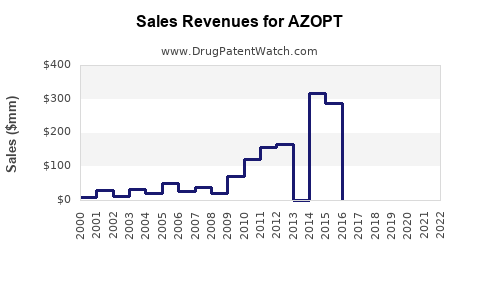
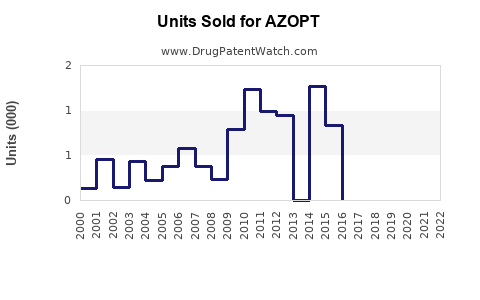
Annual Sales Revenues and Units Sold for AZOPT
| Drug Name | Revenues (USD) | Units | Year |
|---|---|---|---|
| AZOPT | ⤷ Start Trial | ⤷ Start Trial | 2022 |
| AZOPT | ⤷ Start Trial | ⤷ Start Trial | 2021 |
| AZOPT | ⤷ Start Trial | ⤷ Start Trial | 2020 |
| >Drug Name | >Revenues (USD) | >Units | >Year |
AZOPT Market Analysis and Sales Projections: Brinzolamide Ophthalmic Suspension
AZOPT is Alcon’s branded brinzolamide 1% ophthalmic suspension for lowering elevated intraocular pressure in patients with ocular hypertension or open-angle glaucoma. Its U.S. patent exclusivity has expired, generic brinzolamide is available, and the product is no longer positioned as a high-growth branded asset. The commercial outlook is stable to declining, driven by recurring glaucoma demand but constrained by generic substitution, therapeutic competition, and limited pricing power.
Public filings do not separately disclose AZOPT revenue. The projections below estimate net sales using market-access, volume, and price assumptions rather than reported product revenue.
What is AZOPT and how does brinzolamide work?
AZOPT contains brinzolamide, a topical carbonic anhydrase inhibitor. It reduces aqueous humor formation and lowers intraocular pressure. The product is administered as a 1% ophthalmic suspension, generally three times daily as monotherapy or twice daily when used with other glaucoma medicines, according to the FDA-approved label.[1]
AZOPT product profile
| Attribute | Detail |
|---|---|
| Brand | AZOPT |
| Active ingredient | Brinzolamide |
| Strength | 1% ophthalmic suspension |
| Therapeutic class | Topical carbonic anhydrase inhibitor |
| Indications | Ocular hypertension and open-angle glaucoma |
| Original U.S. sponsor | Alcon Laboratories |
| Current commercial owner | Alcon |
| U.S. regulatory application | NDA 020816 |
| Route | Ophthalmic |
| Administration | Topical ocular |
| Primary alternatives | Dorzolamide, timolol, prostaglandin analogs, fixed-combination glaucoma products |
| FDA approval | 1998, according to FDA product records and labeling history[1][2] |
Brinzolamide is pharmacologically similar to dorzolamide but has different suspension characteristics and dosing considerations. It is usually prescribed when a carbonic anhydrase inhibitor is clinically appropriate and a patient, physician, or payer favors brinzolamide over dorzolamide.
What is the current market position of AZOPT?
AZOPT occupies a mature, niche position in the glaucoma market. Its commercial value comes from prescription persistence, brand familiarity, and Alcon’s ophthalmology distribution infrastructure rather than patent protection.
The product competes in a crowded category that includes:
- Prostaglandin analogs such as latanoprost, bimatoprost, and travoprost.
- Beta blockers such as timolol.
- Carbonic anhydrase inhibitors such as dorzolamide and brinzolamide.
- Alpha agonists such as brimonidine.
- Fixed combinations such as dorzolamide/timolol and brimonidine/timolol.
- Newer agents, including netarsudil and latanoprostene bunod.
Prostaglandin analogs generally lead first-line treatment because of once-daily dosing and strong intraocular-pressure reduction. AZOPT is more commonly used as an adjunct, an alternative to another carbonic anhydrase inhibitor, or when treatment is individualized around tolerability and adherence.
How large is the addressable market for AZOPT?
The underlying market is substantial because glaucoma and ocular hypertension require long-term treatment. The addressable market for AZOPT is smaller than the total glaucoma market because brinzolamide is one ingredient in a broad multi-class category and has generic competition.
Global glaucoma prevalence was estimated at more than 75 million people in 2020, with projections rising as populations age.[3] Most patients do not receive brinzolamide. A practical commercial segmentation is:
| Segment | Relevance to AZOPT |
|---|---|
| Diagnosed open-angle glaucoma | Core disease population |
| Ocular hypertension | Secondary labeled population |
| Patients requiring combination therapy | Important use case |
| Patients unable to tolerate or adhere to alternatives | Selective opportunity |
| Patients using generic brinzolamide | Competitive volume pool |
| Patients using branded AZOPT | Narrow residual segment |
The highest-value commercial opportunity is not untreated glaucoma. It is conversion or retention among patients who receive a carbonic anhydrase inhibitor and remain on branded therapy despite generic availability.
What are AZOPT sales and revenue projections?
Alcon does not report AZOPT as a separate revenue line in its public annual filings. The following base-case estimates are therefore modeled product-level sales, not reported Alcon guidance.[4]
Five-year AZOPT sales projection
| Fiscal year | Base-case net sales | Growth versus prior year | Key assumption |
|---|---|---|---|
| 2024A estimated | $35 million | - | Mature branded product with generic erosion |
| 2025E | $33 million | -6% | Continued U.S. substitution |
| 2026E | $31 million | -6% | Stable chronic demand, lower realized price |
| 2027E | $29 million | -6% | Generic share expansion |
| 2028E | $27 million | -7% | Brand contraction in payer-controlled channels |
| 2029E | $25 million | -7% | Residual branded and international demand |
The base case assumes that branded AZOPT retains a small share of brinzolamide prescriptions, with volume declining more slowly than price because glaucoma therapy is chronic and switching is not universal.
Scenario range
| Scenario | 2025E | 2027E | 2029E | Principal driver |
|---|---|---|---|---|
| Upside | $39 million | $38 million | $37 million | Brand retention, supply disruption among generics, stronger international demand |
| Base case | $33 million | $29 million | $25 million | Gradual generic substitution |
| Downside | $27 million | $20 million | $15 million | Aggressive payer mandates and additional low-cost suppliers |
The commercial risk is asymmetric. A supply shortage affecting generic products could temporarily support AZOPT volume, but long-term generic competition is more likely to reduce both unit share and net price.
What is the expected AZOPT growth rate?
AZOPT is expected to decline at approximately 5% to 8% annually in the base case through 2029. The primary causes are loss of exclusivity, generic substitution, and the availability of alternative glaucoma drug classes.
Sales could be more resilient in markets where:
- Brand prescribing remains common.
- Generic reimbursement is weak or fragmented.
- Alcon has strong ophthalmology-channel access.
- Prescribers prioritize established branded products.
- Local registration or supply barriers limit generic competition.
Sales should decline faster in markets with centralized procurement, mandatory generic substitution, or strong pharmacy-level substitution.
What patents protect AZOPT?
AZOPT’s original U.S. patent estate no longer provides meaningful commercial exclusivity. The 1998 approval places the product well beyond the standard U.S. five-year new chemical entity exclusivity period and beyond the relevant patent term for the original development program.[1][2]
AZOPT patent and exclusivity status
| Protection category | Status |
|---|---|
| New chemical entity exclusivity | Expired |
| Original formulation protection | Expired or commercially ineffective |
| U.S. patent exclusivity | No current high-value exclusivity identified from the mature product history |
| Orange Book blocking position | No current patent barrier expected to prevent generic entry |
| Pediatric exclusivity | No material current exclusivity expected |
| Regulatory exclusivity | Expired |
The key competitive issue is therefore not patent litigation. It is brand economics, physician preference, formulary placement, and supply reliability.
What is the Orange Book status of AZOPT?
AZOPT is listed in FDA drug databases under NDA 020816. Its original regulatory protection has expired, and the product is exposed to approved generic competition.[1][2]
An Orange Book listing does not itself preserve market exclusivity. Any relevant listed patent must remain unexpired and enforceable, and the generic applicant must address the listed patents through an applicable certification. For a mature AZOPT product, Paragraph IV litigation is not expected to be the primary market event.
Are there Paragraph IV challenges to AZOPT?
No major current Paragraph IV dispute is central to the AZOPT commercial outlook. The product’s generic-entry phase occurred after its original exclusivity period, and the market has moved into post-exclusivity competition.
Generic entry risk
| Risk | Assessment |
|---|---|
| New Paragraph IV challenge | Low commercial significance |
| Additional generic approvals | Moderate to high |
| Price erosion | High |
| Volume erosion | Moderate to high |
| Authorized generic impact | Possible |
| Brand-only payer coverage | Weakening |
| Litigation-driven launch delay | Low |
A new ANDA entrant could still affect pricing and channel share, but the value of a patent challenge would be limited because the product is already mature.
Which companies challenge or compete with AZOPT?
AZOPT competes with both branded products and generic manufacturers. The relevant competitive set includes Alcon, Bausch + Lomb, Sandoz, Teva, and other FDA-approved generic suppliers, depending on current market authorizations and supply status.
Direct and indirect competitors
| Competitor | Product or class | Competitive effect |
|---|---|---|
| Generic brinzolamide suppliers | Brinzolamide 1% suspension | Direct price and substitution pressure |
| Generic dorzolamide | Carbonic anhydrase inhibitor | Direct therapeutic substitute |
| Cosopt and generic dorzolamide/timolol | Fixed combination | Reduces need for separate agents |
| Xalatan and generic latanoprost | Prostaglandin analog | Strong first-line alternative |
| Lumigan and generic bimatoprost | Prostaglandin analog | Alternative for pressure reduction |
| Alphagan P and generic brimonidine | Alpha agonist | Adjunctive and alternative therapy |
| Rhopressa | Netarsudil | Newer adjunctive option |
| Vyzulta | Latanoprostene bunod | Branded alternative in selected patients |
The most important competitor is not another premium brand. It is generic brinzolamide combined with low-cost glaucoma therapies that satisfy payer step-edit requirements.
What formulations are protected by AZOPT?
AZOPT is a suspension rather than a simple aqueous solution. Brinzolamide’s low water solubility requires formulation technology to maintain dose uniformity and ocular tolerability.
The commercially relevant formulation attributes include:
- Brinzolamide 1% concentration.
- Ophthalmic suspension delivery.
- Particle-size control.
- Redispersibility after storage.
- Preservative system.
- Bottle and dropper performance.
- Ocular comfort and dosing consistency.
These formulation characteristics can create manufacturing and regulatory hurdles for generic suppliers. They do not, by themselves, create current patent exclusivity. FDA-approved generics must demonstrate pharmaceutical equivalence and bioequivalence or otherwise satisfy the applicable ophthalmic product requirements.[5]
How strong is the AZOPT patent estate?
The current patent estate is weak as a commercial defense. AZOPT has several residual protections that may matter to product quality or manufacturing, but the central product is not protected by a live exclusivity position capable of supporting premium pricing.
Patent-strength assessment
| Factor | Rating | Rationale |
|---|---|---|
| Core compound protection | Low | Mature active ingredient |
| Composition-of-matter protection | Low | Original protection expired |
| Formulation protection | Low to moderate | Technical barriers may remain, but broad blocking rights are unlikely |
| Method-of-use protection | Low | Label uses are established and generic entry is available |
| Manufacturing know-how | Moderate | Suspension quality and scale-up can affect supply |
| Litigation leverage | Low | No apparent current blocking patent position |
| Brand equity | Moderate | Alcon ophthalmology presence supports retention |
| Pricing power | Low | Generic substitution limits net price |
Manufacturing know-how may support product consistency, but it is less durable than patent exclusivity and can be replicated by qualified suppliers.
What FDA regulatory issues affect AZOPT?
AZOPT is an approved prescription ophthalmic product. The main regulatory issues are quality, sterility, particulate control, suspension uniformity, preservative performance, labeling, and manufacturing compliance.
For generic suppliers, ophthalmic suspensions can be more technically demanding than simple solutions. FDA scrutiny may focus on:
- Sterility assurance.
- Container-closure integrity.
- Particle-size distribution.
- Dose uniformity.
- Resuspendability.
- Impurity profile.
- Preservative concentration.
- Stability through the labeled shelf life.
These requirements can limit the number of reliable suppliers. They are more likely to support temporary supply stability than long-term branded exclusivity.
What litigation or settlement agreements affect AZOPT?
No material ongoing patent litigation or settlement agreement is required to explain AZOPT’s current market position. The commercial decline is primarily a post-exclusivity market effect.
Any future dispute would more likely concern:
- Manufacturing quality.
- Product liability.
- Advertising or labeling.
- Generic substitution.
- Distribution or supply arrangements.
A patent settlement would have limited strategic value unless a new, enforceable formulation or manufacturing patent were asserted against a specific generic applicant.
Does AZOPT have biosimilar risk?
AZOPT has no biosimilar risk because brinzolamide is a small-molecule drug, not a biologic. The relevant threat is generic ANDA competition under the Hatch-Waxman framework.
This distinction matters commercially:
- Generic approval is generally faster and less costly than biosimilar development.
- Generic suppliers can obtain pharmacy-level substitution.
- No reference-product biologic exclusivity applies.
- Manufacturing competition can expand rapidly once the product is mature.
What licensing deals support AZOPT sales?
AZOPT’s current sales outlook is not dependent on a major newly disclosed licensing transaction. Alcon’s value is based on ownership, commercialization, ophthalmology infrastructure, and portfolio management.
A licensing arrangement could still affect specific territories, but licensing would not restore U.S. patent exclusivity. The most commercially relevant deal structures would involve:
- Regional distribution.
- Co-promotion.
- Tender supply.
- Authorized generic rights.
- Portfolio bundling with other ophthalmic products.
What generic launch scenarios exist for AZOPT?
Scenario 1: Continued gradual erosion
This is the base case. Generic brinzolamide captures additional volume each year, while AZOPT retains patients with brand preference, stable physician prescribing, or limited switching. Net sales decline at a mid-single-digit rate.
Scenario 2: Accelerated payer substitution
Medicare, commercial plans, and pharmacy benefit managers increase mandatory generic substitution. AZOPT loses formulary preference, and annual sales decline by 10% or more for several years.
Scenario 3: Generic supply disruption
A manufacturing interruption or shortage among generic suppliers temporarily increases AZOPT demand. The effect would likely be episodic. It would not change the long-term post-exclusivity trajectory.
Scenario 4: Portfolio defense
Alcon protects ophthalmology-channel access through contracting, physician education, distribution, and combination-product promotion. This could stabilize revenue but would require higher commercial spending and lower net price.
How does AZOPT compare with dorzolamide?
Brinzolamide and dorzolamide are both topical carbonic anhydrase inhibitors. Dorzolamide has a longer generic history and is widely available in standalone and fixed-combination products. AZOPT may retain advantages for selected patients based on tolerability, prescribing familiarity, or suspension characteristics, but these factors do not offset the price advantage of generic dorzolamide.
| Factor | AZOPT | Generic dorzolamide |
|---|---|---|
| Active ingredient | Brinzolamide | Dorzolamide |
| Brand status | Branded | Generic |
| Price position | Premium | Low cost |
| Dosing | Typically three times daily alone | Typically three times daily alone |
| Fixed combinations | Less central to current use | Strong presence with timolol |
| Patent protection | Expired | Expired |
| Payer preference | Weakening | Generally stronger |
| Commercial outlook | Declining mature brand | Stable generic demand |
What is the investment and commercial outlook for AZOPT?
AZOPT should be valued as a mature cash-flow product rather than a growth asset. Its revenue base can remain durable because glaucoma treatment is chronic, but the brand lacks the structural drivers required for expansion.
Commercial investment conclusions
- Revenue exposure is modest relative to Alcon’s broader ophthalmology portfolio.
- Generic competition creates persistent price and volume pressure.
- Patent litigation is unlikely to produce a meaningful change in the outlook.
- Manufacturing quality and supply reliability are more important than intellectual-property exclusivity.
- International markets may decline more slowly where generic substitution is less developed.
- Brand retention programs can reduce erosion but are unlikely to create sustained growth.
- The most attractive opportunity is portfolio bundling with newer ophthalmic products, not standalone AZOPT expansion.
Key Takeaways
- AZOPT is brinzolamide 1% ophthalmic suspension for ocular hypertension and open-angle glaucoma.
- U.S. regulatory and patent exclusivity has expired.
- Generic brinzolamide and generic dorzolamide are the principal direct threats.
- Alcon does not separately report AZOPT revenue.
- A modeled 2024 baseline is approximately $35 million in global net sales.
- Base-case sales decline from about $33 million in 2025 to $25 million in 2029.
- Upside depends on generic supply problems, brand retention, and international demand.
- Downside depends on mandatory substitution and further generic entrants.
- AZOPT has no biosimilar risk because brinzolamide is a small molecule.
- The product’s remaining value is operational and commercial, not patent-driven.
FAQs
When did AZOPT lose U.S. market exclusivity?
AZOPT’s original U.S. exclusivity expired years ago. The product was approved in 1998, placing it well beyond the standard new chemical entity exclusivity period.
Can a generic manufacturer launch brinzolamide without infringing AZOPT patents?
Generic entry is already commercially established. Any applicant must address applicable FDA requirements and any unexpired listed patent, but no current blocking patent position is central to AZOPT’s market outlook.
Is AZOPT still covered by Medicare and commercial insurance?
Coverage varies by plan. Generic brinzolamide is generally favored where available, while branded AZOPT may require prior authorization, step therapy, or higher patient cost sharing.
What is the main reason physicians continue prescribing AZOPT?
Continued use can reflect patient stability, physician familiarity, tolerability, prior treatment response, and practical reluctance to switch a chronic ophthalmic regimen.
Could AZOPT sales increase despite generic competition?
Short-term increases are possible if generic supply is disrupted or if Alcon improves retention in selected markets. A sustained global growth cycle is unlikely without a significant change in pricing, reimbursement, or product positioning.
References
- U.S. Food and Drug Administration. (2024). AZOPT (brinzolamide ophthalmic suspension) prescribing information.
- U.S. Food and Drug Administration. (2024). Orange Book: Approved drug products with therapeutic equivalence evaluations, NDA 020816.
- World Health Organization. (2023). World report on vision and eye care.
- Alcon Inc. (2024). Annual report and Form 10-K.
- U.S. Food and Drug Administration. (2023). Product-specific guidance for ophthalmic drug products and generic drug development.
More… ↓
