Share This Page
Drug Sales Trends for AMOXICILLIN
✉ Email this page to a colleague
Payment Methods and Pharmacy Types for AMOXICILLIN (2022)
Revenues by Pharmacy Type
Units Sold by Pharmacy Type
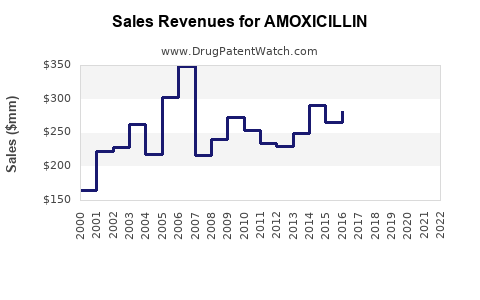
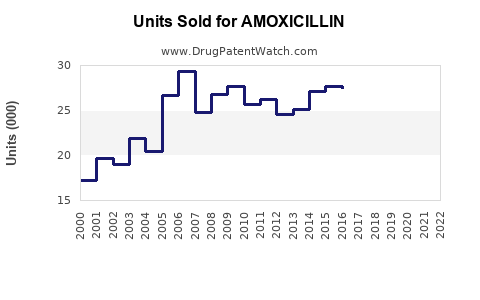
Annual Sales Revenues and Units Sold for AMOXICILLIN
| Drug Name | Revenues (USD) | Units | Year |
|---|---|---|---|
| AMOXICILLIN | ⤷ Start Trial | ⤷ Start Trial | 2022 |
| AMOXICILLIN | ⤷ Start Trial | ⤷ Start Trial | 2021 |
| AMOXICILLIN | ⤷ Start Trial | ⤷ Start Trial | 2020 |
| AMOXICILLIN | ⤷ Start Trial | ⤷ Start Trial | 2019 |
| AMOXICILLIN | ⤷ Start Trial | ⤷ Start Trial | 2018 |
| AMOXICILLIN | ⤷ Start Trial | ⤷ Start Trial | 2017 |
| AMOXICILLIN | ⤷ Start Trial | ⤷ Start Trial | 2016 |
| >Drug Name | >Revenues (USD) | >Units | >Year |
Amoxicillin Market Analysis, Sales Projections, Patent Status, and Generic Competition
Amoxicillin is a mature, off-patent penicillin antibiotic with broad global availability and high prescription volume. Its commercial value comes from scale, pediatric formulations, combination products such as amoxicillin-clavulanate, hospital and outpatient demand, and procurement in emerging markets rather than exclusivity pricing. Global amoxicillin revenue is best estimated as a fragmented market because manufacturers report sales by product portfolio, geography, and combination rather than by active ingredient.
A reasonable base-case model places global amoxicillin product sales at approximately $1.5 billion to $2.5 billion in 2024, excluding a substantial portion of amoxicillin-clavulanate revenue. The market is likely to grow at roughly 3% to 6% annually through 2030 in nominal terms, with volume growth concentrated in Asia-Pacific, Latin America, Africa, and selected Middle Eastern markets.
How large is the global amoxicillin market?
Global amoxicillin revenue is fragmented across branded generics, unbranded generics, government tenders, retail pharmacies, hospitals, and combination products. No single public source provides a definitive worldwide sales figure for amoxicillin alone.
| Market segment | 2024 estimated commercial value | Primary drivers |
|---|---|---|
| Amoxicillin standalone products | $1.0 billion-$1.7 billion | Respiratory, dental, pediatric and primary-care use |
| Amoxicillin-clavulanate products | $3.0 billion-$5.0 billion | Broad-spectrum outpatient prescribing and branded generics |
| Hospital and institutional procurement | Included in the ranges above | Tender pricing, injectable and oral supply |
| Global amoxicillin API demand | Not separately disclosed | Finished-dose production and regional supply chains |
These ranges are analytical estimates rather than reported consolidated sales. Public market reports often combine amoxicillin, amoxicillin-clavulanate, penicillin products, or the wider beta-lactam antibiotics category, producing materially different market sizes.
Amoxicillin remains commercially important because it is a first-line or commonly recommended treatment for several bacterial infections. Its uses include selected respiratory tract infections, acute otitis media, streptococcal pharyngitis, dental infections, urinary tract infections, Helicobacter pylori eradication regimens, and prophylaxis in specific clinical settings. Treatment decisions depend on local resistance patterns and clinical guidelines. The World Health Organization classifies amoxicillin among widely used Access antibiotics in its AWaRe framework, while amoxicillin-clavulanate is categorized separately because of its broader spectrum and stewardship implications (World Health Organization, 2023).
What are the main demand drivers for amoxicillin?
The largest demand drivers are pediatric prescribing, outpatient respiratory infections, dental care, H. pylori treatment, and government procurement.
Pediatric formulations
Amoxicillin is heavily used in children because oral suspensions and dispersible tablets allow weight-based dosing. Demand rises during seasonal respiratory infection periods, although antimicrobial stewardship programs and viral-diagnosis improvements can reduce inappropriate prescribing.
Liquid formulations have distinctive commercial value. They require reliable access to bottles, powder, measuring devices, flavor systems, and stable manufacturing capacity. Pediatric supply interruptions can occur even when API supply is available because shortages may arise from packaging, manufacturing capacity, quality-control releases, or unexpected demand.
Amoxicillin-clavulanate
Amoxicillin-clavulanate expands the addressable market but carries greater manufacturing and regulatory complexity. The product combines amoxicillin with clavulanate potassium, which has different stability characteristics and creates formulation constraints. It is sold in tablets, extended-release tablets, oral suspensions, and, in some markets, injectable forms.
The combination is commercially more valuable than standalone amoxicillin because it supports higher average selling prices and stronger brand recognition. It also faces intense generic competition.
Emerging-market procurement
Public tenders in India, China, Southeast Asia, Latin America, Africa, and the Middle East support high unit volumes but compress prices. Local manufacturing, registration status, tender eligibility, and reliable supply often matter more than brand differentiation.
Dental and primary-care use
Dental prescriptions represent a durable outpatient demand source. Primary-care use remains sensitive to stewardship guidance, resistance data, reimbursement rules, and diagnostic practices.
What are the sales projections for amoxicillin through 2030?
The base case assumes continued generic price pressure, stable global prescription volume, modest population growth, increased access in lower-income markets, and a gradual shift toward combination products in some outpatient settings.
| Year | Standalone amoxicillin estimated sales | Amoxicillin-clavulanate estimated sales | Combined addressable market |
|---|---|---|---|
| 2024 | $1.0B-$1.7B | $3.0B-$5.0B | $4.0B-$6.7B |
| 2025 | $1.1B-$1.8B | $3.1B-$5.3B | $4.2B-$7.1B |
| 2026 | $1.1B-$1.9B | $3.2B-$5.6B | $4.3B-$7.5B |
| 2027 | $1.2B-$2.0B | $3.3B-$5.9B | $4.5B-$7.9B |
| 2028 | $1.2B-$2.1B | $3.4B-$6.2B | $4.6B-$8.3B |
| 2029 | $1.3B-$2.2B | $3.5B-$6.5B | $4.8B-$8.7B |
| 2030 | $1.3B-$2.3B | $3.6B-$6.8B | $4.9B-$9.1B |
The standalone amoxicillin base case implies an approximate 4% annual nominal growth rate. The range includes volume expansion and mix effects, while generic price erosion limits revenue growth in mature markets.
Scenario analysis
| Scenario | 2024-2030 annual growth | 2030 standalone amoxicillin sales | Main assumptions |
|---|---|---|---|
| Downside | 0%-2% | $1.0B-$1.9B | Price deflation, stewardship, supply disruption |
| Base case | 3%-6% | $1.3B-$2.3B | Stable volume and moderate emerging-market expansion |
| Upside | 6%-8% | $1.5B-$2.7B | Higher access, tender expansion, stronger pediatric demand |
These projections are suitable for market sizing and strategic screening, not issuer-level revenue forecasting. Manufacturer-level results require prescription, tender, volume, and price data that are generally not disclosed for this molecule.
When did amoxicillin lose exclusivity?
Amoxicillin lost meaningful composition-of-matter exclusivity decades ago. It is now a generic active ingredient with no remaining global product-level exclusivity comparable to a new molecular entity.
The original amoxicillin patents were filed in the 1960s and reached expiration long before the current generic market. Historical patents covering the compound and early pharmaceutical use do not create a current barrier to ordinary amoxicillin products.
| Exclusivity category | Current status |
|---|---|
| New chemical entity exclusivity | Expired |
| Original composition patents | Expired |
| Pediatric exclusivity | No current exclusivity barrier |
| Orphan-drug exclusivity | Not applicable to ordinary amoxicillin |
| Current U.S. market | Generic competition |
| Biosimilar exclusivity | Not applicable |
What patents protect amoxicillin products today?
Current commercial protection is generally limited to product-specific formulation, manufacturing, packaging, or delivery claims, if any remain in force in a particular jurisdiction. The amoxicillin molecule itself is not protected by an active foundational patent.
Potentially relevant patent categories include:
- Stable oral suspension formulations
- Taste-masked pediatric products
- Modified-release tablets
- Amoxicillin-clavulanate ratio and stability designs
- Manufacturing and crystallization processes
- Injectable formulations
- Drug-delivery systems
- Combination regimens
- Packaging and reconstitution systems
The commercial significance of these patents is usually narrower than composition patents. A competitor may design around a formulation claim by changing excipients, release mechanisms, particle properties, dosage ratios, or packaging.
Formulation patent risk
Formulation claims can delay a specific copycat product but rarely prevent broad generic availability. Risk is highest for extended-release products, specialized pediatric formulations, or combination products with demanding stability specifications.
For ordinary immediate-release amoxicillin capsules, tablets, chewable tablets, and oral suspension, the main competitive barriers are manufacturing validation, regulatory compliance, supply reliability, and distribution rather than patent exclusion.
What is the FDA regulatory and Orange Book status of amoxicillin?
The U.S. Food and Drug Administration regulates amoxicillin as an approved prescription antibiotic. Products are approved in multiple dosage forms and strengths, including capsules, tablets, chewable tablets, and powder for oral suspension. Approved products are listed in FDA’s Drugs@FDA and Orange Book systems under individual application holders and product presentations (U.S. Food and Drug Administration, n.d.-a; U.S. Food and Drug Administration, n.d.-b).
The regulatory structure is highly decentralized:
- Multiple abbreviated new drug applications support generic products.
- Approved products vary by strength, dosage form, manufacturer, and packaging.
- Orange Book patent listings are product-specific.
- An Orange Book listing does not establish market-wide protection for the active ingredient.
- Some products may have no listed patents or only formulation-related listings.
The FDA’s Orange Book must be reviewed at the specific product and application level. A conclusion about a particular manufacturer cannot be applied automatically to all amoxicillin products.
Are there Paragraph IV challenges to amoxicillin?
Paragraph IV litigation is not a central market issue for ordinary amoxicillin because the foundational patents expired many years ago and multiple generic products are already approved.
Paragraph IV disputes could still arise for:
- A newly developed modified-release product
- A specialized suspension or delivery system
- A particular amoxicillin-clavulanate formulation
- A product with a newly listed formulation patent
- A branded product using a differentiated device or packaging system
For standard immediate-release amoxicillin, generic entry is already established. The commercial question is usually approval, supply, pricing, and channel access rather than first-filer exclusivity.
Which companies compete in the amoxicillin market?
Competition is distributed across multinational pharmaceutical companies, generic manufacturers, regional suppliers, contract manufacturers, and government-tender specialists.
Representative participants have included:
- Haleon and legacy GSK commercial brands in relevant markets
- Sandoz
- Teva Pharmaceutical Industries
- Viatris
- Hikma Pharmaceuticals
- Cipla
- Dr. Reddy’s Laboratories
- Aurobindo Pharma
- Sun Pharmaceutical Industries
- Lupin
- Amneal Pharmaceuticals
- Zhejiang-based and other Chinese API and finished-dose manufacturers
- Regional companies in Latin America, Southeast Asia, Africa, and the Middle East
The competitive structure differs by country. A manufacturer may have substantial U.S. retail presence but limited tender access in Africa, or strong API production but no finished-dose registration in Europe.
Competitive comparison
| Product type | Price potential | Patent barrier | Manufacturing complexity | Commercial outlook |
|---|---|---|---|---|
| Amoxicillin immediate-release capsule | Low | Very low | Low to moderate | High-volume, margin-constrained |
| Amoxicillin oral suspension | Moderate | Low to moderate | Moderate | Attractive where pediatric supply is tight |
| Chewable tablet | Moderate | Low | Moderate | Useful for pediatric differentiation |
| Amoxicillin-clavulanate tablet | Moderate to high | Low to moderate | Moderate to high | Larger revenue pool, strong competition |
| Extended-release combination | Higher | Product-specific | High | Smaller market, greater formulation risk |
| Injectable amoxicillin | Moderate | Low | High | Institutional and geographic opportunity |
What manufacturing and intellectual-property barriers affect supply?
Amoxicillin production depends on fermentation-derived intermediates, chemical processing, crystallization, quality testing, and finished-dose manufacturing. The strongest operational barriers are not patent-related.
Key barriers include:
- API capacity and supplier qualification.
- Compliance with current good manufacturing practices.
- Control of impurities and degradation products.
- Validation of oral suspension stability.
- Packaging and reconstitution capacity.
- Reliable access to clavulanate for combination products.
- Regulatory registration in each target market.
- Tender qualification and supply-performance history.
Supply concentration can create pricing and availability risk even when several finished-dose companies exist. API and intermediate production in Asia has a major influence on global cost structures.
What litigation and settlement agreements affect amoxicillin?
There is no broad, current litigation framework comparable to the patent disputes surrounding recently launched specialty drugs. Historical litigation has generally centered on specific patents, formulations, combinations, or marketing conduct rather than the basic amoxicillin molecule.
Settlement agreements, where they exist, are likely to be product-specific and confidential. They should not be treated as evidence of market-wide exclusivity. A diligence review should distinguish:
- Patent infringement litigation
- Antitrust or pay-for-delay allegations
- Product-liability cases
- Manufacturing and quality disputes
- False-marking or labeling claims
- Regulatory enforcement actions
Does amoxicillin face biosimilar risk?
No. Amoxicillin is a small-molecule antibiotic, not a biologic. Biosimilar competition under the Public Health Service Act does not apply.
The relevant competitive threats are conventional generic applicants, authorized generics, regional manufacturers, tender suppliers, and alternative antibiotics. Substitution risk comes from drugs such as penicillin V, cephalexin, azithromycin, doxycycline, and other agents selected according to diagnosis and resistance patterns.
What geographic markets offer the strongest growth?
Asia-Pacific is the largest structural growth region because of population, expanding healthcare access, local manufacturing, and rising pharmaceutical consumption. India and China are important for both supply and demand.
| Region | Market outlook |
|---|---|
| United States | Stable volume, severe generic price competition, occasional supply disruption |
| Europe | Mature market, procurement pressure, stewardship constraints |
| China | Large domestic demand and major API/finished-dose manufacturing base |
| India | Strong production, large domestic market, export potential |
| Latin America | Growth through private retail and public procurement |
| Middle East | Import dependence in several markets, tender-driven demand |
| Africa | Long-term volume growth, public-health procurement, supply reliability constraints |
Geographic expansion requires local registration, approved manufacturing sites, pharmacovigilance systems, and compliance with country-specific labeling and distribution rules.
What generic launch scenarios exist for amoxicillin?
For ordinary amoxicillin, generic launch has already occurred in major markets. Future commercial opportunities are more likely to involve differentiated execution than first entry.
Scenario 1: Low-cost tender entry
A manufacturer competes on API economics, quality records, reliable delivery, and government procurement eligibility. Margins are low, but volume can be substantial.
Scenario 2: Pediatric supply strategy
A company focuses on oral suspension, dispersible tablets, taste masking, and dependable seasonal inventory. This strategy can support better pricing where shortages affect hospitals and pharmacies.
Scenario 3: Combination-product expansion
A manufacturer builds an amoxicillin-clavulanate portfolio across tablets, suspensions, and injectable forms. The opportunity is larger, but stability, sourcing, and regulatory requirements are more demanding.
Scenario 4: Branded generic positioning
A company invests in physician, pharmacy, or institutional relationships. Brand premiums are possible in selected markets but are difficult to sustain in tender-heavy systems.
What is the commercial value and revenue exposure?
Amoxicillin is strategically important but usually not a major margin contributor for diversified pharmaceutical companies. Revenue exposure is highest for companies with:
- Large generic portfolios
- Strong pediatric franchises
- Public-sector tender businesses
- Antibiotic-focused manufacturing
- Established distribution in emerging markets
- Integrated API and finished-dose production
Revenue risk is driven by price erosion, regulatory observations, API disruptions, inventory imbalances, and antimicrobial stewardship. The highest-value commercial exposure often sits in amoxicillin-clavulanate rather than standalone amoxicillin.
Key Takeaways
- Amoxicillin is a mature, off-patent generic antibiotic with no meaningful foundational exclusivity.
- Estimated standalone global sales are approximately $1.0 billion to $1.7 billion in 2024.
- A base-case model projects $1.3 billion to $2.3 billion in standalone sales by 2030.
- Amoxicillin-clavulanate represents a larger commercial pool but has greater formulation and manufacturing complexity.
- Standard amoxicillin products face minimal patent risk and extensive generic competition.
- Formulation, suspension, modified-release, packaging, and combination patents can create product-specific barriers.
- The FDA regulates multiple generic amoxicillin products, and Orange Book analysis must be conducted at the application and product level.
- Biosimilar competition is irrelevant because amoxicillin is a small molecule.
- Growth is likely to come from emerging-market volume, pediatric formulations, and procurement access.
- Manufacturing reliability, API sourcing, quality compliance, and tender execution are more important than patent exclusivity.
FAQs about amoxicillin market projections and competition
Is amoxicillin still profitable for generic manufacturers?
Yes, but profitability depends on scale, manufacturing efficiency, supply reliability, and market selection. Immediate-release products are usually low-margin in the United States and Europe.
Is amoxicillin-clavulanate a better commercial opportunity than amoxicillin?
Usually. It has a larger revenue pool and higher average pricing, but it requires more complex formulation, stability testing, and supply-chain management.
Can a new patent block generic amoxicillin?
A new patent generally cannot restore protection for the old molecule. It may delay a specific formulation or delivery product if the patent claims are valid and enforceable.
Which amoxicillin dosage form has the greatest supply risk?
Oral suspension has greater operational risk than standard capsules because it depends on powder formulation, flavoring, packaging, reconstitution stability, and pediatric demand forecasting.
What is the main investment risk in the amoxicillin market?
The main risks are price deflation, API concentration, regulatory manufacturing findings, tender losses, and antimicrobial stewardship measures that reduce inappropriate antibiotic prescribing.
References
U.S. Food and Drug Administration. (n.d.-a). Approved drug products with therapeutic equivalence evaluations: Orange Book. https://www.fda.gov/drugs/drug-approvals-and-databases/approved-drug-products-therapeutic-equivalence-evaluations-orange-book
U.S. Food and Drug Administration. (n.d.-b). Drugs@FDA: FDA-approved drugs. https://www.accessdata.fda.gov/scripts/cder/daf/
U.S. Food and Drug Administration. (n.d.-c). Drug shortages. https://www.accessdata.fda.gov/scripts/drugshortages/
World Health Organization. (2023). The WHO AWaRe antibiotic book: Infographics. https://www.who.int/publications/i/item/9789240062382
World Health Organization. (2023). WHO model list of essential medicines: 23rd list. https://www.who.int/publications/i/item/WHO-MHP-HPS-EML-2023.02
More… ↓
