Drug Sales Trends for AMLOD/BENAZP
Payment Methods and Pharmacy Types for AMLOD/BENAZP (2022)
Revenues by Pharmacy Type
Units Sold by Pharmacy Type
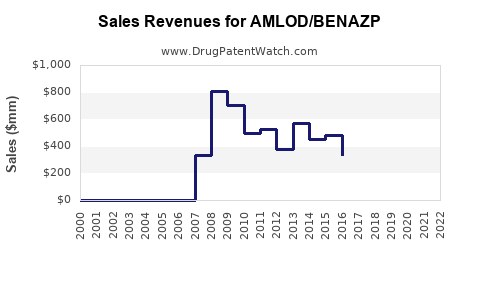
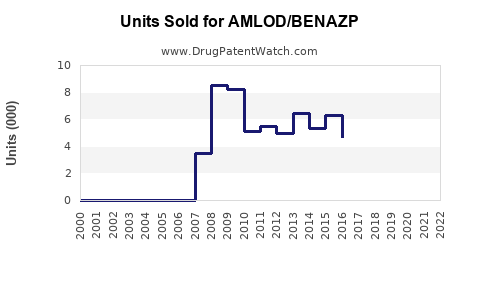
Annual Sales Revenues and Units Sold for AMLOD/BENAZP
| Drug Name | Revenues (USD) | Units | Year |
|---|---|---|---|
| AMLOD/BENAZP | ⤷ Start Trial | ⤷ Start Trial | 2022 |
| AMLOD/BENAZP | ⤷ Start Trial | ⤷ Start Trial | 2021 |
| AMLOD/BENAZP | ⤷ Start Trial | ⤷ Start Trial | 2020 |
| AMLOD/BENAZP | ⤷ Start Trial | ⤷ Start Trial | 2019 |
| AMLOD/BENAZP | ⤷ Start Trial | ⤷ Start Trial | 2018 |
| AMLOD/BENAZP | ⤷ Start Trial | ⤷ Start Trial | 2017 |
| >Drug Name | >Revenues (USD) | >Units | >Year |
AMLOD/BENAZP Market Analysis and Sales Projections
AMLOD/BENAZP is the fixed-dose combination of amlodipine besylate and benazepril hydrochloride, marketed in the United States under the former brand name Lotrel and through multiple generic versions. The product is a mature, off-patent antihypertensive with durable clinical demand but limited pricing power. Its commercial outlook is driven by prescription retention, pharmacy-channel availability, wholesaler contracts and manufacturing cost rather than innovation exclusivity.
A realistic base case is stable or modestly declining prescription volume through 2028, accompanied by continued net-price erosion. The product is unlikely to generate material branded pharmaceutical growth unless a manufacturer gains share through lower-cost production, preferred formulary placement, improved supply reliability or a differentiated packaging strategy.
What is AMLOD/BENAZP and how is it used?
AMLOD/BENAZP combines a calcium-channel blocker with an angiotensin-converting enzyme inhibitor.
| Attribute | Detail |
|---|---|
| Active ingredients | Amlodipine besylate and benazepril hydrochloride |
| Drug class | Calcium-channel blocker plus ACE inhibitor |
| Primary use | Hypertension |
| Original U.S. brand | Lotrel |
| U.S. reference product | NDA 020992 |
| Available strengths | 2.5/10 mg, 5/10 mg, 5/20 mg, 5/40 mg, 10/20 mg, and 10/40 mg |
| Administration | Oral, once daily |
| Regulatory pathway for generics | Abbreviated New Drug Application, or ANDA |
| Biosimilar relevance | None; this is a small-molecule drug |
| Primary commercial channel | Retail pharmacy |
The fixed-dose combination is prescribed when blood pressure is inadequately controlled with monotherapy or when the physician wants to replace two separate prescriptions with one tablet. The FDA label identifies hypertension as the indication and describes the product as a combination of agents with complementary mechanisms of action [1].
How large is the AMLOD/BENAZP market?
The U.S. market is commercially mature and fragmented across generic suppliers. Public FDA sources identify approved products and regulatory status but do not publish a standalone national sales total for all amlodipine/benazepril prescriptions. Commercial market databases such as IQVIA and Symphony Health are normally required to establish audited prescription and revenue estimates.
The addressable market remains meaningful because hypertension is prevalent, chronic and treated predominantly with generic medicines. The Centers for Disease Control and Prevention estimates that nearly half of U.S. adults have hypertension, although treatment and control rates vary by age, insurance status and comorbidity [2]. Amlodipine and ACE inhibitors are both established components of hypertension treatment.
The combination competes with:
- Separate prescriptions for amlodipine and benazepril.
- Amlodipine combined with an angiotensin receptor blocker.
- Amlodipine combined with hydrochlorothiazide.
- Other ACE inhibitor/calcium-channel blocker combinations, including amlodipine/benazepril alternatives.
- Single-agent amlodipine, lisinopril, losartan and benazepril.
The key commercial limitation is substitution. Physicians and pharmacists can move patients from the combination product to two inexpensive generic tablets, often with little clinical disruption.
What are the main demand drivers for AMLOD/BENAZP?
Demand is supported by chronic hypertension treatment, generic affordability and the convenience of once-daily dosing. It is constrained by therapeutic substitution and the availability of lower-cost alternatives.
Positive demand drivers
- Persistent hypertension prevalence. The underlying patient pool is large and recurring.
- Generic affordability. Low acquisition cost supports continued use in Medicare, Medicaid and commercial formularies.
- Treatment intensification. Patients with uncontrolled blood pressure may receive combination therapy.
- Adherence convenience. One tablet can replace two prescriptions.
- Established clinical familiarity. Amlodipine and ACE inhibitors have long prescribing histories.
Negative demand drivers
- Therapeutic substitution. Lisinopril, losartan and separate amlodipine prescriptions are widely available.
- ACE-inhibitor tolerability. Cough, hyperkalemia, renal concerns and angioedema can lead to discontinuation.
- Low switching friction. Pharmacists and payers can substitute among generic antihypertensives.
- Limited differentiation. Generic products generally have no meaningful clinical distinction.
- Price compression. Multiple suppliers compete for the same prescriptions.
The 2017 American College of Cardiology/American Heart Association hypertension guideline supports combination therapy for some patients with substantially elevated blood pressure and recognizes calcium-channel blockers, ACE inhibitors and related agents as major antihypertensive classes [3]. Current prescribing, however, is affected by later guidelines, payer policies and patient-specific factors.
What is the competitive landscape for amlodipine/benazepril?
The product competes in a broad antihypertensive market rather than in a narrowly protected combination market.
| Competitor category | Examples | Competitive effect |
|---|---|---|
| Same combination | Generic amlodipine/benazepril | Direct price competition |
| Separate components | Generic amlodipine plus generic benazepril | Often lower-cost alternative |
| ACE inhibitor combinations | Amlodipine/lisinopril, where available by prescribing strategy | Substitution risk |
| ARB combinations | Amlodipine/valsartan, amlodipine/olmesartan, amlodipine/losartan | Competes where ACE-inhibitor adverse effects matter |
| Single agents | Amlodipine, lisinopril, losartan, benazepril | Step-up or step-down alternatives |
| Diuretic regimens | Hydrochlorothiazide-based combinations | Formulary and guideline-driven substitution |
Amlodipine is one of the most widely used antihypertensive ingredients. That creates a large ecosystem of prescribers and pharmacies but also reduces the strategic value of the specific benazepril combination. The combination is more likely to retain a stable niche than to expand its share of the overall hypertension market.
What is the FDA regulatory and Orange Book status?
AMLOD/BENAZP is an approved small-molecule combination drug. Generic products are approved through ANDAs demonstrating pharmaceutical equivalence and bioequivalence to the reference listed drug.
The product has no biosimilar pathway because biosimilars apply to biological products, not chemically synthesized amlodipine/benazepril tablets. The relevant regulatory risks are ANDA compliance, manufacturing quality, labeling, bioequivalence and supply continuity.
The Orange Book is the authoritative FDA source for reference listed drugs, therapeutic equivalence evaluations and patent or exclusivity information [4]. Lotrel’s commercial exclusivity period has ended, and generic competition has existed for many years. No current branded exclusivity mechanism is expected to protect the core combination from ordinary generic substitution.
How strong is the patent estate?
The core composition-of-matter and combination-product protection is no longer a material commercial barrier in the U.S. The market is post-exclusivity and supplied by generic manufacturers. Any remaining patent-related value would more likely concern a particular formulation, manufacturing process, packaging configuration or non-U.S. jurisdiction rather than the basic amlodipine/benazepril combination.
Method-of-use patents are also unlikely to create meaningful market exclusivity for the ordinary treatment of hypertension. Generic applicants may address any listed patent through certification strategies under the Hatch-Waxman framework, including Paragraph IV certifications where relevant [5].
When does AMLOD/BENAZP lose exclusivity?
The product lost practical U.S. exclusivity years ago. The exact historical timing depends on the patent and regulatory exclusivity record associated with the Lotrel NDA, but current commercial conditions confirm that generic entry is established.
| Exclusivity element | Current commercial assessment |
|---|---|
| New chemical entity exclusivity | Expired |
| Core product patent protection | Expired or no longer commercially blocking |
| Generic competition | Established |
| Paragraph IV risk | Relevant mainly to any later-listed formulation or process patent |
| Biosimilar risk | Not applicable |
| Current launch barrier | Manufacturing, approval and channel access |
The principal generic launch scenario is therefore not a first entry event. It is ongoing supplier competition, including additional ANDA approvals, relaunches after manufacturing remediation and share shifts caused by shortages or contract changes.
What sales projection is reasonable for 2025 to 2028?
A precise dollar forecast cannot be derived from public FDA data because the agency does not publish a consolidated AMLOD/BENAZP revenue figure. A practical forecast should separate prescription demand from net price.
The following normalized model uses 2024 U.S. market revenue as 100. It assumes:
- Prescription volume declines 1% to 2% annually as patients shift to alternative regimens.
- Average net price declines 3% to 6% annually because of generic competition.
- No new branded formulation or meaningful supply disruption.
- No material change in hypertension prevalence.
- Stable reimbursement access.
Base-case normalized revenue projection
| Year | Prescription volume index | Average net price index | Revenue index |
|---|---|---|---|
| 2024 | 100.0 | 100.0 | 100.0 |
| 2025 | 99.0 | 95.0 | 94.1 |
| 2026 | 98.0 | 90.3 | 88.5 |
| 2027 | 97.0 | 85.8 | 83.2 |
| 2028 | 96.0 | 81.5 | 78.2 |
Under this base case, market revenue falls approximately 22% from 2024 to 2028 even though prescription volume declines only 4%. This pattern is typical of mature generic markets: demand remains clinically durable while unit economics deteriorate.
Scenario range
| Scenario | Volume assumption | Price assumption | 2028 revenue versus 2024 |
|---|---|---|---|
| Upside | Flat volume | 3% annual price erosion | 89% |
| Base case | 1% annual volume decline | 5% annual price erosion | 78% |
| Downside | 2% annual volume decline | 8% annual price erosion | 63% |
The upside case requires stronger fixed-dose adherence, stable formulary positioning and limited supplier oversupply. The downside case reflects aggressive tendering, additional generic entrants, channel inventory pressure or a shift toward ARB-based combinations.
What revenue exposure does AMLOD/BENAZP create for manufacturers?
AMLOD/BENAZP is more valuable as part of a broad generic portfolio than as a standalone strategic asset. Manufacturers can use it to expand hypertension coverage alongside amlodipine, lisinopril, losartan, hydrochlorothiazide and other cardiovascular products.
Revenue exposure is concentrated in:
- High-volume retail pharmacy contracts.
- Medicare Part D and Medicaid reimbursement.
- Wholesaler purchasing.
- State and health-system formularies.
- Product availability by strength.
- Cost-efficient production and packaging.
The most commercially important strengths are likely those aligned with common titration patterns, although strength-level demand varies by prescriber and payer. Stockouts in one strength can cause substitution to another strength or to separate tablets, reducing recovery of lost prescriptions.
For a generic manufacturer, expected gross margin depends less on list price than on:
- API cost.
- Tablet manufacturing yield.
- Packaging cost.
- Chargebacks and rebates.
- Contract concentration.
- FDA compliance costs.
- Inventory reserves.
- Recall and shortage risk.
Which companies are challenging AMLOD/BENAZP?
The relevant challengers are generic manufacturers with ANDA approvals or active commercial supply. The competitive field historically includes large U.S. and international generic companies, contract manufacturers and private-label suppliers. Public FDA approval data identify approved applicants, but approval status does not prove current commercial shipment or market share.
Commercial competition should therefore be evaluated by:
- Current NDC availability.
- Number of marketed strengths.
- National Drug Code status.
- Wholesaler inventory.
- Formulary placement.
- Recent FDA warning letters, recalls or manufacturing restrictions.
- Contract awards and pharmacy benefit manager positioning.
A manufacturer with only one strength has lower portfolio value than a supplier able to provide the full strength range. Supply reliability can temporarily outweigh nominal price in a low-margin generic category.
What generic launch risks exist?
Because generic entry is already established, the main risk is competitive displacement rather than a single Paragraph IV launch.
The key risks are:
- New low-cost ANDA entrants.
- Price undercutting by vertically integrated suppliers.
- Loss of a major pharmacy or wholesaler contract.
- FDA manufacturing observations.
- API shortages or quality failures.
- Product recalls.
- Reduced reimbursement rates.
- Greater physician use of ARB-based combinations.
- Patient movement to separate amlodipine and ACE-inhibitor tablets.
The principal barrier is manufacturing execution. Patent rights are unlikely to prevent ordinary competition in the U.S. A supplier that controls API sourcing, maintains multiple manufacturing sites and offers consistent supply has a stronger commercial position than a supplier competing only on nominal price.
How does AMLOD/BENAZP compare with newer antihypertensive products?
AMLOD/BENAZP has a lower cost base but less growth potential than newer branded cardiovascular products.
| Factor | AMLOD/BENAZP | Newer branded or protected therapies |
|---|---|---|
| Patent protection | Minimal or expired | May be active |
| Price | Low generic price | Higher branded price |
| Clinical familiarity | High | Variable |
| Commercial growth | Low | Potentially higher |
| Payer access | Generally broad | Often restricted |
| Differentiation | Limited | May include outcome, dosing or formulation claims |
| Litigation exposure | Low core-product risk | Potentially high |
Its most defensible commercial position is in cost-sensitive formularies and patients already stable on the combination. It is less attractive for premium pricing, specialty distribution or direct-to-consumer promotion.
Key Takeaways
- AMLOD/BENAZP is the generic amlodipine/benazepril combination formerly marketed as Lotrel.
- The U.S. market is mature, competitive and off-patent.
- Biosimilar risk does not apply.
- Core patent protection and branded exclusivity are no longer material commercial barriers.
- Demand should remain durable because hypertension is chronic and widespread.
- Prescription volume is likely to be flat to modestly declining through 2028.
- Net pricing is likely to decline faster than volume.
- A normalized base case projects 2028 revenue at approximately 78% of 2024 revenue.
- The strongest commercial factors are supply reliability, cost control, formulary access and full-strength availability.
- The principal risk is generic price erosion and therapeutic substitution, not patent litigation.
FAQs
Is AMLOD/BENAZP the same as Lotrel?
Yes. Lotrel was the branded amlodipine/benazepril product. Current U.S. prescriptions are primarily supplied through generic versions.
Does AMLOD/BENAZP have a biosimilar competitor?
No. Amlodipine/benazepril is a small-molecule tablet and competes through the generic ANDA pathway, not the biosimilar pathway.
Can a generic manufacturer still file a Paragraph IV challenge for AMLOD/BENAZP?
A Paragraph IV certification can be used against a relevant listed patent, but the core product is already broadly genericized. Any current challenge would most likely concern a later-listed formulation, process or other patent rather than the basic combination.
Is AMLOD/BENAZP a strong licensing opportunity?
The core product has limited licensing value because it lacks meaningful exclusivity. A licensing opportunity would require a differentiated formulation, geographic market access, manufacturing advantage or bundled cardiovascular portfolio.
What would cause AMLOD/BENAZP sales to outperform the base case?
Outperformance would most likely come from stable or rising prescription volume, improved fixed-dose adherence, reduced supplier competition, a major competitor shortage or preferred formulary placement. A premium-price strategy alone is unlikely to succeed in the mature generic market.
References
- U.S. Food and Drug Administration. (n.d.). Lotrel (amlodipine besylate and benazepril hydrochloride) prescribing information.
- Centers for Disease Control and Prevention. (2023). Facts about hypertension.
- Whelton, P. K., Carey, R. M., Aronow, W. S., et al. (2018). 2017 ACC/AHA/AAPA/ABC/ACPM/AGS/APhA/ASH/ASPC/NMA/PCNA guideline for the prevention, detection, evaluation, and management of high blood pressure in adults. Hypertension, 71(6), e13-e115.
- U.S. Food and Drug Administration. (n.d.). Approved drug products with therapeutic equivalence evaluations: Orange Book.
- U.S. Food and Drug Administration. (n.d.). Hatch-Waxman and generic drug approval pathways.
More… ↓
