Drug Sales Trends for AMBIEN CR
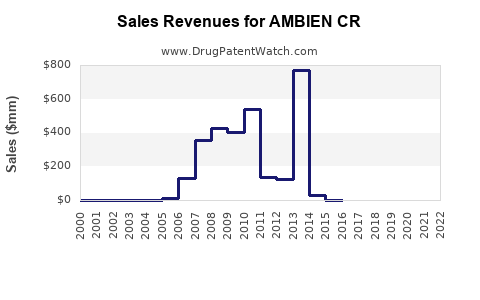
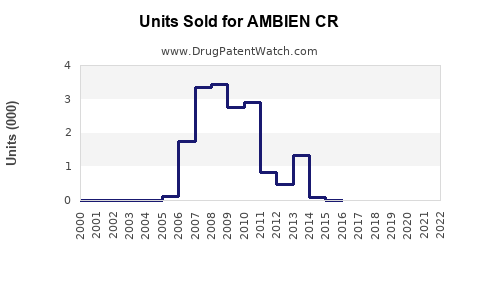
Annual Sales Revenues and Units Sold for AMBIEN CR
| Drug Name | Revenues (USD) | Units | Year |
|---|---|---|---|
| AMBIEN CR | ⤷ Start Trial | ⤷ Start Trial | 2022 |
| AMBIEN CR | ⤷ Start Trial | ⤷ Start Trial | 2021 |
| AMBIEN CR | ⤷ Start Trial | ⤷ Start Trial | 2020 |
| AMBIEN CR | ⤷ Start Trial | ⤷ Start Trial | 2019 |
| AMBIEN CR | ⤷ Start Trial | ⤷ Start Trial | 2018 |
| AMBIEN CR | ⤷ Start Trial | ⤷ Start Trial | 2017 |
| AMBIEN CR | ⤷ Start Trial | ⤷ Start Trial | 2016 |
| >Drug Name | >Revenues (USD) | >Units | >Year |
Ambien CR Market Analysis and Sales Projections
Ambien CR, the extended-release formulation of zolpidem tartrate, is a mature prescription insomnia product with limited remaining brand value. Its commercial position is constrained by generic zolpidem ER competition, long-standing FDA safety restrictions, low barriers to generic substitution, and the absence of meaningful new indications. The principal opportunity is in generic volume, while branded Ambien CR revenue is likely to remain small and decline.
What is Ambien CR and who markets it?
Ambien CR is a two-layer extended-release tablet designed to support sleep initiation and sleep maintenance. The product contains zolpidem tartrate and is approved for short-term treatment of insomnia characterized by difficulty initiating sleep and nighttime awakenings.
| Product | Active ingredient | Dosage form | Original sponsor | FDA application |
|---|---|---|---|---|
| Ambien CR | Zolpidem tartrate | Extended-release tablet | Sanofi, originally through prescription sleep-product operations | NDA 021774 |
The immediate-release Ambien product and Ambien CR are separate dosage forms. Ambien CR is available in 6.25 mg and 12.5 mg strengths. The FDA label identifies risks including next-day impairment, complex sleep behaviors, dependence, abuse, and additive central nervous system depression.[1]
Sanofi has not reported Ambien CR as a separate revenue line in recent public filings. The product sits within a mature portfolio rather than a growth category. Public company reporting therefore does not provide an audited standalone sales figure for Ambien CR.
What is the FDA regulatory status of Ambien CR?
Ambien CR remains an FDA-approved prescription product. Its regulatory status is mature rather than expansionary.
FDA milestones
| Event | Date |
|---|---|
| Ambien immediate-release approval | 1993 |
| Ambien CR approval | 2005 |
| FDA communication on next-morning impairment for zolpidem products | 2013 |
| FDA labeling changes reducing recommended doses, particularly for women | 2013 |
| Generic zolpidem ER approvals | Beginning in the mid-2010s |
| Current regulatory pathway | ANDA generic competition |
The FDA reduced recommended doses for zolpidem products after pharmacokinetic data showed that residual drug concentrations could impair driving and other activities the following morning.[2] The 2019 FDA boxed-warning communication on complex sleep behaviors increased the safety burden across the zolpidem class.[3]
These actions do not remove Ambien CR from the market, but they reduce prescribing flexibility and narrow the product's commercial differentiation.
What patents protect Ambien CR?
Ambien CR was protected primarily by formulation and extended-release technology patents rather than by a long-lived new chemical entity patent.
Patent estate
The principal U.S. patent associated with Ambien CR was U.S. Patent No. 6,514,531, directed to controlled-release zolpidem formulations. The patent was assigned to the product's development organization and was listed in FDA Orange Book records associated with the Ambien CR NDA.[4]
| Patent category | Commercial purpose | Current effect |
|---|---|---|
| Extended-release formulation | Controls initial and later zolpidem release | Core historical protection |
| Tablet composition | Supports two-phase release profile | Limited value after expiry |
| Method-of-use protection | Treats insomnia with zolpidem ER | Narrower enforcement value |
| Manufacturing technology | Controls tablet production and release characteristics | Potential technical barrier, but generally avoidable by ANDA sponsors |
The principal patent protection has expired or is no longer a meaningful barrier to ordinary generic entry. Any remaining listed patents must be reviewed against the current Orange Book rather than historical patent records because listings and delistings can change.[4]
When did Ambien CR lose exclusivity?
Ambien CR lost practical market exclusivity when generic zolpidem ER products entered the U.S. market in the mid-2010s. Even where a patent term extended beyond initial generic approvals, the presence of approved generic alternatives materially changed prescribing and payer behavior.
The product's economic exclusivity therefore ended years before the current projection period. Commercial protection is now based primarily on residual brand demand, prescriber familiarity, and pharmacy availability.
What is the Orange Book status of Ambien CR?
Ambien CR is listed in FDA Drugs@FDA and the Orange Book under NDA 021774. The Orange Book is the controlling source for current listed patents, pediatric exclusivity, and reference-listed-drug status.[4]
A current Orange Book review should distinguish:
- The reference-listed drug, Ambien CR.
- Approved ANDAs for zolpidem tartrate extended-release tablets.
- Any active patent certifications submitted by generic applicants.
- Whether listed patents have expired, been delisted, or remain subject to litigation.
The practical conclusion is clear: Ambien CR does not have a current patent position comparable to a newly launched branded extended-release product.
Which companies challenged Ambien CR patents?
Generic-drug manufacturers have entered the zolpidem ER market through abbreviated new drug applications. Historical patent challenges and market-entry disputes involved major generic companies, including Teva, Sandoz, Mylan and other ANDA sponsors, depending on the strength and timing of each application.
A Paragraph IV certification can trigger litigation under the Hatch-Waxman Act and a potential 30-month stay of ANDA approval. That mechanism was commercially important before generic entry. It has limited current importance because the market is already genericized.[5]
Current Paragraph IV risk
The primary Paragraph IV risk is no longer a threat to Ambien CR's future launch. It is a generic-on-generic issue involving:
- Additional strengths;
- Alternative release profiles;
- Manufacturing changes;
- Labeling differences;
- Patent certifications for late-listed or newly asserted patents.
The likelihood of a new, durable brand-protective litigation outcome is low unless a new formulation or delivery technology is introduced.
What formulations are protected by Ambien CR patents?
Ambien CR uses an extended-release architecture intended to provide an initial release for sleep initiation and a later release for sleep maintenance. That profile distinguishes the product from immediate-release zolpidem.
The formulation concept creates technical differentiation, but the protection is difficult to monetize after patent expiry. Generic companies can seek approval using the same active ingredient and comparable release characteristics without copying every manufacturing parameter. FDA bioequivalence requirements remain important, but they are regulatory hurdles rather than durable exclusivity rights.
Potentially protectable future innovations could include:
- Abuse-deterrent zolpidem formulations;
- Lower-dose products targeting next-day impairment;
- Modified-release products for specific insomnia phenotypes;
- Pediatric or geriatric dosage forms;
- Combination products;
- Digital adherence or sleep-monitoring systems linked to pharmacotherapy.
No such innovation currently changes the commercial profile of standard Ambien CR.
How large is the Ambien CR and zolpidem market?
The relevant market has three layers:
| Market layer | Commercial condition | Outlook |
|---|---|---|
| Branded Ambien CR | Small residual segment | Declining |
| Generic zolpidem ER | Price-competitive mature segment | Stable to declining in value |
| Total prescription insomnia treatment | Broader market including other hypnotics and newer agents | Mixed growth |
Zolpidem remains one of the most widely recognized prescription insomnia medicines. Its volume base benefits from physician familiarity and low generic cost. Its value base is weaker because generic prices are low and payers generally prefer generic substitution.
Competitive products include:
- Generic immediate-release zolpidem;
- Generic zolpidem ER;
- Eszopiclone;
- Zaleplon;
- Doxepin;
- Ramelteon;
- Suvorexant;
- Lemborexant;
- Daridorexant;
- Off-label sedating antidepressants and antipsychotics.
Dual orexin receptor antagonists compete for patients who need sleep-maintenance treatment but may have concerns about zolpidem-related complex sleep behaviors, next-day impairment, dependence, or controlled-substance restrictions. The orexin class has stronger current brand economics but higher acquisition costs.
How strong is the Ambien CR patent estate?
The current patent estate is weak from a commercial-defense perspective.
| Factor | Assessment | Business effect |
|---|---|---|
| Core compound protection | Expired | No meaningful protection |
| Extended-release formulation | Historical protection, largely exhausted | Generic substitution permitted |
| Method-of-use claims | Narrow and difficult to enforce broadly | Limited revenue protection |
| Manufacturing patents | Potentially avoidable | Low-to-moderate barrier |
| Regulatory exclusivity | Expired | No current block on ANDA entry |
| Brand recognition | Still significant | Supports residual prescriptions |
| Switching costs | Very low | Accelerates generic substitution |
The main remaining advantage is brand familiarity, not patent exclusivity. That advantage is insufficient to support premium pricing in most insured channels.
What is the revenue exposure for Ambien CR?
Sanofi's public reporting does not provide a separate Ambien CR revenue line. A precise historical or current sales figure cannot be derived from consolidated annual reports without proprietary prescription and transaction data.
A practical commercial estimate is to model Ambien CR as a residual branded product rather than a growth asset.
U.S. branded Ambien CR sales projection
The following scenario is a market model, not reported company revenue. It assumes continued generic substitution, no product relaunch, no new indication, and stable FDA labeling.
| Calendar year | Low case | Base case | High case |
|---|---|---|---|
| 2025 | $2 million | $7 million | $15 million |
| 2026 | $1.5 million | $5.5 million | $12 million |
| 2027 | $1 million | $4 million | $9 million |
| 2028 | $0.7 million | $3 million | $7 million |
| 2029 | $0.5 million | $2.3 million | $5.5 million |
| 2030 | $0.3 million | $1.8 million | $4.5 million |
The base case implies a compound annual decline of roughly 13% from 2025 through 2030. The high case assumes a larger cash-pay and brand-loyalty segment. The low case assumes formulary exclusion, supply contraction, or near-complete substitution with generic zolpidem ER.
Generic zolpidem ER projection
Generic sales should be evaluated separately from Ambien CR brand sales. Generic manufacturers may maintain unit demand while experiencing continued price erosion.
| Metric | 2025-2030 expectation |
|---|---|
| Prescription volume | Flat to low-single-digit decline |
| Net price | Continued decline |
| Total market value | Low-single-digit annual decline |
| Manufacturer count | Stable, subject to supply exits |
| Brand share | Declining |
| Payer preference | Generic-first |
The generic opportunity is volume-driven. Manufacturing efficiency, reliable API supply, and pharmacy contracting matter more than patent ownership.
What generic entry risks exist for Ambien CR?
Generic entry is already established, so the risk is persistent rather than upcoming.
The main risks are:
- Continued substitution at the pharmacy counter.
- Formulary removal or non-preferred brand placement.
- Reimbursement pressure from pharmacy benefit managers.
- Generic price competition.
- Prescriber migration to orexin antagonists or non-zolpidem therapies.
- Safety-driven reductions in use among older adults.
- Manufacturing interruptions that reduce brand availability.
The brand could retain a niche among patients who report better tolerability or effectiveness with the branded product. That segment is unlikely to support material growth.
How does Ambien CR compare with newer insomnia drugs?
| Product class | Main advantage | Main disadvantage | Patent position |
|---|---|---|---|
| Ambien CR | Familiarity, low-cost generic alternatives, sleep initiation and maintenance profile | Controlled-substance status, next-day impairment, complex sleep behaviors | Weak or expired |
| Immediate-release zolpidem | Low cost and broad familiarity | Less targeted to sleep maintenance | Generic |
| Doxepin | Non-controlled option at low doses | Narrower clinical positioning | Mature |
| Ramelteon | Low abuse potential | Modest efficacy for some patients | Mature |
| Orexin antagonists | Sleep-maintenance positioning and non-GABA mechanism | Higher price and branded competition | Stronger current estates |
| Eszopiclone | Generic availability and maintenance benefit | Taste disturbance and next-day effects | Mature |
Ambien CR remains commercially relevant as a low-cost treatment option, but it is poorly positioned as a premium branded asset.
What licensing deals affect Ambien CR?
No recent publicly disclosed licensing transaction has materially changed the commercial outlook for Ambien CR. Historical rights and commercialization arrangements are less important than current generic approval status and distribution economics.
A new licensing opportunity would require a differentiated asset, such as a reformulated zolpidem product with a defensible patent position, improved safety profile, or a new delivery system. Licensing the existing Ambien CR brand alone would offer limited strategic value unless acquisition pricing were very low and distribution costs were minimal.
What litigation and settlement agreements affect Ambien CR?
Historical Hatch-Waxman litigation would have focused on generic ANDA filings, patent validity, infringement, and launch timing. Any settlements could have permitted authorized or licensed generic entry before full patent expiry.
For current investment analysis, the key point is that historic litigation no longer creates a material barrier to generic competition. Any live case should be confirmed through the FDA Orange Book, PACER, and district-court docket records before being used in a transaction or litigation forecast.
What are the geographic opportunities for Ambien CR?
The United States is the most relevant market for the Ambien CR brand because of its historical brand recognition and the availability of a defined reference-listed drug. Outside the U.S., commercial rights, trademarks, formulations, and generic competition vary by country.
Geographic expansion is unlikely to generate meaningful brand growth because:
- Zolpidem is already widely available internationally;
- Local generic prices are low;
- Controlled-substance rules differ by jurisdiction;
- Brand ownership and regulatory registrations may be fragmented;
- Sleep medicines face country-specific prescribing restrictions.
The strongest residual opportunity is generally in markets where the brand retains physician recognition and generic substitution is less automatic.
Key Takeaways
- Ambien CR is an FDA-approved extended-release zolpidem product with mature, largely exhausted exclusivity.
- Generic zolpidem ER competition has been established since the mid-2010s.
- The core commercial protection is brand familiarity, not an active patent moat.
- Sanofi does not publicly report standalone Ambien CR revenue.
- A reasonable modeled U.S. branded-sales range for 2025 is $2 million to $15 million, with a base case of approximately $7 million.
- Base-case branded revenue declines to about $1.8 million by 2030.
- Generic zolpidem ER retains volume but faces continued price erosion.
- Newer orexin antagonists represent the main branded competitive threat.
- A meaningful value-creation opportunity would require a new, patent-protected formulation or safety improvement.
- Ambien CR is a declining cash-flow product, not a growth or exclusivity asset.
FAQs
Is Ambien CR still commercially available?
Ambien CR remains an FDA-approved prescription product, although availability and payer coverage may vary by market and pharmacy.
Is zolpidem CR the same as Ambien CR?
Zolpidem CR is the generic equivalent category for Ambien CR. Ambien CR is the branded product, while generic manufacturers market zolpidem tartrate extended-release tablets.
Does Ambien CR have remaining patent protection?
The principal historical formulation protection has expired or no longer provides a meaningful barrier to ordinary generic entry. Current Orange Book records control the status of any remaining listed patents.
Can a company still launch a generic Ambien CR product?
A company may seek approval through the ANDA pathway if it satisfies FDA bioequivalence, quality, labeling, and manufacturing requirements and resolves applicable patent certifications.
Would an Ambien CR reformulation have stronger commercial value?
Yes, if the reformulation delivered a clinically meaningful benefit, such as lower next-day impairment or reduced abuse potential, and secured enforceable patents and FDA approval. The existing product alone has limited growth potential.
References
-
U.S. Food and Drug Administration. (2023). Ambien CR (zolpidem tartrate extended-release tablets) prescribing information. FDA.
-
U.S. Food and Drug Administration. (2013). FDA requiring lower recommended dose for certain patients taking zolpidem. FDA Drug Safety Communication.
-
U.S. Food and Drug Administration. (2019). FDA adds boxed warning for risk of serious injuries caused by sleepwalking with certain prescription insomnia medicines. FDA Drug Safety Communication.
-
U.S. Food and Drug Administration. (2024). Approved drug products with therapeutic equivalence evaluations: Orange Book. FDA.
-
U.S. Congress. (1984). Drug Price Competition and Patent Term Restoration Act of 1984, Pub. L. No. 98-417, 98 Stat. 1585.
More… ↓
