Share This Page
Drug Sales Trends for tadalafil
✉ Email this page to a colleague
Payment Methods and Pharmacy Types for tadalafil (2022)
Revenues by Pharmacy Type
Units Sold by Pharmacy Type
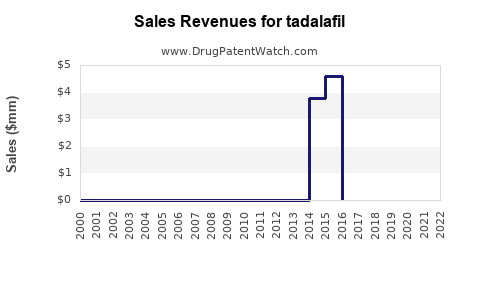
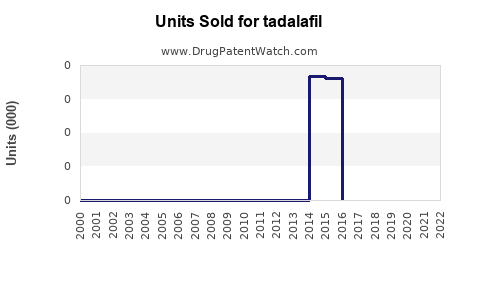
Annual Sales Revenues and Units Sold for tadalafil
| Drug Name | Revenues (USD) | Units | Year |
|---|---|---|---|
| TADALAFIL | ⤷ Start Trial | ⤷ Start Trial | 2022 |
| TADALAFIL | ⤷ Start Trial | ⤷ Start Trial | 2021 |
| TADALAFIL | ⤷ Start Trial | ⤷ Start Trial | 2020 |
| TADALAFIL | ⤷ Start Trial | ⤷ Start Trial | 2019 |
| TADALAFIL | ⤷ Start Trial | ⤷ Start Trial | 2018 |
| TADALAFIL | ⤷ Start Trial | ⤷ Start Trial | 2017 |
| TADALAFIL | ⤷ Start Trial | ⤷ Start Trial | 2016 |
| >Drug Name | >Revenues (USD) | >Units | >Year |
Tadalafil is a mature, genericized PDE5 inhibitor with durable global demand in erectile dysfunction and benign prostatic hyperplasia. The commercial opportunity is shifting from branded Cialis to low-cost generics, private-label products, telehealth distribution, and fixed-dose or differentiated formulations. A reasonable base case places the global tadalafil market at approximately $3.2 billion in 2024, rising to $4.1 billion by 2030 at a 4% to 5% compound annual growth rate. Eli Lilly’s direct Cialis exposure is limited relative to the total tadalafil market because U.S. composition and use patents have expired and generic competition is established.
Tadalafil Market Analysis, Patent Expiration, Generic Competition, and Sales Projections
What is the current market size for tadalafil?
The global tadalafil market is estimated at approximately $3.0 billion to $3.5 billion in 2024, including branded Cialis, authorized and unbranded generics, contract-manufactured products, online pharmacy sales, and tadalafil API. Published market studies vary because some count only finished pharmaceutical sales while others include API, combination products, and non-U.S. private-label channels.
The central commercial facts are:
| Metric | 2024 estimate or status |
|---|---|
| Global tadalafil market | $3.0 billion-$3.5 billion |
| Projected 2030 market | $3.9 billion-$4.4 billion |
| 2024-2030 CAGR | 4%-5% |
| Erectile dysfunction share | Approximately 75%-85% |
| Benign prostatic hyperplasia share | Approximately 10%-20% |
| U.S. generic penetration | High |
| Branded Cialis share of global volume | Minority share |
| Primary active ingredient | Tadalafil |
| Drug class | Phosphodiesterase type 5 inhibitor |
| Original innovator | ICOS Corporation, later Eli Lilly |
| FDA approval | Cialis approved in 2003; tadalafil for BPH approved in 2011 |
Demand is supported by population aging, increased diagnosis of erectile dysfunction, broader access through telehealth, treatment of lower urinary tract symptoms associated with BPH, and increased generic availability. Price erosion limits revenue growth in mature markets.
How is the tadalafil market segmented?
Erectile dysfunction
Erectile dysfunction remains the largest tadalafil indication. Tadalafil has a commercial advantage over sildenafil because its approved duration of action is up to 36 hours, creating demand for both as-needed and once-daily dosing.
Key dosage forms include:
- 2.5 mg once daily
- 5 mg once daily
- 10 mg as needed
- 20 mg as needed
The 5 mg once-daily dose is also used for BPH and for patients requiring continuous symptom management. The main competitive products are sildenafil, vardenafil, and avanafil.
Benign prostatic hyperplasia
Tadalafil 5 mg once daily is approved for BPH and for erectile dysfunction with BPH. BPH creates a more stable chronic-use market than episodic erectile dysfunction treatment. Patients using tadalafil for BPH may have higher prescription persistence and lower sensitivity to occasional promotional pricing.
BPH is a smaller tadalafil segment but has strategic value because it supports recurring prescriptions and reduces dependence on discretionary erectile dysfunction demand.
Combination and alternative formulations
Commercial development has focused on:
- Orodispersible tablets
- Chewable tablets
- Sublingual dosage forms
- Modified-release products
- Tadalafil combined with finasteride or other BPH agents
- Telehealth-specific packaging
- High-dose and low-dose private-label products
Most formulation claims have limited commercial value unless they provide clear clinical differentiation, reduce dosing frequency, improve adherence, or obtain regulatory exclusivity.
What companies compete in the tadalafil market?
The market has three major groups: Eli Lilly, generic pharmaceutical companies, and digital or specialty pharmacies.
Eli Lilly and Cialis
Cialis is the original major brand. Eli Lilly acquired the commercial rights to tadalafil through its acquisition of ICOS in 2007. The brand retains physician recognition and patient familiarity, but it competes against substantially lower-priced generic tadalafil.
Cialis remains relevant in markets where brand trust, physician prescribing, insurance reimbursement, and pharmacy substitution rules support branded products. Its strategic importance is much lower in the United States than before patent expiry.
Generic manufacturers
Generic tadalafil is supplied by numerous companies, including:
- Teva Pharmaceutical Industries
- Dr. Reddy's Laboratories
- Aurobindo Pharma
- Cipla
- Torrent Pharmaceuticals
- Zydus Lifesciences
- Sun Pharmaceutical Industries
- Mylan, now part of Viatris
- Hikma Pharmaceuticals
- Apotex
- Amneal Pharmaceuticals
The competitive basis is manufacturing cost, regulatory compliance, supply reliability, pharmacy contracting, API access, and distribution. Generic companies generally compete on volume rather than molecule-level differentiation.
Online pharmacies and telehealth platforms
Direct-to-consumer channels have increased tadalafil access, particularly for erectile dysfunction. Telehealth providers can acquire customers through digital advertising, conduct remote consultations, and dispense through affiliated or contracted pharmacies.
These channels can expand the number of treated patients but may compress net prices through subscription models and low-cost monthly plans. They also create demand for private-label packaging, rapid fulfillment, and flexible tablet quantities.
What is the FDA regulatory status of tadalafil?
The FDA approved Cialis for erectile dysfunction in November 2003. FDA approval for once-daily tadalafil for BPH and erectile dysfunction with BPH followed in 2011.[1]
Tadalafil is an approved small-molecule prescription drug, not a biologic. Biosimilar competition does not apply. Competition occurs through abbreviated new drug applications, or ANDAs, and through authorized generic or private-label supply arrangements.
The main FDA regulatory considerations are:
| Issue | Commercial impact |
|---|---|
| ANDA approval | Enables generic substitution |
| Bioequivalence | Limits clinical differentiation between standard tablets |
| Controlled manufacturing | Critical for FDA compliance and supply continuity |
| Labeling restrictions | Limit unapproved sexual-health claims |
| Combination products | May require new regulatory and patent analysis |
| Compounded products | Create quality and enforcement risks |
| Telehealth prescribing | Affects customer acquisition and channel economics |
Tadalafil is contraindicated with nitrates because of the risk of significant hypotension. Labeling also addresses alpha blockers, antihypertensives, alcohol, renal impairment, hepatic impairment, and potent CYP3A4 inhibitors.[1]
What patents protect Cialis and tadalafil?
The principal Cialis patent estate is substantially expired in the United States.
| Patent or protection | Subject matter | Status |
|---|---|---|
| U.S. Patent No. 5,859,006 | Tadalafil compound and pharmaceutical use | Expired in 2017 |
| U.S. Patent No. 6,821,975 | Tadalafil-related composition and use claims | Expired around 2020, subject to applicable adjustments |
| FDA pediatric exclusivity | Regulatory exclusivity extension | Expired |
| Standard U.S. product exclusivity | Small-molecule approval protection | Expired |
| Later formulation patents | Potential dosage-form or combination claims | Product-specific and jurisdiction-dependent |
The strongest historical protection covered tadalafil itself and its use in erectile dysfunction. That protection prevented generic entry during the main commercial life of Cialis. Once the relevant U.S. patents expired, ANDA applicants entered at materially lower prices.
Patent risk now depends more on specific formulations, combinations, manufacturing processes, and method-of-use claims than on the tadalafil molecule.
When did tadalafil lose exclusivity?
Tadalafil lost its principal U.S. composition-patent protection in 2017. Generic entry followed, including competition from multiple ANDA applicants. A later Cialis patent was associated with protection through approximately 2020, but the market had already transitioned toward generic competition.
The practical exclusivity timeline is:
| Year | Event |
|---|---|
| 1990s | Tadalafil discovered and developed by ICOS |
| 2003 | FDA approves Cialis for erectile dysfunction |
| 2007 | Eli Lilly acquires ICOS |
| 2011 | FDA approves tadalafil for BPH |
| 2017 | Main U.S. tadalafil patent expires; generic entry expands |
| 2020 | Later U.S. patent protection reaches expiration range |
| 2021-2024 | Generic and telehealth channels gain share |
| 2025-2030 | Market growth depends on patient expansion and formulation innovation |
Patent expiry did not eliminate Cialis revenue immediately. Brand loyalty, payer restrictions, international patent timing, and pharmacy substitution practices can delay full generic erosion.
Are there Paragraph IV challenges to tadalafil patents?
Paragraph IV litigation was relevant before the main Cialis patents expired. Generic applicants could challenge listed patents by asserting that patents were invalid, unenforceable, or not infringed. The commercial result was eventual generic entry after the relevant protection periods.
The current Paragraph IV risk is lower for standard tadalafil tablets because the core U.S. patent barriers have expired. Future litigation could arise around:
- New dosage strengths
- Chewable or orally disintegrating tablets
- Fixed-dose tadalafil combinations
- Modified-release products
- BPH-specific methods of use
- Manufacturing processes
- Device-based delivery systems
A formulation patent can delay a particular product without restoring molecule-wide exclusivity. Investors should separate product-specific litigation from protection of tadalafil itself.
What is the Orange Book status of Cialis?
Cialis was listed in the FDA Orange Book with patents covering tadalafil and its approved uses. Those listings supported patent certifications by ANDA applicants and affected the timing of generic approval and launch.
The current commercial significance of Orange Book listings is limited for conventional tadalafil tablets because the major listed protections have expired. Orange Book analysis remains relevant for later-approved strengths, combinations, or new delivery systems if they receive separate FDA approval and listed patent protection.
An Orange Book listing does not guarantee enforceability. It creates a regulatory patent-certification framework and can trigger litigation under the Hatch-Waxman Act.
How strong is the current tadalafil patent estate?
The current patent estate is weak for the core tadalafil molecule and moderate for selected differentiated products.
| Patent category | Current strength |
|---|---|
| Tadalafil composition of matter | Very weak; expired |
| Standard immediate-release tablets | Weak |
| Erectile dysfunction method of use | Weak for conventional dosing |
| BPH method of use | Weak to moderate, depending on claim scope |
| Chewable or orally disintegrating products | Moderate if claims are valid and commercially relevant |
| Fixed-dose combinations | Moderate |
| Manufacturing processes | Moderate, but difficult to enforce across global suppliers |
| New delivery systems | Moderate to strong if clinically differentiated |
A new product must overcome automatic substitution, low generic pricing, established API supply, and limited physician need for switching. Patent protection alone may not create substantial value unless paired with regulatory exclusivity, a distinctive patient benefit, or a defensible distribution channel.
What generic entry risks exist for tadalafil?
Generic entry risk is already realized rather than prospective. The main risks to branded or premium-priced tadalafil products are:
- Price compression from multiple ANDA suppliers.
- Pharmacy substitution into generic tadalafil.
- Online competitors offering monthly subscriptions.
- API oversupply and low-cost manufacturing in India and China.
- Private-label competition using the same approved active ingredient.
- Regulatory action against noncompliant or illegally marketed products.
- Reduced reimbursement for branded Cialis.
The major remaining risk to generic suppliers is not patent infringement. It is margin erosion, manufacturing inspection findings, shortages, and customer-acquisition cost in direct-to-consumer channels.
What are tadalafil sales projections through 2030?
The following model uses a 2024 global market base of $3.2 billion. It assumes volume growth from patient expansion and telehealth access, offset by declining average selling prices in generic markets.
| Year | Bear case | Base case | Upside case |
|---|---|---|---|
| 2024 | $3.0B | $3.2B | $3.5B |
| 2025 | $3.1B | $3.3B | $3.7B |
| 2026 | $3.2B | $3.5B | $3.9B |
| 2027 | $3.3B | $3.6B | $4.1B |
| 2028 | $3.4B | $3.8B | $4.3B |
| 2029 | $3.5B | $4.0B | $4.6B |
| 2030 | $3.6B | $4.1B | $4.9B |
| 2024-2030 CAGR | 3.1% | 4.2% | 5.7% |
Base-case assumptions
The base case assumes:
- Global prescription volume grows 5% to 7% annually.
- Average net prices decline 1% to 3% annually.
- BPH contributes a larger share of recurring prescriptions.
- Telehealth expands access but reduces average acquisition and dispensing margins.
- Cialis retains a premium niche but loses volume to generics.
- No major new indication produces molecule-wide exclusivity.
- Regulatory enforcement reduces some unapproved and counterfeit supply without materially reducing legitimate demand.
Revenue by channel
A possible 2030 base-case split is:
| Channel | 2030 estimated revenue | Share |
|---|---|---|
| Traditional generic pharmacy | $2.1B | 51% |
| Branded Cialis and premium brands | $650M | 16% |
| Telehealth and online pharmacy | $850M | 21% |
| API and other institutional supply | $500M | 12% |
| Total | $4.1B | 100% |
These figures represent market revenue, not Eli Lilly revenue. Lilly’s direct Cialis sales are expected to remain a small and declining portion of the global tadalafil economy compared with aggregate generic and private-label sales.
How does tadalafil compare with sildenafil?
| Factor | Tadalafil | Sildenafil |
|---|---|---|
| Main ED positioning | Longer duration, once-daily option | Shorter duration, established first-line use |
| BPH approval | Yes | No comparable broad BPH role |
| Generic status | Mature generic | Mature generic |
| Brand | Cialis | Viagra |
| Differentiation | Duration and daily dosing | Familiarity, price, broad availability |
| Main growth opportunity | BPH, daily therapy, telehealth | Volume, low price, global access |
| Patent risk | Core patents expired | Core patents expired |
Tadalafil has a stronger chronic-use platform because of its BPH indication and once-daily dosing. Sildenafil generally has greater global familiarity and a larger low-price generic footprint. Neither molecule has meaningful remaining composition-of-matter exclusivity in the United States.
What geographic markets offer the strongest growth?
Growth is most attractive in regions with rising diagnosis rates, expanding private healthcare, and improving pharmacy access:
- Asia-Pacific: large untreated population and manufacturing strength, with intense price competition.
- Latin America: expanding private-pay and online channels, but fragmented regulation.
- Middle East: demand supported by private healthcare and medical tourism.
- Eastern Europe: generic penetration is high, but access continues to improve.
- United States: volume growth through telehealth, while pricing remains heavily compressed.
- Western Europe: mature demand, strong generic substitution, and regulated reimbursement.
The United States remains commercially important because of prescription scale and telehealth adoption. It is not the strongest market for premium pricing.
What manufacturing and intellectual-property barriers affect tadalafil?
Manufacturing barriers are operational rather than molecule-specific. Suppliers must maintain consistent API purity, impurity controls, dissolution performance, stability, and tablet uniformity. FDA and European regulators can impose significant commercial costs through warning letters, inspections, recalls, or import restrictions.
The most defensible manufacturing positions may involve:
- High-yield API processes
- Low-impurity synthesis
- Continuous manufacturing
- Stable high-throughput tableting
- Taste-masking technology
- Improved dissolution for alternative formulations
- Reliable supply in regulated markets
Process patents can support licensing or supply contracts, but they rarely prevent alternative production routes once the core active ingredient is generic.
What licensing deals affect tadalafil?
The most important historical transaction was Eli Lilly’s acquisition of ICOS in 2007, which transferred control of Cialis and related tadalafil commercialization to Lilly.[2] Current commercial arrangements are more likely to involve:
- API supply agreements
- Authorized generic arrangements
- Regional commercialization licenses
- Contract manufacturing
- Telehealth pharmacy partnerships
- Private-label distribution
Licensing value is highest for differentiated formulations, regulatory approvals in restricted markets, or reliable API supply. A license covering standard tadalafil tablets has limited negotiating power because multiple generic alternatives exist.
Key Takeaways
- Tadalafil is a mature global market estimated at approximately $3.0 billion to $3.5 billion in 2024.
- Base-case market revenue could reach about $4.1 billion by 2030.
- Generic products account for most volume and an increasing share of revenue.
- Cialis has lost its principal U.S. exclusivity, with the core patent barrier ending in 2017 and later protection reaching expiration around 2020.
- Paragraph IV litigation is no longer the main risk for conventional tadalafil tablets.
- BPH and once-daily dosing provide the strongest clinical and commercial differentiation.
- Telehealth is expanding demand while compressing channel margins.
- Biosimilar risk does not apply because tadalafil is a small-molecule drug.
- New formulation, combination, and manufacturing patents may support niche products but do not restore molecule-wide exclusivity.
- The main investment variables are prescription-volume growth, generic price erosion, API costs, telehealth acquisition economics, and regulatory compliance.
FAQs
Is tadalafil still profitable after generic competition?
Yes. Profitability remains possible through high-volume generic supply, efficient API production, private-label distribution, BPH prescriptions, and telehealth channels. Margins are materially lower than during the Cialis exclusivity period.
Does tadalafil have patent protection in Europe?
Core tadalafil patents have expired in major European markets. Country-specific supplementary protection, national patent status, formulation claims, and regulatory exclusivity require jurisdiction-by-jurisdiction review.
Can a new tadalafil formulation receive FDA exclusivity?
Yes, if it obtains a qualifying FDA approval and satisfies applicable statutory requirements. Formulation approval does not automatically provide exclusivity over ordinary tadalafil tablets.
Is tadalafil a controlled substance?
No. Tadalafil is a prescription medicine but is not classified as a controlled substance under the U.S. Controlled Substances Act.
What is the largest long-term opportunity for tadalafil manufacturers?
The strongest opportunities are high-quality low-cost generic production, BPH-focused recurring therapy, telehealth fulfillment, and differentiated dosage forms that improve adherence or patient convenience.
References
- U.S. Food and Drug Administration. (2003). Cialis prescribing information. FDA.
- Eli Lilly and Company. (2007). Lilly completes acquisition of ICOS Corporation.
- U.S. Food and Drug Administration. (2024). Approved drug products with therapeutic equivalence evaluations. FDA.
- U.S. Patent and Trademark Office. (1999). U.S. Patent No. 5,859,006: Pyrazino[1',2':1,6]pyrido[3,4-b]indole derivatives.
- U.S. Patent and Trademark Office. (2004). U.S. Patent No. 6,821,975: Compositions containing tadalafil.
- Eli Lilly and Company. (2024). Annual report.
- World Health Organization. (2023). Global report on ageism and population aging. WHO.
More… ↓
