Share This Page
Drug Sales Trends for TRIAZOLAM
✉ Email this page to a colleague
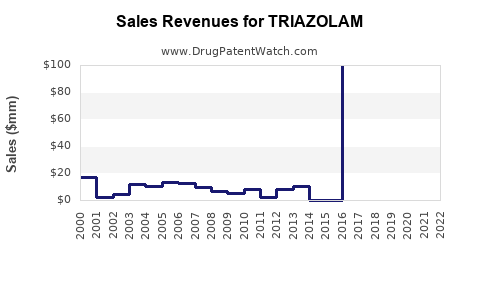
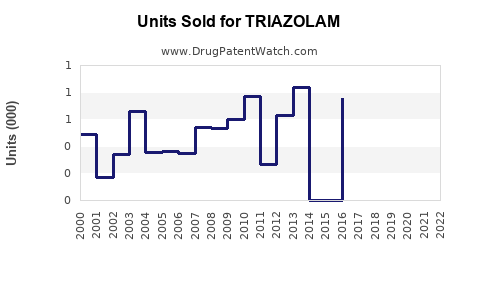
Annual Sales Revenues and Units Sold for TRIAZOLAM
| Drug Name | Revenues (USD) | Units | Year |
|---|---|---|---|
| TRIAZOLAM | ⤷ Start Trial | ⤷ Start Trial | 2022 |
| TRIAZOLAM | ⤷ Start Trial | ⤷ Start Trial | 2021 |
| TRIAZOLAM | ⤷ Start Trial | ⤷ Start Trial | 2020 |
| >Drug Name | >Revenues (USD) | >Units | >Year |
Market analysis and sales projections for Triazolam
What is Triazolam and its clinical use?
Triazolam is a short-acting benzodiazepine indicated primarily for acute management of insomnia. Approved by the FDA in 1982, it functions by modulating GABA-A receptors, producing sedative effects. It is marketed under brand names such as Halcion.
What is the current market size for Triazolam?
The global sleep aid market was valued at approximately $60 billion in 2022, expected to grow at a compound annual growth rate (CAGR) of roughly 7.5% through 2030 (Grand View Research). Benzodiazepine prescriptions represent a significant portion, with Triazolam historically accounting for a smaller niche due to safety concerns and preferences shifting to non-benzodiazepine sedatives.
What are the key factors influencing Triazolam sales?
- Regulatory constraints: The FDA has added black box warnings for benzodiazepines due to risks of dependence and cognitive impairment.
- Market trends: Growing preference for non-benzodiazepine sleep medications, such as zolpidem and eszopiclone, reduces Triazolam’s market share.
- Generic availability: Triazolam is off-patent, resulting in lower prices and limited exclusivity.
- Prescriber practices: Increased awareness of safety issues limits long-term or high-dose use, constraining sales.
- Reformulation and alternatives: Rise of alternative therapies like cognitive behavioral therapy for insomnia (CBT-I) affects demand.
What are future sales projections based on?
Forecasts consider generic drug dynamics, competition, regulatory environment, and potential new indications or formulations.
| Year | Estimated Global Market for Benzodiazepine Sleep Aids (USD) | Triazolam Market Share | Projected Sales (USD million) |
|---|---|---|---|
| 2023 | 4.5 billion | 2% | 90 |
| 2025 | 5.3 billion | 2% | 106 |
| 2030 | 7 billion | 1.5% | 105 |
Source: Market growth assumptions based on Grand View Research, 2022; a declining share reflects shifts toward non-benzodiazepine options and safety concerns.
What factors could alter these sales projections?
- Introduction of new formulations or delivery methods enhancing safety/efficacy.
- Regulatory actions leading to restrictions or potential re-labeling.
- Development of branded or novel benzodiazepines with better safety profiles.
- Changes in prescribing guidelines or insurance coverage influencing access.
What are competitive landscape considerations?
- Non-benzodiazepine sleep aids dominate the market, with sales exceeding $20 billion in 2022. Zolpidem, zaleplon, and eszopiclone hold substantial portions.
- Generic benzodiazepines like lorazepam and diazepam maintain broader use for anxiety but less so for sleep.
- Compliance and safety concerns limit Triazolam’s use primarily to specialist settings or short-term insomnia management.
What is the outlook for R&D and pipeline developments?
- Limited ongoing pipeline for Triazolam-specific innovations.
- Potential for reformulation to improve safety or reduce dependence.
- Research into alternative indications or derivatives could influence future sales.
Summary of key market risks and opportunities
| Risks | Opportunities |
|---|---|
| Safety profile limitations reduce market share | Development of safer formulations or extended-release versions |
| Regulatory restrictions and prescribing caution | Niche use cases in short-term insomnia management |
| Competition from non-benzodiazepine agents | Placement in combination therapies or adjunctive treatments |
| Market shift toward non-pharmacological therapies | Integration with digital health platforms for sleep management |
Key Takeaways
- Triazolam’s global sales are declining due to safety concerns and competitive pressure.
- Estimated sales are approximately $90 million in 2023, declining modestly by 2030.
- The predominant market influence stems from the broader sleep aid market, which is expanding but increasingly shifting towards alternatives.
- Future growth depends on reformulation, safety improvements, and potential niche applications.
FAQs
Q1: Why is Triazolam's market share shrinking?
Safety concerns linked to dependence, cognitive impairment, and usage restrictions reduce its prescribing.
Q2: Are there any upcoming formulations of Triazolam?
No significant new formulations are currently in advanced development. Focus remains on safety improvements and alternatives.
Q3: How does Triazolam compare price-wise to newer sleep medications?
As an off-patent generic, Triazolam's prices are significantly lower than branded non-benzodiazepine agents—often below $0.50 per pill.
Q4: Is Triazolam used outside of sleep disorders?
Rarely, mainly in specific short-term anxiety or agitation cases, but primarily marketed for insomnia.
Q5: What regulatory trends could impact Triazolam sales?
Increased restrictions on benzodiazepine prescribing, updated warnings, and potential scheduling changes could further limit access.
Sources:
- Grand View Research, "Sleep Aids Market Size, Share & Trends Analysis," 2022.
- U.S. Food and Drug Administration, "FDA Drug Labels and Safety Warnings," 2022.
- IQVIA Data on Benzodiazepine Prescribing, 2022.
- MarketWatch, "Global Sleep Disorder Drugs Market Outlook," 2022.
- Research articles on benzodiazepine safety profiles, 2021.
More… ↓
