Drug Sales Trends for MOBIC
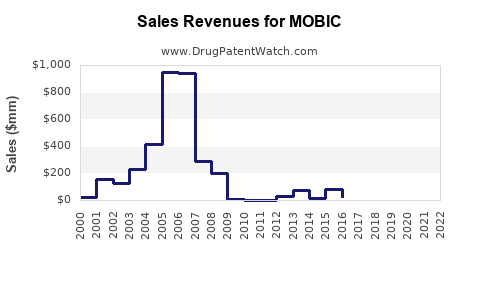
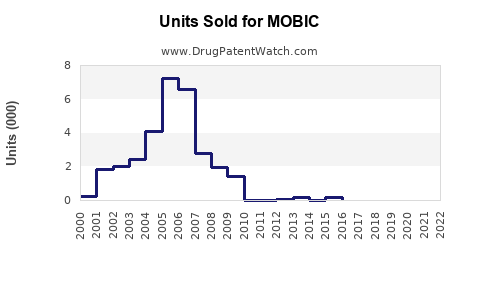
Annual Sales Revenues and Units Sold for MOBIC
| Drug Name | Revenues (USD) | Units | Year |
|---|---|---|---|
| MOBIC | ⤷ Start Trial | ⤷ Start Trial | 2022 |
| MOBIC | ⤷ Start Trial | ⤷ Start Trial | 2021 |
| MOBIC | ⤷ Start Trial | ⤷ Start Trial | 2020 |
| MOBIC | ⤷ Start Trial | ⤷ Start Trial | 2019 |
| MOBIC | ⤷ Start Trial | ⤷ Start Trial | 2018 |
| MOBIC | ⤷ Start Trial | ⤷ Start Trial | 2017 |
| >Drug Name | >Revenues (USD) | >Units | >Year |
# MOBIC (Meloxicam) Market Analysis, Patent Status, Competitive Landscape and Sales Projections
Mobic is the branded formulation of meloxicam, a prescription nonsteroidal anti-inflammatory drug used primarily for osteoarthritis and rheumatoid arthritis. Its U.S. composition-of-matter protection has expired, generic meloxicam is widely available, and the brand has limited commercial leverage. Future market growth will come from generic prescription volume, price stability, international demand and alternative formulations rather than from branded pricing power.
Public sources do not report current standalone Mobic revenue. The projections below therefore estimate the meloxicam market rather than audited sales of the Mobic brand.
What is Mobic and how large is its addressable market?
Mobic contains meloxicam, a preferential cyclooxygenase-2 inhibitor within the NSAID class. The FDA approved Mobic tablets for osteoarthritis and rheumatoid arthritis in adults. U.S. dosage strengths include 7.5 mg and 15 mg tablets. Meloxicam is also available in oral suspension and injectable products in certain markets and under multiple generic labels.[1]
The addressable market consists of:
- Osteoarthritis patients requiring chronic or intermittent NSAID treatment
- Rheumatoid arthritis patients using NSAIDs for symptom control
- Adults who require once-daily oral dosing
- Patients seeking lower-cost alternatives to branded COX-2 inhibitors
- Veterinary users, where meloxicam products are sold under separate approvals and should not be included in human Mobic revenue
The U.S. osteoarthritis population is large and aging. The Centers for Disease Control and Prevention estimates that more than 32 million U.S. adults have osteoarthritis, creating a durable demand base for NSAIDs, although many patients use over-the-counter ibuprofen, naproxen or acetaminophen instead of prescription meloxicam.[2]
Mobic competes in a mature category. Market expansion is constrained by cardiovascular, gastrointestinal and renal safety risks associated with chronic NSAID use. The FDA-approved labeling recommends using the lowest effective dose for the shortest duration consistent with treatment goals.[1]
What is the current Mobic market position?
Mobic has shifted from a branded pharmaceutical product to a reference product for a large generic market.
| Market factor | Current position |
|---|---|
| Active ingredient | Meloxicam |
| Main indications | Osteoarthritis and rheumatoid arthritis |
| U.S. dosage forms | Tablets; oral suspension and injectable forms are available through separate products |
| Brand owner or sponsor | Boehringer Ingelheim associated with the original Mobic product |
| U.S. regulatory status | Approved prescription drug |
| Generic availability | Broad |
| Branded pricing power | Low |
| Primary demand driver | Chronic musculoskeletal disease and prescription substitution |
| Main competitors | Generic meloxicam, celecoxib, naproxen, ibuprofen, diclofenac and etodolac |
| Key commercial risk | Generic price erosion and substitution |
| Key clinical risk | Gastrointestinal, cardiovascular and renal adverse events |
Generic meloxicam is generally the commercial benchmark. Pharmacies, insurers and health systems have little reason to pay a premium for Mobic when an FDA-approved generic contains the same active ingredient and is available in the same core tablet strengths.
The brand may retain limited demand among prescribers and patients who recognize Mobic by name, but that demand is unlikely to support material U.S. revenue relative to the generic category.
When did Mobic lose exclusivity?
Mobic lost meaningful U.S. commercial exclusivity after the expiration of its original patent and regulatory exclusivity period. Generic meloxicam entered the U.S. market in the mid-2000s, and broad generic competition has existed for many years.
| Milestone | Approximate timing | Commercial effect |
|---|---|---|
| Original meloxicam patent protection | Expired before or around initial U.S. launch period | Removed composition-level monopoly |
| FDA approval of Mobic | 2000 | Established the reference product |
| Generic meloxicam availability | Mid-2000s | Began major price and share erosion |
| Current market | 2020s | Mature generic market with limited brand economics |
The original meloxicam compound patent is generally identified with U.S. Patent No. 4,233,299. The patent was issued in 1980 and did not provide current protection for the product. Later formulation, manufacturing or use patents, where applicable, do not recreate the commercial protection of a live composition-of-matter patent.[3]
What is the Orange Book status of Mobic?
Mobic is listed in FDA drug databases as an approved prescription product. The Orange Book identifies approved drug products and relevant patent and exclusivity information for listed reference products.[4]
The commercial significance of the Orange Book listing is limited because:
- The core meloxicam compound is no longer protected.
- Generic meloxicam products are established in the market.
- Any remaining listing would need to cover a specific approved formulation, method of use or other qualifying subject matter.
- A listed patent would not necessarily prevent generic tablets that do not practice the claimed subject matter.
The principal regulatory pathway for generic meloxicam tablets is an abbreviated new drug application demonstrating pharmaceutical equivalence and bioequivalence to the reference product. Generic applicants do not repeat the full clinical development program required for the original NDA.[5]
Are there Paragraph IV challenges to Mobic?
Paragraph IV litigation is not a current central risk to the Mobic brand because the core product has already experienced generic entry. Paragraph IV certifications are most commercially important before or during initial generic launch, when the reference sponsor still has meaningful market exclusivity.
For a mature product such as Mobic, the relevant questions are different:
- Whether any later formulation has a separate patent estate
- Whether a generic manufacturer can obtain approval for a new dosage form
- Whether market exclusivity applies to a reformulated or combination product
- Whether a brand sponsor is asserting non-Orange-Book intellectual property
There is no obvious current litigation barrier that would restore Mobic’s former brand monopoly. Any active litigation would need to involve a specific defendant, patent and formulation rather than meloxicam as a molecule.
What formulations are protected by Mobic-related patents?
The commercial value of Mobic-related formulation protection is limited compared with a composition patent. Potentially relevant formulations include:
- Immediate-release meloxicam tablets
- Orally disintegrating or rapidly dissolving tablets
- Oral suspensions
- Injectable preparations
- Controlled-release dosage forms
- Combination products
- Veterinary formulations
Standard 7.5 mg and 15 mg immediate-release tablets are heavily exposed to generic competition. A later formulation could obtain patent protection if it met U.S. novelty, non-obviousness and written-description requirements, but that protection would cover only the claimed formulation and not all meloxicam products.
Manufacturing patents can create technical barriers when they claim a particular polymorph, particle-size distribution, impurity profile, crystallization process or high-purity production method. These barriers generally affect cost, supply reliability and litigation risk rather than creating broad market exclusivity.
How strong is the Mobic patent estate?
The current patent estate is weak from a branded revenue perspective.
| Patent category | Current strength |
|---|---|
| Meloxicam composition patent | Expired |
| Standard tablet protection | Effectively overcome by generic entry |
| Method-of-use patents | Limited commercial impact unless tied to a distinct approved use |
| Formulation patents | Potentially relevant only to specific dosage forms |
| Manufacturing patents | May affect supply and cost, but usually do not block all generic products |
| Regulatory exclusivity | No current exclusivity expected for the original Mobic product |
| Litigation leverage | Low for standard tablets |
The strongest remaining barriers are commercial rather than legal. These include manufacturing scale, pharmacy contracts, preferred formulary placement, regulatory compliance and consistent supply. None provides the pricing power associated with active patent exclusivity.
Which companies compete with Mobic and generic meloxicam?
The market is fragmented across generic manufacturers. Major global generic companies, regional pharmaceutical manufacturers and contract manufacturers may sell meloxicam products depending on jurisdiction.
The main therapeutic competitors are:
| Competitor | Active ingredient | Position |
|---|---|---|
| Generic meloxicam | Meloxicam | Direct substitution |
| Celebrex and generic celecoxib | Celecoxib | COX-2 selective alternative |
| Aleve and generic naproxen | Naproxen | OTC and prescription competitor |
| Advil, Motrin and generic ibuprofen | Ibuprofen | High-volume OTC competitor |
| Voltaren and generic diclofenac | Diclofenac | Oral and topical NSAID competitor |
| Lodine and generic etodolac | Etodolac | Prescription NSAID alternative |
Celecoxib is the closest branded and clinical comparator because both products are used for chronic inflammatory and musculoskeletal pain. Celecoxib has a more visible COX-2-selective positioning, while meloxicam often competes on once-daily dosing and lower generic cost.
What are Mobic sales projections through 2030?
No reliable public source reports current global Mobic brand sales separately from meloxicam generics. A precise brand-revenue forecast would therefore be unsupported. A market-based scenario forecast is more defensible.
The table below uses an indexed 2025 meloxicam market baseline of 100. It assumes mature-market generic erosion, low unit-price growth and modest volume growth in emerging markets.
| Scenario | 2025 index | 2030 index | Implied 2025-2030 CAGR | Main assumptions |
|---|---|---|---|---|
| Downside | 100 | 88 | -2.5% | Price compression, substitution by OTC NSAIDs and topical products |
| Base case | 100 | 105 | 1.0% | Stable chronic-use volume with modest generic price decline |
| Upside | 100 | 116 | 3.0% | Aging populations, higher diagnosis rates and international volume growth |
The base case implies a mature, low-growth market. Revenue growth is unlikely to come from price increases. Volume growth may be offset by lower reimbursement and generic tender pricing.
For the Mobic brand specifically, the outlook is weaker:
| Brand scenario | 2025-2030 expectation |
|---|---|
| U.S. branded Mobic | Flat to declining, with limited standalone visibility |
| Generic meloxicam | Stable volume, modest revenue pressure |
| International branded meloxicam | Country-specific; stronger where generic penetration is lower |
| Reformulated products | Possible niche growth if differentiated by delivery or tolerability |
| Veterinary meloxicam | Separate market with different demand and regulatory dynamics |
A reasonable commercial forecast is that the original Mobic brand will remain a small share of the total meloxicam market, while generic meloxicam will capture most prescription volume.
What revenue exposure exists for manufacturers?
Revenue exposure depends on whether a company sells the original brand, a generic tablet or a differentiated formulation.
Brand exposure
Brand revenue is exposed to:
- Generic substitution
- Formulary exclusion
- Low patient willingness to pay
- Limited physician dependence on the brand
- Absence of current composition protection
Generic exposure
Generic manufacturers face:
- Price competition
- Contract and tender concentration
- FDA inspection and compliance risk
- Active pharmaceutical ingredient supply disruption
- Product recalls
- Consolidation among buyers
Generic meloxicam can remain commercially attractive when manufacturing costs are low and regulatory compliance is strong. Its value is based on recurring prescription demand rather than high margins.
Formulation exposure
A differentiated formulation could support better economics if it demonstrates a practical advantage such as improved adherence, administration for patients unable to swallow tablets or reduced dosing frequency. The product would still face clinical, reimbursement and patent-validity risks.
What generic launch scenarios exist for Mobic?
Generic launch risk is already realized for standard meloxicam tablets. The relevant scenarios are continued substitution rather than a single future launch event.
Scenario 1: Continued standard generic erosion
Pharmacy and payer substitution remains high. Brand Mobic volume declines gradually, while generic volume remains stable. Prices fall modestly as manufacturers compete for formulary access.
Scenario 2: Additional low-cost entrants
New generic suppliers could increase price pressure, especially in public tenders and large health-system contracts. The effect would be most visible in revenue per prescription.
Scenario 3: Formulation-specific competition
A new oral suspension, injectable product or modified-release formulation could compete with a protected or differentiated product. The effect on standard tablets would be limited unless the new dosage form gains broad clinical preference.
Scenario 4: Safety-driven substitution
New safety communications or changes in prescribing practice could reduce chronic NSAID use. Patients could shift toward topical NSAIDs, acetaminophen, physical therapy, intra-articular injections or other analgesic classes.
How does Mobic compare with celecoxib and naproxen?
| Factor | Meloxicam | Celecoxib | Naproxen |
|---|---|---|---|
| Generic availability | Broad | Broad | Broad |
| Typical dosing | Often once daily | Usually once or twice daily | Often twice daily |
| Primary use | Osteoarthritis and rheumatoid arthritis | Arthritis and acute pain indications | Pain and inflammatory conditions |
| OTC presence | Limited for standard prescription use | Limited | Strong OTC presence |
| Brand economics | Low | Higher brand recognition in some markets | Brand and OTC competition |
| Key differentiation | Once-daily dosing and cost | COX-2-selective positioning | Familiarity and low-cost OTC access |
| Main safety concern | Class NSAID risks | Cardiovascular and class NSAID risks | Gastrointestinal and class NSAID risks |
Meloxicam has a practical adherence advantage for patients using once-daily dosing. That advantage does not create meaningful exclusivity because generic products provide the same active ingredient and dosing schedule.
What is the FDA regulatory outlook for Mobic?
The FDA regulatory outlook is stable for the original Mobic product. The principal regulatory issues are routine quality, labeling, manufacturing compliance and post-market safety monitoring.
Relevant FDA considerations include:
- Prescription-only status
- NSAID boxed-warning language for cardiovascular and gastrointestinal risks
- Bioequivalence requirements for generic tablets
- Product-specific approval requirements for suspensions and injections
- Good manufacturing practice compliance
- Pharmacovigilance for renal, cardiovascular and gastrointestinal events
A new meloxicam product would need a clear regulatory and commercial rationale. A minor reformulation without a meaningful clinical or administration benefit would face weak reimbursement and adoption prospects.
Key Takeaways
- Mobic is the branded form of meloxicam, a mature prescription NSAID.
- The original composition-level protection has expired, and generic meloxicam is widely available.
- Standard Mobic tablets have low current patent and pricing power.
- Public sources do not disclose reliable standalone Mobic revenue.
- The total meloxicam market is likely to remain stable to modestly growing through 2030.
- Base-case market growth is approximately 1% annually on a volume-and-revenue index basis.
- Brand Mobic revenue is likely to remain flat to declining.
- Generic manufacturers compete primarily on price, supply reliability and formulary access.
- Formulation and manufacturing patents may create narrow barriers but do not restore broad exclusivity.
- The largest commercial risks are generic price erosion, NSAID safety concerns and substitution by celecoxib, naproxen, ibuprofen, diclofenac and non-drug treatments.
FAQs
Is Mobic still sold in the United States?
Mobic is an FDA-approved meloxicam reference product, but U.S. demand is dominated by generic meloxicam. Availability of the branded product can vary by distributor, pharmacy and market channel.
Is meloxicam more profitable than ibuprofen?
Usually not on a per-unit basis in mature generic markets. Meloxicam may generate higher prescription reimbursement per course than low-cost OTC ibuprofen, but generic competition and payer substitution limit margins.
Can a company obtain a new patent on meloxicam?
A company cannot re-patent the old meloxicam molecule. It may seek patents for a novel formulation, manufacturing process, polymorph, combination or specific method of use if the statutory patent requirements are met.
Does Mobic have biosimilar risk?
No. Mobic is a small-molecule drug, not a biologic. Biosimilar pathways do not apply. Its competitive risk comes from generic drugs approved through abbreviated new drug applications.
What is the investment thesis for a meloxicam manufacturer?
The investment case depends on low-cost production, reliable API supply, regulatory execution and access to pharmacy or institutional contracts. The product has recurring demand but limited pricing power and little opportunity for monopoly returns.
References
- U.S. Food and Drug Administration. (2022). Mobic (meloxicam) prescribing information.
- Centers for Disease Control and Prevention. (2024). Osteoarthritis.
- U.S. Patent and Trademark Office. (1980). U.S. Patent No. 4,233,299.
- U.S. Food and Drug Administration. (2024). Approved drug products with therapeutic equivalence evaluations: Orange Book.
- U.S. Food and Drug Administration. (2024). Generic drug facts and abbreviated new drug application requirements.
More… ↓
