Drug Sales Trends for LOSARTAN
Payment Methods and Pharmacy Types for LOSARTAN (2022)
Revenues by Pharmacy Type
Units Sold by Pharmacy Type
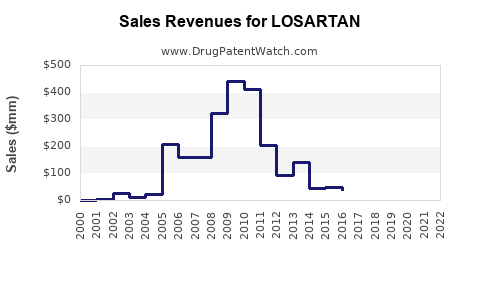
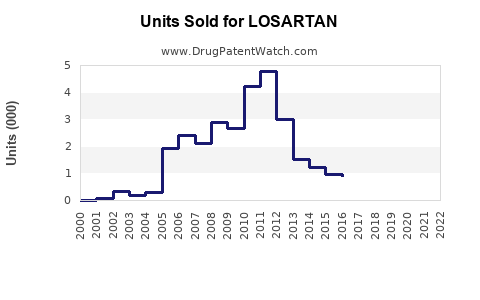
Annual Sales Revenues and Units Sold for LOSARTAN
| Drug Name | Revenues (USD) | Units | Year |
|---|---|---|---|
| LOSARTAN | ⤷ Start Trial | ⤷ Start Trial | 2022 |
| LOSARTAN | ⤷ Start Trial | ⤷ Start Trial | 2021 |
| LOSARTAN | ⤷ Start Trial | ⤷ Start Trial | 2020 |
| LOSARTAN | ⤷ Start Trial | ⤷ Start Trial | 2019 |
| >Drug Name | >Revenues (USD) | >Units | >Year |
Losartan Market Analysis and Sales Projections Through 2030
Losartan is a mature, low-cost generic angiotensin II receptor blocker with broad global use in hypertension, diabetic nephropathy, and stroke-risk reduction. Its commercial value is driven by prescription volume rather than pricing power. Global losartan revenue is likely concentrated in generic manufacturers, distributors, and national health systems, while Merck’s branded Cozaar and Hyzaar products no longer control the market.
A reasonable base-case outlook is for global losartan finished-dose sales to remain broadly stable in unit volume through 2030, while revenue declines at approximately 2% to 5% annually because of price competition, substitution by other generic ARBs, and ongoing payer pressure. The U.S. market is likely to experience continued price compression, although losartan should retain a large installed base because of low cost, clinical familiarity, and guideline-supported use.
What is the current market position of losartan?
Losartan potassium is a small-molecule generic drug sold primarily as immediate-release oral tablets. Its principal indications are hypertension, reduction of stroke risk in patients with hypertension and left ventricular hypertrophy, and diabetic nephropathy in patients with type 2 diabetes and hypertension.[1]
Losartan is marketed as:
| Product | Active ingredient | Typical strengths | Market status |
|---|---|---|---|
| Cozaar | Losartan potassium | 25 mg, 50 mg, 100 mg | Originator brand; patent protection expired |
| Hyzaar | Losartan potassium and hydrochlorothiazide | Multiple combinations | Originator combination brand; patent protection expired |
| Generic losartan | Losartan potassium | 25 mg, 50 mg, 100 mg | Widely available |
| Generic losartan/HCTZ | Losartan potassium and hydrochlorothiazide | Multiple combinations | Widely available |
The drug competes in the ARB class against valsartan, irbesartan, candesartan, telmisartan and olmesartan. It also competes indirectly with ACE inhibitors, calcium-channel blockers, thiazide diuretics and fixed-dose antihypertensive combinations.
Losartan has several commercial advantages:
- Low manufacturing cost.
- Established clinical evidence.
- Once-daily administration for most patients.
- Availability in multiple tablet strengths.
- Broad generic supplier participation.
- Use in combination products.
- Inclusion in many national reimbursement formularies.
Its main disadvantages are generic price erosion, limited differentiation, availability of once-daily ARBs with stronger perceived duration of action, and competition from inexpensive ACE inhibitors such as lisinopril.
How large is the losartan market?
There is no single authoritative public source reporting global sales for all losartan products. Generic sales are fragmented across manufacturers, wholesalers, pharmacy channels and government procurement systems. Company filings generally combine losartan with broader generic portfolios rather than reporting product-level revenue.
A practical market estimate should therefore separate units from revenue.
| Market measure | 2024 estimated position | 2030 base-case outlook |
|---|---|---|
| Global finished-dose revenue | Approximately $250 million to $600 million | Approximately $190 million to $500 million |
| Global unit demand | Approximately stable to modestly declining | 95% to 105% of 2024 volume |
| U.S. generic revenue | Approximately $50 million to $150 million | Approximately $30 million to $100 million |
| Average generic price trend | Declining | Further decline of 15% to 30% cumulatively |
| Brand contribution | Low | Minimal |
| Combination-product contribution | Material but smaller than monotherapy | Stable to modestly declining |
These ranges are commercial estimates rather than audited market totals. They reflect the mature generic status of losartan, the large number of suppliers and the absence of meaningful exclusivity.
What are the sales projections for losartan through 2030?
The base case assumes stable hypertension prevalence, continued generic substitution, modest migration to competing ARBs and annual price erosion. Under this framework, global revenue declines despite relatively stable prescription volume.
| Year | Base-case global revenue | Base-case change | Main driver |
|---|---|---|---|
| 2024 | $250 million to $600 million | Baseline | Mature generic demand |
| 2025 | $240 million to $570 million | -2% to -5% | Price competition |
| 2026 | $230 million to $545 million | -2% to -5% | Formulary pressure |
| 2027 | $220 million to $520 million | -2% to -5% | Generic substitution |
| 2028 | $210 million to $500 million | -2% to -5% | Further unit-price decline |
| 2029 | $200 million to $485 million | -1% to -4% | Stable volume, lower price |
| 2030 | $190 million to $500 million | Cumulative decline | Mature, durable demand |
Bull case
The bull case assumes growth in treated hypertension, stronger use in emerging markets, sustained demand for low-cost ARBs and slower price erosion. Under this scenario, global units grow 1% to 3% annually and revenue is flat to modestly higher by 2030.
Base case
The base case assumes demand remains durable, but revenue declines 2% to 5% annually. This is the most likely outcome for a mature generic antihypertensive.
Bear case
The bear case assumes faster conversion to valsartan, telmisartan or combination therapies, aggressive tender pricing and reduced use of ARBs where ACE inhibitors remain preferred. Revenue could decline 5% to 8% annually, with the largest pressure in institutional and public-payer channels.
When did losartan lose exclusivity?
Losartan’s core U.S. compound patent, U.S. Patent No. 5,138,069, was assigned to E.I. du Pont de Nemours and later associated with Merck’s Cozaar franchise. The patent covered losartan and related compounds and expired in 2010 after applicable patent-term adjustments and pediatric considerations.[2]
The expiration opened the U.S. market to generic losartan. Generic approvals were subsequently issued under abbreviated new drug applications for losartan potassium and losartan/hydrochlorothiazide products.[3]
| Exclusivity element | Position |
|---|---|
| Core compound patent | Expired |
| U.S. generic entry | Began after 2010 |
| Current compound exclusivity | None |
| Pediatric exclusivity | Expired |
| Regulatory exclusivity for tablets | None |
| Biosimilar exclusivity | Not applicable |
Losartan has no remaining small-molecule market exclusivity comparable to a new chemical entity. Commercial protection now depends on manufacturing cost, procurement contracts, supply reliability, channel access and product quality.
What is the Orange Book status of losartan?
The FDA Orange Book lists approved drug products and certain patents submitted by sponsors. Cozaar and Hyzaar were approved as prescription products, but their primary patent protection has expired. Generic products are approved through abbreviated new drug applications and are therapeutically equivalent where assigned an appropriate FDA rating.[4]
The practical Orange Book position is:
- No active core patent prevents generic losartan entry.
- Paragraph IV litigation is no longer the central market issue.
- Product-specific patents, if any, must be reviewed by application and listing date.
- Generic competition is established rather than pending.
- No FDA exclusivity blocks routine generic substitution.
Because Orange Book entries can change, product-level legal analysis should use the current FDA listing for the relevant dosage form and abbreviated new drug application.
Which companies manufacture or sell losartan?
Losartan is supplied by a large group of generic manufacturers. U.S. and international suppliers have included Teva Pharmaceutical Industries, Torrent Pharmaceuticals, Lupin, Zydus Lifesciences, Dr. Reddy’s Laboratories, Sandoz, Apotex, Cipla, Aurobindo Pharma and other regional manufacturers.
The competitive structure differs by channel:
| Channel | Competitive characteristic |
|---|---|
| U.S. retail pharmacy | Multiple approved suppliers and wholesaler substitution |
| Medicaid and government procurement | Tender and contract pricing |
| Hospitals | Formulary selection and supply reliability |
| Europe | National reimbursement and parallel distribution |
| India | Strong branded-generic competition |
| Emerging markets | Local manufacturing and distributor relationships |
Supplier economics are exposed to active pharmaceutical ingredient costs, quality-compliance events, manufacturing concentration and recalls. A supplier can lose share quickly if it has a manufacturing interruption, warning letter, product recall or failure to maintain preferred wholesaler contracts.
What formulations and combination products are protected by losartan patents?
The principal commercial formulations are immediate-release losartan tablets and losartan/hydrochlorothiazide tablets. These products do not have meaningful remaining patent barriers in the U.S.
The original Hyzaar combination paired losartan with hydrochlorothiazide. Combination products remain commercially relevant because they improve adherence and allow physicians to intensify treatment without adding a separate prescription. Their value is operational rather than patent-driven.
Potential formulation differentiation includes:
- Fixed-dose losartan/hydrochlorothiazide tablets.
- Packaging designed for adherence.
- Alternative tablet sizes or scoring.
- Regional oral dosage forms.
- Hospital and institutional packaging.
- Combination products with other antihypertensive agents.
New formulation patents would need to claim a genuine technical feature, such as a novel composition, release profile or manufacturing process. Routine changes in tablet strength, excipients or packaging generally provide limited durable protection and may not materially alter generic competition.
Are there Paragraph IV challenges involving losartan?
Paragraph IV litigation was commercially relevant when generic manufacturers first sought approval before expiration of Merck’s core patents. That period has passed. Current losartan competition is primarily post-expiry generic competition, not an active first-wave Paragraph IV contest.
For diligence purposes, the principal legal risks are now:
- Product liability and recall exposure.
- Manufacturing compliance.
- API supply interruptions.
- Trade-secret or process disputes.
- Pricing and contracting investigations.
- Patent disputes involving a newly developed formulation or combination.
A new entrant seeking to market standard losartan tablets does not face the same patent barrier that existed before 2010. The remaining barrier is commercial execution.
What regulatory issues affect losartan sales?
Losartan is approved by the FDA and marketed globally through national regulatory systems. The drug has been subject to regulatory scrutiny related to nitrosamine impurities, particularly N-nitroso-N-methyl-4-aminobutyric acid, known as NMBA, and other impurities associated with certain active pharmaceutical ingredient supply chains.[5]
The 2018-2020 ARB impurity recalls affected losartan, valsartan and irbesartan products. These events created temporary supply disruptions, recalls and supplier reallocations. They also increased regulatory expectations for:
- API impurity testing.
- Supplier qualification.
- Batch-level monitoring.
- Change-control documentation.
- Stability assessment.
- Manufacturing-site oversight.
The long-term impact on losartan demand was limited because hypertension treatment could be shifted temporarily among ARBs or to other antihypertensive classes. The event did increase the commercial value of reliable quality systems and diversified API sourcing.
How strong is the losartan patent estate?
The patent estate for standard losartan is weak from a market-exclusivity perspective because the core composition patent expired and generic entry is established.
| Patent estate factor | Assessment |
|---|---|
| Core composition patent | Expired |
| Standard tablet protection | Weak or expired |
| Combination-product protection | Expired for original products |
| Method-of-use protection | Limited commercial relevance |
| Manufacturing-process patents | Potentially relevant but avoidable |
| Formulation patents | Relevant only for genuinely differentiated products |
| Biosimilar protection | Not applicable |
| Litigation leverage | Low for standard products |
A company developing a new losartan product would need to create value through adherence, combination therapy, geographic access, supply reliability or a differentiated delivery system. A conventional losartan tablet has little capacity to support premium pricing.
What generic entry risks exist for losartan manufacturers?
Generic entry risk is high because the market is already open and suppliers are numerous. The relevant risk is not a single new entrant but continuous price competition from existing and new suppliers.
Key risks include:
- Wholesale acquisition price declines.
- State and national tender losses.
- Pharmacy benefit manager substitution.
- Loss of preferred generic status.
- API shortages.
- Manufacturing-site remediation.
- Recalls related to impurities.
- Channel consolidation.
- Customer concentration.
- Inventory write-downs after contract losses.
The lowest-cost suppliers with reliable regulatory records are best positioned to retain volume. Smaller suppliers can remain viable if they serve shortage markets, regional tenders or specialized packaging channels.
How does losartan compare with competing ARBs?
| Drug | Commercial position | Patent status | Competitive pressure |
|---|---|---|---|
| Losartan | High-volume mature generic | Expired | High |
| Valsartan | High-volume generic, broad combinations | Expired | High |
| Irbesartan | Mature generic, diabetes-related use | Expired | Moderate to high |
| Telmisartan | Generic with long half-life and combination use | Expired | Moderate |
| Candesartan | Generic, strong clinical positioning | Expired | Moderate |
| Olmesartan | Generic, established hypertension use | Expired | Moderate |
| Lisinopril | ACE inhibitor, very low-cost substitute | Expired | Very high |
Losartan retains advantages in familiarity, availability and cost. Telmisartan and candesartan can compete on pharmacologic positioning, while valsartan has broad combination-product recognition. Lisinopril remains a major price-based alternative, especially in formularies that prioritize ACE inhibitors.
What licensing deals and commercial partnerships affect losartan?
Losartan’s originator commercialization involved Merck’s Cozaar and Hyzaar franchises, but current market economics are dominated by generic supply and distribution agreements rather than high-value licensing transactions.
Relevant partnership structures include:
- Generic manufacturing and supply agreements.
- API sourcing arrangements.
- Contract manufacturing.
- National distributor agreements.
- Tender-based supply contracts.
- Co-marketing of branded generics.
- Authorized-generic arrangements.
No active originator licensing arrangement is likely to create a meaningful global pricing moat for standard losartan. The commercial focus is procurement access and supply continuity.
What revenue exposure does losartan create for generic manufacturers?
For large generic companies, losartan is usually a small product within a broad cardiovascular portfolio. Revenue exposure is therefore more meaningful at the portfolio level than at the company level.
A supplier’s exposure depends on:
- Share of losartan prescriptions in its target countries.
- Dependence on one API source.
- Number of approved manufacturing sites.
- Government-tender concentration.
- Exposure to U.S. pharmacy channels.
- Ability to substitute production across sites.
- Product recall history.
Losartan can provide stable volume but is unlikely to produce significant margin expansion. Manufacturers should treat it as a scale product, not a growth product.
What are the most likely generic launch scenarios?
Standard tablet launch
A new standard tablet entrant can obtain regulatory approval but will face immediate competition from established suppliers. The launch requires low cost, dependable supply and payer or distributor access. Price premiums are unlikely.
Combination-product launch
A losartan/hydrochlorothiazide product may offer better commercial positioning than monotherapy if the manufacturer secures formulary access. The product remains exposed to generic substitution.
Differentiated formulation launch
A novel formulation could support stronger pricing only if it demonstrates improved adherence, bioavailability, tolerability or dosing convenience and receives meaningful regulatory or patent protection. Development costs and substitution risk are higher.
Emerging-market launch
Emerging markets can offer unit growth, especially where hypertension diagnosis and treatment rates are increasing. Revenue per tablet remains low, and local registration, distributor control and tender access determine success.
Key Takeaways
- Losartan is a mature generic ARB with no meaningful remaining core patent barrier.
- The U.S. compound patent expired in 2010, enabling broad generic entry.
- Revenue is likely to decline modestly through 2030 because of price erosion, while unit demand remains relatively durable.
- The most defensible commercial advantages are manufacturing reliability, low cost, API quality and procurement access.
- Standard losartan tablets have weak patent strength and limited premium-pricing potential.
- Losartan/hydrochlorothiazide combinations remain commercially relevant but are not protected by the original franchise patents.
- Nitrosamine controls and manufacturing compliance remain important supply risks.
- Generic manufacturers should view losartan as a stable-volume product with limited growth and declining unit economics.
FAQs
Is losartan still a profitable drug for generic manufacturers?
Yes, but mainly as a scale product. Profitability depends on manufacturing efficiency, supply reliability and contract access rather than pricing power.
Can a company obtain new patents on losartan?
A company may obtain patents on a genuinely novel formulation, manufacturing process or combination. A conventional losartan tablet is unlikely to support strong new exclusivity.
Will losartan sales grow as hypertension prevalence increases?
Unit demand may grow in some emerging markets, but global revenue growth is constrained by generic price erosion and substitution by competing antihypertensive drugs.
Does losartan have biosimilar competition?
No. Losartan is a chemically synthesized small molecule, so it faces generic competition rather than biosimilar competition.
Did the ARB impurity recalls permanently reduce losartan demand?
No. The recalls caused temporary product withdrawals and supplier changes. Long-term demand remained supported by the prevalence of hypertension and the low cost of generic treatment.
References
-
U.S. Food and Drug Administration. (2018). Cozaar (losartan potassium) prescribing information. FDA.
-
U.S. Patent and Trademark Office. (1992). U.S. Patent No. 5,138,069: Imidazole-5-acetic acid derivatives. USPTO.
-
U.S. Food and Drug Administration. (2024). Drugs@FDA: Losartan potassium and losartan potassium/hydrochlorothiazide products. FDA.
-
U.S. Food and Drug Administration. (2024). Approved drug products with therapeutic equivalence evaluations: Orange Book. FDA.
-
U.S. Food and Drug Administration. (2020). FDA updates and press announcements on nitrosamine impurities in medicines. FDA.
More… ↓
