Share This Page
Drug Sales Trends for JANTOVEN
✉ Email this page to a colleague
Payment Methods and Pharmacy Types for JANTOVEN (2022)
Revenues by Pharmacy Type
Units Sold by Pharmacy Type
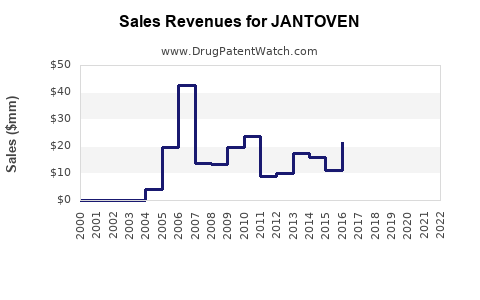
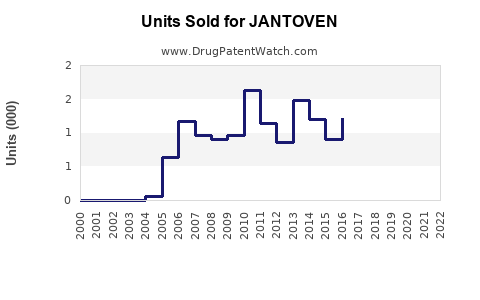
Annual Sales Revenues and Units Sold for JANTOVEN
| Drug Name | Revenues (USD) | Units | Year |
|---|---|---|---|
| JANTOVEN | ⤷ Start Trial | ⤷ Start Trial | 2022 |
| JANTOVEN | ⤷ Start Trial | ⤷ Start Trial | 2021 |
| JANTOVEN | ⤷ Start Trial | ⤷ Start Trial | 2020 |
| >Drug Name | >Revenues (USD) | >Units | >Year |
Jantoven Market Analysis, Patent Status, Competitive Landscape, and Sales Projections
Jantoven is a U.S.-marketed warfarin sodium product manufactured by Upsher-Smith Laboratories. Its commercial opportunity is limited by extensive generic competition, declining warfarin use, and the substitution of direct oral anticoagulants (DOACs). Jantoven has no meaningful remaining composition-of-matter exclusivity. Its value is concentrated in continued supply, physician familiarity, payer coverage, and patient segments for which warfarin remains clinically preferred.
Public company filings do not disclose Jantoven’s product-level revenue. The projection below therefore uses a market-based model rather than reported sales. Under the base case, U.S. Jantoven sales decline from an estimated $10 million to $15 million range in 2024 to approximately $6 million to $9 million by 2029.
What is Jantoven and how large is its market?
Jantoven contains warfarin sodium, a vitamin K antagonist anticoagulant. It is available in multiple tablet strengths and is used to reduce the risk of thromboembolism in conditions including atrial fibrillation, venous thromboembolism, and patients with mechanical heart valves, subject to individualized international normalized ratio (INR) management. The FDA-approved labeling requires regular coagulation monitoring and includes extensive drug, food, and disease-interaction warnings (U.S. Food and Drug Administration [FDA], 2024a).
The relevant market is the U.S. oral anticoagulant market, divided between:
| Segment | Principal products | Commercial position |
|---|---|---|
| Vitamin K antagonists | Warfarin, Jantoven, generic warfarin sodium | Mature, declining, low-cost |
| Factor Xa inhibitors | Eliquis, Xarelto, Savaysa | Dominant branded oral anticoagulant segment |
| Direct thrombin inhibitors | Pradaxa | Smaller DOAC segment |
| Parenteral anticoagulants | Heparin, enoxaparin and related products | Hospital and perioperative use |
Warfarin remains clinically important for mechanical heart-valve patients. DOACs are generally not used in patients with mechanical prosthetic valves, and warfarin continues to have a role in selected patients with rheumatic mitral stenosis, advanced kidney disease, cost constraints, or established INR-monitoring infrastructure (Otto et al., 2021; January et al., 2019).
Jantoven competes primarily against generic warfarin rather than against other branded products. Its commercial differentiation is limited.
How much are Jantoven sales?
Upsher-Smith does not publicly report Jantoven revenue in a separate product line. The estimates below are modeled ranges based on the mature U.S. warfarin market, expected brand share, generic pricing pressure, and continued DOAC substitution.
| Year | Estimated U.S. warfarin market revenue | Estimated Jantoven revenue, bear case | Base case | Bull case |
|---|---|---|---|---|
| 2024 | $150 million-$250 million | $6 million | $12 million | $20 million |
| 2025 | $145 million-$240 million | $5 million | $11 million | $19 million |
| 2026 | $138 million-$230 million | $4.5 million | $10 million | $18 million |
| 2027 | $131 million-$220 million | $4 million | $9 million | $17 million |
| 2028 | $124 million-$210 million | $3.5 million | $8 million | $16 million |
| 2029 | $117 million-$200 million | $3 million | $7 million | $15 million |
These figures are gross-market estimates, not audited net sales. Rebates, wholesaler discounts, Medicaid pricing, and institutional purchasing may reduce realized manufacturer revenue.
The base case assumes:
- U.S. warfarin prescription volume declines approximately 3% to 5% annually.
- Jantoven retains a small branded share among prescriptions dispensed as warfarin.
- Generic competition continues to suppress average selling prices.
- No major manufacturing interruption occurs.
- No new clinical indication materially expands warfarin use.
The bull case requires stable warfarin utilization in mechanical-valve and renal-disease populations, sustained product availability, and limited erosion from low-price generic suppliers. The bear case assumes more rapid conversion to DOACs and further price compression.
When does Jantoven lose exclusivity?
Jantoven has no commercially significant remaining regulatory or patent exclusivity. Warfarin has been marketed in the United States for decades, and generic warfarin sodium products are widely available.
The key exclusivity events are historical rather than prospective:
| Protection category | Jantoven status |
|---|---|
| New chemical entity exclusivity | Expired |
| Composition-of-matter patent | Expired |
| Pediatric exclusivity | No current commercial relevance |
| Orphan-drug exclusivity | Not applicable |
| Reference-product exclusivity | Expired |
| Formulation exclusivity | No material barrier identified |
| Method-of-use exclusivity | No material barrier identified |
The FDA identifies Jantoven as a warfarin sodium product approved through the NDA framework, while multiple generic warfarin sodium products are approved through ANDAs (FDA, 2024b; FDA, 2024c). The commercial issue is therefore not the date of a future patent cliff. Generic entry has already occurred.
What patents protect Jantoven?
No active patent estate appears to protect the core Jantoven molecule or ordinary warfarin tablet formulations in a way that prevents generic substitution.
Potentially relevant patent categories include:
- Warfarin’s chemical composition.
- Salt or polymorph forms.
- Tablet formulations.
- Packaging and stability systems.
- Therapeutic dosing or monitoring methods.
- Manufacturing and quality-control processes.
For Jantoven, these categories do not create a meaningful current exclusivity barrier. Warfarin sodium is an established active pharmaceutical ingredient, and conventional tablets are readily manufactured by multiple suppliers. Any historical patents covering warfarin chemistry, basic tablet formulations, or early therapeutic use have expired.
What is the Orange Book status of Jantoven?
Jantoven is listed by the FDA as a prescription drug product in the warfarin sodium category. The Orange Book provides FDA approval and therapeutic-equivalence information for listed products and generic alternatives (FDA, 2024b).
The commercial implications are:
- Jantoven is an approved prescription product.
- Generic warfarin sodium products can receive an AB therapeutic-equivalence rating when they meet FDA requirements.
- Pharmacists and payers can substitute lower-cost generic warfarin where state law, payer policy, and prescriber instructions permit.
- An Orange Book listing does not provide current exclusivity by itself.
- No active patent listing is expected to block generic warfarin supply.
Because warfarin has a narrow therapeutic index, changes among manufacturers can create practical concerns for INR management. The FDA labeling states that patients should be monitored when therapy is initiated, adjusted, or affected by changes in interacting drugs, diet, illness, or other clinical factors (FDA, 2024a).
Are there Paragraph IV challenges to Jantoven?
There is no commercially significant current Paragraph IV risk associated with Jantoven. Generic warfarin products entered the market long ago, and the product is already exposed to multiple generic suppliers.
Paragraph IV litigation is typically material when a generic applicant challenges an active Orange Book patent before patent expiration. Jantoven’s relevant patents, if any, do not appear to create a forward-looking litigation barrier comparable to newer branded anticoagulants.
The more relevant legal risks are:
- Product-liability claims related to bleeding.
- Manufacturing deviations or recalls.
- Failure-to-warn allegations.
- Supply disruption.
- Labeling disputes involving drug interactions or anticoagulation monitoring.
What formulation patents protect Jantoven?
Jantoven’s standard tablet formulation has limited defensibility. The product is not a long-acting implant, transdermal system, complex biologic, inhaled device, or proprietary delivery platform.
Potential commercial protections are operational rather than patent-based:
- Consistent tablet potency across strengths.
- Reliable color and strength differentiation.
- Stability through the labeled shelf life.
- Packaging that reduces medication errors.
- Manufacturing controls for a narrow-therapeutic-index drug.
- Distribution reliability.
These factors may support customer retention, but they do not prevent generic substitution. Generic manufacturers can reproduce conventional warfarin tablet dosage forms subject to FDA quality requirements.
How does Jantoven compare with Eliquis, Xarelto, and generic warfarin?
| Factor | Jantoven | Generic warfarin | Eliquis | Xarelto |
|---|---|---|---|---|
| Active ingredient | Warfarin sodium | Warfarin sodium | Apixaban | Rivaroxaban |
| Monitoring | Regular INR monitoring | Regular INR monitoring | No routine INR monitoring | No routine INR monitoring |
| Mechanical heart valves | Used | Used | Not established for this use | Not established for this use |
| Price | Higher than generic warfarin | Lowest | High | High |
| Patent position | Mature, expired | Mature, expired | Historically protected through the 2020s | Historically protected through the 2020s |
| Generic substitution | Competes with generics | Direct low-cost competitor | Increasing generic-entry exposure | Increasing generic-entry exposure |
| Clinical convenience | Low | Low | High | High |
Eliquis and Xarelto benefit from simpler dosing and the absence of routine INR testing. Warfarin retains advantages in specific clinical populations and in patients for whom drug cost is decisive. Clinical guidelines generally favor DOACs over warfarin for many patients with nonvalvular atrial fibrillation, but exclude mechanical heart valves and certain valvular conditions from that preference (January et al., 2019).
What generic entry risks affect Jantoven?
Generic substitution is the primary risk, not a future event. Jantoven can lose volume through:
- Pharmacy-level substitution to generic warfarin.
- Formulary exclusion or nonpreferred-brand status.
- Low-cost institutional purchasing.
- Medicare and Medicaid reimbursement pressure.
- Physician adoption of DOACs.
- Reduced warfarin use in atrial fibrillation.
- Consolidation among generic manufacturers.
Warfarin’s low acquisition cost limits the absolute savings available from switching between generic suppliers. The larger economic shift is from warfarin to DOACs, where payers may accept higher drug costs in exchange for reduced monitoring, fewer dietary restrictions, and simpler administration.
Which companies compete with Jantoven?
Jantoven’s direct competitors include generic manufacturers and distributors with approved warfarin sodium products. The competitive field has included major generic suppliers such as Teva Pharmaceuticals, Mylan or Viatris, Sandoz, and other ANDA holders, depending on product strength and market availability.
Indirect competitors include:
- Bristol Myers Squibb and Pfizer with Eliquis.
- Janssen and Bayer with Xarelto.
- Boehringer Ingelheim with Pradaxa.
- Hospital and specialty-pharmacy suppliers of low-molecular-weight heparins.
The most important competitive distinction is not brand versus brand. It is low-cost warfarin versus higher-priced anticoagulants with simpler monitoring requirements.
What is the FDA regulatory status of Jantoven?
Jantoven is an FDA-approved prescription warfarin sodium product. Its labeling contains a boxed warning regarding major or fatal bleeding and requires careful dosing, monitoring, and management of interactions (FDA, 2024a).
Regulatory risks include:
- Labeling changes related to bleeding or drug interactions.
- Manufacturing observations.
- Product recalls.
- Shortages affecting specific tablet strengths.
- Medication errors from strength changes or tablet appearance.
- Pharmacogenomic labeling considerations involving CYP2C9 and VKORC1 variation.
No biosimilar pathway applies. Jantoven is a small-molecule drug, so competitive products are approved as generics, not biosimilars.
How strong is the Jantoven patent estate?
Jantoven’s patent estate is weak from an exclusivity perspective. The product has four commercial strengths:
- FDA approval and established labeling.
- Long clinical history.
- Recognition among anticoagulation providers.
- Potential supply reliability.
Its weaknesses are more material:
- No meaningful active composition patent.
- No current market exclusivity.
- Broad generic competition.
- Declining use in atrial fibrillation.
- Limited differentiation from generic warfarin.
- High monitoring burden.
- Exposure to DOAC substitution.
The product is therefore better viewed as a mature cash-flow asset than as a patent-protected growth asset.
What licensing deals or settlements affect Jantoven?
No major current licensing transaction or Paragraph IV settlement appears to drive Jantoven’s market position. The drug’s commercial history predates the modern wave of branded anticoagulant patent settlements. Market access depends primarily on manufacturing, distribution, reimbursement, and generic competition.
What generic launch scenarios exist for Jantoven?
Because generic warfarin is already available, the relevant scenarios concern further erosion rather than first generic launch.
| Scenario | Market effect | Estimated Jantoven outcome |
|---|---|---|
| Stable niche | Warfarin remains necessary for mechanical valves and selected high-risk patients | Revenue declines slowly |
| Generic price compression | More suppliers compete on price and contracts | Brand share and net price fall |
| Accelerated DOAC conversion | Warfarin use falls in atrial fibrillation and VTE | Volume declines 5% or more annually |
| Supply disruption | Shortages increase demand for available labeled products | Temporary volume and price benefit |
| Quality event | Recall or manufacturing issue reduces prescriptions | Sharp short-term revenue decline |
Key Takeaways
- Jantoven is a mature warfarin sodium product with no meaningful remaining patent exclusivity.
- Generic warfarin is the principal direct competitor.
- DOACs, especially Eliquis and Xarelto, are the main source of long-term market decline.
- Warfarin remains important for mechanical heart valves, selected valvular disease, advanced kidney disease, and cost-sensitive patients.
- Product-level Jantoven sales are not publicly disclosed.
- Modeled U.S. revenue is approximately $10 million to $15 million in 2024, with a base-case decline to about $7 million by 2029.
- No biosimilar risk applies; competitors use the generic small-molecule pathway.
- The commercial value of Jantoven depends on supply reliability and niche clinical demand rather than patent protection.
FAQs About Jantoven Market Size and Exclusivity
Is Jantoven the same as warfarin?
Jantoven contains warfarin sodium. Generic warfarin sodium products contain the same active ingredient and compete directly with Jantoven.
Is Jantoven still protected by patents?
No material patent protection appears to prevent generic competition. Warfarin’s core patents and historical formulation protections have expired.
Can a pharmacy substitute generic warfarin for Jantoven?
In many cases, yes. Substitution depends on state pharmacy law, payer rules, product availability, and the prescriber’s instructions. INR monitoring remains important after product or dose changes.
Does Jantoven have biosimilar competition?
No. Biosimilars apply to biologic products. Jantoven is a small-molecule drug and competes with FDA-approved generic warfarin products.
Will Jantoven sales increase if warfarin shortages occur?
A shortage affecting competing warfarin products could temporarily increase demand for Jantoven if Upsher-Smith maintains supply. Such an effect would likely be temporary and would not change the product’s long-term patent position.
References
- U.S. Food and Drug Administration. (2024a). Jantoven (warfarin sodium) tablets: Prescribing information.
- U.S. Food and Drug Administration. (2024b). Approved drug products with therapeutic equivalence evaluations: Orange Book.
- U.S. Food and Drug Administration. (2024c). Drugs@FDA: FDA-approved drugs.
- January, C. T., Wann, L. S., Calkins, H., et al. (2019). 2019 AHA/ACC/HRS focused update of the guideline for the management of patients with atrial fibrillation. Circulation, 140(6), e285-e292.
- Otto, C. M., Nishimura, R. A., Bonow, R. O., et al. (2021). 2020 ACC/AHA guideline for the management of patients with valvular heart disease. Circulation, 143(5), e72-e227.
More… ↓
