Share This Page
Drug Sales Trends for GRALISE
✉ Email this page to a colleague
Payment Methods and Pharmacy Types for GRALISE (2022)
Revenues by Pharmacy Type
Units Sold by Pharmacy Type
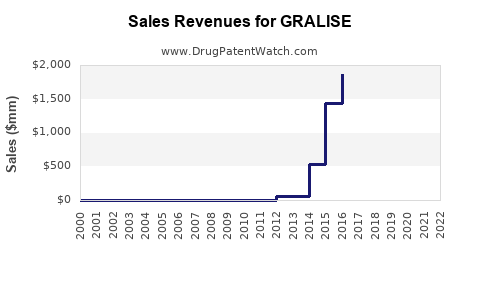
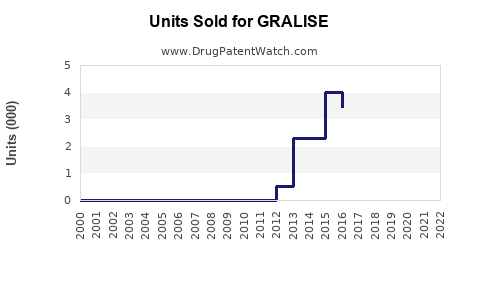
Annual Sales Revenues and Units Sold for GRALISE
| Drug Name | Revenues (USD) | Units | Year |
|---|---|---|---|
| GRALISE | ⤷ Start Trial | ⤷ Start Trial | 2022 |
| GRALISE | ⤷ Start Trial | ⤷ Start Trial | 2021 |
| GRALISE | ⤷ Start Trial | ⤷ Start Trial | 2020 |
| GRALISE | ⤷ Start Trial | ⤷ Start Trial | 2019 |
| GRALISE | ⤷ Start Trial | ⤷ Start Trial | 2018 |
| >Drug Name | >Revenues (USD) | >Units | >Year |
Gralise Market Analysis, Sales Projections, Patent Exclusivity, and Generic Risk
Gralise is a mature branded gabapentin extended-release product with declining commercial potential but a defensible niche in postherpetic neuralgia. The product’s value depends on maintaining reimbursement, prescriber familiarity, and the absence of a substitutable generic extended-release version. A reasonable base case places U.S. net sales near $18 million to $22 million in 2024, declining to approximately $10 million to $14 million by 2028 as the product ages and payer pressure increases.
What is Gralise and how does it compete in the gabapentin market?
Gralise contains gabapentin and is approved as a once-daily treatment for postherpetic neuralgia in adults. The product is supplied as 300 mg and 600 mg extended-release tablets and must be taken with an evening meal to improve absorption. The FDA approved Gralise under NDA 022544 in January 2011. [1]
Gralise competes against:
- Generic immediate-release gabapentin
- Horizant, an extended-release gabapentin enacarbil product
- Lyrica and generic pregabalin
- Tricyclic antidepressants
- Serotonin-norepinephrine reuptake inhibitors
- Topical lidocaine and capsaicin products
- Opioid and non-opioid pain therapies
The product’s core commercial distinction is reduced dosing frequency. Generic gabapentin usually requires multiple daily doses, while Gralise is administered once daily. That benefit is clinically relevant for some patients but has limited pricing power because generic gabapentin is inexpensive and widely available.
Who markets Gralise?
Gralise was developed by Depomed, which later became Assertio Therapeutics. Assertio has marketed the product as part of a portfolio of specialty pharmaceuticals, including pain and neurology products. The commercial strategy has focused on branded prescribing, reimbursement support, and targeted promotion rather than broad primary-care penetration.
How large is the Gralise market?
The addressable market is the U.S. postherpetic neuralgia segment, not the entire gabapentin market. Gabapentin is widely prescribed for off-label neuropathic pain, but Gralise’s FDA-approved indication is narrower.
The market has three structural characteristics:
- Generic gabapentin sets a low price benchmark.
- Postherpetic neuralgia is a relatively small indication compared with diabetic neuropathy and broader off-label pain use.
- Once-daily dosing supports differentiation but does not eliminate formulary substitution.
Gralise therefore operates in a specialty branded market with high prescription volume at the molecule level but modest revenue potential for the extended-release brand.
Gralise market positioning
| Attribute | Gralise | Generic gabapentin | Horizant | Generic pregabalin |
|---|---|---|---|---|
| Active ingredient | Gabapentin | Gabapentin | Gabapentin enacarbil | Pregabalin |
| Formulation | Extended release | Immediate release | Extended release prodrug | Immediate release or extended release |
| Typical dosing advantage | Once daily | Usually multiple daily doses | Usually twice daily for neuralgia | Usually twice daily |
| FDA-approved pain use | Postherpetic neuralgia | Postherpetic neuralgia and epilepsy | Postherpetic neuralgia and restless legs syndrome | Neuropathic pain and other indications |
| Generic competition | Limited direct ER substitution historically | Extensive | Limited or developing | Extensive |
| Price pressure | High | Very high | High | High |
What are Gralise sales and revenue trends?
Gralise sales have declined from the product’s earlier commercial peak. Depomed reported strong growth after launch, but the product later faced reimbursement restrictions, greater use of low-cost generic gabapentin, and reduced promotional leverage.
Public company filings indicate that Gralise became a smaller component of Assertio’s portfolio over time. The product remained commercially relevant but no longer represented a high-growth asset. Annual sales in recent years have generally been measured in tens of millions of dollars rather than hundreds of millions. [2][3]
A practical normalized estimate for recent U.S. net sales is:
| Year | Estimated Gralise net sales | Commercial interpretation |
|---|---|---|
| 2021 | $25 million-$32 million | Mature branded product |
| 2022 | $22 million-$28 million | Continued payer and generic pressure |
| 2023 | $20 million-$25 million | Declining prescription economics |
| 2024 | $18 million-$22 million | Base-year estimate |
| 2025 | $16 million-$20 million | Moderate erosion |
| 2026 | $14 million-$18 million | Greater formulary pressure |
| 2027 | $12 million-$16 million | Late-life branded revenue |
| 2028 | $10 million-$14 million | Residual specialty demand |
These figures are market estimates rather than Assertio guidance. Reported results can differ because of gross-to-net deductions, inventory timing, channel mix, rebates, copay programs, and product transfers.
What are the Gralise sales projections through 2028?
The base-case forecast assumes no major direct generic launch, continued brand availability, stable postherpetic neuralgia demand, and gradual loss of formulary access.
Base-case projection
| Year | Projected sales | Year-over-year change |
|---|---|---|
| 2024 | $20 million | Base year |
| 2025 | $18 million | -10% |
| 2026 | $16 million | -11% |
| 2027 | $14 million | -13% |
| 2028 | $12 million | -14% |
The base case implies a compound annual decline of approximately 11% from 2024 through 2028.
Upside scenario
The upside case assumes stronger payer coverage, continued prescriber use among patients who value once-daily dosing, and no approved directly substitutable generic extended-release product.
| Year | Upside sales |
|---|---|
| 2025 | $21 million |
| 2026 | $21 million |
| 2027 | $20 million |
| 2028 | $19 million |
This scenario requires stable net pricing and effective retention of existing prescribers. It does not represent a return to the product’s earlier growth phase.
Downside scenario
The downside case assumes a successful Paragraph IV challenge, a generic extended-release launch, loss of favorable formulary positioning, or a sharp reduction in branded promotion.
| Year | Downside sales |
|---|---|
| 2025 | $16 million |
| 2026 | $9 million |
| 2027 | $5 million |
| 2028 | $3 million |
A direct generic launch could reduce branded sales by 50% to 80% within two years, depending on the number of entrants, substitution rules, payer policies, and the generic’s price discount.
When does Gralise lose exclusivity?
Gralise’s commercial exclusivity is determined by several overlapping rights:
- New chemical entity exclusivity, which expired years after the 2011 approval
- Patent protection covering the extended-release gabapentin formulation
- Patent protection covering dosing or administration methods
- Any pediatric exclusivity or regulatory extensions
- The status of FDA Orange Book listings and associated certifications
The product is no longer protected by ordinary new chemical entity exclusivity. Gabapentin itself is an old active ingredient. Gralise’s remaining defensibility has therefore depended primarily on formulation and method-of-use patents rather than molecule-level exclusivity.
What patents protect Gralise?
Gralise protection has historically centered on extended-release gabapentin technology and once-daily administration. The relevant patent analysis should separate:
- Composition and formulation claims covering the controlled-release tablet.
- Pharmacokinetic claims covering a specific release profile.
- Method-of-use claims directed to postherpetic neuralgia.
- Manufacturing claims covering tablet production or release-control technology.
The Orange Book is the controlling source for currently listed patents and expiration dates. Patent-family records can contain continuation patents, terminal disclaimers, reissued claims, and expiration adjustments that materially affect a generic entrant’s strategy. [4]
A patent’s expiration date does not automatically establish market entry. A generic applicant may challenge the patent before expiration, design around it, or obtain a license. Conversely, an apparently narrow formulation patent may still delay entry if it creates regulatory or litigation costs.
What is the Orange Book status of Gralise?
Gralise is an FDA-approved prescription drug listed under NDA 022544. The relevant Orange Book questions are:
- Which patents remain listed against NDA 022544?
- Are the listed patents formulation patents, method-of-use patents, or both?
- Which claims must an ANDA applicant certify against?
- Has any patent been delisted, expired, or removed?
- Are any patents subject to pediatric or patent-term-extension adjustments?
FDA Orange Book listings provide the regulatory framework for ANDA patent certifications, but they do not determine whether each patent will survive litigation. [4]
For commercial diligence, the key distinction is between listed patents that can trigger a Paragraph IV notice and unlisted patents that may still support separate infringement litigation. The absence of an Orange Book listing does not eliminate all patent risk, but it can reduce the ability to delay FDA approval through the Hatch-Waxman framework.
Which companies are challenging Gralise?
No widely disclosed, commercially established generic launch has displaced Gralise in the U.S. market on the scale seen with immediate-release gabapentin. The principal competitive threat comes from generic-drug manufacturers that could pursue an ANDA for an equivalent extended-release product.
Potential entrants include large generic companies with controlled-release manufacturing capabilities, such as:
- Teva Pharmaceutical Industries
- Viatris
- Sandoz
- Amneal Pharmaceuticals
- Lupin
- Zydus Pharmaceuticals
- Dr. Reddy’s Laboratories
The presence of a company in this list does not establish that it has filed an ANDA or issued a Paragraph IV certification. Public confirmation requires an FDA approval record, litigation complaint, Paragraph IV notice, or company disclosure.
What Paragraph IV risks exist for Gralise?
A Paragraph IV challenge would assert that a listed Gralise patent is invalid, unenforceable, or not infringed. The filing of an ANDA with a Paragraph IV certification can produce:
- A 45-day period for the NDA holder to file an infringement action
- A potential 30-month stay of FDA approval, subject to statutory exceptions
- Settlement negotiations
- An agreed generic launch date
- Litigation over formulation, release profile, dosage, or method-of-use claims
The highest-value claims are formulation claims that are difficult to design around while still meeting the FDA’s bioequivalence requirements. Method-of-use claims are generally narrower in commercial effect because an ANDA applicant may seek a label carve-out for protected indications.
Is Gralise exposed to biosimilar competition?
No. Gralise is a small-molecule drug, not a biologic. Biosimilar regulations do not apply. The relevant pathway is an ANDA under the Hatch-Waxman Act, followed in some cases by litigation over Orange Book-listed patents.
This distinction matters because biosimilar entry usually involves reference-product exclusivity, interchangeability, and biologic manufacturing complexity. Gralise faces conventional generic risk instead.
What formulation patents protect Gralise?
The commercial value of Gralise is tied to its extended-release delivery system. A successful generic must generally demonstrate pharmaceutical equivalence and bioequivalence while meeting applicable FDA requirements for release characteristics.
Formulation risks may involve:
- Polymer or matrix technology
- Tablet dissolution profile
- Food-effect characteristics
- Gabapentin exposure over the dosing interval
- Manufacturing process controls
- Stability and dose proportionality
A generic company could pursue a design-around formulation, but that approach may require additional development work and may create regulatory uncertainty. Formulation patents are more important to Gralise than active-ingredient patents because gabapentin itself is off-patent.
What litigation and settlement issues affect Gralise?
Gralise’s legal risk is concentrated in patent litigation involving extended-release gabapentin products. A litigation review should track:
- ANDA filing and Paragraph IV notices
- Complaints filed in federal district court
- Patent validity and infringement rulings
- Claim construction decisions
- Settlement agreements
- Authorized-generic provisions
- Agreed launch dates
- License rights and royalty obligations
A settlement can preserve branded revenue longer than a court judgment if it gives the generic company a delayed-entry date. The commercial effect depends on whether the settlement includes an authorized generic, because an authorized generic can materially reduce the first-filer’s expected returns.
What licensing deals affect Gralise?
Gralise was commercialized through Depomed’s proprietary development and commercial platform before the company became Assertio. The principal economic issue is not a major current co-promotion arrangement but ownership of the product’s intellectual property, commercialization rights, and any legacy obligations attached to the product.
For valuation, investors should review Assertio’s annual reports for:
- Product-level revenue
- Royalty or milestone obligations
- Manufacturing agreements
- Distribution contracts
- Product liability reserves
- Patent litigation contingencies
- Changes in product strategy
Public filings are the most reliable source for current licensing obligations and related-party arrangements. [2][3]
How strong is the Gralise patent estate?
The patent estate is moderate to weak from a long-term exclusivity perspective.
Its strengths are:
- A differentiated extended-release dosage form
- A once-daily administration profile
- Regulatory recognition as an approved postherpetic neuralgia product
- Potential complexity in reproducing the release characteristics
Its weaknesses are:
- Gabapentin is an old, low-cost active ingredient
- The approved indication is narrow
- Immediate-release generic substitution is well established
- Method-of-use claims may be subject to label carve-outs
- Mature branded products generally face increasing payer pressure
- The commercial value of the remaining patent estate is limited by declining prescription volume
The estate may still delay or deter a generic entrant, but it is unlikely to support sustained premium pricing indefinitely.
What generic launch scenarios exist for Gralise?
Scenario 1: No direct generic launch
Gralise retains a small specialty market. Sales decline approximately 8% to 12% annually as prescriptions migrate to generic gabapentin and generic pregabalin.
Scenario 2: One generic entrant
The first generic entrant captures price-sensitive prescriptions, while Gralise retains some protected or physician-directed use. Brand sales decline 40% to 60% over two years.
Scenario 3: Multiple generic entrants
Wholesale acquisition cost falls sharply, payer substitution accelerates, and brand sales decline 70% to 90%. Residual sales come from patients with continuity-of-care preferences or limited alternatives.
Scenario 4: Authorized generic
The NDA holder launches or licenses an authorized generic. Total gabapentin ER revenue may remain higher than in an uncontrolled multi-generic launch, but branded Gralise revenue falls materially.
What is the competitive outlook for Gralise?
Gralise has a narrow and defensible commercial niche but limited growth prospects. Generic gabapentin is the primary competitive threat, not Horizant. Horizant has a different active ingredient and dosing profile, while generic gabapentin offers the strongest price-based alternative.
Gralise’s most viable commercial strategy is focused prescribing in patients who:
- Have adherence problems with multiple daily dosing
- Experience inadequate tolerability or response with immediate-release gabapentin
- Have postherpetic neuralgia requiring continued therapy
- Receive reimbursement that does not impose a substantial brand penalty
Broad market expansion would require stronger clinical differentiation or a major reimbursement change, neither of which is reflected in the product’s mature market profile.
Key Takeaways
- Gralise is a once-daily extended-release gabapentin product approved for postherpetic neuralgia.
- The product’s active ingredient is off-patent; remaining protection depends on formulation, release-profile, and method-of-use rights.
- The FDA regulatory pathway for a competitor is an ANDA, not a biosimilar application.
- Estimated 2024 sales are approximately $18 million to $22 million.
- Base-case sales decline to approximately $10 million to $14 million by 2028.
- A direct generic launch could reduce branded sales by 50% to 80% within two years.
- Gralise has moderate formulation-related defenses but weak long-term molecule-level exclusivity.
- Generic immediate-release gabapentin remains the principal commercial competitor.
- The Orange Book and current federal litigation records are the controlling sources for live patent and Paragraph IV analysis.
FAQs
Is Gralise still commercially available?
Yes. Gralise remains an FDA-approved branded product marketed for postherpetic neuralgia, subject to commercial supply and prescribing conditions.
Is there a generic version of Gralise?
A generic immediate-release gabapentin is widely available, but it is not automatically substitutable for Gralise’s extended-release formulation. Direct substitution depends on FDA approval of an equivalent extended-release product and applicable state and payer rules.
Can gabapentin be substituted for Gralise?
Physicians may prescribe generic gabapentin instead of Gralise, but the products differ in formulation, dosing schedule, pharmacokinetics, and administration instructions. Pharmacy-level substitution generally requires an approved therapeutically equivalent product.
Does Gralise have pediatric exclusivity?
Gralise’s original approval did not create a meaningful current exclusivity position based on pediatric status. Any active patent-term adjustment or exclusivity must be confirmed in the current FDA records.
What would increase Gralise’s valuation?
The largest potential valuation drivers would be a delayed generic launch, a favorable patent settlement, stronger reimbursement, an authorized-generic strategy, or evidence that once-daily dosing produces measurable adherence or healthcare-utilization benefits.
References
-
U.S. Food and Drug Administration. (2011). Gralise: Prescribing information, NDA 022544. FDA.
-
Assertio Therapeutics, Inc. (2023). Annual report pursuant to Section 13 or 15(d) of the Securities Exchange Act of 1934, Form 10-K. U.S. Securities and Exchange Commission.
-
Assertio Therapeutics, Inc. (2024). Annual report pursuant to Section 13 or 15(d) of the Securities Exchange Act of 1934, Form 10-K. U.S. Securities and Exchange Commission.
-
U.S. Food and Drug Administration. (n.d.). Approved drug products with therapeutic equivalence evaluations: Orange Book. FDA.
More… ↓
