Drug Sales Trends for CONSTULOSE
Payment Methods and Pharmacy Types for CONSTULOSE (2022)
Revenues by Pharmacy Type
Units Sold by Pharmacy Type
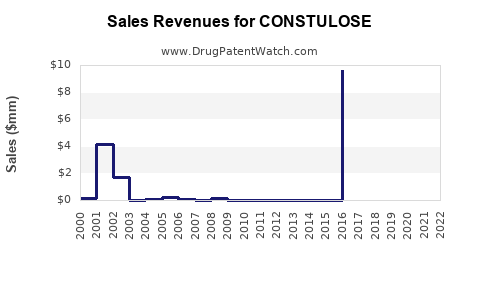
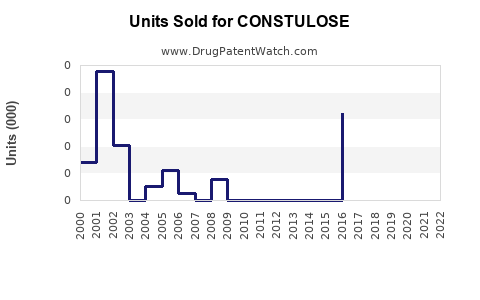
Annual Sales Revenues and Units Sold for CONSTULOSE
| Drug Name | Revenues (USD) | Units | Year |
|---|---|---|---|
| CONSTULOSE | ⤷ Start Trial | ⤷ Start Trial | 2022 |
| CONSTULOSE | ⤷ Start Trial | ⤷ Start Trial | 2021 |
| CONSTULOSE | ⤷ Start Trial | ⤷ Start Trial | 2020 |
| CONSTULOSE | ⤷ Start Trial | ⤷ Start Trial | 2019 |
| CONSTULOSE | ⤷ Start Trial | ⤷ Start Trial | 2018 |
| CONSTULOSE | ⤷ Start Trial | ⤷ Start Trial | 2017 |
| >Drug Name | >Revenues (USD) | >Units | >Year |
Constulose Market Analysis, Patent Position, and Sales Projections
Constulose is a lactulose oral solution used primarily for constipation and reduction of intestinal ammonia in patients with portal-systemic encephalopathy. Its commercial opportunity is a mature, low-growth prescription market dominated by generic lactulose products. The product has limited pricing power, no meaningful patent moat, and low expected risk of biosimilar competition because lactulose is a small-molecule disaccharide rather than a biologic.
Public sources do not disclose reliable brand-level revenue for Constulose. The projections below are therefore scenario-based estimates for U.S. net sales, not reported company revenue.
What is Constulose and how is it used?
Constulose is a prescription lactulose solution, generally supplied at a concentration of 10 grams per 15 mL. Lactulose is a synthetic disaccharide that is minimally absorbed in the gastrointestinal tract.
The product has two principal FDA-labeled uses:
| Use | Commercial relevance |
|---|---|
| Chronic constipation | Larger patient population, but highly price-sensitive and exposed to OTC alternatives |
| Portal-systemic encephalopathy, including hepatic encephalopathy | Smaller population, but higher clinical reliance and more recurring prescription use |
For constipation, lactulose is typically administered orally in divided doses and adjusted to produce regular soft stools. For hepatic encephalopathy, dosing is adjusted to achieve multiple soft bowel movements daily. The FDA label identifies diarrhea, abdominal cramping, flatulence, nausea and vomiting as important tolerability issues.[1]
Constulose competes with:
- Generic lactulose oral solution
- Lactulose products sold under other trade names
- Polyethylene glycol 3350
- Senna and stimulant laxatives
- Docusate and other stool softeners
- Prescription agents for chronic constipation, including linaclotide, plecanatide and lubiprostone
- Hospital and specialty-pharmacy supply contracts for hepatic encephalopathy
The product's value proposition is established clinical familiarity and low acquisition cost, rather than differentiation.
What is the U.S. market size for lactulose?
The U.S. lactulose market is a mature prescription market with demand tied to chronic constipation, cirrhosis, liver failure, hospital discharge prescribing and long-term care usage.
Publicly available information does not provide a clean, audited market-revenue figure covering every lactulose manufacturer and channel. A practical commercial estimate is that the U.S. prescription lactulose market is in the low hundreds of millions of dollars on a gross-to-net market basis, with substantial variation depending on whether hospital purchases, Medicaid rebates, cash-pay prescriptions and competing lactulose labels are included.
A reasonable market structure is:
| Segment | Estimated share of lactulose demand | Market characteristics |
|---|---|---|
| Constipation | 55% to 70% | High generic substitution and OTC competition |
| Hepatic encephalopathy | 30% to 45% | More medically necessary, higher refill persistence |
| Retail pharmacy | 65% to 80% | Reimbursement pressure and multiple suppliers |
| Institutional, hospital and long-term care | 20% to 35% | Contract pricing and supply reliability are important |
The hepatic encephalopathy segment is more attractive than the constipation segment because lactulose remains a standard component of care and is often used chronically. The constipation segment has greater unit volume but lower revenue per prescription.
How large is Constulose’s addressable market?
Constulose’s practical addressable market is narrower than the total lactulose market because pharmacies and prescribers can dispense therapeutically equivalent products from multiple manufacturers.
The product addresses three commercial pools:
- Retail prescriptions for chronic constipation.
- Chronic outpatient treatment for hepatic encephalopathy.
- Institutional use in hospitals, rehabilitation centers, nursing facilities and specialty care settings.
The largest constraint is substitution. A pharmacy can generally dispense another lactulose solution when the prescription permits generic substitution or when the payer’s formulary favors another supplier.
Constulose is therefore best viewed as a share-of-market product in a commodity category. Its revenue depends on:
- Wholesale acquisition price
- Formulary placement
- Pharmacy purchasing contracts
- Product availability
- Bottle size and packaging
- Manufacturer supply continuity
- Refill persistence among hepatic encephalopathy patients
- Medicaid and commercial payer reimbursement
What are the sales projections for Constulose?
The following projections use a modeled U.S. net-sales framework. They assume that Constulose remains commercially available, retains a small share of the U.S. lactulose market, and does not obtain a differentiated indication or formulation.
Base-case U.S. sales projection
| Fiscal year | Estimated net sales | Year-over-year growth | Key assumption |
|---|---|---|---|
| 2024A | $8 million to $15 million | N/A | Small established brand or label share |
| 2025E | $8 million to $15 million | -3% to 3% | Stable demand, continued price pressure |
| 2026E | $7.5 million to $14.5 million | -5% to 0% | Generic competition and contracting |
| 2027E | $7 million to $14 million | -5% to 0% | Mature market with limited volume growth |
| 2028E | $6.5 million to $13.5 million | -5% to 0% | Ongoing price erosion |
| 2029E | $6 million to $13 million | -5% to 0% | Stable clinical demand but lower realized price |
These estimates represent a base case for a small commercial share. They are not reported sales figures.
Scenario analysis
| Scenario | 2029 U.S. net sales | Compound annual trend | Conditions |
|---|---|---|---|
| Downside | $2 million to $6 million | -10% to -15% | Supply disruption, payer exclusion, aggressive generic pricing |
| Base case | $6 million to $13 million | -3% to -7% | Stable supply and gradual price erosion |
| Upside | $15 million to $30 million | 3% to 8% | Contract wins, improved availability or focused hepatic-encephalopathy promotion |
The upside scenario requires commercial execution rather than patent protection. A new bottle configuration, better packaging, improved pharmacy availability or institutional contracting could increase volume, but these changes would not necessarily create durable pricing power.
What drives Constulose revenue?
Hepatic encephalopathy demand
Hepatic encephalopathy is the strongest recurring-use segment. Patients with cirrhosis or advanced liver disease may use lactulose for extended periods, and adherence can generate recurring prescriptions.
The main competitive pressure is rifaximin, marketed in the United States as Xifaxan. Rifaximin is commonly used as an add-on to lactulose for prevention of recurrent hepatic encephalopathy. It does not eliminate the need for lactulose in many patients, but broader rifaximin use can affect lactulose dosing, adherence and treatment patterns.[2]
Constipation demand
Constipation produces larger potential volume but weaker economics. Lactulose competes with inexpensive OTC products, including polyethylene glycol, bisacodyl and senna. Prescribers may reserve lactulose for patients who do not respond to or tolerate less expensive alternatives.
Payer mix
Medicaid and Medicare patients are important for hepatic encephalopathy and long-term care use. Medicaid reimbursement can materially reduce net sales after rebates. Commercial plans often impose generic substitution and pharmacy benefit manager pricing controls.
Supply reliability
In a commodity market, availability can be a commercial advantage. Pharmacies and hospitals may shift purchases toward manufacturers with reliable inventory, acceptable packaging and predictable wholesaler supply. This benefit is usually reversible if competitors restore supply.
What patents protect Constulose?
Constulose has no apparent modern composition-of-matter patent estate capable of excluding generic lactulose products. Lactulose has been used clinically for decades, and the active ingredient is an established synthetic disaccharide.
The relevant protection profile is:
| IP category | Constulose position |
|---|---|
| Composition-of-matter patent | No meaningful current exclusivity identified |
| New chemical entity exclusivity | Not applicable |
| Formulation patent | No commercially important Constulose-specific formulation estate identified |
| Method-of-use patent | No current patent position expected to block ordinary lactulose use |
| Manufacturing patent | Potential process know-how may exist, but it is unlikely to create a broad market barrier |
| Trademark | Brand protection may cover the Constulose name, not the active ingredient |
| Regulatory exclusivity | No current exclusivity expected for an established lactulose solution |
Patent protection for a brand name is separate from protection for lactulose. A competitor can market an equivalent lactulose solution under a different name without infringing the Constulose trademark, provided it avoids confusingly similar branding.
When does Constulose lose exclusivity?
Constulose does not appear to have a commercially meaningful future patent cliff. The product is already exposed to generic competition.
The principal exclusivity dates are therefore historical or administrative rather than forward-looking:
- Lactulose active-ingredient exclusivity: expired
- New chemical entity exclusivity: not applicable
- Ordinary generic substitution barriers: limited
- Trademark rights: potentially maintained through renewal, but commercially narrow
- FDA approval rights: depend on the specific application and label history
Constulose’s commercial position should be analyzed as a mature generic-market product rather than as a branded drug approaching patent expiration.
What is the FDA regulatory status of Constulose?
Constulose is an FDA-regulated prescription lactulose solution. FDA labeling identifies the product for constipation and portal-systemic encephalopathy.[1]
The product is not a biologic and does not require a biosimilar pathway. A competing lactulose product would generally proceed through an abbreviated or otherwise applicable drug approval pathway depending on the product’s regulatory history and application type.
Key regulatory considerations include:
- Same active ingredient and concentration
- Equivalent dosage form
- Labeling alignment
- Product quality and microbiological controls
- Stability of the oral solution
- Container-closure compatibility
- Manufacturing consistency
- Bioequivalence or applicable regulatory equivalence requirements
Because lactulose is a solution, formulation and manufacturing controls remain important even though clinical differentiation is limited.
What is the Orange Book status of Constulose?
The Orange Book analysis depends on the specific FDA application and the product’s listed marketing status. A generic lactulose solution generally does not carry the type of patent listing profile associated with newer branded drugs.
For commercial diligence, the key findings are:
- No known Orange Book-listed patent should be expected to delay ordinary generic lactulose competition.
- Any listed patent would need to be reviewed by application number and product listing.
- Orange Book listing does not itself create a durable commercial moat for a commodity lactulose solution.
- A product’s marketing status and application history can differ from the status of similarly named lactulose products.
Orange Book data should be checked against the current FDA database before relying on any specific application or patent number.[3]
Which companies compete with Constulose?
Constulose competes in a fragmented supplier market. Relevant participants include:
- Pharmaceutical Associates, Inc., if identified as the current manufacturer or labeler for the product
- Other generic lactulose solution suppliers
- Major generic manufacturers and distributors
- Hospital and long-term care pharmaceutical wholesalers
- Branded and generic suppliers of rifaximin for hepatic encephalopathy
- Manufacturers of competing constipation treatments
The competitive landscape is driven less by molecule-level innovation than by supply, price, packaging and payer access.
| Competitor type | Competitive threat |
|---|---|
| Generic lactulose solution | Direct substitution and price erosion |
| Polyethylene glycol 3350 | Strong threat in constipation |
| Rifaximin | Adjunctive or alternative pressure in hepatic encephalopathy |
| Linaclotide and plecanatide | Premium prescription alternatives for chronic constipation |
| Hospital suppliers | Institutional contract displacement |
| OTC laxative manufacturers | Volume erosion in self-managed constipation |
What generic launch risks exist for Constulose?
Generic entry risk is already embedded in the market. The primary issue is not a future first generic launch but continuing competition among existing lactulose suppliers.
The highest-risk events are:
- A competitor wins a national pharmacy benefit contract.
- A major supplier cuts price to gain wholesaler share.
- A supply shortage redirects demand to another label.
- A payer removes Constulose from preferred status.
- A manufacturer discontinues a bottle size or presentation.
- A competing supplier improves institutional distribution.
A large-scale generic launch could reduce Constulose net pricing by 10% to 30% if the product currently has a meaningful brand premium. If Constulose is already priced near generic parity, the effect would be more likely to appear as volume loss than as a sharp price decline.
What formulation patents protect lactulose products?
Lactulose solutions can involve formulation know-how related to:
- Concentration and viscosity
- Flavoring and palatability
- Preservative systems
- Container materials
- Dosing devices
- Stability and storage
- Manufacturing controls
These features may support product differentiation but do not necessarily create enforceable patent barriers. A competitor can often design around nonessential formulation characteristics while preserving the same therapeutic ingredient and concentration.
A formulation patent would have the greatest commercial value if it covered a clinically meaningful improvement, such as materially better tolerability, longer stability, easier dosing or reduced contamination risk. No such widely recognized Constulose-specific patent position is apparent.
How strong is the Constulose patent estate?
The Constulose patent estate is weak from an exclusivity perspective.
| Patent-strength factor | Assessment |
|---|---|
| Core active ingredient | Weak; established compound |
| Clinical use | Weak; standard uses are longstanding |
| Formulation differentiation | Limited |
| Manufacturing barrier | Possible know-how, limited exclusionary value |
| Trademark | Moderate brand-identification value, weak product exclusivity |
| Generic substitution defense | Weak |
| Litigation leverage | Low |
| Long-term pricing protection | Low |
The product’s commercial durability depends on operating execution rather than intellectual property.
What patent litigation affects Constulose?
No major, widely reported patent litigation involving Constulose is apparent as a material driver of the U.S. market. The absence of known litigation is consistent with the product’s mature generic profile.
Potential disputes would more likely involve:
- Trademark infringement
- False advertising
- Product quality
- Manufacturing contracts
- Distribution agreements
- FDA application issues
- Supply or wholesaler relationships
Paragraph IV litigation is unlikely to be a central Constulose risk because the product does not appear to rely on a current patent estate that would create a significant barrier to an ANDA entrant.
Are biosimilar competitors a risk to Constulose?
No. Biosimilar competition is not a relevant risk category for Constulose because lactulose is a small-molecule drug, not a biologic.
The relevant competition is generic substitution and therapeutic competition. FDA biosimilar approval pathways apply to biological products under the Public Health Service Act, while lactulose is regulated as a conventional drug.[4]
Are licensing deals relevant to Constulose?
Licensing is unlikely to be a major value driver unless a manufacturer controls a regional distribution right, hospital contract or branded portfolio arrangement.
Potential commercial agreements could involve:
- Contract manufacturing
- Private-label distribution
- Wholesaler supply
- Long-term-care pharmacy networks
- Hospital group purchasing organizations
- Regional rights outside the United States
There is no widely reported licensing transaction that materially changes the Constulose outlook. Any value in a licensing deal would likely arise from distribution scale or supply access rather than from protected technology.
What are the main commercial risks through 2029?
The largest risks are:
- Continued net-price erosion
- Generic substitution
- Low-cost OTC competition
- Manufacturer or wholesaler supply disruption
- Reduced prescribing in constipation
- Greater use of rifaximin in hepatic encephalopathy
- Loss of preferred payer status
- Lack of product differentiation
- Brand discontinuation or label transfer
The strongest support factors are:
- Long clinical history
- Established use in hepatic encephalopathy
- Low unit cost
- Familiarity among gastroenterologists, hepatologists and primary-care prescribers
- Recurring use among patients with chronic liver disease
- Institutional demand
How does Constulose compare with competing treatments?
| Product or class | Main use | Price position | Competitive effect on Constulose |
|---|---|---|---|
| Generic lactulose | Constipation and hepatic encephalopathy | Low | Direct competitor |
| Polyethylene glycol | Constipation | Very low | Major substitute for constipation |
| Rifaximin | Recurrent hepatic encephalopathy | High | Adjunctive competitor |
| Linaclotide | Chronic idiopathic constipation and IBS-C | High | Premium alternative |
| Plecanatide | Chronic idiopathic constipation and IBS-C | High | Premium alternative |
| Senna/bisacodyl | Constipation | Very low | OTC substitute |
| Lubiprostone | Chronic constipation and IBS-C | Moderate to high | Narrower prescription competitor |
Constulose is most defensible in hepatic encephalopathy, where clinical use is tied to liver disease management. It is less defensible in routine constipation, where cheaper alternatives are widely available.
Key Takeaways
- Constulose is a mature lactulose oral solution with established use in constipation and hepatic encephalopathy.
- The product has no apparent commercially meaningful patent moat.
- Biosimilar competition is irrelevant; generic and therapeutic substitution are the primary risks.
- U.S. brand-level sales are not publicly disclosed in a reliable form.
- A modeled base case places U.S. Constulose net sales at approximately $6 million to $13 million by 2029, assuming a small existing market share.
- Hepatic encephalopathy provides the most durable recurring demand.
- Constipation volume is larger but faces substantial OTC and generic pressure.
- Revenue depends on pricing, supply reliability, payer access and institutional contracting.
- Paragraph IV litigation and patent-driven launch risk are likely to be limited.
- The product’s commercial outlook is stable to declining unless distribution or supply execution creates share gains.
FAQs About Constulose Market Exclusivity and Sales
Is Constulose a branded drug or a generic drug?
Constulose is a branded lactulose product, but it competes in a market with multiple generic lactulose solutions. Its brand name does not provide active-ingredient exclusivity.
Does Constulose have an Orange Book patent?
No commercially important Orange Book patent is expected to protect ordinary lactulose competition. The specific FDA application and current listing status should be reviewed for definitive application-level analysis.
Can pharmacies substitute another lactulose product for Constulose?
In many situations, pharmacies can dispense an equivalent generic lactulose solution subject to prescription language, state law, payer rules and product availability.
Is lactulose still used for hepatic encephalopathy?
Yes. Lactulose remains a standard therapy for hepatic encephalopathy and is often used chronically. Rifaximin may be added for prevention of recurrent episodes.
What would increase Constulose sales?
The most credible growth drivers are improved product availability, hospital and long-term-care contracts, stronger pharmacy distribution, and share gains in chronic hepatic encephalopathy treatment. Patent-based price expansion is not a realistic growth strategy.
References
- U.S. Food and Drug Administration. (n.d.). Constulose: Lactulose solution prescribing information. DailyMed.
- Vilstrup, H., Amodio, P., Bajaj, J., et al. (2014). Hepatic encephalopathy in chronic liver disease: 2014 practice guideline by AASLD and EASL. Hepatology, 60(2), 715-735.
- U.S. Food and Drug Administration. (n.d.). Approved drug products with therapeutic equivalence evaluations. FDA Orange Book.
- U.S. Food and Drug Administration. (n.d.). Biosimilar and interchangeable biosimilar products. FDA.
More… ↓
