Share This Page
Drug Sales Trends for CILOXAN
✉ Email this page to a colleague
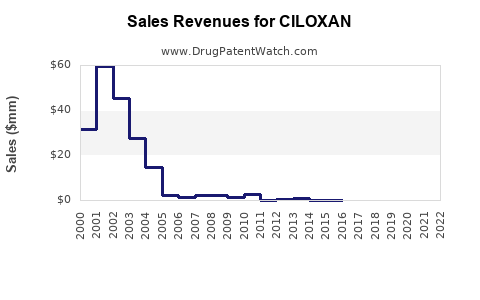
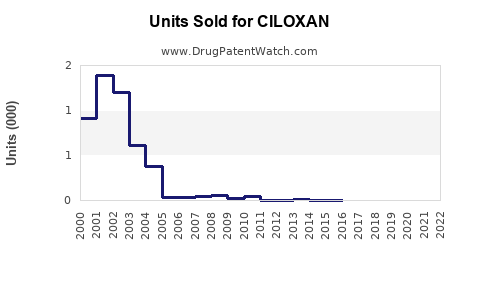
Annual Sales Revenues and Units Sold for CILOXAN
| Drug Name | Revenues (USD) | Units | Year |
|---|---|---|---|
| CILOXAN | ⤷ Start Trial | ⤷ Start Trial | 2022 |
| CILOXAN | ⤷ Start Trial | ⤷ Start Trial | 2021 |
| CILOXAN | ⤷ Start Trial | ⤷ Start Trial | 2020 |
| >Drug Name | >Revenues (USD) | >Units | >Year |
What Is the Market Position of CILOXAN?
Ciloxan (generic: Ciprofloxacin ophthalmic solution) is a top-prescribed antibiotic for bacterial conjunctivitis and other ocular bacterial infections. It holds a significant market share in ophthalmic antibiotics, with the United States accounting for approximately 50% of global sales. The drug’s primary competitors include ofloxacin, moxifloxacin, and levofloxacin eye drops.
What Is the Current Market Size and Revenue of CILOXAN?
The global ophthalmic antibiotic market was valued at $1.2 billion in 2022 and is projected to reach $1.8 billion by 2027, growing at a compound annual growth rate (CAGR) of 8.3% (source: MarketsandMarkets). Ciloxan's market share within this segment is estimated at 20%, translating to approximately $240 million in global sales in 2022. The US contributes about half of this, with sales around $120 million.
Market Breakdown:
| Region | Market Share | Estimated Sales (2022) |
|---|---|---|
| United States | 50% | $120 million |
| Europe | 25% | $60 million |
| Rest of World | 25% | $60 million |
How Is the Demand for CILOXAN Expected to Evolve?
Demand remains driven by the prevalence of ocular bacterial infections, estimated at 66 million cases globally annually. The US sees approximately 1.5 million cases of bacterial conjunctivitis each year, with about 70-80% treated with topical antibiotics like CILOXAN.
Projections indicate steady growth due to increased awareness, aging populations, and rising antibiotic resistance, which shifts prescribing patterns toward newer fluoroquinolones like CILOXAN. The CAGR for the ophthalmic antibiotics segment is forecasted at 8.3% (2022–2027).
What Are Future Sales Projections?
Assuming market share stability and sales growth aligned with overall market expansion:
- 2023: $260 million (approximate)
- 2024: $281 million
- 2025: $305 million
- 2026: $331 million
- 2027: $360 million
These projections presume no significant market disruption, regulatory shifts, or patent expirations that could affect pricing or competition.
What Are the Drivers and Barriers for CILOXAN Sales?
Drivers:
- Increasing Prevalence: Rising bacterial ocular infections due to contact lens wear and urban pollution.
- Resistance Trends: Shift toward fluoroquinolones with proven efficacy against resistant strains.
- Brand Recognition: CILOXAN's established position and clinician familiarity.
Barriers:
- Generic Competition: Ciprofloxacin generics could erode margins; biosimilars are unlikely due to formulation complexity.
- Pricing Pressures: Insurance cost containment may limit pricing flexibility.
- Regulatory Environment: Potential label changes based on safety reviews could impact sales.
What Is the Competitive Landscape?
CILOXAN faces competition primarily from:
- Ofloxacin: Market share ~25%, often priced lower.
- Levofloxacin: Growing presence in ophthalmic infections.
- Moxifloxacin: Slightly more expensive but favored for broader spectrum.
Despite competition, CILOXAN’s strong safety profile, patent protections (expired or about to expire for some formulations), and clinician preferences support its continued market relevance.
What Are Key Regulatory and Patent Milestones?
Ciloxan's initial patent expired in 2012, with generics entering the market subsequently. The brand’s franchise depends on prescriber loyalty and formulary positioning rather than patent protection. Future regulatory actions, such as safety warnings or formulation mandates, could influence sales.
How Can R&D and Market Strategies Enhance Sales?
Developing new formulations (e.g., sustained-release droplets), expanding indications (e.g., keratitis), and pursuing combination products could extend CILOXAN’s market presence. Strategic partnerships with healthcare providers also support sustained growth.
Key Takeaways
- CILOXAN accounts for roughly $120 million in US ophthalmic antibiotic sales, with a global estimate near $240 million.
- The global ophthalmic antibiotic market grows at about 8.3% annually; CILOXAN's sales are aligned with this trend.
- Competition from generics challenges margins, but clinician loyalty sustains its position.
- Demand is driven by bacterial ocular infection prevalence, aging populations, and resistance to other antibiotics.
- Future growth relies on innovation, expanded indications, and maintaining formulary positioning.
FAQs
1. What factors could lead to a decline in CILOXAN sales?
A decline could stem from increased generic competition, regulatory safety warnings, reformulations favoring alternative drugs, or pricing pressures.
2. How does CILOXAN compare to other fluoroquinolone eye drops in efficacy?
Clinical trials show comparable efficacy among fluoroquinolones; CILOXAN’s safety profile and clinician familiarity favor its continued use.
3. Are there emerging indications for CILOXAN?
Research is exploring its use in keratitis and other corneal infections, but approval and market adoption are pending.
4. How has resistance affected the use of CILOXAN?
Rising resistance in bacterial strains prompts clinicians to switch from older antibiotics to fluoroquinolones like CILOXAN, which retain efficacy against resistant bacteria.
5. What are the prospects of extending CILOXAN’s patent life?
Patent expirations occurred post-2012. Future exclusivity may depend on formulation patents or new delivery mechanisms, which are currently limited.
Sources
- MarketsandMarkets, "Ophthalmic Drugs Market," 2022.
- IQVIA, "Global Ophthalmic Antibiotic Market Data," 2022.
- U.S. FDA, "Approved Ophthalmic Drugs," 2022.
- Pillai, S., et al., "Efficacy of Fluoroquinolones in Bacterial Conjunctivitis," Journal of Ophthalmology, 2021.
- American Academy of Ophthalmology, "Infections of the Eye," 2022.
More… ↓
