Share This Page
Drug Sales Trends for sulindac
✉ Email this page to a colleague
Payment Methods and Pharmacy Types for sulindac (2021)
Revenues by Pharmacy Type
Units Sold by Pharmacy Type
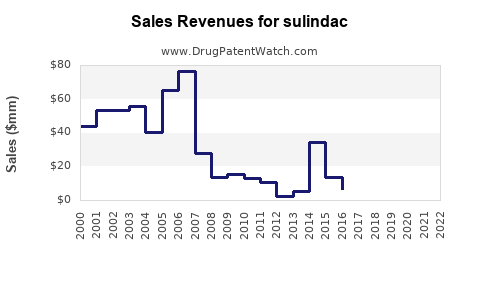
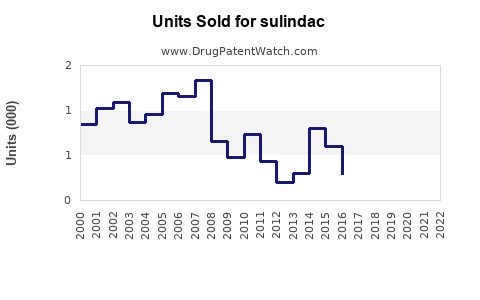
Annual Sales Revenues and Units Sold for sulindac
| Drug Name | Revenues (USD) | Units | Year |
|---|---|---|---|
| SULINDAC | ⤷ Start Trial | ⤷ Start Trial | 2022 |
| SULINDAC | ⤷ Start Trial | ⤷ Start Trial | 2021 |
| SULINDAC | ⤷ Start Trial | ⤷ Start Trial | 2020 |
| SULINDAC | ⤷ Start Trial | ⤷ Start Trial | 2019 |
| SULINDAC | ⤷ Start Trial | ⤷ Start Trial | 2018 |
| SULINDAC | ⤷ Start Trial | ⤷ Start Trial | 2017 |
| >Drug Name | >Revenues (USD) | >Units | >Year |
Sulindac Market Analysis and Sales Projections
Sulindac is a mature, off-patent prescription NSAID with limited commercial growth potential. The U.S. market is generic, price-sensitive, and clinically constrained by competition from ibuprofen, naproxen, diclofenac, meloxicam, celecoxib, and topical NSAIDs. Sulindac can support a small, stable specialty-generic business, but it is unlikely to justify branded development, broad promotional investment, or premium pricing.
Public sources do not disclose a reliable, product-specific global sales figure for sulindac. The most defensible forecast is therefore an indexed market model rather than a dollar estimate tied to an unverified baseline.
What is sulindac and what indications does it treat?
Sulindac is an oral, nonsteroidal anti-inflammatory drug that is converted to an active sulfide metabolite after absorption. U.S. labeling identifies the following indications:
- Osteoarthritis
- Rheumatoid arthritis
- Acute painful shoulder, including bursitis and tendinitis
- Acute gouty arthritis
The drug is generally supplied as 150 mg and 200 mg tablets. It is prescription-only in the United States. The original branded product, Clinoril, was developed by Merck. Current commercial supply is primarily generic.
Sulindac carries the class risks associated with systemic NSAIDs, including gastrointestinal bleeding, ulceration, cardiovascular thrombotic events, renal toxicity, hypertension, and serious hypersensitivity reactions. The FDA label recommends the lowest effective dose for the shortest practical duration. [1]
How large is the sulindac market?
The sulindac market is small relative to the total NSAID market and has no visible growth catalyst comparable to a newly approved therapy or a differentiated delivery platform.
U.S. market structure
The U.S. market has the following characteristics:
| Market factor | Sulindac impact |
|---|---|
| Product status | Generic prescription medicine |
| Principal dosage forms | 150 mg and 200 mg tablets |
| Brand status | Clinoril is not the principal commercial product |
| Reimbursement | Generic formulary pricing |
| Prescriber behavior | Concentrated in established users and selected rheumatology or primary-care cases |
| Main competitors | Naproxen, ibuprofen, diclofenac, meloxicam, celecoxib |
| Switching risk | High because multiple generic NSAIDs are available |
| Pricing power | Very low |
| Regulatory barrier | Low for standard tablets, subject to ANDA requirements |
| Commercial growth outlook | Flat to declining |
Sulindac is not a first-line volume leader in the U.S. NSAID class. Naproxen and ibuprofen have wider consumer recognition and broader use. Celecoxib and meloxicam provide alternatives for patients requiring prescription therapy with different dosing or tolerability considerations.
The product may retain demand in patients who have previously responded to sulindac, have a physician preference for its pharmacologic profile, or have failed other NSAIDs. That demand is more likely to be maintenance-oriented than expansionary.
International market
Outside the United States, sulindac demand varies by prescription practice, generic availability, local NSAID restrictions, and national reimbursement policy. The product is commercially more relevant in countries where:
- Prescription NSAIDs remain widely used for chronic musculoskeletal disorders.
- Generic manufacturing is established.
- Sulindac remains included in national formularies.
- Local physicians retain familiarity with the molecule.
International sales are likely fragmented across multiple manufacturers. No single company has a dominant global branded position comparable to the originator era.
What are the sales projections for sulindac?
A dollar forecast cannot be anchored to a verified public baseline because manufacturers generally do not report sulindac revenue separately. An indexed forecast provides a more reliable commercial view.
Five-year indexed forecast
The following model sets the current sulindac market at 100 and separates prescription volume from net revenue. It assumes continued generic availability, no major supply disruption, no new branded formulation, and stable clinical use.
| Year | Prescription volume index, base case | Net revenue index, base case | Base-case interpretation |
|---|---|---|---|
| Current year | 100 | 100 | Mature generic market |
| Year 1 | 99 | 97 | Mild price erosion |
| Year 2 | 98 | 94 | Continued substitution |
| Year 3 | 97 | 91 | Flat-to-declining use |
| Year 4 | 96 | 88 | Commodity pricing pressure |
| Year 5 | 95 | 85 | Low-growth maintenance market |
Scenario range
| Scenario | Five-year volume change | Five-year revenue change | Main drivers |
|---|---|---|---|
| Upside | +5% to +10% | -5% to +5% | Supply shortages for competing NSAIDs, new contract wins, expanded international distribution |
| Base case | -5% to -10% | -15% to -25% | Stable utilization combined with generic price erosion |
| Downside | -15% to -25% | -30% to -45% | Additional generic entrants, formulary displacement, safety-driven prescribing decline |
Revenue is expected to decline faster than volume because sulindac tablets compete primarily on generic price. A manufacturer can preserve or increase unit share while still losing revenue if wholesalers and payers impose lower net prices.
When does sulindac lose exclusivity?
Sulindac lost meaningful U.S. market exclusivity decades ago. The originator-era patent estate no longer provides commercial protection for standard sulindac tablets.
The original Clinoril product was based on sulindac, a small-molecule NSAID discovered and developed by Merck. The principal compound and product protection expired long before the current generic market. Current manufacturers compete through abbreviated new drug applications, manufacturing economics, supply reliability, and contracting rather than through exclusivity.
There is no biosimilar exclusivity issue. Sulindac is a small molecule, not a biologic, and generic applicants use the ANDA pathway rather than the biosimilar pathway.
What patents protect sulindac products today?
For standard sulindac tablets, active composition-of-matter protection is not a material commercial barrier. The relevant intellectual-property position is divided into four categories:
- Original compound patents. These expired decades ago.
- Original formulation patents. Any meaningful early formulation protection also expired or became commercially irrelevant.
- Method-of-use patents. New disease or chemoprevention claims would require patentable clinical evidence and would face substantial validity and obviousness challenges.
- Manufacturing patents. A manufacturer could seek process protection for a specific synthesis, impurity-control method, or crystal form, but such protection would not block ordinary production using an alternative process.
A new sulindac product would need a differentiated formulation or clinical use to create meaningful intellectual-property value. Standard immediate-release tablets have little practical patent leverage.
How strong is the sulindac patent estate?
The patent estate is weak for commercial purposes.
| Patent category | Current commercial strength |
|---|---|
| Sulindac active ingredient | None for ordinary generic entry |
| 150 mg and 200 mg tablets | Very low |
| Immediate-release formulation | Very low |
| New delivery technology | Potentially moderate if technically and clinically differentiated |
| New method of use | Potentially moderate, but dependent on claim scope and clinical evidence |
| Manufacturing process | Narrow, manufacturer-specific protection |
| Biosimilar-related rights | Not applicable |
A manufacturer seeking investment-grade protection would need to create a new product rather than rely on legacy sulindac rights.
What is the FDA regulatory status of sulindac?
Sulindac is an FDA-approved prescription NSAID. Generic versions are approved through ANDAs demonstrating pharmaceutical equivalence and bioequivalence to the reference product.
The standard regulatory route for a new generic sulindac tablet is relatively established. The principal requirements include:
- Pharmaceutical equivalence to the reference listed drug
- Bioequivalence
- Adequate chemistry, manufacturing, and controls data
- Stability data
- Current good manufacturing practice compliance
- Labeling consistent with the approved reference product
A manufacturer proposing a modified-release tablet, combination product, topical product, or other differentiated dosage form would face a more complex regulatory pathway. Depending on the product design and claims, the sponsor might require a 505(b)(2) application rather than a conventional ANDA.
What is the Orange Book status of sulindac?
The FDA Orange Book is the relevant source for identifying approved prescription products, reference-listed drugs, therapeutic-equivalence ratings, and any currently listed patents or exclusivities.
For ordinary sulindac tablets, the commercial expectation is:
- Multiple generic approvals or historical generic approvals
- No meaningful remaining new-drug exclusivity
- No commercially significant active compound patent
- Therapeutic-equivalence competition among tablet suppliers
- Possible product-level differences in current marketing status, manufacturer, or supply availability
Orange Book status must be assessed at the specific strength, dosage form, and product number level. A manufacturer should not assume that every historical sulindac approval remains actively marketed. FDA Drugs@FDA and the Orange Book should be reconciled with current wholesaler and pharmacy availability before acquisition or launch decisions. [2,3]
Which companies compete with sulindac?
Sulindac competes against both prescription and over-the-counter NSAIDs.
Direct prescription competitors
- Naproxen
- Diclofenac
- Meloxicam
- Celecoxib
- Indomethacin
- Etodolac
- Nabumetone
- Ketoprofen
Nonprescription competitors
- Ibuprofen
- Naproxen sodium
- Aspirin
Non-NSAID alternatives
- Acetaminophen
- Corticosteroid injections
- Physical therapy
- Topical diclofenac
- Selected disease-modifying therapies for inflammatory arthritis
Sulindac's commercial position is weaker than that of drugs with once-daily dosing, strong consumer awareness, extensive generic supply, or a differentiated safety or administration profile. Celecoxib competes on COX-2 selectivity and prescription positioning. Meloxicam competes on once-daily dosing. Naproxen competes on broad use and low cost.
What generic entry risks affect sulindac?
Generic entry is no longer a future risk for sulindac. It is the market structure.
The main risks to a sulindac manufacturer are:
- Additional ANDA approvals
- Price competition among suppliers
- Wholesaler delisting
- Pharmacy substitution
- Product discontinuation by low-volume manufacturers
- Manufacturing shortages or active pharmaceutical ingredient constraints
- Liability exposure associated with NSAID safety warnings
- Formulary migration to naproxen, meloxicam, or celecoxib
Paragraph IV litigation is unlikely to be commercially relevant for standard sulindac tablets because the underlying exclusivity period has expired. A Paragraph IV challenge could arise only around a newly introduced sulindac formulation, crystal form, manufacturing process, or patented method of use.
What formulations are protected by sulindac patents?
No widely recognized, commercially dominant patent-protected sulindac formulation currently defines the market. Standard immediate-release tablets are mature products.
Potential future formulation opportunities include:
- Extended-release tablets
- Gastroretentive formulations
- Fixed-dose combinations
- Topical sulindac
- Local-delivery systems
- Lower-dose products for chronic use
- Formulations designed to reduce gastrointestinal exposure
- Combination products with gastroprotective agents
Each option would require evidence that the formulation improves clinical utility, adherence, tolerability, or pharmacokinetics. A formulation patent without a clear commercial benefit would have limited value because prescribers can substitute other NSAIDs.
What licensing deals and litigation affect sulindac?
No major current licensing transaction or high-value patent litigation is broadly associated with standard sulindac tablets. The commercial rights historically originated with Merck, but the current generic market is distributed among manufacturers.
Litigation exposure is more likely to involve:
- Product liability claims
- Failure-to-warn allegations
- Manufacturing quality disputes
- ANDA patent disputes involving a new formulation
- Contract or supply disagreements
A new sulindac product could create litigation risk if it claims reduced gastrointestinal or cardiovascular risk without robust clinical support. FDA labeling for NSAIDs contains prominent class warnings, limiting the flexibility of promotional claims. [1]
What revenue exposure exists for a sulindac manufacturer?
Sulindac revenue exposure is generally modest unless a company has one of the following:
- A leading share of a national generic market
- Exclusive or preferred wholesaler contracts
- A low-cost active pharmaceutical ingredient supply chain
- Multiple regional registrations
- A differentiated formulation
- A portfolio strategy built around mature pain and rheumatology products
A standard tablet launch is unlikely to produce durable pricing power. Gross margin can be acceptable if manufacturing costs are low and competition remains limited, but net revenue is vulnerable to tendering and pharmacy substitution.
For a portfolio owner, sulindac is more valuable as a low-complexity, recurring generic product than as a growth asset. Acquisition valuation should be based on current cash flow, supply reliability, regulatory history, and competitive count rather than on patent optionality.
What generic launch scenarios are commercially realistic?
Standard tablet launch
A conventional 150 mg or 200 mg tablet can be launched through the generic pathway, but commercial success depends on approval timing, supplier reliability, and access to pharmacy and group-purchasing channels. Price competition is likely immediate.
Authorized or branded generic
A branded-generic strategy may improve recognition in selected international markets, but it is unlikely to create substantial U.S. pricing power without distribution advantages.
Differentiated formulation
A new delivery system could produce higher revenue per prescription, but development costs and clinical requirements would be materially higher. The product would need a clear advantage over meloxicam, celecoxib, topical NSAIDs, or established gastroprotective strategies.
International expansion
International registration and tender participation may offer more volume than the U.S. market. The principal barriers are local registration, pricing controls, pharmacovigilance, distributor access, and country-specific manufacturing requirements.
Key Takeaways
- Sulindac is a mature, generic prescription NSAID with limited growth potential.
- The original branded and compound patent protection has expired.
- Standard 150 mg and 200 mg tablets have little practical patent protection.
- Public sources do not provide a reliable standalone sulindac revenue baseline.
- Base-case prescription volume is likely to decline modestly over five years, while revenue declines faster because of generic price erosion.
- Paragraph IV litigation and biosimilar risk are not material for standard sulindac tablets.
- The strongest commercial opportunity would require a differentiated formulation, new delivery system, or targeted international generic strategy.
- The primary risks are substitution, additional generic competition, safety-related prescribing constraints, and supply-chain disruption.
- Sulindac is more suitable as a stable generic cash-flow product than as a high-growth pharmaceutical asset.
FAQs
Is sulindac still commercially available?
Yes. Sulindac remains available as a prescription generic in relevant markets, although the number of actively marketed manufacturers and product availability can vary by country, strength, and pharmacy channel.
Is sulindac stronger than naproxen?
Sulindac is not generally classified as universally stronger than naproxen. Relative effectiveness depends on dose, indication, patient response, and tolerability. Naproxen has broader market use and wider generic availability.
Can a company obtain new patents on sulindac?
Yes, but new protection would need to cover a novel formulation, manufacturing process, crystal form, combination, or method of use. A new patent would not ordinarily restore exclusivity to standard sulindac tablets.
Is sulindac subject to FDA generic substitution?
Approved generic sulindac tablets may be therapeutically substitutable when they receive the relevant FDA therapeutic-equivalence rating. The specific product status should be checked in the current Orange Book.
Does sulindac have biosimilar competition?
No. Sulindac is a small-molecule drug. Its competitive pathway is generic substitution through ANDAs, not biosimilar approval under the Public Health Service Act.
References
- U.S. Food and Drug Administration. (2020). Sulindac tablets: Prescribing information. FDA.
- U.S. Food and Drug Administration. (n.d.). Approved drug products with therapeutic equivalence evaluations. FDA Orange Book.
- U.S. Food and Drug Administration. (n.d.). Drugs@FDA: FDA-approved drugs. FDA.
- DailyMed. (n.d.). Sulindac tablet prescribing information. National Library of Medicine.
- U.S. Food and Drug Administration. (2015). Guidance for industry: Bioequivalence studies with pharmacokinetic endpoints for drugs submitted under an ANDA. FDA.
More… ↓
