Share This Page
Drug Sales Trends for nadolol
✉ Email this page to a colleague
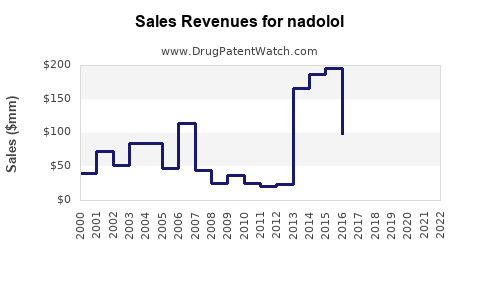
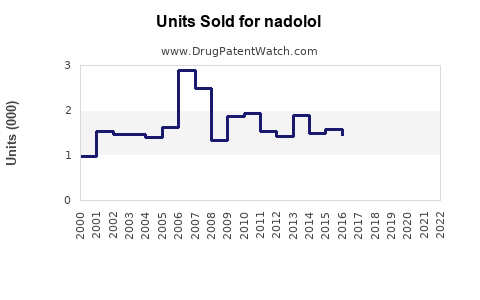
Annual Sales Revenues and Units Sold for nadolol
| Drug Name | Revenues (USD) | Units | Year |
|---|---|---|---|
| NADOLOL | ⤷ Start Trial | ⤷ Start Trial | 2022 |
| NADOLOL | ⤷ Start Trial | ⤷ Start Trial | 2021 |
| NADOLOL | ⤷ Start Trial | ⤷ Start Trial | 2020 |
| >Drug Name | >Revenues (USD) | >Units | >Year |
Nadolol Market Analysis, Sales Projections, Patent Status, and Generic Competition
Nadolol is a mature, low-cost generic beta blocker with limited growth potential but durable demand in hypertension, angina, arrhythmia management, and selected off-label cardiovascular uses. The U.S. market is driven almost entirely by generic prescriptions. No active branded exclusivity supports Corgard, and nadolol is not a biologic subject to biosimilar competition. Base-case U.S. sales are likely to remain broadly stable through 2029, with revenue growth driven by price, channel mix, and supply conditions rather than prescription expansion.
A reasonable planning range for the U.S. nadolol market is approximately $20 million to $50 million in annual manufacturer and pharmacy sales, depending on the revenue definition used. Public sources do not provide a single authoritative, current nadolol market-sales figure. The projections below therefore use a volume-and-price model rather than reported company revenue.
What is nadolol and how is it used?
Nadolol is a long-acting, nonselective beta-adrenergic blocker. It reduces heart rate, myocardial contractility, and renin release. The FDA-approved indications for Corgard included hypertension and angina pectoris. Nadolol is also used off label for certain arrhythmias, congenital long-QT syndrome, portal hypertension, and migraine prevention, although clinical practice varies by indication and patient population.[1]
What are nadolol’s main dosage forms?
Nadolol is primarily sold as immediate-release tablets in the following strengths:
| Strength | Typical use |
|---|---|
| 20 mg | Lower-dose initiation or dose adjustment |
| 40 mg | Common maintenance strength |
| 80 mg | Common maintenance strength |
| 160 mg | Higher-dose treatment |
Nadolol is generally administered once daily. Its long elimination half-life, commonly reported at approximately 20 to 24 hours, supports once-daily dosing. The drug is substantially eliminated through the kidneys, making renal-function assessment important for dosing.[1]
Which patients are most relevant commercially?
The principal commercial segments are:
- Patients with hypertension who remain on a long-established beta-blocker regimen.
- Patients with angina or rate-control requirements.
- Patients with congenital long-QT syndrome or other arrhythmia indications, where nadolol may be selected for its long duration of action.
- Patients requiring a low-cost alternative to other beta blockers.
Nadolol is not a first-line growth product in most modern hypertension treatment algorithms. Current guidelines generally favor thiazide-type diuretics, ACE inhibitors, angiotensin-receptor blockers, and calcium-channel blockers for many patients.[2] This limits prescription expansion.
How large is the nadolol market?
Nadolol is a small generic market within the broader beta-blocker category. Metoprolol, atenolol, propranolol, carvedilol, and bisoprolol have larger patient populations and broader commercial reach.
U.S. market structure
The market has four defining characteristics:
- Generic substitution is extensive.
- Brand Corgard has little commercial relevance compared with generic nadolol.
- Manufacturer concentration can change quickly because several suppliers may enter or exit.
- Unit prices are low, but shortages or discontinuations can produce temporary price increases.
The market is split between retail pharmacy prescriptions and institutional, specialty, or mail-order distribution. Retail volume is likely the largest component, while congenital arrhythmia use is commercially small but clinically important.
Competitive comparison with other beta blockers
| Drug | Selectivity | Typical dosing | Market position | Competitive effect on nadolol |
|---|---|---|---|---|
| Nadolol | Nonselective | Once daily | Mature niche generic | Retains users requiring long duration or established therapy |
| Propranolol | Nonselective | Often multiple daily doses | Broad generic and specialty use | Strong substitute in arrhythmia, migraine, and tremor |
| Metoprolol tartrate | Beta-1 selective | Often twice daily | High-volume generic | Major substitute in hypertension and cardiovascular disease |
| Metoprolol succinate | Beta-1 selective | Once daily | High-volume chronic therapy | Competes for once-daily cardiovascular treatment |
| Atenolol | Beta-1 selective | Once daily | Mature generic | Competes on price and simplicity |
| Carvedilol | Nonselective with alpha blockade | Once or twice daily | Heart-failure and hypertension use | Less direct substitution in some indications |
Nadolol’s strongest commercial defenses are patient continuity, physician familiarity, once-daily dosing, and use in selected arrhythmia populations. Its principal weaknesses are low differentiation, generic pricing, renal dosing constraints, and competition from much larger beta-blocker franchises.
What are the nadolol sales projections through 2029?
The following model uses a 2024 U.S. market baseline of $30 million in estimated annual sales across generic nadolol and residual branded-equivalent products. The model assumes approximately 1.5 million annual prescriptions, an average realized revenue of $20 per prescription, and a mature-market prescription decline of 0% to 1% annually.
Base-case U.S. sales projection
| Year | Estimated prescriptions | Average realized revenue per prescription | Estimated market sales |
|---|---|---|---|
| 2024 | 1.50 million | $20.00 | $30.0 million |
| 2025 | 1.49 million | $20.20 | $30.1 million |
| 2026 | 1.48 million | $20.40 | $30.2 million |
| 2027 | 1.47 million | $20.60 | $30.3 million |
| 2028 | 1.46 million | $20.80 | $30.4 million |
| 2029 | 1.45 million | $21.00 | $30.5 million |
The base case implies essentially flat nominal growth and a modest decline in prescription volume. This is the most likely commercial profile for an old generic without new indications, new formulations, or supply disruption.
Scenario analysis
| Scenario | 2029 prescriptions | 2029 average revenue per prescription | 2029 sales | Principal drivers |
|---|---|---|---|---|
| Downside | 1.20 million | $16 | $19.2 million | Substitution by metoprolol or propranolol, supplier exits, reimbursement pressure |
| Base case | 1.45 million | $21 | $30.5 million | Stable chronic use and modest price inflation |
| Upside | 1.75 million | $28 | $49.0 million | Supply shortages, increased arrhythmia use, higher acquisition prices |
The upside case is more likely to arise from temporary supply tightness than from sustained demand growth. In a competitive generic market, elevated prices usually attract additional supply, limiting the duration of price expansion.
Global sales outlook
Global nadolol sales are harder to isolate because many countries report beta-blocker sales at the class level or combine products under hospital and pharmacy procurement categories. Europe and Canada have established generic access, while commercial opportunity in emerging markets is constrained by low prices and competition from atenolol, propranolol, and metoprolol.
A reasonable global outlook is low-single-digit annual decline or flat performance through 2029, unless a manufacturer secures a differentiated formulation or a major supply contract. The U.S. should remain the most commercially relevant market because of higher prescription reimbursement and a larger branded-generic price spread.
When does nadolol lose exclusivity?
Nadolol has already lost commercial exclusivity in the United States. Corgard was approved decades ago, and generic nadolol products are widely available. The relevant commercial question is not loss of exclusivity but generic-supply economics.
The FDA’s Orange Book is the principal source for approved products, therapeutic-equivalence information, and listed patents or exclusivity for FDA-approved drugs.[3] Nadolol’s current market status is consistent with a fully genericized product:
- No meaningful branded market protection remains.
- Generic tablets are available from multiple manufacturers or authorized distributors.
- No active new-drug exclusivity is expected to block additional abbreviated new drug applications.
- Patent risk is low for the legacy active ingredient and standard tablet formulation.
What is the Orange Book status of nadolol?
Nadolol’s commercial Orange Book position is that of an old small-molecule drug with generic equivalents. Corgard is associated with the original NDA for nadolol, while generic manufacturers market products through ANDAs.
Patent and exclusivity assessment
| Issue | Nadolol status |
|---|---|
| Active ingredient patent | Expired or commercially irrelevant |
| Original product patent | Expired |
| FDA new-drug exclusivity | Expired |
| Generic ANDA pathway | Available |
| Orange Book patent barrier | No material current barrier identified |
| Biosimilar pathway | Not applicable |
| Paragraph IV significance | Low for the legacy product |
Publicly available FDA product records do not identify a current patent estate capable of preventing ordinary generic competition for standard nadolol tablets. The principal legal exposure for a new entrant would arise from a later-developed formulation, combination product, manufacturing process, or method-of-use patent rather than from the original nadolol molecule.[3]
What formulations are protected by nadolol patents?
Standard immediate-release nadolol tablets have limited patent defensibility. A manufacturer seeking differentiated protection would need to pursue a product such as:
- A modified-release formulation.
- A fixed-dose combination.
- A liquid formulation with improved pediatric or swallowing suitability.
- A formulation designed for renal impairment or dose titration.
- A specialty presentation supported by a new clinical indication.
Any such product would require separate FDA approval and potentially new patent claims. Formulation patents would not necessarily block existing generic immediate-release tablets. Their commercial value would depend on clinical benefit, reimbursement, and whether physicians switch patients from inexpensive generics.
Manufacturing and intellectual-property barriers
Nadolol is a chemically established small molecule. Manufacturing barriers are therefore more likely to involve quality systems, validation, supply reliability, and regulatory compliance than difficult chemistry. Relevant commercial risks include:
- Dependence on a limited number of active pharmaceutical ingredient suppliers.
- Batch failures or manufacturing-site remediation.
- FDA inspection findings.
- Low market value relative to fixed regulatory costs.
- Inability to maintain adequate inventory during demand spikes.
For a low-priced generic, regulatory and supply-chain execution can be more important than patent ownership.
Which companies are challenging nadolol’s market?
The competitive field consists primarily of generic manufacturers and distributors rather than branded innovators. Supplier participation can vary by dosage strength and time period. Common market participants in generic cardiovascular products have included large U.S. and international generic companies such as Teva, Viatris, Sandoz, Zydus, and Par Pharmaceutical, although product availability must be verified against current FDA listings and wholesaler data.
No biosimilar companies are relevant because nadolol is a synthetic small molecule, not a biologic. The relevant competitive threats are:
- Additional ANDA entrants.
- Contract manufacturers offering lower-cost supply.
- Competing beta blockers.
- Retail substitution driven by formulary placement.
- Manufacturer withdrawals caused by low margins.
What patent litigation affects nadolol?
No product-defining patent litigation is apparent for legacy immediate-release nadolol tablets. Paragraph IV litigation is unlikely to be commercially significant because the original active-ingredient and branded-product protections have expired.
Litigation risk could emerge if a company launches a new nadolol formulation or pursues a narrow method-of-use indication. In that case, patent disputes could involve:
- Validity of formulation claims.
- Obviousness of once-daily or extended-release delivery.
- Written-description and enablement requirements.
- Induced infringement based on prescribing information.
- Inter partes review or district-court challenges.
There is no established settlement framework comparable to major branded products with high-value generic launch dates. Any future settlement would likely concern a new specialty formulation rather than the standard generic tablet market.
What FDA regulatory status does nadolol have?
Nadolol is an FDA-approved prescription drug marketed for cardiovascular use. Standard generic versions are approved through the ANDA pathway and must demonstrate pharmaceutical equivalence and bioequivalence to the reference product.[4]
The regulatory profile is favorable for established manufacturers but still requires compliance with:
- Current good manufacturing practice requirements.
- Stability and dissolution specifications.
- Bioequivalence standards.
- Labeling and pharmacovigilance obligations.
- Supply-chain and drug-shortage reporting requirements.
The regulatory risk is moderate for new entrants because the clinical development burden is limited, but manufacturing and quality requirements remain material.
How strong is the nadolol patent estate?
The patent estate is weak for the legacy product and potentially moderate for a genuinely differentiated follow-on product.
| Patent category | Strength | Commercial assessment |
|---|---|---|
| Original molecule | Low | Expired and open to generic competition |
| Standard tablet | Low | Limited differentiation |
| New dosage form | Moderate | Depends on technical performance and claim scope |
| Fixed-dose combination | Moderate | Requires clinical and regulatory support |
| Method of use | Low to moderate | Vulnerable if based on known beta-blocker use |
| Manufacturing process | Moderate | Can protect supply economics but is difficult to enforce broadly |
The strongest potential moat would be a clinically validated formulation with improved adherence, pediatric utility, or a clearly defined specialty indication. Without those attributes, nadolol remains a price-driven generic.
What generic launch risks exist for nadolol?
A new generic entrant would face low patent risk but meaningful commercial risk. Expected challenges include:
- Small total addressable market.
- Low average selling prices.
- Established prescriber habits.
- Limited incentive for physicians to switch stable patients.
- Wholesaler and pharmacy concentration.
- Potential price erosion after launch.
- Difficulty securing profitable supply contracts.
- Competition from therapeutic substitutes.
A launch is most attractive when the applicant has a reliable API source, multiple dosage strengths, and a distribution platform already serving cardiovascular generics. Launching only one strength would reduce inventory cost but limit formulary and pharmacy uptake.
What is the revenue exposure for manufacturers?
Nadolol is unlikely to be material to the revenue of a diversified generic company. For a small or mid-sized manufacturer, however, a nadolol product can provide stable niche revenue if the company avoids excessive price competition and maintains supply reliability.
The product has low strategic value as a standalone asset but may have portfolio value when combined with other cardiovascular generics. Acquisition interest would likely focus on:
- Existing ANDA approval.
- Manufacturing cost position.
- Approved dosage-strength coverage.
- Historical supply reliability.
- Contracted institutional volume.
- Absence of unresolved FDA quality issues.
Key Takeaways
- Nadolol is a mature, fully genericized beta blocker with stable but limited commercial demand.
- The U.S. market is reasonably modeled at approximately $20 million to $50 million annually, with a base case near $30 million.
- Base-case sales through 2029 are broadly flat because stable chronic use offsets modest prescription erosion.
- Metoprolol, propranolol, atenolol, and carvedilol are the main therapeutic competitors.
- No meaningful Orange Book exclusivity or legacy patent barrier protects standard nadolol tablets.
- Biosimilar risk is irrelevant because nadolol is a synthetic small molecule.
- The most credible growth opportunity is a differentiated formulation or specialty indication, not additional standard-tablet volume.
- Generic launch economics depend more on supply reliability, reimbursement, and manufacturing cost than on patent protection.
- Patent litigation and Paragraph IV risk are low for existing immediate-release nadolol products.
FAQs
Is nadolol still commercially profitable for generic manufacturers?
It can be profitable as part of a broader cardiovascular portfolio, but standalone profitability is constrained by low prices, limited market size, and potential price erosion.
Does nadolol have an authorized generic?
An authorized generic depends on the current marketing and distribution arrangements for the reference product. The practical market is already genericized, so an authorized-generic designation would have limited impact on overall competition.
Can a company obtain new patents on nadolol?
Yes. New patents could cover a novel formulation, fixed-dose combination, manufacturing process, or clinically supported method of use. Such patents would not automatically block existing immediate-release generic tablets.
Is nadolol included in drug-shortage monitoring?
Nadolol availability can vary by manufacturer and dosage strength. Shortage exposure is most relevant when few suppliers remain active or when a manufacturing disruption affects multiple strengths.
Which nadolol indication has the highest future growth potential?
Specialty arrhythmia use, particularly congenital long-QT syndrome, offers greater differentiation than routine hypertension treatment. The addressable population is small, so the indication is more valuable for clinical positioning than for large-scale revenue growth.
References
- U.S. Food and Drug Administration. (2023). Corgard (nadolol) prescribing information.
- Whelton, P. K., Carey, R. M., Aronow, W. S., Casey, D. E., Collins, K. J., Dennison Himmelfarb, C., DePalma, S. M., Gidding, S., Jamerson, K. A., Jones, D. W., MacLaughlin, E. J., Muntner, P., Ovbiagele, B., Smith, S. C., Spencer, C. C., Stafford, R. S., Taler, S. J., Thomas, R. J., Williams, K. A., Williamson, J. D., & Wright, J. T. (2018). 2017 ACC/AHA clinical practice guideline for the prevention, detection, evaluation, and management of high blood pressure in adults. Hypertension, 71(6), e13-e115.
- U.S. Food and Drug Administration. (2024). Approved drug products with therapeutic equivalence evaluations: Orange Book.
- U.S. Food and Drug Administration. (2024). Generic drug facts and ANDA approval standards.
More… ↓
