Share This Page
Drug Sales Trends for dexamethasone
✉ Email this page to a colleague
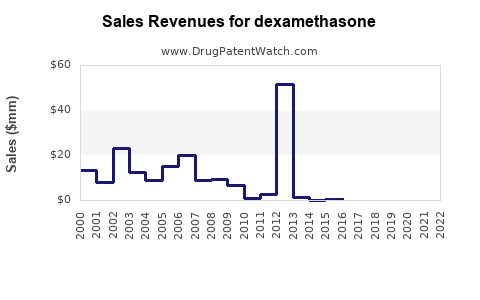
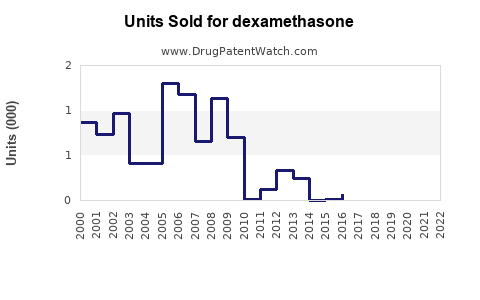
Annual Sales Revenues and Units Sold for dexamethasone
| Drug Name | Revenues (USD) | Units | Year |
|---|---|---|---|
| DEXAMETHASONE | ⤷ Start Trial | ⤷ Start Trial | 2022 |
| DEXAMETHASONE | ⤷ Start Trial | ⤷ Start Trial | 2021 |
| DEXAMETHASONE | ⤷ Start Trial | ⤷ Start Trial | 2020 |
| DEXAMETHASONE | ⤷ Start Trial | ⤷ Start Trial | 2019 |
| DEXAMETHASONE | ⤷ Start Trial | ⤷ Start Trial | 2018 |
| >Drug Name | >Revenues (USD) | >Units | >Year |
Dexamethasone Market Analysis and Sales Projections Through 2030
Dexamethasone is a mature, low-cost corticosteroid with broad use in oncology, antiemesis, respiratory disease, ophthalmology, rheumatology, emergency medicine, and perioperative care. Its global unit demand should remain stable through 2030, while value growth will be concentrated in specialty delivery systems, branded hospital products, ophthalmic formulations, and combination therapies. Conventional oral tablets and injectable dexamethasone face persistent generic price erosion.
A reasonable base-case projection is global dexamethasone pharmaceutical revenue growth of approximately 2% to 4% annually through 2030, driven primarily by volume rather than price. Specialty formulations could grow 5% to 8% annually, while conventional generic products may show flat or declining revenue despite stable or rising unit demand.
What is the current market position of dexamethasone?
Dexamethasone is a synthetic glucocorticoid with high anti-inflammatory and immunosuppressive activity. It is marketed in multiple dosage forms:
| Product category | Principal uses | Commercial position |
|---|---|---|
| Oral tablets and solutions | Inflammation, oncology, cerebral edema, adrenal disorders | Highly commoditized |
| Injectable dexamethasone sodium phosphate | Emergency care, oncology, surgery, severe inflammation | High-volume generic hospital product |
| Ophthalmic suspensions and solutions | Postoperative inflammation, uveitis, ocular allergy | Generic and branded competition |
| Intravitreal implants | Macular edema, diabetic macular edema, retinal vein occlusion | Specialty, higher-value segment |
| Combination ophthalmic products | Inflammation with bacterial infection risk | Branded and generic competition |
| Veterinary products | Inflammation and allergic conditions | Separate animal-health market |
| COVID-19 hospital use | Severe or critical COVID-19 | Demand surge largely normalized |
Dexamethasone has no single consolidated commercial market. Reported market values vary depending on whether analysts include only human pharmaceutical products or also veterinary products, compounded medicines, combination products, and drug-delivery devices.
The active pharmaceutical ingredient is widely available from multiple manufacturers. Competitive differentiation therefore depends on formulation, regulatory approvals, manufacturing reliability, hospital contracts, distribution, and delivery technology rather than molecule ownership.
How large is the dexamethasone market?
Public market reports commonly place the global dexamethasone market in the low-single-digit billions of dollars, but estimates differ materially because of inconsistent product scope and currency assumptions. The most defensible commercial conclusion is that conventional dexamethasone products represent a large unit-volume market with modest dollar growth.
A practical 2024 indexed baseline is:
| Segment | Estimated 2024 revenue index | 2024-2030 outlook |
|---|---|---|
| Oral generic products | 30 | 0% to 2% annual value growth |
| Injectable hospital products | 35 | 1% to 3% annual value growth |
| Ophthalmic products | 15 | 2% to 4% annual value growth |
| Specialty delivery systems | 15 | 5% to 8% annual value growth |
| Other and veterinary products | 5 | 2% to 5% annual value growth |
| Total market | 100 | 2% to 4% annual value growth |
The index avoids false precision caused by inconsistent market definitions. If the 2024 market baseline is treated as 100, the base-case 2030 index would be approximately 113 to 127, depending on the mix of generic and specialty products.
What is driving demand?
Demand is supported by several durable factors:
- Continued use in chemotherapy-induced nausea and vomiting.
- Perioperative and postoperative anti-inflammatory use.
- Treatment of cerebral edema and selected hematologic malignancies.
- Use in severe inflammatory and respiratory conditions.
- Growth in ophthalmic procedures and retinal disease treatment.
- Inclusion in hospital formularies because of low cost and clinical familiarity.
- Expansion of generic access in emerging markets.
COVID-19 created a temporary increase in dexamethasone demand after the RECOVERY trial showed mortality benefits in certain hospitalized patients requiring oxygen or mechanical ventilation. The World Health Organization incorporated systemic corticosteroids into guidance for severe and critical COVID-19, but post-pandemic demand has returned closer to baseline levels [1, 2].
What are the sales projections for dexamethasone through 2030?
The following scenarios use a 2024 revenue index of 100 and model global human pharmaceutical sales.
| Scenario | Annual growth | 2030 revenue index | Commercial assumptions |
|---|---|---|---|
| Downside | -1% to 1% | 94 to 106 | Generic price compression, lower hospital purchasing value, limited specialty expansion |
| Base case | 2% to 4% | 113 to 127 | Stable units, modest emerging-market volume growth, specialty formulation gains |
| Upside | 5% to 7% | 134 to 150 | Strong retinal-care growth, new delivery systems, increased oncology and hospital use |
Base-case sales outlook by segment
| Segment | 2024 index | 2030 base-case index | Expected trend |
|---|---|---|---|
| Oral tablets and solutions | 30 | 30-34 | Stable volume, falling prices |
| Injectable products | 35 | 37-42 | Stable hospital demand with procurement pressure |
| Ophthalmic products | 15 | 17-19 | Moderate procedure-led growth |
| Specialty delivery systems | 15 | 20-24 | Fastest value growth |
| Other products | 5 | 6-8 | Geographic and veterinary expansion |
| Total | 100 | 113-127 | Low-to-mid single-digit growth |
These projections apply to product revenue, not manufacturer profit. Gross margins for basic generic dexamethasone can be compressed by tendering, hospital group purchasing, and API competition. Specialty ophthalmic products may support substantially higher revenue per treatment but carry greater clinical, regulatory, manufacturing, and commercialization costs.
Which companies compete in the dexamethasone market?
Competition is fragmented. Relevant participants include multinational generic manufacturers, regional injectable suppliers, ophthalmic companies, specialty pharmaceutical companies, and contract manufacturers.
Representative market participants include:
- Hikma Pharmaceuticals
- Fresenius Kabi
- Pfizer and legacy Hospira operations
- Sandoz
- Teva Pharmaceutical Industries
- Viatris
- Sun Pharmaceutical Industries
- Cipla
- Dr. Reddy's Laboratories
- Zydus Lifesciences
- Amneal Pharmaceuticals
- Endo and Par Pharmaceutical operations
- AbbVie, through selected ophthalmic and specialty products
- Bausch + Lomb, through ophthalmic products and delivery platforms
- Otsuka, through selected ophthalmic product activities
The competitive set differs by dosage form. Injectable dexamethasone is primarily a hospital procurement market. Oral products compete on price and availability. Ophthalmic products compete on preservative profile, bottle technology, combination positioning, dosing convenience, and product reliability. Intravitreal implants compete through clinical evidence, physician familiarity, reimbursement, and delivery-system differentiation.
What patents protect dexamethasone products?
The basic dexamethasone molecule is long off patent. Composition-of-matter protection does not constrain generic entry for conventional dexamethasone tablets, injections, or standard ophthalmic products.
Patent risk is concentrated in product-specific improvements:
- Sustained-release ocular implants.
- Microparticle and injectable depot systems.
- Novel ophthalmic delivery devices.
- Fixed-dose combinations.
- Drug-device configurations.
- Manufacturing processes with commercial value.
- Method-of-use claims directed to specific diseases or patient groups.
The most commercially important branded delivery system is Ozurdex, an intravitreal dexamethasone implant marketed by AbbVie’s Allergan business for certain retinal conditions. Its value is linked to the implant and applicator technology rather than to new chemical protection for dexamethasone. FDA labeling identifies the approved indications and administration requirements for the product [3].
What formulation patents are important?
Formulation patents can protect:
- Polymer matrices that control dexamethasone release.
- Implant geometry and degradation characteristics.
- Sterility and packaging systems.
- Ophthalmic suspension particle size and stability.
- Preservative-free delivery.
- Combination formulations with antibiotics.
- Device-assisted administration.
These patents can delay direct competition even when the active ingredient is generic. Their practical strength depends on claim scope, prosecution history, patent-term adjustment, obviousness exposure, and whether a competing product can use a different formulation or device.
What is the FDA regulatory and Orange Book status of dexamethasone?
FDA regulatory status varies by dosage form and product.
Conventional dexamethasone tablets and injections are generally approved through abbreviated new drug applications or legacy pathways. Standard generic products are listed in the FDA Orange Book when they qualify for listing under the applicable approval framework. Product-specific patent and exclusivity information must be reviewed at the individual application level because dexamethasone has many approved manufacturers and dosage forms [4].
The regulatory profile is divided into two categories:
Conventional generic products
These include tablets, oral solutions, and injectable dexamethasone sodium phosphate. Their primary commercial barriers are:
- ANDA approval timing.
- Bioequivalence.
- Sterility and manufacturing compliance.
- API supply.
- Drug-shortage risk.
- Hospital contracting.
Specialty products
Specialty ophthalmic products and implants may require more complex clinical, device, manufacturing, or combination-product evidence. They can retain pricing power after conventional dexamethasone products have become generic.
Are there Paragraph IV challenges involving dexamethasone?
Paragraph IV litigation is not a material market-wide issue for conventional dexamethasone because the core compound and standard dosage forms are generic. Paragraph IV activity is more relevant to branded specialty products with listed formulation, device, or method-of-use patents.
For a product such as a dexamethasone implant, a generic or competing manufacturer may challenge listed patents through an ANDA paragraph IV certification. The resulting dispute can concern:
- Non-infringement.
- Invalidity.
- Patent eligibility.
- Obviousness.
- Written description and enablement.
- Device or applicator claims.
- Label-scope issues.
The economic effect is product-specific. A successful challenge could accelerate entry into a higher-margin ophthalmic segment, while a settlement could delay entry until a negotiated date. No single Paragraph IV event defines the conventional dexamethasone market.
When does dexamethasone lose exclusivity?
Dexamethasone lost core molecule exclusivity decades ago. Conventional oral and injectable forms are already generic in major markets. Remaining exclusivity is tied to individual products, formulation patents, regulatory exclusivity, or device claims.
| Protection type | Status |
|---|---|
| Dexamethasone molecule | Expired |
| Standard oral tablets | Generic |
| Standard injectable products | Generic |
| Standard ophthalmic products | Mostly generic, subject to product-specific approvals |
| Extended-release ocular implants | Product-specific patent and regulatory analysis required |
| Combination products | Product-specific patents and approvals |
| Method-of-use claims | Narrow, indication-specific protection |
There is no single dexamethasone patent expiration date applicable to all products.
What generic entry risks exist?
Generic entry risk is high for standard dexamethasone products and moderate to high for many ophthalmic products. The principal risks are commercial rather than legal.
High-risk products
- Standard tablets.
- Standard injectable vials.
- Basic oral solutions.
- Conventional ophthalmic suspensions.
Moderate-risk products
- Preservative-free ophthalmic products.
- Combination ophthalmic products.
- Ready-to-use injectable presentations.
- Products requiring specialized packaging.
Lower near-term entry risk
- Complex intravitreal implants.
- Drug-device products.
- Formulations supported by difficult-to-replicate release profiles.
- Products with manufacturing and clinical complexity.
Manufacturing is a meaningful barrier in sterile injectables and implants. FDA warning letters, supply interruptions, and facility remediation can affect market share quickly because hospital buyers prioritize reliable supply. The same factor can create upside for suppliers with redundant API sourcing, validated sterile facilities, and strong regulatory compliance.
How does dexamethasone compare with competing corticosteroids?
| Drug | Relative commercial position | Key competitive issue |
|---|---|---|
| Dexamethasone | Broad, low-cost, high familiarity | Price erosion |
| Prednisone/prednisolone | Large oral and ophthalmic markets | Established use across chronic inflammation |
| Methylprednisolone | Strong injectable and oral presence | Hospital and acute-care competition |
| Hydrocortisone | Essential acute-care and replacement therapy | Different potency and clinical role |
| Betamethasone | Dermatology and obstetric uses | Narrower but durable indications |
| Triamcinolone | Injectable, dermatology, ophthalmology | Procedure and specialty demand |
Dexamethasone’s advantages are potency, long clinical experience, low cost, and use across multiple specialties. Its disadvantages are limited differentiation in standard formulations and high exposure to generic procurement pressure.
What licensing deals and commercial partnerships matter?
Licensing value is concentrated in delivery systems, ophthalmic products, and combination technologies. A license for generic dexamethasone API has limited strategic value unless it includes:
- A differentiated formulation.
- Regulatory approvals in difficult markets.
- Reliable sterile manufacturing.
- A device or implant platform.
- Hospital distribution rights.
- A branded ophthalmic franchise.
- Technology that reduces dosing frequency.
For conventional tablets and injections, manufacturers typically compete through supply agreements, contract manufacturing, tenders, and distributor relationships rather than high-value molecule licenses.
What is the revenue exposure for manufacturers?
Revenue exposure varies sharply by business model.
| Business model | Revenue outlook | Margin profile |
|---|---|---|
| Commodity oral generic | Stable units, declining price | Low to moderate |
| Hospital injectable supplier | Stable demand, tender pressure | Moderate if supply is reliable |
| Ophthalmic generic supplier | Moderate growth | Moderate |
| Specialty implant company | Higher growth potential | Higher revenue per treatment, higher development cost |
| API manufacturer | Volume-driven | Sensitive to capacity and pricing |
| Branded combination-product company | Niche growth | Dependent on formulation differentiation |
The strongest commercial opportunity is in products that preserve clinical convenience or reduce dosing frequency. The weakest opportunity is an undifferentiated oral or injectable product entering a crowded market without a cost or supply advantage.
What is the outlook for dexamethasone from 2025 to 2030?
Dexamethasone should remain commercially durable but structurally generic. Volume demand is likely to remain resilient because the drug is embedded in hospital protocols, oncology pathways, surgery, ophthalmology, and emergency medicine. Revenue growth will be limited by generic competition and procurement pressure.
The principal upside factors are:
- Growth in retinal disease treatment.
- Expansion of specialty ocular delivery systems.
- Emerging-market access.
- Stable oncology and antiemetic demand.
- Hospital supply disruptions affecting incumbent competitors.
- New fixed-dose combinations or device-enabled products.
The principal downside factors are:
- Continued price deflation.
- API overcapacity.
- Hospital tender consolidation.
- Lower pandemic-related demand.
- Regulatory remediation at manufacturing sites.
- Substitution with other corticosteroids.
Key Takeaways
- Dexamethasone is a mature, genericized corticosteroid with high global unit demand.
- Conventional tablets and injections have limited pricing power and high generic entry risk.
- Specialty ophthalmic implants and delivery systems offer the strongest value-growth prospects.
- A reasonable global revenue forecast is 2% to 4% annual growth through 2030, with specialty products growing faster.
- The active ingredient has no meaningful remaining composition-of-matter exclusivity.
- Patent risk is concentrated in formulations, implants, devices, combinations, and narrow methods of use.
- COVID-19 demand was temporary; long-term demand rests on oncology, surgery, ophthalmology, emergency care, and chronic inflammatory disease.
- Manufacturing reliability and hospital contracting are as important as patent position for standard dexamethasone products.
Frequently Asked Questions
Is dexamethasone still a profitable drug?
It can be profitable at scale, particularly in injectable, ophthalmic, and specialty delivery formats. Standard tablets are generally low-margin because of generic competition.
Does dexamethasone have biosimilar competition?
No. Dexamethasone is a small-molecule drug, not a biologic. Competition occurs through generic drugs and complex generic or specialty-product pathways rather than biosimilar approval.
Can a company obtain new patents on dexamethasone?
Yes. New patents may cover formulations, implants, delivery devices, combinations, manufacturing processes, or specific methods of treatment. A new patent cannot restore expired composition-of-matter protection for the old molecule.
Which dexamethasone product has the highest commercial growth potential?
Long-acting ophthalmic delivery systems and intravitreal implants have the strongest growth potential because they can command higher prices and reduce dosing frequency.
Is dexamethasone included in the FDA Orange Book?
Many approved human dexamethasone products and related branded products are listed in FDA databases, but Orange Book status must be assessed by individual product, dosage form, application, and patent listing.
References
- World Health Organization. (2020). Corticosteroids for COVID-19: Living guidance. WHO.
- RECOVERY Collaborative Group. (2021). Dexamethasone in hospitalized patients with Covid-19. New England Journal of Medicine, 384(8), 693-704.
- U.S. Food and Drug Administration. (2024). Ozurdex prescribing information. FDA.
- U.S. Food and Drug Administration. (2024). Approved drug products with therapeutic equivalence evaluations: Orange Book. FDA.
- U.S. Food and Drug Administration. (2024). Drugs@FDA: FDA-approved drugs. FDA.
More… ↓
