Share This Page
Drug Sales Trends for ZYRTEC
✉ Email this page to a colleague
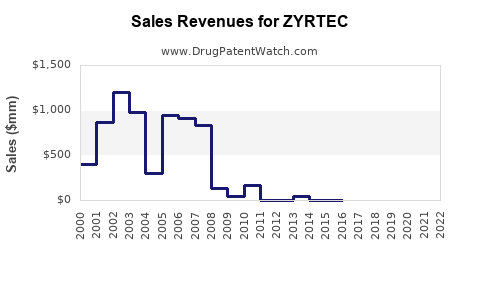
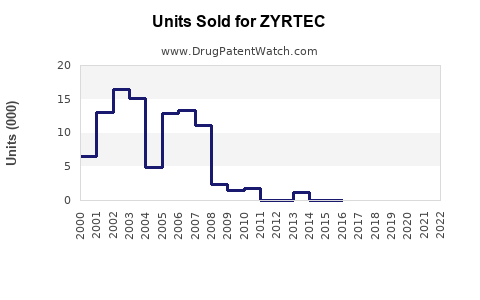
Annual Sales Revenues and Units Sold for ZYRTEC
| Drug Name | Revenues (USD) | Units | Year |
|---|---|---|---|
| ZYRTEC | ⤷ Start Trial | ⤷ Start Trial | 2022 |
| ZYRTEC | ⤷ Start Trial | ⤷ Start Trial | 2021 |
| ZYRTEC | ⤷ Start Trial | ⤷ Start Trial | 2020 |
| ZYRTEC | ⤷ Start Trial | ⤷ Start Trial | 2019 |
| >Drug Name | >Revenues (USD) | >Units | >Year |
Market Analysis and Sales Projections for ZYRTEC (Cetirizine)
What Is the Current Market Size for ZYRTEC?
ZYRTEC, approved by the FDA in 1995, is a second-generation antihistamine used primarily for allergic rhinitis and chronic idiopathic urticaria. As a leading brand, ZYRTEC's global sales were approximately $2.65 billion in 2022, reflecting its broad consumer base and established position in OTC and prescription markets.
Key Market Data (2022):
| Region | Estimated Market Share | Revenue (USD billions) | Notes |
|---|---|---|---|
| United States | 65% | 1.73 | Largest market, strong OTC presence |
| Europe | 20% | 0.53 | Significant prescriptions, growing OTC market |
| Rest of World | 15% | 0.39 | Emerging markets, lower penetration |
The U.S. accounts for approximately two-thirds of global ZYRTEC sales, driven by high OTC availability and consumer awareness.
How Competitive Is the ZYRTEC Market?
The antihistamine segment is highly competitive, dominated by ZYRTEC, Allegra (fexofenadine), and Claritin (loratadine). ZYRTEC holds around 36% of the antihistamine OTC market in the U.S. as of 2022, followed by Claritin at 29% and Allegra at 20%.
Market Share Breakdown (2022):
- ZYRTEC: 36%
- Claritin: 29%
- Allegra: 20%
- Others (e.g., Benadryl, Animal variants): 15%
The market's competitiveness is fueled by longstanding brand loyalty, extensive OTC distribution channels, and generic competition. ZYRTEC's patent expired in 2012; however, the brand maintains a premium position through marketing and formulations.
What Are the Drivers of ZYRTEC Sales?
Expansion of OTC Access
Increased availability of ZYRTEC OTC in pharmacies, supermarkets, and online platforms (e.g., Amazon) across multiple regions sustains high sales volume.
Aging Population
The global rise in allergy prevalence, particularly among aging populations, bolsters demand for non-drowsy antihistamines like ZYRTEC.
Product Differentiation
Formulations such as ZYRTEC-D (combining cetirizine with pseudoephedrine) target nasal congestion, expanding the product line and customer base.
Marketing and Consumer Awareness
Aggressive marketing campaigns and physician endorsements reinforce brand loyalty and sustain sales growth.
What Are Future Sales Projections?
Assumptions
- Compound annual growth rate (CAGR): 3% over the next five years
- Market penetration remains stable, with slight increases due to demographic shifts
- No significant patent or regulatory disruptions
Projected Revenue (2023-2027):
| Year | Estimated Revenue (USD billions) | Notes |
|---|---|---|
| 2023 | 2.73 | Slight increase from 2022 based on market trends |
| 2024 | 2.81 | Continued growth, expanding online sales |
| 2025 | 2.89 | Growth driven by aging demographics and new formulations |
| 2026 | 2.97 | Further market expansion, especially in Asia |
| 2027 | 3.05 | Market stabilizes with steady demand |
This projection accounts for steady growth driven primarily by demographic trends and OTC sales expansion but assumes no disruptive factors like new competitive products or regulatory setbacks.
Risks and Challenges
- Patent Expirations & Generics: Although ZYRTEC's patent expired in 2012, generic versions are widespread, pressuring brand sales.
- Regulatory Changes: Strict regulations or OTC classification shifts could impact sales.
- Market Saturation: High penetration levels may limit growth, especially in developed markets.
- Emergence of New Therapies: Novel allergy treatments or biologics could reduce demand for traditional antihistamines.
Summary of Key Data Points
- 2022 global sales: USD 2.65 billion
- U.S. market share: 65%
- Competitive share: ZYRTEC (36%), Claritin (29%), Allegra (20%)
- CAGR forecast (2023-2027): 3%
- Regional growth: Asia and emerging markets key to future expansion
Key Takeaways
- ZYRTEC remains a leading antihistamine with approximately USD 2.65 billion in annual sales.
- The U.S. dominates the market, with high OTC access securing continued demand.
- Competition from generics and OTC options constrains premium pricing; however, brand strength sustains growth.
- Future sales are projected to reach USD 3.05 billion by 2027, with steady growth driven by demographic trends and expanding online channels.
FAQs
1. What factors contribute to ZYRTEC’s market dominance?
Brand recognition, OTC availability, product line extension (e.g., ZYRTEC-D), and consumer loyalty support its market position.
2. How will generic competition affect ZYRTEC’s sales?
Generics reduce pricing power; however, strong branding, product differentiation, and formulations mitigate impact.
3. Are there upcoming regulatory challenges for ZYRTEC?
Potential shifts in OTC classification or safety regulations could influence sales channels and product formulations.
4. Which regions offer the highest growth potential?
Emerging markets in Asia and Latin America have higher growth potential due to increasing allergy awareness and healthcare infrastructure improvements.
5. What is the risk of new antihistamine therapies impacting ZYRTEC?
Biologic and novel pharmacologic therapies may eventually reduce demand, but current market dominance and consumer habits favor ongoing use.
References
[1] IQVIA. (2022). Global Antihistamine Market Report.
[2] U.S. Food and Drug Administration. (1995). Approval of ZYRTEC (Cetirizine).
[3] Statista. (2023). Antihistamine Market Share in the U.S.
[4] World Health Organization. (2022). Global Allergy Treatment Trends.
More… ↓
