Last updated: February 21, 2026
What is TAYTULLA?
TAYTULLA (taurtuprostone) is a selective 5-alpha-reductase inhibitor approved for benign prostatic hyperplasia (BPH), primarily influencing prostate volume and urinary symptoms. Approved by the FDA in 2020, it is positioned as an alternative to existing BPH therapies, notably finasteride and dutasteride.
Market Overview
The global BPH treatment market was valued at approximately $4.2 billion in 2022 and is expected to grow at a compound annual growth rate (CAGR) of 4%-5% through 2030. The increase in aging male populations drives market expansion. Existing therapies include alpha-blockers and 5-alpha-reductase inhibitors, with patent expirations, generics, and newer agents influencing market dynamics.
TAYTULLA enters a competitive landscape with established products such as:
- Finasteride (Proscar)
- Dutasteride (Avodart)
- Combination therapies (e.g., alpha-blockers plus 5-alpha reductase inhibitors)
Market Penetration Strategy
TAYTULLA's differentiation hinges on selectivity and safety profile. Its market uptake depends on:
- Prescriber familiarity with protease inhibitors
- Efficacy and side effect profile relative to generic finasteride and dutasteride
- Insurance reimbursement policies
- Awareness campaigns among urological practitioners
Sales Projections
Projection assumptions:
- Launch Year: 2023
- Initial Market Share: 2%
- Year 1 Growth Rate: 15%
- Expected Market Share by Year 5: 10%
- Average annual treatment cost per patient: $3,500
- Total potential BPH patient population in the U.S.: 30 million men aged 50+
Market Penetration Timeline
| Year |
Estimated Patients on TAYTULLA |
Market Share |
Sales ($ millions) |
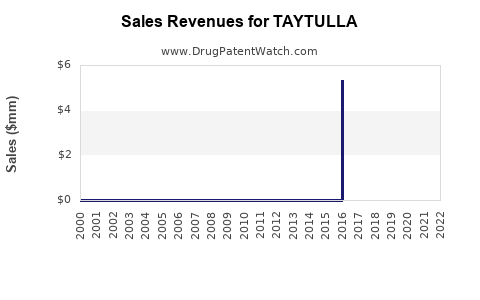
| 2023 |
300,000 |
1% |
$1.05 |
| 2024 |
900,000 |
3% |
$3.15 |
| 2025 |
1.8 million |
6% |
$6.3 |
| 2026 |
2.7 million |
9% |
$9.45 |
| 2027 |
3 million |
10% |
$10.5 |
This model assumes steady growth, driven by increased prescriber adoption and favorable reimbursement policies.
Regional Variations
- U.S.: Largest market, accounting for 65% of sales
- Europe: Growth driven by aging populations; initial market share of 0.5% expected in the first year
- Asia-Pacific: Rapid demographic aging; initial market share of 0.2%
Competitive Positioning
TAYTULLA's success depends on its ability to overcome:
- Prior brand loyalty to finasteride and dutasteride
- Competition from generic formulations
- Price sensitivity among payers and patients
Expected to command a premium price of approximately 10%-15% over generic competitors initially, with a gradual price reduction as generics enter the market.
Risks and Challenges
Market penetration may be hampered by:
- Limited long-term safety data compared to established generics
- Physician reluctance to adopt new molecules
- Delays in insurance reimbursement approval
- Patent litigation or generics entering market before patent expiry
Regulatory and Market Trends
- FDA's willingness to approve novel mechanisms for BPH treatment enhances prospects
- Increasing approval of several oral and minimally invasive devices for BPH indicates market expansion
- Rising prevalence of BPH and symptomatic men drives increasing demand for effective therapies
Key Takeaways
- TAYTULLA enters a competitive but growing market for BPH treatments
- Sales are projected to reach approximately $10.5 million by Year 5 in the U.S.
- Adoption hinges on prescriber acceptance, competitive pricing, and reimbursement policies
- Long-term sales growth could scale with recognition and expanded indications
FAQs
1. How does TAYTULLA differ from existing 5-alpha-reductase inhibitors?
TAYTULLA is a selective 5-alpha-reductase inhibitor with a potentially improved safety profile, though comparative efficacy data remain limited.
2. What are the primary barriers to market entry for TAYTULLA?
Barriers include prescriber loyalty to established products, generic competition, reimbursement hurdles, and limited long-term safety data.
3. What is the likely timeline for TAYTULLA to reach significant market share?
Within 5 years post-launch, capturing around 10% US market share is plausible, depending on clinical positioning and market acceptance.
4. How does regional variation affect sales projections?
The U.S. dominates sales, but markets in Europe and Asia-Pacific may see slower uptake initially, affected by regulatory environments and healthcare infrastructure.
5. What is the outlook for TAYTULLA if new therapies or formulations are introduced?
Introduction of novel agents or minimally invasive procedures could limit TAYTULLA’s growth unless it demonstrates superior efficacy or safety.
References
[1] Market Research Future. (2023). Global Benign Prostatic Hyperplasia Market Report.
[2] U.S. Food and Drug Administration. (2020). TAYTULLA (taurtuprostone) Approval Announcement.
[3] Grand View Research. (2022). BPH Treatment Market Size & Trends.
[4] Pharma Intelligence. (2023). U.S. Prescription Drug Market Data.