Share This Page
Drug Sales Trends for SPIRONOLACTONE
✉ Email this page to a colleague
Payment Methods and Pharmacy Types for SPIRONOLACTONE (2021)
Revenues by Pharmacy Type
Units Sold by Pharmacy Type
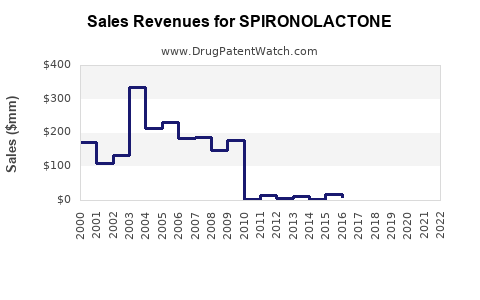
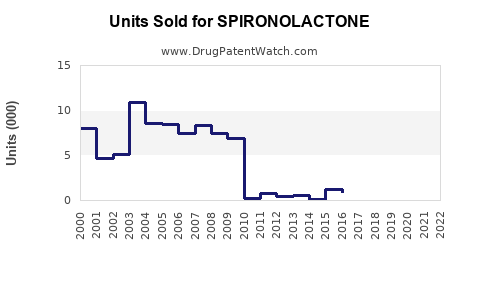
Annual Sales Revenues and Units Sold for SPIRONOLACTONE
| Drug Name | Revenues (USD) | Units | Year |
|---|---|---|---|
| SPIRONOLACTONE | ⤷ Start Trial | ⤷ Start Trial | 2022 |
| SPIRONOLACTONE | ⤷ Start Trial | ⤷ Start Trial | 2021 |
| SPIRONOLACTONE | ⤷ Start Trial | ⤷ Start Trial | 2020 |
| >Drug Name | >Revenues (USD) | >Units | >Year |
Spironolactone Market Analysis and Sales Projections
Spironolactone is a potassium-sparing diuretic and aldosterone antagonist used to treat congestive heart failure, hypertension, and edema. The drug also has applications in treating hyperaldosteronism and managing hirsutism and acne in women. The global spironolactone market is driven by the increasing prevalence of cardiovascular diseases, hormonal disorders, and a growing elderly population susceptible to these conditions. Patent expirations and the availability of generic versions have increased market access and affordability, fueling demand.
What is the Current Market Size for Spironolactone?
The global spironolactone market was valued at approximately $1.1 billion in 2023. Market growth is projected to continue at a compound annual growth rate (CAGR) of 3.5% from 2024 to 2030, reaching an estimated $1.4 billion by the end of the forecast period.
Key Market Drivers
- Increasing Cardiovascular Disease Prevalence: The World Health Organization reports that cardiovascular diseases remain the leading cause of death globally. Spironolactone's efficacy in treating hypertension and heart failure directly addresses this growing health burden. The number of individuals diagnosed with hypertension globally is estimated to exceed 1.3 billion people [1].
- Rising Incidence of Hormonal Disorders: Conditions such as hyperaldosteronism and polycystic ovary syndrome (PCOS), which often involve hormonal imbalances, are becoming more frequently diagnosed. Spironolactone is a key therapeutic option for managing these conditions, particularly in cases of hirsutism and acne associated with PCOS. The estimated prevalence of PCOS ranges from 6% to 20% among women of reproductive age [2].
- Aging Global Population: The demographic shift towards an older population contributes to increased demand for medications treating age-related conditions like heart failure and hypertension. The United Nations projects that the proportion of the global population aged 65 and over will increase from 10% in 2022 to 16% by 2050 [3].
- Generic Competition and Affordability: The expiration of key patents for spironolactone has led to widespread availability of generic formulations. This has significantly reduced treatment costs, making spironolactone more accessible to a broader patient population and driving volume growth.
Key Market Restraints
- Adverse Effects: Spironolactone can cause hyperkalemia, gynecomastia, and menstrual irregularities, which may limit its use in certain patient populations or require close monitoring.
- Competition from Newer Diuretics and Antihypertensives: While spironolactone remains a mainstay, newer pharmacological agents with potentially improved side-effect profiles or greater efficacy in specific patient subgroups are continually entering the market.
How is the Spironolactone Market Segmented?
The spironolactone market can be segmented by application, formulation, and distribution channel.
Segmentation by Application
- Hypertension: This segment represents the largest share of the spironolactone market due to the widespread use of the drug in managing high blood pressure. The estimated number of adults with uncontrolled hypertension in 2023 was over 500 million [4].
- Congestive Heart Failure (CHF): Spironolactone is a critical component in the management of CHF, particularly in reducing mortality and hospitalizations. Approximately 6.5 million adults in the United States alone have heart failure, with a significant portion benefiting from aldosterone antagonists [5].
- Edema: The drug is used to treat edema associated with liver cirrhosis, nephrotic syndrome, and other conditions.
- Hormonal Disorders (PCOS, Hirsutism): This segment, while smaller, demonstrates steady growth driven by increased awareness and diagnosis of conditions like PCOS.
- Other Applications: Includes treatment for hyperaldosteronism and research applications.
Segmentation by Formulation
- Tablets: This is the most common formulation, accounting for over 95% of the market share. Spironolactone tablets are available in various strengths, typically 25 mg, 50 mg, and 100 mg.
- Oral Suspension: Less common but available for patients with difficulty swallowing tablets.
Segmentation by Distribution Channel
- Hospital Pharmacies: Significant volume driven by inpatient treatment and management of acute conditions.
- Retail Pharmacies: The largest segment, serving the outpatient market and chronic disease management.
- Online Pharmacies: Growing segment, offering convenience and competitive pricing.
What are the Key Geographic Markets for Spironolactone?
The spironolactone market is distributed globally, with North America and Europe currently leading in terms of revenue. Asia-Pacific is projected to exhibit the fastest growth.
North America
- Market Value: Approximately $380 million in 2023.
- Drivers: High prevalence of cardiovascular diseases, established healthcare infrastructure, and significant R&D investment. The U.S. Food and Drug Administration (FDA) has approved numerous generic spironolactone products, contributing to market access.
- Key Trends: Increasing use in combination therapies for hypertension and heart failure.
Europe
- Market Value: Approximately $350 million in 2023.
- Drivers: Aging population, high rates of chronic diseases, and strong regulatory frameworks supporting generic drug availability.
- Key Trends: Focus on cost-effective treatment options and adherence programs.
Asia-Pacific
- Market Value: Approximately $250 million in 2023, projected CAGR of 4.8% through 2030.
- Drivers: Rapidly growing population, increasing disposable income, rising awareness of chronic diseases, and improving healthcare access in countries like China and India.
- Key Trends: Expanding generic drug manufacturing capabilities and increasing demand for affordable healthcare solutions.
Rest of the World (Latin America, Middle East & Africa)
- Market Value: Approximately $120 million in 2023.
- Drivers: Improving healthcare infrastructure, increasing diagnosis rates for chronic conditions, and a growing demand for essential medicines.
- Key Trends: Focus on expanding access to basic cardiovascular and hormonal disorder treatments.
What is the Competitive Landscape for Spironolactone?
The spironolactone market is highly competitive due to the presence of numerous generic manufacturers. Brand-name products have largely been supplanted by generics. Key players focus on market penetration through competitive pricing and efficient distribution networks.
Major Manufacturers and Generic Suppliers
- Teva Pharmaceutical Industries Ltd.
- Sun Pharmaceutical Industries Ltd.
- Viatris Inc. (formerly Mylan)
- Hikma Pharmaceuticals PLC
- Aurobindo Pharma Ltd.
- Cipla Ltd.
- Dr. Reddy's Laboratories Ltd.
- Bayer AG (historically, now largely generic market)
The market is characterized by price competition and market share battles among these generic producers. Contract manufacturing organizations (CMOs) also play a significant role in the supply chain.
What are the Future Sales Projections for Spironolactone?
Based on current market trends, the global spironolactone market is forecast to reach approximately $1.4 billion by 2030, growing at a CAGR of 3.5% from 2024.
Factors Influencing Future Sales
- Continued Growth in Cardiovascular Disease Management: The persistent rise in hypertension and heart failure globally will maintain steady demand. Combination therapies are expected to drive further use.
- Expanding Indications and Off-Label Use: Ongoing research into spironolactone's therapeutic benefits for other conditions, coupled with increased physician awareness of off-label applications, could create new demand streams. For instance, studies are investigating its potential in conditions beyond its primary indications.
- Emerging Markets Penetration: As healthcare systems in developing economies mature and become more accessible, the demand for essential medicines like spironolactone is expected to rise significantly, particularly in the Asia-Pacific region.
- Impact of Health Policies: Government initiatives aimed at reducing the burden of cardiovascular diseases and improving access to essential medicines will influence market growth.
- Technological Advancements in Drug Delivery: While currently dominated by oral tablets, future innovations in drug delivery could offer new formulations that improve patient adherence or efficacy, though major shifts are not currently anticipated to disrupt the existing tablet-dominated market.
Key Takeaways
The spironolactone market, valued at $1.1 billion in 2023, is projected to reach $1.4 billion by 2030, driven by the increasing prevalence of cardiovascular and hormonal disorders, an aging population, and the affordability of generic versions. North America and Europe represent the largest current markets, while Asia-Pacific is poised for the fastest growth. The market is highly competitive, dominated by generic manufacturers. Future sales will be influenced by sustained demand for cardiovascular treatments, potential expansion of indications, and penetration into emerging economies.
Frequently Asked Questions
-
What is the primary use of spironolactone in current medical practice? Spironolactone is primarily used to treat hypertension and congestive heart failure. It also addresses edema and hormonal imbalances such as those found in hyperaldosteronism and polycystic ovary syndrome.
-
Which geographical region is expected to exhibit the highest growth rate for spironolactone sales in the coming years? The Asia-Pacific region is projected to experience the fastest growth rate in spironolactone sales through 2030.
-
What impact has patent expiration had on the spironolactone market? Patent expirations have led to the widespread availability of generic spironolactone, significantly reducing its cost and increasing market accessibility and affordability for patients.
-
Are there any significant new therapeutic indications for spironolactone currently under investigation? While primary indications remain cardiovascular and hormonal disorders, research is ongoing into potential benefits for other conditions. Specific details on investigational uses are subject to ongoing clinical trial data.
-
What are the main challenges facing the spironolactone market? Key challenges include potential adverse effects such as hyperkalemia and gynecomastia, and competition from newer pharmacological agents with potentially different efficacy or safety profiles.
Citations
[1] World Health Organization. (2023). Cardiovascular diseases (CVDs). Retrieved from https://www.who.int/news-room/fact-sheets/detail/cardiovascular-diseases-(cvds)
[2] United States Department of Health and Human Services. (2023). Polycystic Ovary Syndrome (PCOS). National Institute of Diabetes and Digestive and Kidney Diseases. Retrieved from https://www.niddk.nih.gov/health-information/endocrine-diseases/polycystic-ovary-syndrome-pcos
[3] United Nations. (2022). World Population Ageing Highlights 2022. Retrieved from https://www.un.org/en/development/desa/population/publications/ageing/world-population-ageing-highlights-2022.asp
[4] American Heart Association. (2023). High Blood Pressure Facts. Retrieved from https://www.heart.org/en/health-topics/high-blood-pressure/understanding-high-blood-pressure/high-blood-pressure-facts-and-statistics
[5] Centers for Disease Control and Prevention. (2023). Heart Failure. Retrieved from https://www.cdc.gov/heartdisease/heart_failure.htm
More… ↓
