Drug Sales Trends for SERTRALINE
Payment Methods and Pharmacy Types for SERTRALINE (2021)
Revenues by Pharmacy Type
Units Sold by Pharmacy Type
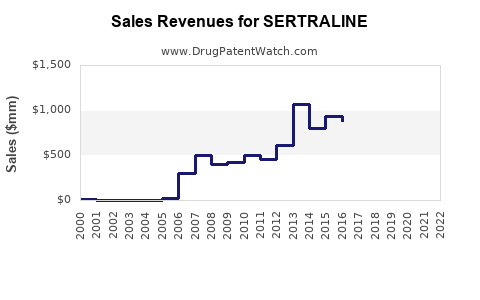
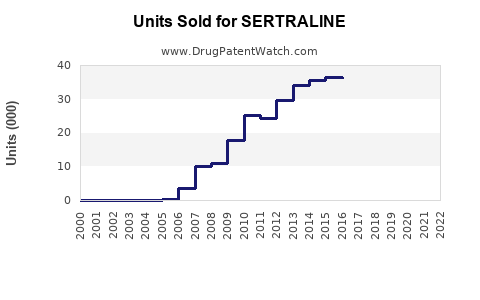
Annual Sales Revenues and Units Sold for SERTRALINE
| Drug Name | Revenues (USD) | Units | Year |
|---|---|---|---|
| SERTRALINE | ⤷ Start Trial | ⤷ Start Trial | 2022 |
| SERTRALINE | ⤷ Start Trial | ⤷ Start Trial | 2021 |
| SERTRALINE | ⤷ Start Trial | ⤷ Start Trial | 2020 |
| SERTRALINE | ⤷ Start Trial | ⤷ Start Trial | 2019 |
| SERTRALINE | ⤷ Start Trial | ⤷ Start Trial | 2018 |
| SERTRALINE | ⤷ Start Trial | ⤷ Start Trial | 2017 |
| SERTRALINE | ⤷ Start Trial | ⤷ Start Trial | 2016 |
| >Drug Name | >Revenues (USD) | >Units | >Year |
Sertraline Market Analysis, Sales Projections, Patent Status, and Generic Competition
Sertraline is a mature, globally marketed selective serotonin reuptake inhibitor (SSRI) sold primarily as a low-cost generic and under Pfizer’s Zoloft brand. The U.S. product has no meaningful remaining regulatory exclusivity, and the core compound patent expired years ago. Commercial value is concentrated in manufacturing scale, supply reliability, institutional contracts, geographic registrations, and differentiated dosage forms rather than in exclusivity.
The base-case outlook is stable global volume with low single-digit annual value growth through 2029. Price erosion will limit revenue expansion in the United States and other mature markets. Growth is more likely in emerging markets, pediatric treatment, anxiety-related prescribing, hospital procurement, and expanded access to generic antidepressants.
What is the current market position of sertraline?
Sertraline hydrochloride is one of the most widely prescribed SSRIs. It is approved for major depressive disorder, obsessive-compulsive disorder, panic disorder, post-traumatic stress disorder, social anxiety disorder, and premenstrual dysphoric disorder in the United States.[1]
The main commercial products are:
| Product | Company or supplier | Market position |
|---|---|---|
| Zoloft tablets and oral concentrate | Pfizer | Original brand; limited residual share |
| Generic sertraline tablets | Multiple manufacturers | Dominant U.S. volume source |
| Generic sertraline oral solution or concentrate | Multiple manufacturers, market-dependent | Smaller but differentiated segment |
| Sertraline tablets in international markets | Regional and multinational generic companies | Broadly distributed |
| Sertraline hydrochloride API | Multiple Asian and global suppliers | Competitive, price-sensitive supply chain |
U.S. prescription volume remains substantial because sertraline is prescribed across primary care, psychiatry, obstetrics and gynecology, emergency medicine, and pediatric practice. IQVIA ranked sertraline among the leading U.S. antidepressant products by prescription volume in recent years, although the market is reported primarily by product and molecule rather than by publicly disclosed manufacturer revenue.[2]
How large is the sertraline market?
Public sources do not provide a single audited global revenue figure for all sertraline products. Market-research estimates vary because some reports include only branded and generic finished products, while others include active pharmaceutical ingredient sales or broader antidepressant categories.
A practical commercial estimate is:
| Market segment | Indicative 2024 annual value | Expected 2024-2029 trend |
|---|---|---|
| U.S. finished sertraline products | $150 million-$350 million | Flat to low single-digit growth |
| European finished products | $200 million-$450 million | Low single-digit growth |
| Rest-of-world finished products | $300 million-$700 million | Mid-single-digit growth |
| Global finished-product market | $650 million-$1.5 billion | Approximately 1%-4% annual value growth |
| Sertraline API | Included within finished-product economics | Price pressure and capacity competition |
These ranges are commercial modeling estimates rather than reported company sales. The original brand’s historical revenue is not a reliable proxy for the current molecule market because generic substitution occurred after U.S. loss of exclusivity.
When did sertraline lose exclusivity?
Sertraline’s core U.S. compound patent expired in the mid-2000s. Pfizer’s Zoloft was approved by the FDA in 1991, and the product later received pediatric exclusivity and additional regulatory protection associated with approved indications.[1,3]
Sertraline exclusivity timeline
| Event | Approximate date | Commercial effect |
|---|---|---|
| U.S. approval of Zoloft | 1991 | Pfizer exclusivity begins |
| Original compound patent term | Expired by 2006 | Core generic entry barrier removed |
| Generic approvals and launches | 2006 onward | Rapid price and share erosion |
| Current U.S. market | No meaningful core exclusivity | Generic-dominated |
| Current brand position | Post-exclusivity | Primarily residual prescribing, supply preference, and brand recognition |
The principal compound patent, U.S. Patent No. 4,356,518, covered sertraline-related compounds and was assigned to Pfizer predecessor entities. Its expiration eliminated the principal legal barrier to generic entry.[4]
What is the Orange Book status of sertraline?
The FDA Orange Book is relevant to U.S. approved sertraline products, but current commercial risk is not driven by a surviving compound patent. Generic applicants historically used Abbreviated New Drug Applications (ANDAs) with Paragraph III or Paragraph IV certifications depending on the timing of patent expiration and listed patents.[5]
Current Orange Book considerations include:
- Multiple approved generic sertraline tablet products.
- Strengths generally including 25 mg, 50 mg, and 100 mg tablets.
- Oral solution or concentrate products in certain markets.
- No commercially meaningful remaining Orange Book patent barrier for the core molecule.
- Manufacturer-specific discontinuations, shortages, or supply changes that can affect market share without changing patent status.
Patent listings may vary by product, formulation, and historical reference-listed drug. A listed method-of-use patent would not necessarily block all generic indications if a carve-out or “skinny label” strategy were available under FDA rules.
Which companies are challenging or competing with Zoloft?
Sertraline is no longer characterized by a small number of named patent challengers. Competition is broad and largely generic.
Major competitive groups
- Large generic manufacturers with U.S. ANDA portfolios.
- Contract manufacturers supplying private-label and pharmacy products.
- Indian and Chinese API manufacturers.
- Regional companies selling tablets and oral formulations outside the United States.
- Pfizer’s residual branded Zoloft business.
The leading competitive factors are manufacturing cost, FDA compliance history, product availability, wholesaler relationships, state and health-plan formulary placement, and the ability to maintain supply during disruptions.
Brand competition from escitalopram, fluoxetine, paroxetine, venlafaxine, duloxetine, and newer therapies affects sertraline demand. Sertraline remains competitive because of extensive clinical use, physician familiarity, broad indications, generic affordability, and established use during pregnancy and postpartum care, although treatment decisions remain patient-specific.[6]
What formulations are protected by sertraline patents?
The core sertraline molecule is no longer protected by an active U.S. compound patent. Potentially differentiated commercial products may rely on formulation, dosage, manufacturing, or delivery claims rather than the original active ingredient.
Relevant formulation categories
| Formulation | Commercial relevance | Patent strength |
|---|---|---|
| Immediate-release tablets | Main volume segment | Low for the core product; competition is extensive |
| Oral solution or concentrate | Useful for dose titration and patients unable to swallow tablets | Moderate only if a valid formulation claim remains in a specific jurisdiction |
| Pediatric-friendly liquid products | Niche opportunity | Depends on formulation and regulatory approval |
| Modified-release products | Limited established commercial presence | Potentially stronger if clinically differentiated, but requires development and approval |
| Combination products | Limited | Requires new clinical, regulatory, and patent work |
| Alternative salts or solid forms | API and manufacturing relevance | May support process or solid-state claims, but freedom to operate is jurisdiction-specific |
A new sertraline formulation would need to overcome a low-cost generic reference market. Clinical differentiation, improved adherence, reduced dosing frequency, or a clearly defined pediatric or geriatric use would be needed to support premium pricing.
What generic entry risks exist for sertraline?
Generic entry risk is already realized rather than prospective in the United States. The key risk for incumbent suppliers is continued price erosion and customer substitution.
Generic launch scenarios
| Scenario | Probability | Market effect |
|---|---|---|
| Stable generic supply | High | Low single-digit volume growth; continued price pressure |
| New low-cost entrant | Moderate | Additional price erosion, especially in tenders and wholesalers |
| Manufacturer quality action | Moderate | Temporary share shift to approved suppliers |
| API disruption | Low to moderate | Short-term price increases and allocation |
| Branded reformulation launch | Low | Limited impact without clinical differentiation |
| New digital or specialty distribution channel | Moderate | Modest channel-share changes |
A U.S. generic applicant does not need to replicate the historical Zoloft commercial model. It must demonstrate bioequivalence and satisfy FDA quality requirements through the ANDA pathway.[5] This makes entry feasible for established generic manufacturers but less attractive for small companies without compliant production capacity or distribution access.
How strong is the sertraline patent estate?
The patent estate is weak for the core molecule and stronger only in narrow, jurisdiction-specific areas.
| Patent category | Current strength | Commercial assessment |
|---|---|---|
| Core compound patent | Expired | No blocking value |
| Original salt or composition claims | Largely expired or narrow | Limited value |
| Basic tablet formulation | Generally weak | Heavy generic competition |
| Oral liquid formulation | Potentially moderate | Depends on claim scope and market |
| Manufacturing process patents | Variable | Can protect efficiency, impurity control, or yield |
| Solid-form patents | Variable | Relevant mainly to API suppliers |
| Method-of-use patents | Limited practical blocking power | Skinny-label and prescribing issues reduce impact |
| Device or delivery patents | Limited | Relevant only to a differentiated product |
The largest practical barriers are manufacturing know-how, regulatory compliance, validated analytical methods, impurity control, stable API sourcing, and commercial scale. These are operational barriers, not durable exclusivity rights.
What is the FDA regulatory status of sertraline?
Sertraline is FDA-approved and marketed as an immediate-release oral antidepressant. The reference product is Zoloft, and generic products are approved through ANDAs.[1,5]
Regulatory considerations include:
- Bioequivalence to the reference-listed drug.
- Compliance with current good manufacturing practice requirements.
- Stability and impurity control.
- Labeling for approved indications.
- Pediatric dosing and safety requirements.
- Warnings relating to suicidality in children, adolescents, and young adults.
- Drug-interaction and serotonin-syndrome risks.
- Withdrawal symptoms associated with abrupt discontinuation.
Regulatory risk is concentrated in inspections, manufacturing deviations, recalls, product shortages, and pharmacovigilance rather than in approval exclusivity.
What licensing deals affect sertraline?
Sertraline’s original commercial development and global distribution were associated with Pfizer and its predecessor companies. The molecule’s post-exclusivity market has largely shifted to ordinary generic supply, contract manufacturing, distribution, and regional commercialization arrangements.
No major current licensing transaction is required to explain generic sertraline availability. Commercial agreements typically involve:
- API supply.
- Finished-dose contract manufacturing.
- Regional product registrations.
- Private-label distribution.
- Hospital and government procurement.
- Technology transfer for formulation or manufacturing.
The absence of a dominant current licensing structure reduces dependence on a single originator but increases competition among low-cost suppliers.
What patent litigation affects sertraline?
The principal historic litigation risk involved generic challenges to Zoloft patents before and around loss of exclusivity. After expiration of the core compound patent and launch of numerous generics, sertraline ceased to be a major branded patent-litigation market.
Current litigation exposure is more likely to arise from:
- ANDA patent challenges involving a narrow formulation.
- Manufacturing and supply agreements.
- Product liability claims.
- Quality and recall disputes.
- Trademark or trade-dress issues.
- Competition-law allegations related to generic launch timing or distribution.
No active litigation is needed to explain current sertraline market access. The economic center of gravity is supply execution, not patent enforcement.
What are sertraline sales projections through 2029?
The following projections apply to global finished-product sales across branded and generic sertraline. They exclude broad SSRI-market revenue and are presented as scenario estimates.
| Year | Bear case | Base case | Bull case |
|---|---|---|---|
| 2024 | $650 million | $1.0 billion | $1.5 billion |
| 2025 | $640 million | $1.03 billion | $1.56 billion |
| 2026 | $635 million | $1.06 billion | $1.62 billion |
| 2027 | $630 million | $1.09 billion | $1.68 billion |
| 2028 | $625 million | $1.12 billion | $1.75 billion |
| 2029 | $620 million | $1.16 billion | $1.82 billion |
| 2024-2029 CAGR | -1.0% | 3.0% | 4.0% |
Projection assumptions
The base case assumes:
- Global prescription volume growth of approximately 2%-4% annually.
- Continuing generic price erosion in the United States.
- Stable access to API and finished-dose manufacturing.
- Increased antidepressant diagnosis and treatment in emerging markets.
- Limited branded premium capture.
- No major new sertraline formulation with broad clinical adoption.
The bull case requires stronger emerging-market volume growth, continued expansion of mental-health treatment, and supply disruptions that temporarily raise average selling prices. The bear case assumes intensified generic competition, procurement consolidation, and substitution toward other SSRIs or newer antidepressants.
How does sertraline compare with competing antidepressants?
| Drug | Generic status | Competitive position |
|---|---|---|
| Sertraline | Mature generic | Broad indications and strong primary-care use |
| Escitalopram | Mature generic | Major SSRI competitor with strong tolerability reputation |
| Fluoxetine | Mature generic | Long half-life and extensive historical use |
| Paroxetine | Mature generic | Effective but constrained by tolerability and withdrawal considerations |
| Venlafaxine | Mature generic | SNRI option; different efficacy and adverse-effect profile |
| Duloxetine | Mature generic | SNRI with depression, anxiety, and pain positioning |
| Vortioxetine | Branded or limited generic depending on market | Higher price and differentiated product positioning |
Sertraline’s commercial advantage is breadth and familiarity. Its disadvantage is the absence of patent-based pricing power.
What revenue exposure do manufacturers face?
For large generic companies, sertraline is usually a portfolio product rather than a material standalone revenue driver. Exposure depends on contract concentration, formulation mix, and market geography.
The largest risks are:
- U.S. price compression.
- Reliance on a single API source.
- FDA warning letters or manufacturing remediation.
- Tender losses in Europe and emerging markets.
- Wholesaler inventory destocking.
- Product discontinuation by a low-margin supplier.
- Unexpected demand during antidepressant supply disruptions.
Manufacturers with oral-liquid capability, reliable pediatric products, or strong government-market access may achieve better margins than suppliers selling undifferentiated tablets.
Key Takeaways
- Sertraline is a mature generic SSRI with no meaningful remaining core U.S. exclusivity.
- Zoloft’s commercial peak is historical; current value is distributed across generic manufacturers.
- The global finished-product market is best modeled at approximately $650 million-$1.5 billion in 2024.
- Base-case global sales reach about $1.16 billion by 2029, equivalent to approximately 3% annual growth from a modeled 2024 base.
- U.S. pricing remains under pressure, while emerging markets provide the strongest volume-growth opportunity.
- Formulation and manufacturing patents can have narrow value, but they do not recreate the original compound monopoly.
- Biosimilar risk is not applicable because sertraline is a conventional small-molecule drug, not a biologic.
- The main commercial barriers are quality compliance, API supply, cost, registration coverage, and distribution.
FAQs
Is sertraline still patented?
The core sertraline compound patent expired years ago. Current commercial products generally rely on generic approvals rather than active compound exclusivity.
Is Zoloft still commercially important?
Zoloft retains brand recognition, but generic sertraline controls most market volume in the United States and other mature markets.
Can a new company still launch sertraline?
Yes. A qualified manufacturer can pursue an ANDA or applicable international generic pathway, but success depends on cost, compliance, supply reliability, and distribution.
Does sertraline have biosimilar competition?
No. Sertraline is a small-molecule drug. Its competitors are generic versions, not biosimilars.
Which sertraline formulation offers the best commercial opportunity?
Oral liquids, pediatric-friendly dosage forms, and products with supply or adherence advantages offer more differentiation than standard immediate-release tablets. Their opportunity remains limited unless supported by regulatory or clinical differentiation.
References
-
U.S. Food and Drug Administration. (2024). Zoloft prescribing information. FDA.
-
IQVIA. (2024). National prescription audit and U.S. pharmaceutical market data. IQVIA.
-
U.S. Food and Drug Administration. (2006). Orange Book: Approved drug products with therapeutic equivalence evaluations. FDA.
-
U.S. Patent No. 4,356,518. (1982). Tetralin derivatives. United States Patent and Trademark Office.
-
U.S. Food and Drug Administration. (2024). Generic drug facts and abbreviated new drug application guidance. FDA.
-
National Institute for Health and Care Excellence. (2022). Depression in adults: Treatment and management. NICE.
More… ↓
