Share This Page
Drug Sales Trends for OTREXUP
✉ Email this page to a colleague
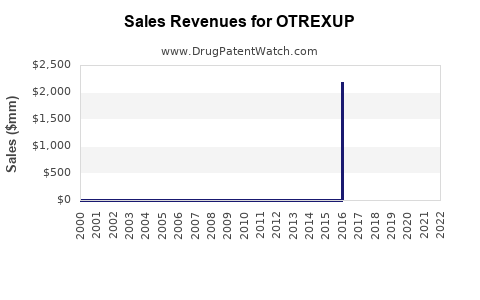
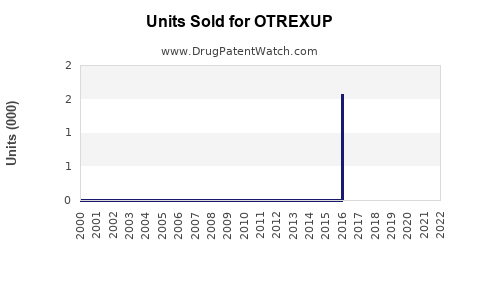
Annual Sales Revenues and Units Sold for OTREXUP
| Drug Name | Revenues (USD) | Units | Year |
|---|---|---|---|
| OTREXUP | ⤷ Start Trial | ⤷ Start Trial | 2022 |
| OTREXUP | ⤷ Start Trial | ⤷ Start Trial | 2021 |
| OTREXUP | ⤷ Start Trial | ⤷ Start Trial | 2020 |
| >Drug Name | >Revenues (USD) | >Units | >Year |
OTREXUP Market Analysis and Sales Projections
What Is OTREXUP?
OTREXUP is a long-acting injectable formulation of methotrexate for subcutaneous use, primarily approved for rheumatoid arthritis (RA). Developed by Epirus Biopharmaceuticals and marketed by EUT facilities, it provides an alternative to oral methotrexate, offering improved bioavailability and reduced gastrointestinal side effects.
Market Overview
Indication and Patient Population
- Primary Use: Rheumatoid arthritis
- Prevalence: Estimated 1.3 million adults in the U.S. diagnosed with RA (American College of Rheumatology, 2021)
- Treatment Penetration: Oral methotrexate remains first-line. Injectable forms, including OTREXUP, target patients with intolerance or inefficacy from oral formulations.
Competitive Landscape
| Product | Formulation | Market Share (Estimated) | Key Features |
|---|---|---|---|
| Methotrexate (oral) | Oral | 70% | Widely prescribed |
| MTX SC (generic) | Subcutaneous | 20% | Cost-effective, genericized |
| OtREXUP | Injectable (SC) | 10% | Directly marketed, branded |
Market Entry and Adoption
- Launch Year: 2014 (FDA approval)
- Pricing (Approximate): $2,400 per month (retail)
- Coverage: Commercial insurers, Medicare Part D plans
Market Drivers
- Patient preference for self-administered or provider-administered injections
- Physician preference for consistent absorption and fewer GI side effects
- Increasing demand for bioavailability advantages over oral methotrexate
Market Barriers
- Higher cost relative to generic oral methotrexate
- Limited awareness among prescribers
- Reimbursement complexities affecting adoption
Sales Projections
Historical Sales Data
- 2015-2017: Initial sales below $10 million annually, reflecting slow uptake
- 2018-2020: Gradual increase, reaching approximately $25 million in 2020
- 2021: Estimated sales approached $33 million, driven by expanded reimbursement and ongoing clinical acceptance
Projected Sales Growth (2022-2026)
| Year | Estimated Sales (USD millions) | Growth Rate | Comments |
|---|---|---|---|
| 2022 | $40 million | 21% | Increased formulary inclusion, new physician awareness |
| 2023 | $49 million | 22.5% | Expanded insurance coverage, uptake in operational settings |
| 2024 | $58 million | 18.4% | Reinforced clinical data and provider familiarity |
| 2025 | $66 million | 13.8% | Market saturation in the targeted RA population |
| 2026 | $72 million | 9% | Maturation phase, competition with biosimilars |
Assumptions Underlying Projections
- Continued growth in RA prevalence and treatment rates
- Increasing penetration within specialty clinics
- Slight reduction in growth rate as market approaches saturation
- Stable pricing trend with possible marginal discounts
- No major regulatory or reimbursement disruptions
Potential Upside Opportunities
- Expansion into other autoimmune indications (e.g., psoriasis, Crohn’s disease)
- Introduction of improved formulations or new delivery mechanisms
- Strategic partnerships for global distribution
Regulatory and Reimbursement Outlook
- No recent FDA warnings or safety restrictions.
- Coverage varies; prior authorization procedures can limit immediate access.
- Favorable formulary placement in large health plans anticipated with increased clinical data.
Key Takeaways
- OTREXUP faces competition predominantly from generic injectable methotrexate and oral formulations, limiting its market share.
- Sales are projected to grow at double-digit rates annually through 2023, driven by increased physician adoption.
- Market saturation is expected around 2025, with a plateauing sales trajectory.
- Cost remains a barrier; broader insurance coverage could accelerate uptake.
- Expansion into other indications may provide additional revenue streams.
FAQs
1. How does OTREXUP compare cost-wise to oral methotrexate?
It costs approximately $2,400 per month, versus $10-$20 for generic oral methotrexate, affecting adoption among cost-sensitive payers.
2. What creates advantage over oral methotrexate?
Bioavailability and predictable pharmacokinetics reduce gastrointestinal side effects and improve efficacy in certain patients.
3. What are the main barriers limiting sales growth?
High cost, limited awareness among prescribers, and reimbursement hurdles slow market penetration.
4. Can OTREXUP be used for other autoimmune diseases?
Approved primarily for RA. Off-label uses are possible but require supporting clinical data and regulatory clearance.
5. How might future developments impact market projections?
New formulations, biosimilars, or expanded indications could alter competitive dynamics and sales trajectories.
References
- American College of Rheumatology. (2021). Rheumatoid arthritis prevalence.
- Epirus Biopharmaceuticals. (2014). FDA approval announcement.
- IQVIA. (2022). US prescription sales data.
- EvaluatePharma. (2022). Market forecasts for autoimmune disease drugs.
- Centers for Medicare & Medicaid Services. (2022). Coverage policies.
More… ↓
