Drug Sales Trends for NASONEX
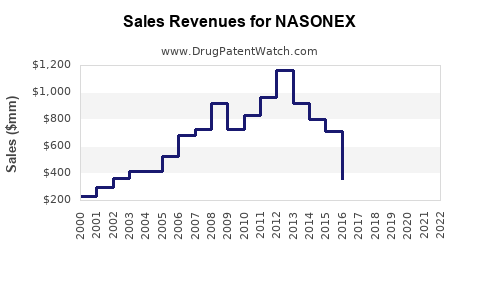
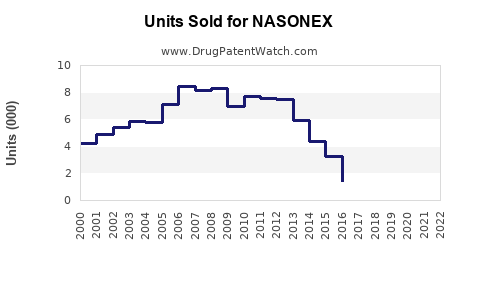
Annual Sales Revenues and Units Sold for NASONEX
| Drug Name | Revenues (USD) | Units | Year |
|---|---|---|---|
| NASONEX | ⤷ Start Trial | ⤷ Start Trial | 2022 |
| NASONEX | ⤷ Start Trial | ⤷ Start Trial | 2021 |
| NASONEX | ⤷ Start Trial | ⤷ Start Trial | 2020 |
| NASONEX | ⤷ Start Trial | ⤷ Start Trial | 2019 |
| >Drug Name | >Revenues (USD) | >Units | >Year |
Nasonex Market Analysis, Patent Status, Competitive Landscape, and Sales Projections
Nasonex, the brand name for mometasone furoate nasal spray, is a mature intranasal corticosteroid with limited remaining branded revenue and substantial generic competition. Its commercial value has shifted from prescription brand sales to generic mometasone volume, over-the-counter allergy products, manufacturing scale, and retailer distribution. A base-case model estimates global Nasonex and mometasone nasal-spray sales of approximately $650 million in 2025, rising to about $760 million by 2030 at a 3.2% compound annual growth rate. Branded Nasonex represents only a minority of that value.
What is Nasonex and how large is its addressable market?
Nasonex contains mometasone furoate, a synthetic corticosteroid administered as a nasal spray. The product is approved for allergic rhinitis and, depending on the formulation and labeling, nasal polyps. The standard prescription dosage is 50 micrograms per spray.
The addressable market includes:
- Seasonal allergic rhinitis
- Perennial allergic rhinitis
- Nasal congestion
- Nasal polyps
- Pediatric allergic rhinitis
- Over-the-counter allergy treatment
Nasonex competes in the broader intranasal corticosteroid market with fluticasone propionate, fluticasone furoate, triamcinolone acetonide, budesonide, beclomethasone dipropionate, and ciclesonide.
The market is defensive rather than high growth. Demand is supported by recurring allergy seasons, climate-related pollen exposure, increased diagnosis of allergic rhinitis, and consumer preference for non-sedating therapies. Pricing is constrained by generic substitution and extensive over-the-counter competition.
Market segmentation
| Segment | Main products | Commercial profile |
|---|---|---|
| Prescription mometasone | Generic mometasone and branded Nasonex | Low to moderate pricing; high generic penetration |
| OTC nasal corticosteroids | Flonase, Nasacort, Rhinocort and OTC Nasonex | Larger consumer marketing opportunity |
| Nasal polyps | Mometasone and other corticosteroids; biologics for severe disease | Higher unmet need but smaller population |
| Combination allergy products | Antihistamine and corticosteroid combinations | Faster growth, stronger differentiation |
| Institutional and international markets | Generic nasal sprays | Tender-driven, price-sensitive sales |
The largest commercial opportunity is not the legacy Nasonex prescription brand. It is the broader mometasone molecule market and retail allergy channel.
How much did Nasonex historically sell?
Nasonex was a major Merck respiratory product before generic erosion. Merck reported Nasonex sales of approximately $1 billion annually around the period immediately before or near loss of exclusivity. Sales declined sharply after generic mometasone nasal sprays entered the U.S. market.
Public company reporting no longer isolates Nasonex as a material standalone revenue line. Merck’s later disclosures aggregate or omit the product because of generic competition and portfolio changes.
Historical commercial trajectory
| Period | Commercial position | Estimated revenue direction |
|---|---|---|
| 2000-2008 | Branded prescription growth | Rapid expansion |
| 2009-2011 | Peak or near-peak brand sales | Approximately $0.9 billion to $1.1 billion globally |
| 2011-2014 | U.S. generic entry and price erosion | Sharp decline |
| 2015-2020 | Mature brand and generic market | Low branded growth |
| 2021 onward | OTC positioning and generic volume | Stable to modest market growth |
The exact current Nasonex brand revenue is not publicly reported. Commercial assessments should therefore separate branded Nasonex revenue from total mometasone nasal-spray sales.
What are the Nasonex sales projections through 2030?
The following projection estimates total global sales associated with Nasonex and generic mometasone nasal spray. It is a market model, not reported company guidance.
Base-case global sales projection
| Year | Total mometasone nasal-spray market | Branded Nasonex | Generic mometasone | Annual growth |
|---|---|---|---|---|
| 2024 | $630 million | $120 million | $510 million | 2.5% |
| 2025 | $650 million | $115 million | $535 million | 3.2% |
| 2026 | $670 million | $111 million | $559 million | 3.1% |
| 2027 | $691 million | $108 million | $583 million | 3.1% |
| 2028 | $713 million | $105 million | $608 million | 3.2% |
| 2029 | $736 million | $102 million | $634 million | 3.2% |
| 2030 | $760 million | $99 million | $661 million | 3.3% |
The model assumes:
- Low-single-digit growth in the underlying allergic-rhinitis market.
- Continued volume growth for generic mometasone.
- Ongoing price pressure in U.S. prescription channels.
- Stable or declining branded prescription volume.
- Modest benefit from OTC distribution and brand recognition.
- No major new formulation or combination-product launch.
Scenario analysis
| Scenario | 2030 global market | Implied 2025-2030 CAGR | Primary driver |
|---|---|---|---|
| Downside | $570 million | -2.6% | Aggressive generic substitution and brand withdrawal |
| Base case | $760 million | 3.2% | Stable allergy demand and generic volume growth |
| Upside | $930 million | 7.4% | Strong OTC expansion and international penetration |
The upside case requires successful consumer-channel execution, expanded retail distribution, and stronger demand in emerging markets. It does not depend on a return of historical Nasonex pricing.
What is the FDA regulatory status of Nasonex?
Nasonex was approved by the FDA as a prescription nasal spray under New Drug Application 020762. The active ingredient is mometasone furoate, generally supplied as a monohydrate in the nasal-spray formulation. The product label covers allergic rhinitis and other nasal indications depending on the specific presentation and labeling history.[1]
Mometasone nasal spray has also entered the over-the-counter allergy market. The FDA approved OTC Nasonex 24HR Allergy in 2022, expanding the brand beyond the traditional prescription channel.[2]
Regulatory implications
The OTC switch increases consumer access but changes the economics:
- Retail shelf placement becomes more important than physician prescribing.
- Advertising and retailer promotions can increase unit volume.
- Average selling price is lower than historical prescription pricing.
- The brand competes directly with established OTC products.
- Generic prescription volume remains a separate commercial channel.
The OTC opportunity is therefore volume-positive but margin-constrained.
What patents protect Nasonex?
Nasonex’s principal commercial patent protection has expired in the United States. The product’s early patent estate covered mometasone compounds, pharmaceutical formulations, and nasal delivery compositions. Generic entry substantially reduced the value of the original patent estate.
Key U.S. patent considerations
| Patent category | Protection | Current commercial significance |
|---|---|---|
| Mometasone compound patents | Active pharmaceutical ingredient | Expired or commercially exhausted |
| Nasal-spray formulation patents | Suspension, excipients and delivery | Limited protection after generic approvals |
| Method-of-use patents | Allergic rhinitis and nasal polyps | Narrower value; vulnerable to labeling strategies |
| Manufacturing patents | Crystalline form, particle size and process controls | Potential barrier for selected manufacturers |
| Pediatric exclusivity | Regulatory extension | Historical value only |
The Orange Book should be reviewed for the specific Nasonex product and listing history because patents can differ by dosage form, label and sponsor. The commercial conclusion is clear: Nasonex no longer has a strong blocking patent position against ordinary generic mometasone nasal spray.
When did Nasonex lose exclusivity?
Nasonex lost effective U.S. market exclusivity in the early 2010s as generic mometasone nasal sprays received approval. Generic entry followed expiration or erosion of the key product and formulation protections.
The loss of exclusivity had three consequences:
- Prescription pricing declined.
- Pharmacy substitution increased.
- Merck’s revenue shifted from branded economics to residual brand demand and channel-specific sales.
Patent expiry dates should not be treated as a single commercial event. Generic competition can begin through Paragraph IV litigation, settlement, or authorized-generic strategies before every secondary patent expires.
How many patents cover Nasonex today?
The answer depends on whether the analysis includes expired patents, international rights, manufacturing patents, and patents covering related formulations. The commercially relevant U.S. blocking estate is limited.
Nasonex is not comparable to a biologic with dozens of active formulation, manufacturing and dosing patents. Its remaining risk profile is concentrated in:
- Product-specific Orange Book listings
- Formulation distinctions
- Nasal delivery devices
- Combination products
- Method-of-use labeling
- International rights with later expiry dates
A patent-count approach can overstate protection. For Nasonex, claim scope and enforceability matter more than the number of historical filings.
Which companies compete with Nasonex and generic mometasone?
Direct prescription and OTC competitors
| Company or brand | Active ingredient | Competitive position |
|---|---|---|
| Haleon, Flonase | Fluticasone propionate or fluticasone furoate | Leading OTC brand recognition |
| Opella, Nasacort | Triamcinolone acetonide | Established OTC competitor |
| Perrigo and private-label suppliers | Fluticasone, triamcinolone, budesonide | Retail and store-brand pressure |
| AstraZeneca, Rhinocort | Budesonide | OTC and international presence |
| Generic manufacturers | Mometasone furoate | Price-led substitution |
| Organon and other branded suppliers | Mometasone products, depending on market | Residual brand and geographic sales |
Fluticasone has the strongest consumer-channel position in the United States. Mometasone retains clinical familiarity and a broad international generic base but lacks the same level of consumer advertising power.
Nasonex versus Flonase
| Metric | Nasonex | Flonase |
|---|---|---|
| Active ingredient | Mometasone furoate | Fluticasone propionate or furoate |
| Patent status | Mature, genericized | Mature, genericized |
| Consumer recognition | Moderate | High |
| Prescription economics | Weak | Weak to moderate |
| OTC opportunity | Meaningful but late | Strong and established |
| Generic pressure | High | High |
| Differentiation | Formulation, tolerability and brand familiarity | Brand scale and retail distribution |
Nasonex can compete clinically, but Flonase has a stronger consumer marketing platform.
What generic entry risks affect Nasonex?
Generic entry risk is already realized in the U.S. prescription market. Future risk relates to additional price compression and substitution rather than first entry.
Principal generic risks
- New suppliers entering international markets
- Retailers expanding private-label nasal sprays
- Pharmacy benefit managers increasing substitution
- Authorized-generic or co-branded products undercutting Nasonex
- Generic manufacturers improving device usability
- Combination products shifting patients away from single-agent sprays
Generic manufacturers face relatively modest technical barriers. The product requires control over particle size, suspension uniformity, spray performance, dose delivery and microbiological quality. Those requirements create manufacturing discipline but do not generally prevent competition from established inhalation and nasal-spray manufacturers.
What formulation and manufacturing barriers protect mometasone nasal spray?
Mometasone nasal spray is a suspension-based product. Manufacturing performance depends on:
- Consistent particle-size distribution
- Uniform suspension during shelf life
- Reliable metered-dose delivery
- Pump actuation force
- Container-closure integrity
- Preservative and microbial control
- Device compatibility
- Batch-to-batch dose uniformity
These factors can delay generic approval or create product-quality issues, but they do not provide the same barrier as complex inhaled biologics or long-acting injectables.
The strongest residual intellectual-property opportunity is likely to involve differentiated delivery devices, pediatric usability, preservative-free formulations, combination products, or improved adherence systems rather than ordinary mometasone spray.
What is the Orange Book status of Nasonex?
Nasonex has historically been listed in the FDA Orange Book as an approved prescription drug. Orange Book listings are product-specific and can change as sponsors update approvals, withdraw products, or modify commercial status.[3]
For market analysis, the key Orange Book conclusion is:
- The historic Nasonex listing does not provide a broad current barrier to generic mometasone nasal spray.
- Any active listing must be assessed against its expiration date and claim scope.
- OTC Nasonex products are not evaluated through the same generic substitution framework as prescription NDA products.
- OTC monograph and switch-related regulatory rights can affect market entry without restoring broad patent exclusivity.
Which companies are challenging Nasonex patents?
Generic companies challenged or pursued entry against the historical Nasonex patent estate during the product’s loss-of-exclusivity period. The commercially significant outcome was approval and market entry of generic mometasone nasal sprays.
Because Nasonex is a mature product, current competitive activity is more likely to involve:
- Abbreviated New Drug Application approvals
- ANDA supplements
- Labeling disputes
- Manufacturing changes
- Device suppliers
- Retail private-label contracts
There is no business case for treating Nasonex as an active high-value Paragraph IV target comparable to a recently launched specialty drug.
What is the Nasonex litigation and settlement outlook?
Historical litigation risk centered on generic entry and the scope of formulation or method-of-use patents. The current litigation outlook is low relative to the product’s historical period because the core commercial exclusivity has expired.
Potential disputes could still arise over:
- OTC brand use
- Trademark rights
- Device patents
- Manufacturing processes
- Product-quality claims
- False advertising
- Contract manufacturing
- International patent rights
Settlement agreements involving early generic entry can affect individual jurisdictions and launch timing, but they are unlikely to restore durable U.S. exclusivity for the Nasonex brand.
What licensing deals affect Nasonex?
Nasonex was developed and commercialized within Merck’s prescription portfolio. Its commercial history was affected by portfolio restructuring, consumer-health transactions and distribution arrangements. Public reporting does not indicate a current licensing transaction that materially changes the global economics of the mature molecule.
The most relevant commercial arrangements today are likely to be:
- OTC distribution agreements
- Regional trademark licenses
- Contract manufacturing
- Private-label supply agreements
- Generic marketing authorizations
- Retailer distribution contracts
These arrangements can shift revenue recognition without changing the underlying market size.
What revenue exposure does Nasonex create for manufacturers?
Revenue sensitivity
| Factor | Impact on branded Nasonex | Impact on generic mometasone |
|---|---|---|
| Higher allergy prevalence | Positive | Positive |
| OTC conversion | Positive volume, lower price | Neutral to positive |
| Retail competition | Negative | Negative for price; positive for volume |
| Prescription substitution | Negative | Positive |
| New nasal combinations | Negative if share shifts | Mixed |
| Manufacturing disruption | Negative | Negative |
| International expansion | Positive | Positive |
| Brand advertising | Positive | Limited |
The brand is exposed to retail execution and consumer awareness. Generic manufacturers are exposed to price competition, supply reliability and formulary placement.
How strong is the Nasonex patent estate?
The Nasonex patent estate is weak as a current U.S. exclusivity asset but remains relevant as a historical and international portfolio.
Patent-strength assessment
| Dimension | Assessment |
|---|---|
| Core compound protection | Weak or expired |
| Standard nasal formulation | Weak against ordinary generic entry |
| Method-of-use claims | Narrow |
| Device protection | Potentially moderate for specific designs |
| Manufacturing know-how | Moderate operational value |
| International protection | Country-specific |
| Litigation leverage | Low in the United States |
| Commercial defensibility | Dependent on brand, distribution and quality |
Nasonex’s competitive position is commercial rather than patent-driven.
What generic launch scenarios exist for Nasonex?
Downside scenario
Additional generic suppliers enter key markets, prescription pricing falls, and OTC Nasonex fails to gain meaningful shelf share. Branded revenue declines to approximately $70 million by 2030.
Base-case scenario
Generic mometasone volume grows with the allergy market while branded Nasonex maintains a limited OTC and international presence. Total molecule sales reach approximately $760 million by 2030.
Upside scenario
The Nasonex brand gains stronger OTC distribution, international markets expand, and consumers respond to differentiated packaging or delivery claims. Total mometasone nasal-spray sales approach $930 million by 2030.
How does Nasonex compare with newer allergy therapies?
Nasonex competes with established nasal corticosteroids rather than high-cost biologics in most patients. Biologics such as dupilumab, omalizumab and mepolizumab may be used for severe chronic rhinosinusitis with nasal polyps, but they do not directly replace routine intranasal corticosteroid treatment for allergic rhinitis.
Biologic competition affects Nasonex mainly in severe nasal-polyp populations. The broader allergic-rhinitis market remains dominated by low-cost sprays, oral antihistamines and OTC products.
Key Takeaways
- Nasonex is a mature mometasone furoate nasal-spray brand with limited U.S. patent leverage.
- Generic entry occurred in the early 2010s and permanently reduced branded pricing.
- The commercial market is now driven by generic volume, OTC distribution and international sales.
- Estimated total global mometasone nasal-spray sales are approximately $650 million in 2025.
- Base-case sales reach about $760 million by 2030, representing a 3.2% CAGR.
- Branded Nasonex revenue is estimated at approximately $115 million in 2025 and $99 million in 2030.
- Flonase has a stronger U.S. consumer brand position, while Nasonex retains clinical familiarity and international relevance.
- Manufacturing complexity creates execution risk but does not provide a strong barrier to established generic suppliers.
- Current value lies in distribution, formulation differentiation, OTC positioning and regional licensing rather than core patent exclusivity.
FAQs
Is Nasonex still a profitable product?
Nasonex can remain profitable as an OTC or regional brand, but its economics are materially weaker than before generic entry. Profitability depends on manufacturing cost, retailer terms, brand support and channel mix.
Is mometasone nasal spray still under patent?
The principal U.S. exclusivity supporting branded Nasonex has expired or lost practical force. Specific device, formulation or international patents must be evaluated separately.
Does Nasonex have biosimilar competition?
No. Nasonex is a small-molecule nasal spray, not a biologic. Its competitors are generic drugs and other nasal corticosteroids, not biosimilars.
What is the largest commercial risk for Nasonex?
The largest risk is continued substitution by lower-priced generic mometasone and established OTC brands, particularly fluticasone products.
Can a new company still enter the mometasone nasal-spray market?
Yes. Entry remains possible through an ANDA, an OTC pathway, a private-label arrangement, or a differentiated formulation. The main barriers are regulatory quality, device performance, supply reliability and distribution access.
References
- U.S. Food and Drug Administration. (2024). Nasonex 50 mcg nasal spray prescribing information.
- U.S. Food and Drug Administration. (2022). FDA approves Nasonex 24HR Allergy for over-the-counter use.
- U.S. Food and Drug Administration. (2024). Approved drug products with therapeutic equivalence evaluations: Orange Book.
- Merck & Co., Inc. (2011). Annual report for the year ended December 31, 2010.
- Merck & Co., Inc. (2014). Annual report for the year ended December 31, 2013.
- U.S. Food and Drug Administration. (2011). Approved abbreviated new drug applications for mometasone furoate nasal spray.
More… ↓
