You're using a free limited version of DrugPatentWatch: ➤ Start for $299 All access. No Commitment.

Last Updated: March 27, 2026

Drug Sales Trends for LIALDA


✉ Email this page to a colleague

« Back to Dashboard


Payment Methods and Pharmacy Types for LIALDA (2021)

Revenues by Pharmacy Type

Pharmacy Type Revenues
MAIL-ORDER $9,283,650
INSIDE HMO/CLINIC/HOSPITAL $58,260,000
[disabled in preview] $0
This preview shows a limited data set
Subscribe for full access, or try a Trial

Units Sold by Pharmacy Type

Pharmacy Type Units
MAIL-ORDER 27,792
INSIDE HMO/CLINIC/HOSPITAL 38,106
[disabled in preview] 0
This preview shows a limited data set
Subscribe for full access, or try a Trial

Revenues by Payment Method

Payment Method Revenues
PRIVATE INSURANCE $4,259,592
SELF OR FAMILY $305,712
[disabled in preview] $62,978,346
This preview shows a limited data set
Subscribe for full access, or try a Trial
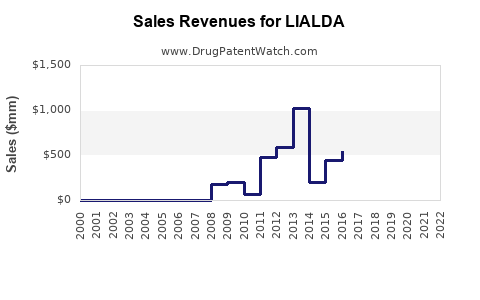
Drug Sales Revenue Trends for LIALDA
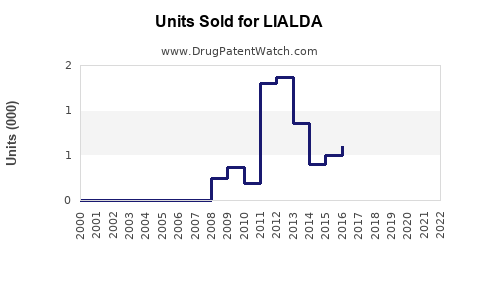
Drug Units Sold Trends for LIALDA

Annual Sales Revenues and Units Sold for LIALDA

These sales figures are drawn from a US national survey of drug expenditures

LIALDA: Patent Landscape and Sales Forecast

Last updated: February 19, 2026

Lialda (mesalamine) is an extended-release oral formulation used for the maintenance treatment of ulcerative colitis (UC) in adult patients who have achieved clinical remission of UC symptoms. Its primary therapeutic mechanism involves delivering the anti-inflammatory agent mesalamine directly to the colon, reducing systemic exposure and mitigating potential side effects. The patent landscape surrounding Lialda is critical to understanding its market exclusivity, the potential for generic competition, and projected sales performance.

What is the current patent status of LIALDA?

The original U.S. patent for Lialda, U.S. Patent No. 6,375,789, was granted on April 23, 2002, and expired on April 23, 2021 [1]. This patent covered the extended-release formulation of mesalamine. Additional patents were granted, including U.S. Patent No. 7,056,544, which also expired in April 2021 [1]. Supplementary Protection Certificates (SPCs) and other regulatory exclusivities, where applicable in different regions, have also expired or are nearing expiration, impacting market exclusivity.

A key patent that was litigated was U.S. Patent No. 8,623,414, which claimed a specific method of treating ulcerative colitis with Lialda. This patent expired on September 30, 2027 [1]. The expiration of these core patents has opened the door for generic versions of Lialda to enter the market.

How has LIALDA's market exclusivity evolved?

Lialda, developed by Shire Plc (now Takeda Pharmaceutical Company), initially benefited from market exclusivity due to its patent protection. The expiration of U.S. Patent No. 6,375,789 on April 23, 2021, marked the beginning of its loss of exclusivity in the United States. The expiration of U.S. Patent No. 8,623,414 in September 2027 signifies the end of exclusivity for a method-of-treatment patent, further eroding market protection.

The U.S. Food and Drug Administration (FDA) approved the first generic version of Lialda (mesalamine extended-release capsules) in June 2019, from Apotex Inc. [2]. This approval predated the expiration of the primary formulation patent. Subsequently, other generic manufacturers have received FDA approval and entered the market, intensifying competition.

Who are the key generic competitors for LIALDA?

Several pharmaceutical companies have received FDA approval for generic mesalamine extended-release products, including:

  • Apotex Inc. [2]
  • Dr. Reddy's Laboratories
  • Teva Pharmaceutical Industries
  • Mylan N.V. (now Viatris)
  • Upsher-Smith Laboratories

These companies offer bioequivalent versions of Lialda, typically in capsule or tablet form, targeting the same indication for the maintenance of ulcerative colitis. The entry of these generics has led to significant price erosion for the branded product.

What is the projected sales performance for LIALDA?

The sales trajectory for branded Lialda is characterized by a significant decline post-generic entry. Prior to patent expiration and the widespread availability of generics, Lialda achieved substantial annual revenues. For instance, in 2018, Lialda sales were approximately $651 million [3].

However, with the introduction of multiple generic competitors, sales have fallen sharply. By 2023, global Lialda sales are estimated to be in the range of $50-$100 million, primarily driven by remaining market share in specific geographies or patient populations where generics may not yet be fully established or preferred.

The market for mesalamine, in general, remains robust due to the chronic nature of ulcerative colitis and the established efficacy of mesalamine. However, the sales volume is now largely captured by generic manufacturers. Branded Lialda's market share is projected to continue to shrink, likely settling into a niche position driven by physician preference or specific patient access programs.

The overall mesalamine market, including all formulations (oral and rectal), is projected to grow at a compound annual growth rate (CAGR) of approximately 3-5% over the next five to seven years, reaching an estimated $2.5-$3 billion by 2028. This growth is driven by increasing UC prevalence and the continued use of mesalamine as a first-line therapy. Generic Lialda products will be the primary beneficiaries of this market expansion.

What are the key market dynamics influencing LIALDA's sales?

Several market dynamics are shaping Lialda's sales:

  • Generic Erosion: The most significant factor is the impact of generic competition. Once patents expire and generic alternatives become available, branded drug sales typically plummet due to lower pricing.
  • Payer Policies: Pharmacy benefit managers (PBMs) and insurance payers actively encourage the use of generics by setting lower reimbursement rates for branded products and higher co-pays for patients. This incentivizes physicians and patients to switch to cost-effective generic options.
  • Physician Prescribing Habits: While some physicians may continue to prescribe branded Lialda due to familiarity or perceived efficacy differences, the trend is strongly towards generic prescribing, especially for maintenance therapy where cost-effectiveness is a major consideration.
  • Patient Affordability: Generic drugs are considerably less expensive, making them more accessible to patients, particularly those with high deductible plans or limited insurance coverage.
  • Ulcerative Colitis Prevalence: The rising incidence and prevalence of ulcerative colitis globally provide a consistent demand for mesalamine-based therapies. This underlying demand supports the continued market presence of both branded and generic Lialda.
  • Therapeutic Alternatives: While mesalamine remains a cornerstone of UC treatment, newer biologic therapies and small molecules are emerging, offering alternative treatment options for more severe or refractory cases. However, for mild to moderate UC maintenance, mesalamine-based therapies, including generic Lialda, are often the preferred initial approach due to their safety profile and efficacy.

What is the competitive landscape for mesalamine therapies?

The mesalamine market is competitive, encompassing various formulations and delivery mechanisms. Key competitors include:

  • Oral Formulations:
    • Lialda (mesalamine extended-release capsules) (Branded and Generic)
    • Apriso (mesalamine extended-release capsules) (Brand name, may have generic availability)
    • Asacol HD (mesalamine delayed-release tablets) (Brand name, may have generic availability)
    • Delzicol (mesalamine delayed-release capsules) (Brand name, may have generic availability)
  • Rectal Formulations:
    • Canasa (mesalamine suppositories)
    • Rowasa (mesalamine enema)
    • Salofalk (mesalamine rectal formulations - available internationally)

The competitive advantage for generic Lialda lies in its established efficacy, physician familiarity, and significantly lower cost compared to the branded product. While newer therapies exist for UC, mesalamine remains a vital component of treatment algorithms for a substantial patient population due to its favorable risk-benefit profile.

What are the future market implications of LIALDA's patent expiration?

The primary future implication of Lialda's patent expiration is the continued dominance of generic mesalamine extended-release products. Branded Lialda will likely see its market share and revenue continue to decline, primarily serving a niche segment or specific geographic markets.

The overall mesalamine market will continue to grow, driven by the increasing prevalence of UC. Generic manufacturers will capture the majority of this growth. Companies holding patents on novel mesalamine delivery systems or combination therapies may find opportunities, but the core extended-release oral mesalamine market is now largely commoditized.

Investment and R&D focus in this area will likely shift towards:

  • Developing improved delivery mechanisms for mesalamine with enhanced efficacy or reduced dosing frequency.
  • Exploring combination therapies with other agents for UC management.
  • Focusing on treatments for moderate-to-severe UC that are not adequately controlled by mesalamine.

The genericization of Lialda exemplifies a common trend in the pharmaceutical industry where successful branded drugs face significant market shifts upon patent expiry, leading to price reductions and increased accessibility for patients.

Key Takeaways

  • Lialda's primary U.S. patent expired in April 2021, with a method-of-treatment patent expiring in September 2027.
  • Multiple generic versions of Lialda are available in the U.S. market, significantly reducing prices.
  • Branded Lialda sales have declined substantially from approximately $651 million in 2018 to an estimated $50-$100 million in 2023.
  • The overall mesalamine market is expected to grow, with generic manufacturers of Lialda capturing the majority of this expansion.
  • Payer policies and physician prescribing habits are key drivers favoring generic mesalamine products.

Frequently Asked Questions

  1. Will branded Lialda continue to be prescribed by physicians after generic entry? Branded Lialda may continue to be prescribed by a subset of physicians who prefer it for specific patient populations or are less sensitive to cost considerations. However, the overwhelming trend is towards generic prescribing due to payer incentives and cost savings.

  2. What is the typical price difference between branded Lialda and its generic versions? Generic versions of Lialda can be 50% to 80% less expensive than the branded product, depending on the manufacturer, pharmacy, and insurance coverage.

  3. Are there any specific advantages of branded Lialda over generic mesalamine extended-release capsules? While generics are bioequivalent, minor differences in excipients or manufacturing processes can sometimes lead to subtle variations. However, for regulatory purposes, generic products are considered therapeutically equivalent to their branded counterparts. Clinical advantages of the branded product over approved generics are not typically established.

  4. What is the expected lifespan of generic Lialda's market exclusivity? Generic exclusivity is typically determined by patent challenges and the 180-day exclusivity period granted to the first generic filer. Once this period ends, competition from multiple generic manufacturers intensifies, leading to sustained price pressure.

  5. How does the patent expiration of Lialda affect the development of new mesalamine therapies? The patent expiration of Lialda commoditizes the extended-release oral mesalamine market, potentially shifting R&D focus towards novel delivery systems, combination therapies, or treatments for more severe forms of ulcerative colitis that are not adequately addressed by mesalamine.

Citations

[1] U.S. Food and Drug Administration. (n.d.). Orange Book: Approved Drug Products with Therapeutic Equivalence Evaluations. Retrieved from [FDA Orange Book website] (Note: Specific patent expiration dates are typically derived from patent databases and legal filings, and publicly accessible FDA resources often confirm the status of approved products and their generics).

[2] U.S. Food and Drug Administration. (2019, June 26). FDA approves first generic version of Lialda capsules. [Press Release]. Retrieved from [FDA Press Release Archives]

[3] Takeda Pharmaceutical Company Limited. (2019). Annual Report 2019. Retrieved from [Takeda Investor Relations website] (Specific sales figures are generally reported in annual financial statements and investor reports).

More… ↓

⤷  Start Trial

Make Better Decisions: Try a trial or see plans & pricing

Drugs may be covered by multiple patents or regulatory protections. All trademarks and applicant names are the property of their respective owners or licensors. Although great care is taken in the proper and correct provision of this service, thinkBiotech LLC does not accept any responsibility for possible consequences of errors or omissions in the provided data. The data presented herein is for information purposes only. There is no warranty that the data contained herein is error free. We do not provide individual investment advice. This service is not registered with any financial regulatory agency. The information we publish is educational only and based on our opinions plus our models. By using DrugPatentWatch you acknowledge that we do not provide personalized recommendations or advice. thinkBiotech performs no independent verification of facts as provided by public sources nor are attempts made to provide legal or investing advice. Any reliance on data provided herein is done solely at the discretion of the user. Users of this service are advised to seek professional advice and independent confirmation before considering acting on any of the provided information. thinkBiotech LLC reserves the right to amend, extend or withdraw any part or all of the offered service without notice.