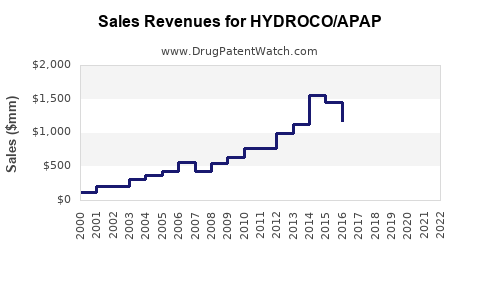
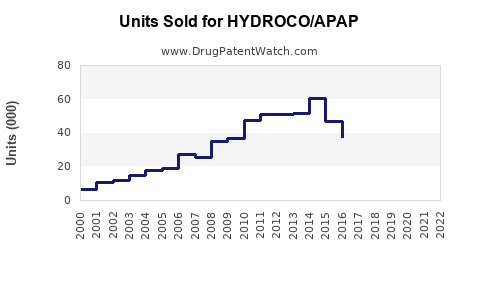
Market Analysis and Sales Projections for HydroCo/APAP
Last updated: February 20, 2026
What is HydroCo/APAP and What is its Market Position?
HydroCo/APAP combines hydrocodone with acetaminophen, a formulation historically used for pain management. It is classified as a Schedule II opioid in the United States and is included in various national formularies for moderate to severe pain relief.
Current formulation: typically 5 mg hydrocodone with 325 mg acetaminophen per tablet. It is marketed under multiple brand names, with generic versions available.
Market Size and Demand Drivers
Current Market Size
The global analgesic drugs market was valued at approximately $10.5 billion in 2022.
The North American opioid analgesics segment comprises about 65% of this market, driven by high opioid prescription rates.
Prescription Trends
U.S. prescriptions for hydrocodone/acetaminophen peaked in 2012 with over 100 million prescriptions annually.
After regulatory tightening, prescriptions declined to approximately 60 million in 2021.
Regulatory Environment
The Controlled Substances Act classifies hydrocodone as Schedule II, with restrictions impacting prescribing patterns.
The CDC guidelines limit outpatient opioid prescriptions, reducing distribution volumes.
Competitive Landscape
Leading brands: Vicodin, Lortab, Norco.
Generics dominate the market, accounting for over 90% of prescriptions.
Emergence of abuse-deterrent formulations has influenced market preferences.
Sales Projections and Growth Opportunities
Short-term (2023-2025)
Prescriptions are expected to decline by approximately 10% annually due to ongoing regulation and increased awareness of opioid risks.
Market revenue estimated to decrease from $2 billion in 2022 to about $1.45 billion in 2025.
Long-term (2026-2030)
Growth hinges on regulatory shifts, reformulation strategies, and development of non-opioid alternatives.
If regulatory constraints loosen, sales could stabilize or grow modestly, reaching around $1.8 billion by 2030.
The evolution of abuse-deterrent formulations and combination approaches may capture market share from traditional products.
Market Expansion Factors
Chronic pain management needs, especially in aging populations.
Adoption of integrated pain management protocols reducing reliance on opioids.
Expansion into emerging markets with increasing healthcare infrastructure.
Pricing and Margins
Average retail price per tablet: approximately $0.50-$1.00.
Cost of goods sold (COGS): estimated at $0.10-$0.20 per tablet.
Gross margins typically range from 60-75% in the generics market.
Regulatory and Ethical Risks
Heightened scrutiny over opioid prescriptions due to addiction concerns.
Potential for increased regulation or outright bans, affecting market stability.
Legal risks from litigation related to opioid epidemic impacts.
Strategic Considerations
Companies must evaluate patent expirations and the role of brand trials.
Investment in abuse-deterrent formulations could extend product lifecycle.
Diversification into non-opioid analgesics offers growth pathways amid regulatory instability.
Quantitative Summary Table
Year
Market Revenue (USD billion)
Prescription Volume (millions)
Key Regulatory Changes
2022
2.00
60
Increased DEA oversight, abuse-deterrent focus
2023
1.80
54
Continued prescribing restrictions
2025
1.45
48
Ongoing regulatory tightening
2030
1.80 (potential)
50-55 (potential)
Possible regulatory easing, generic competition
Key Takeaways
The market for HydroCo/APAP is declining in North America due to regulatory constraints and societal shifts toward reducing opioid dependence.
Prescriptions are expected to decrease over the next two years, with a potential stabilization or modest growth capable of 6-8% annual increase post-2025 if new formulations or policies emerge.
Pricing remains stable, but margins are pressured by generic competition and regulatory costs.
Long-term growth depends on regulatory developments, reformulation strategies, and alternative pain management solutions.
Frequently Asked Questions
How will regulatory policies impact HydroCo/APAP sales?
Stricter prescribing guidelines reduce prescription volumes; potential policy easing could stabilize or grow sales.
Are there non-opioid alternatives competing with HydroCo/APAP?
Yes, non-opioid analgesics like NSAIDs, acetaminophen alone, and nerve pain medications are alternatives.
Drugs may be covered by multiple patents or regulatory protections. All trademarks and applicant names are the property of their respective owners or licensors.
Although great care is taken in the proper and correct provision of this service, thinkBiotech LLC does not accept any responsibility for possible consequences of errors or omissions in the provided data.
The data presented herein is for information purposes only. There is no warranty that the data contained herein is error free.
We do not provide individual investment advice. This service is not registered with any financial regulatory agency. The information we publish is educational only and based on our opinions plus our models.
By using DrugPatentWatch you acknowledge that we do not provide personalized recommendations or advice.
thinkBiotech performs no independent verification of facts as provided by public sources nor are attempts made to provide legal or investing advice. Any reliance on data provided herein is done solely at the discretion of the user.
Users of this service are advised to seek professional advice and independent confirmation before considering acting on any of the provided information. thinkBiotech LLC reserves the right to amend, extend or withdraw any part or all of the offered service without notice.
Alerts Available With Subscription
Alerts are available for users with active subscriptions.