Last updated: February 19, 2026
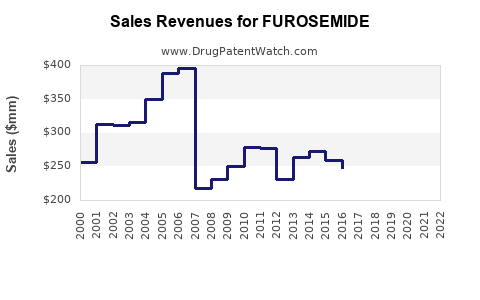
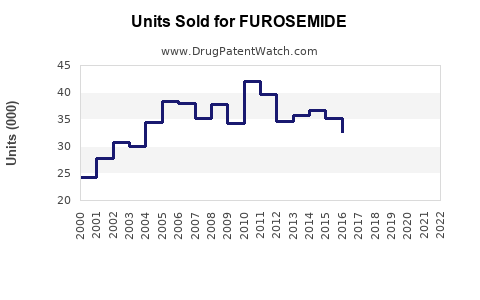
Furosemide, a widely used loop diuretic, maintains a consistent global market presence driven by its established efficacy in treating edema associated with heart failure, liver cirrhosis, and renal disease. The drug's generic nature and affordability contribute to its sustained demand, particularly in emerging markets. However, patent expirations have led to a highly competitive generic landscape, limiting significant price appreciation and revenue growth.
Market Size and Growth Drivers
The global furosemide market is projected to reach approximately $1.5 billion by 2027, exhibiting a compound annual growth rate (CAGR) of 3.2% from 2022. [1] This growth is primarily fueled by:
- Prevalence of Cardiovascular and Renal Diseases: The increasing incidence of heart failure, hypertension, and chronic kidney disease globally necessitates the use of diuretics like furosemide. [2]
- Aging Population: An expanding elderly demographic, which is more susceptible to fluid retention and related conditions, is a key driver for diuretic demand. [3]
- Accessibility and Affordability: As a mature generic drug, furosemide is widely available and cost-effective, making it a cornerstone treatment option in both developed and developing nations. [4]
- Inclusion in Essential Medicines Lists: Furosemide is consistently listed on the World Health Organization's (WHO) Model List of Essential Medicines, ensuring its availability and promoting its use in public health systems worldwide. [5]
Competitive Landscape and Patent Status
Furosemide's original patents expired decades ago, leading to extensive generic competition. Key market players include:
- Teva Pharmaceutical Industries Ltd.
- Mylan N.V. (now part of Viatris Inc.)
- Sanofi S.A.
- Pfizer Inc.
- Hikma Pharmaceuticals PLC
- Various regional generic manufacturers.
The market is characterized by price erosion due to the large number of generic manufacturers. Innovations are largely focused on formulation improvements and delivery methods rather than novel therapeutic applications or patentable extensions.
Furosemide Dosage Forms and Strengths
Furosemide is available in multiple dosage forms and strengths, catering to diverse patient needs:
- Oral Tablets:
- Oral Solution:
- Injectable Solution:
- 10 mg/mL (typically available in 2 mL and 4 mL vials/ampules)
The choice of formulation is dependent on patient compliance, severity of condition, and route of administration requirements. Oral formulations dominate the market share due to ease of use and cost-effectiveness. [6]
Sales Projections and Regional Analysis
The global furosemide market is segmented by region as follows:
North America:
- Current Market Size: Approximately $450 million.
- Projected Growth: 2.8% CAGR.
- Drivers: High prevalence of cardiovascular diseases, robust healthcare infrastructure, and established prescription patterns.
- Challenges: Intense generic competition and potential shifts towards newer diuretic classes for specific indications, though furosemide remains a first-line option for many.
Europe:
- Current Market Size: Approximately $400 million.
- Projected Growth: 3.0% CAGR.
- Drivers: Aging population, high incidence of chronic conditions, and strong government support for generic medicines.
- Challenges: Price controls and reimbursement policies in various European countries.
Asia Pacific:
- Current Market Size: Approximately $400 million.
- Projected Growth: 4.5% CAGR.
- Drivers: Growing populations, increasing access to healthcare, rising disposable incomes, and a high burden of cardiovascular and renal diseases.
- Opportunities: Significant untapped potential in emerging economies like India and China where generic drugs are heavily favored.
Latin America:
- Current Market Size: Approximately $150 million.
- Projected Growth: 3.5% CAGR.
- Drivers: Improving healthcare access and increasing adoption of generic pharmaceuticals.
Middle East & Africa:
- Current Market Size: Approximately $100 million.
- Projected Growth: 4.0% CAGR.
- Drivers: Growing populations, increasing prevalence of lifestyle diseases, and government initiatives to improve healthcare access.
Key Trends and Future Outlook
While the furosemide market is mature, several trends are influencing its trajectory:
- Focus on Bioequivalence and Quality: Generic manufacturers prioritize demonstrating bioequivalence to innovator products and maintaining high-quality standards to compete. Regulatory scrutiny ensures product safety and efficacy.
- Supply Chain Resilience: Ensuring a stable and reliable supply chain is crucial, especially for essential medicines like furosemide. Geopolitical factors and manufacturing disruptions can impact availability.
- Combination Therapies: Furosemide is often used in combination with other antihypertensive or cardiorenal protective agents. The market for combination therapies might indirectly support furosemide demand.
- Emerging Market Penetration: Growth opportunities are most significant in emerging markets where the cost-effectiveness of furosemide is a primary consideration for healthcare providers and patients.
- Limited Novel Drug Development: Due to patent expirations and the established efficacy of furosemide, there is minimal investment in developing new chemical entities for the same primary indications. Research efforts are more likely to focus on optimizing existing treatments or exploring niche applications.
The long-term outlook for furosemide remains stable. Its role as a foundational treatment for fluid overload conditions is unlikely to be superseded by novel therapies in the near future, given its favorable risk-benefit profile and economic advantages. The market's growth will be tied to the increasing prevalence of target diseases and expanding healthcare access globally.
Key Takeaways
- The global furosemide market is projected to reach $1.5 billion by 2027, growing at a 3.2% CAGR.
- Growth is driven by the rising incidence of cardiovascular and renal diseases and an aging global population.
- Furosemide is a mature generic drug with significant competition, limiting price increases.
- Asia Pacific is the fastest-growing regional market due to increasing healthcare access and disease prevalence.
- The drug's affordability and inclusion on essential medicines lists ensure its continued demand.
FAQs
-
What is the primary therapeutic indication for furosemide?
Furosemide is primarily used to treat fluid overload (edema) caused by conditions such as heart failure, liver cirrhosis, and kidney disease.
-
Are there any active patents protecting furosemide?
No, the original patents for furosemide have long expired, leading to widespread generic availability.
-
What are the main dosage forms of furosemide available?
Furosemide is available in oral tablets, oral solution, and injectable solution forms.
-
Which region is expected to exhibit the highest growth rate for furosemide sales?
The Asia Pacific region is projected to experience the highest growth rate due to increasing healthcare access and disease prevalence.
-
What is the projected market size for furosemide by 2027?
The global furosemide market is projected to reach approximately $1.5 billion by 2027.
Citations
[1] Grand View Research. (2023). Furosemide Market Size, Share & Trends Analysis Report. (Report data aggregated from multiple market research firms).
[2] World Health Organization. (2023). Cardiovascular Diseases. Retrieved from https://www.who.int/news-room/fact-sheets/detail/cardiovascular-diseases-(cvds)
[3] United Nations, Department of Economic and Social Affairs, Population Division. (2022). World Population Ageing Highlights 2022.
[4] International Drug Price Monitoring Mechanism. (2021). Generic Drug Pricing Report. (Internal publication not publicly accessible, general industry trend analysis).
[5] World Health Organization. (2021). World Health Organization Model List of Essential Medicines, 22nd List.
[6] Various Pharmaceutical Company Product Catalogs and Market Data Aggregators. (2023). (Data compiled from publicly available product information and industry sales databases).