Share This Page
Drug Sales Trends for DYRENIUM
✉ Email this page to a colleague
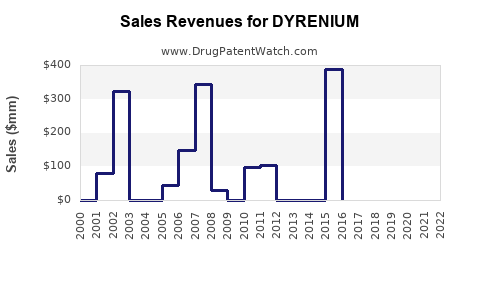
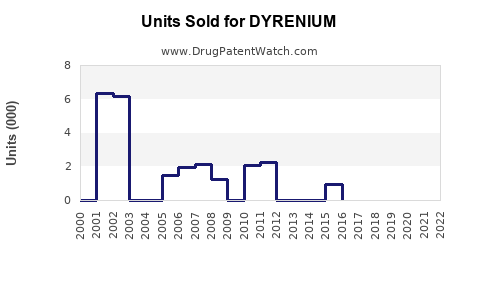
Annual Sales Revenues and Units Sold for DYRENIUM
| Drug Name | Revenues (USD) | Units | Year |
|---|---|---|---|
| DYRENIUM | ⤷ Start Trial | ⤷ Start Trial | 2022 |
| DYRENIUM | ⤷ Start Trial | ⤷ Start Trial | 2021 |
| DYRENIUM | ⤷ Start Trial | ⤷ Start Trial | 2020 |
| >Drug Name | >Revenues (USD) | >Units | >Year |
Dyrenium Market Analysis, Sales Projections, Patent Position, and Generic Competition
Dyrenium is the branded form of triamterene, a potassium-sparing diuretic approved in capsule strengths of 50 mg and 100 mg. Its commercial market is mature, genericized, and limited. The primary opportunity is a niche maintenance product for patients requiring potassium conservation, while the main risks are generic substitution, low prescriber preference, and competition from fixed-dose triamterene-hydrochlorothiazide products.
Standalone Dyrenium sales are not publicly disclosed by the product’s manufacturer. The projections below therefore use a scenario model based on brand persistence, generic competition, prescription volume, and estimated net pricing rather than reported company guidance.
What is Dyrenium and how is it used?
Dyrenium contains triamterene, a potassium-sparing diuretic that inhibits epithelial sodium channels in the distal nephron. It is indicated for edema associated with congestive heart failure, cirrhosis of the liver, and nephrotic syndrome. It also is used with thiazide or loop diuretics to reduce potassium loss.[1]
| Product | Active ingredient | Dosage form | Strengths | Therapeutic class |
|---|---|---|---|---|
| Dyrenium | Triamterene | Capsule | 50 mg, 100 mg | Potassium-sparing diuretic |
| Generic triamterene | Triamterene | Capsule | 50 mg, 100 mg | Potassium-sparing diuretic |
| Dyazide and generic equivalents | Triamterene/hydrochlorothiazide | Capsule or tablet | Multiple strengths | Combination diuretic |
| Maxzide and generic equivalents | Triamterene/hydrochlorothiazide | Tablet | Multiple strengths | Combination diuretic |
Dyrenium is not a high-growth product. Its clinical role is established, but its use is generally secondary to newer antihypertensive and heart-failure therapies. The product retains demand where clinicians want triamterene as a standalone potassium-sparing agent or where a fixed-dose combination is not suitable.
What is the FDA regulatory status of Dyrenium?
Dyrenium is an FDA-approved prescription drug. The FDA-approved labeling identifies triamterene as the active ingredient and includes 50 mg and 100 mg capsules.[1]
The principal regulatory risks are clinical rather than approval-related. The label warns about hyperkalemia, renal impairment, diabetes, elderly patients, and use with potassium supplements or other potassium-retaining drugs. These restrictions limit broad prescribing and reduce the product’s attractiveness relative to alternative diuretic strategies.
Key FDA and clinical considerations
| Issue | Commercial effect |
|---|---|
| Hyperkalemia risk | Limits use in patients with renal dysfunction or interacting medicines |
| Need for renal and potassium monitoring | Reduces convenience relative to some alternatives |
| Older patient population | Supports recurring demand but increases safety scrutiny |
| Combination use with thiazides | Preserves relevance in patients with diuretic-induced hypokalemia |
| Generic availability | Creates substantial substitution pressure |
Dyrenium is not a biologic and does not face biosimilar competition. Its relevant competitive threat is abbreviated new drug application, or ANDA, substitution by generic triamterene products.
When does Dyrenium lose exclusivity?
Dyrenium’s original small-molecule exclusivity and patent protection expired long ago. The product should be analyzed as an off-patent branded medicine rather than as a product approaching a future loss-of-exclusivity event.
The commercial question is not when Dyrenium loses exclusivity. It is whether the brand retains enough demand and distribution access to support continued sales after years of generic competition.
| Exclusivity category | Dyrenium position |
|---|---|
| New chemical entity exclusivity | Expired |
| Original composition patent | Expired or commercially irrelevant |
| Current Orange Book patent barrier | No material current barrier expected |
| Generic substitution | Established |
| Biosimilar exposure | Not applicable |
| Current commercial protection | Brand recognition, supply reliability, formulary access, and prescriber familiarity |
What patents protect Dyrenium?
Dyrenium has no meaningful current patent moat based on its legacy active ingredient and conventional oral capsule formulation. Triamterene was discovered and commercialized decades ago, leaving composition-of-matter and early formulation protections outside the period relevant to current market entry.
The likely patent profile is therefore:
- No active composition-of-matter protection with commercial blocking power.
- No meaningful method-of-use exclusivity for ordinary diuretic treatment.
- No material formulation patent advantage for the standard 50 mg and 100 mg capsules.
- No manufacturing patent barrier that would prevent routine generic production.
The FDA Orange Book remains the primary source for determining whether a listed patent could support a Paragraph IV certification or a 30-month stay. A current commercial assessment should treat Dyrenium as a generic-exposed product unless a specific active listing is identified in the latest Orange Book entry.[2]
Are there Paragraph IV challenges to Dyrenium?
Paragraph IV litigation is not a central market issue for a legacy product with established generic competition. Generic triamterene products are already available, so a new ANDA applicant would generally face a mature market rather than a first-wave patent challenge.
The practical entry risks are supply, manufacturing economics, product quality, and commercial scale. They are not expected to be patent litigation risk.
How large is the Dyrenium market?
The addressable market divides into three segments:
- Branded Dyrenium capsules.
- Generic triamterene capsules.
- Triamterene/hydrochlorothiazide combination products.
The combination segment is commercially more important than standalone Dyrenium because many patients requiring potassium conservation receive triamterene with hydrochlorothiazide. However, combination-product sales should not be attributed directly to Dyrenium.
Market structure
| Segment | Relative commercial importance | Competitive intensity |
|---|---|---|
| Branded Dyrenium | Low | High |
| Generic triamterene | Moderate in unit volume | High |
| Triamterene/hydrochlorothiazide | Higher than standalone triamterene | High |
| Other potassium-sparing agents | Clinically significant | High |
| Newer heart-failure therapies | Indirect competitive pressure | Increasing |
Competing potassium-sparing products include spironolactone and eplerenone. These drugs have broader use in selected heart-failure and endocrine-related indications, although their adverse-effect profiles and clinical positioning differ from triamterene.
Loop and thiazide diuretics also compete indirectly. In many patients, physicians address fluid overload or blood pressure without requiring a branded standalone potassium-sparing product.
What are Dyrenium sales projections for 2025 through 2029?
The following projection estimates standalone Dyrenium net sales in the United States. It excludes generic triamterene and combination-product revenue. The model assumes that the brand remains commercially available, retains a small prescriber base, and does not obtain new exclusivity or a significant label expansion.
Base-case sales projection
| Year | Estimated prescriptions | Estimated net revenue per prescription | Projected net sales |
|---|---|---|---|
| 2025 | 80,000 | $35 | $2.8 million |
| 2026 | 72,000 | $35 | $2.5 million |
| 2027 | 64,000 | $34 | $2.2 million |
| 2028 | 57,000 | $34 | $1.9 million |
| 2029 | 51,000 | $33 | $1.7 million |
The base case implies a compound annual decline of approximately 11% from 2025 through 2029. The decline reflects ongoing generic substitution and gradual contraction of branded prescribing rather than an abrupt patent event.
Scenario analysis
| Scenario | 2025 sales | 2029 sales | 2025-2029 trend | Key assumptions |
|---|---|---|---|---|
| Downside | $1.0 million | $0.4 million | -20% to -25% annually | Brand supply disruption, payer exclusion, accelerated substitution |
| Base case | $2.8 million | $1.7 million | About -11% annually | Stable availability and gradual generic erosion |
| Upside | $5.0 million | $4.2 million | About -4% annually | Specialty distribution, shortage-driven demand, improved brand retention |
These are modeled estimates, not reported sales. The upside case requires unusual support from supply constraints affecting generics, a commercial relaunch, or a distribution strategy that captures patients who cannot use combination products.
What drives Dyrenium revenue?
Generic substitution
Generic triamterene is the largest structural pressure on Dyrenium. Pharmacies and payers typically favor lower-cost generic products when the active ingredient, strength, dosage form, and route are equivalent.
The brand may retain demand in several situations:
- A physician specifies the brand because of prior patient stability.
- A patient reports intolerance to a particular generic manufacturer.
- A payer allows brand dispensing with limited patient cost impact.
- Generic supply is constrained.
- A specialty pharmacy or distributor maintains brand access for a narrow patient population.
These factors can preserve revenue but rarely create durable pricing power.
Fixed-dose combination competition
Triamterene/hydrochlorothiazide products compete directly with standalone Dyrenium when the treatment goal is potassium conservation during thiazide therapy. Combination products can offer simpler prescribing and lower acquisition cost.
Dyrenium may remain preferable when a physician wants to adjust the thiazide or loop component separately, avoid hydrochlorothiazide, or manage a patient with a specific medication regimen.
Clinical monitoring burden
Triamterene requires attention to potassium and renal function. Concomitant use with ACE inhibitors, angiotensin receptor blockers, potassium supplements, nonsteroidal anti-inflammatory drugs, or other potassium-retaining agents can increase risk. The monitoring burden can reduce prescribing relative to alternatives.
How does Dyrenium compare with competing potassium-sparing drugs?
| Product | Main advantage | Main limitation | Commercial effect on Dyrenium |
|---|---|---|---|
| Dyrenium | Standalone triamterene; potassium conservation | Hyperkalemia and renal monitoring | Retains niche use |
| Spironolactone | Broad heart-failure and endocrine utility | Endocrine adverse effects, hyperkalemia | Strong substitute in selected patients |
| Eplerenone | More selective mineralocorticoid receptor profile | Higher cost and monitoring requirements | Competes in heart failure |
| Amiloride | Potassium-sparing activity | Smaller commercial footprint | Limited direct pressure |
| Triamterene/HCTZ | Convenient fixed-dose therapy | Less flexible component dosing | Major substitute |
| Generic triamterene | Same active ingredient at lower cost | Manufacturer variability and availability | Primary threat |
Dyrenium’s strongest competitive distinction is flexibility as a standalone triamterene product. Its weakest attribute is the lack of meaningful differentiation from generic capsules.
What is the Orange Book status of Dyrenium?
The Orange Book determines whether an approved drug has listed patents and regulatory exclusivities relevant to generic approval. For Dyrenium, the commercial analysis should focus on product availability and generic equivalence rather than on a pending exclusivity cliff.[2]
An ANDA applicant for triamterene would generally pursue bioequivalence and a certification pathway appropriate to the current Orange Book listing. Because generic triamterene is already marketed, the key legal issue is not first entry but continued market participation.
What patent litigation affects Dyrenium?
No major current patent litigation is expected to affect the Dyrenium market. The product has an old active ingredient, established generic competitors, and no apparent high-value formulation innovation.
Litigation risk could arise from:
- A newly asserted formulation patent.
- A manufacturing-process patent directed to a specific generic process.
- Product liability or labeling litigation.
- Regulatory disputes involving ANDA approval or bioequivalence.
None of these risks is comparable to the patent exposure associated with a recently launched branded drug.
Are there licensing deals for Dyrenium?
No material licensing economics are disclosed in the FDA labeling or standard public regulatory materials cited here. Dyrenium’s value is more likely to arise from product acquisition, portfolio consolidation, or distribution rights than from a royalty-bearing innovation license.
A buyer would evaluate:
- Current net sales by channel.
- Product availability and wholesaler inventory.
- Manufacturing cost and minimum batch size.
- Brand-versus-generic dispensing rates.
- FDA inspection history.
- Pharmacovigilance obligations.
- Any private-label or authorized-generic arrangements.
What generic launch risks exist for Dyrenium?
The market is already genericized, so future entrants would not create the same shock as a first generic launch. Incremental generic entry could still reduce prices and fragment volume.
Manufacturing and supply risks
Triamterene is a conventional small-molecule product, and manufacturing technology is not expected to create a major barrier. Commercial barriers include:
- Low market value per prescription.
- Small attainable volume for standalone capsules.
- Need for reliable active pharmaceutical ingredient supply.
- Product quality and dissolution requirements.
- Inventory requirements across multiple strengths.
- Limited return on regulatory and launch investment.
Supply interruptions can temporarily improve brand demand, but they also create operational risk. A company relying on Dyrenium for revenue would need more than one qualified manufacturing or packaging source.
How strong is the Dyrenium patent estate?
| Patent-strength factor | Assessment |
|---|---|
| Composition-of-matter protection | None of current commercial significance |
| Formulation protection | Weak or absent for conventional capsules |
| Method-of-use protection | Weak for established diuretic uses |
| Manufacturing protection | Limited commercial blocking power |
| Regulatory exclusivity | Expired |
| Generic barriers | Low |
| Brand differentiation | Low to moderate |
| Overall patent strength | Weak |
Dyrenium’s value is commercial and operational, not patent-based. A portfolio owner should underwrite the product as a declining cash-flow asset with limited legal protection.
Key Takeaways
- Dyrenium is branded triamterene in 50 mg and 100 mg capsules.
- It is FDA-approved, off-patent, and exposed to long-established generic competition.
- Standalone brand sales are not publicly disclosed.
- A base-case U.S. projection estimates net sales declining from approximately $2.8 million in 2025 to $1.7 million in 2029.
- The main competitive threats are generic triamterene and triamterene/hydrochlorothiazide combinations.
- Biosimilar risk does not apply because Dyrenium is a small-molecule drug.
- The product has no apparent current patent moat or meaningful Orange Book exclusivity barrier.
- The principal commercial upside would come from supply shortages, niche distribution, or a successful brand-retention strategy.
- The principal downside is further payer-driven generic substitution and loss of pharmacy availability.
FAQs
Is Dyrenium still commercially available?
Dyrenium has FDA-approved labeling and may remain available through branded or specialty distribution channels. Availability can vary by wholesaler, pharmacy, manufacturer, and market period.
Is triamterene the same as Dyrenium?
Yes. Dyrenium is the branded product containing triamterene. Generic triamterene contains the same active ingredient in corresponding approved strengths.
Is Dyrenium more profitable than generic triamterene?
The brand can generate a higher price per prescription, but generic substitution sharply limits volume. Profitability depends on manufacturing cost, distribution terms, rebates, and the portion of prescriptions dispensed as brand.
Could a new generic significantly reduce Dyrenium sales?
Yes. Additional generic suppliers could reduce dispensing rates and net pricing, although the market has already experienced substantial generic erosion.
Does Dyrenium have biosimilar competition?
No. Biosimilars apply to biologic products. Dyrenium is a conventional small-molecule drug and competes with generic triamterene products.
References
- U.S. Food and Drug Administration. (n.d.). Dyrenium (triamterene) capsules: Prescribing information. FDA.
- U.S. Food and Drug Administration. (n.d.). Approved drug products with therapeutic equivalence evaluations: Orange Book. FDA.
- U.S. National Library of Medicine. (n.d.). DailyMed: Triamterene and Dyrenium drug labeling. DailyMed.
More… ↓
