Share This Page
Drug Sales Trends for COUMADIN
✉ Email this page to a colleague
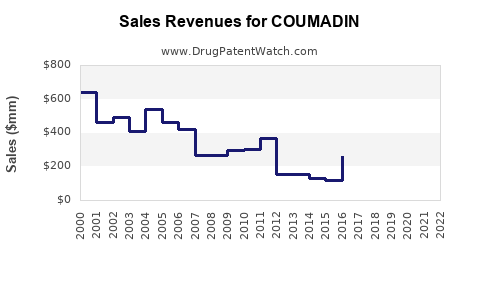
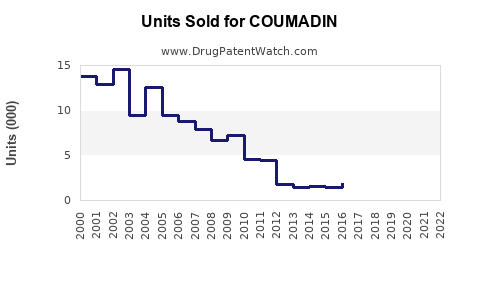
Annual Sales Revenues and Units Sold for COUMADIN
| Drug Name | Revenues (USD) | Units | Year |
|---|---|---|---|
| COUMADIN | ⤷ Start Trial | ⤷ Start Trial | 2022 |
| COUMADIN | ⤷ Start Trial | ⤷ Start Trial | 2021 |
| COUMADIN | ⤷ Start Trial | ⤷ Start Trial | 2020 |
| COUMADIN | ⤷ Start Trial | ⤷ Start Trial | 2019 |
| COUMADIN | ⤷ Start Trial | ⤷ Start Trial | 2018 |
| COUMADIN | ⤷ Start Trial | ⤷ Start Trial | 2017 |
| COUMADIN | ⤷ Start Trial | ⤷ Start Trial | 2016 |
| >Drug Name | >Revenues (USD) | >Units | >Year |
Coumadin Market Analysis and Sales Projections
Coumadin is the brand name for warfarin sodium, an oral vitamin K antagonist anticoagulant. Its clinical market remains material because warfarin is inexpensive, effective, and usable in patient groups where direct oral anticoagulants are unsuitable. The commercial outlook for the Coumadin brand is weak, however, because generic warfarin dominates dispensing, the product has no meaningful remaining regulatory exclusivity, and reimbursement favors low-cost generic supply.
The strongest commercial opportunity is in generic warfarin manufacturing, hospital supply, anticoagulation monitoring services, and selected indications such as mechanical heart valves. A standalone Coumadin brand investment case is substantially weaker.
What is Coumadin and how large is its addressable market?
Coumadin is warfarin sodium, an anticoagulant approved in the United States for indications including prevention and treatment of venous thrombosis and pulmonary embolism, prevention of thromboembolic complications associated with atrial fibrillation or cardiac valve replacement, and reduction of recurrent myocardial infarction risk in specified patients.[1]
Warfarin competes with apixaban, rivaroxaban, dabigatran, and edoxaban. Direct oral anticoagulants have taken share in nonvalvular atrial fibrillation and venous thromboembolism because they generally require less monitoring and have fewer food and drug interactions. Warfarin remains important where direct oral anticoagulants are contraindicated, clinically unsuitable, or not reimbursed.
| Market segment | Coumadin/warfarin position | Commercial outlook |
|---|---|---|
| Nonvalvular atrial fibrillation | Declining share | Continued substitution by direct oral anticoagulants |
| Mechanical heart valves | Established standard | Defensible, specialized demand |
| Severe renal impairment | Selective use | Warfarin retains clinical relevance |
| Venous thromboembolism | Minority treatment share | Generic, price-driven market |
| Low-income and underinsured populations | Frequently used | Supported by low acquisition cost |
| Hospital anticoagulation | Established | Stable demand, generic sourcing |
| Brand Coumadin | Minimal share | Continued erosion and limited pricing power |
Warfarin demand is therefore declining in some indications but is unlikely to disappear. The market is mature rather than structurally obsolete.
What is the current FDA regulatory status of Coumadin?
Coumadin is an FDA-approved prescription drug, and warfarin sodium is widely available through abbreviated new drug applications from generic manufacturers. The product is not a biologic, so biosimilar substitution rules do not apply.
| Regulatory issue | Status |
|---|---|
| Active ingredient | Warfarin sodium |
| FDA pathway | Original NDA for the branded product; ANDAs for generic warfarin |
| Dosage forms | Oral tablets, with multiple strengths |
| Controlled substance status | Not controlled under the federal Controlled Substances Act |
| Therapeutic monitoring | INR monitoring is required for safe dose management |
| Generic availability | Extensive |
| Pediatric exclusivity | None relevant to the mature product |
| New chemical entity exclusivity | Expired |
| Orphan-drug exclusivity | None applicable to the core product |
| Biosimilar exposure | None |
| Regulatory risk | Primarily manufacturing, labeling, supply, and safety compliance |
Warfarin has a narrow therapeutic index. Excess exposure can cause major bleeding, while inadequate exposure can cause thrombosis. FDA labeling emphasizes frequent INR monitoring, dose individualization, interactions, and variation in patient response.[1]
What patents protect Coumadin and when does warfarin lose exclusivity?
No meaningful patent-based exclusivity remains for the original Coumadin product. Warfarin has been marketed for decades, and the core compound, basic oral tablet formulation, and principal uses are outside any commercially relevant patent term.
The relevant U.S. intellectual-property position is as follows:
| IP category | Current commercial position |
|---|---|
| Core warfarin compound | Patent term expired |
| Original Coumadin tablet formulation | Patent term expired or no longer commercially blocking |
| Basic anticoagulation methods of use | Long expired or vulnerable to generic competition |
| Brand name "Coumadin" | Trademark protection may remain, but it does not block generic warfarin |
| New formulations | Potentially patentable if technically distinct, but not required for generic entry |
| Manufacturing process | Possible trade-secret value, but no barrier to ordinary generic supply |
| Orange Book blocking patents | No material unexpired patent barrier identified for standard warfarin tablets |
The FDA Orange Book remains the primary source for determining whether an approved drug has listed patents or exclusivity affecting ANDA approval.[2] For standard warfarin tablets, generic competition is not dependent on a future patent-expiration date. The commercial exclusivity event occurred decades ago.
What is the Orange Book status of Coumadin?
The Orange Book lists approved drug products and, where applicable, patents and exclusivity information. Coumadin’s practical Orange Book position is that of a mature, off-patent product with generic equivalents.
A generic applicant seeking approval for warfarin tablets generally relies on an ANDA demonstrating pharmaceutical equivalence and bioequivalence rather than challenging a current, commercially significant Coumadin patent. Paragraph IV litigation is therefore not the principal market-access issue.
The key regulatory barriers are instead:
- Demonstrating bioequivalence across strengths and tablet presentations.
- Maintaining consistent potency and content uniformity.
- Managing narrow-therapeutic-index expectations.
- Complying with current good manufacturing practice requirements.
- Maintaining reliable supply of active pharmaceutical ingredient.
- Meeting labeling and medication-guide requirements.
- Managing recalls, shortages, and manufacturing-site transfers.
Are there current Paragraph IV challenges to Coumadin?
Paragraph IV litigation is not a meaningful current risk category for standard Coumadin tablets because the original product has no commercially important unexpired patent estate that would ordinarily support a major ANDA challenge.
Potential litigation could arise around:
- A newly developed warfarin formulation.
- A modified-release product.
- A combination product.
- A digital dosing or monitoring system tied to a patented treatment method.
- A new use with sufficiently specific claim language.
- A manufacturing process with enforceable patent claims.
Those issues would affect a differentiated follow-on product, not routine generic warfarin tablets.
What formulations are protected by Coumadin patents?
The commercial tablet market is based on conventional immediate-release warfarin sodium tablets. The principal product differentiation is dose strength, not a protected delivery platform.
Potential formulation opportunities include:
| Formulation opportunity | Commercial rationale | Patent strength |
|---|---|---|
| Pediatric liquid warfarin | Improves dosing flexibility | Potentially stronger if technically differentiated |
| Unit-dose packaging | Reduces medication errors | Usually limited patent durability |
| Modified-release warfarin | Could reduce dosing variability | Development and safety burden is high |
| Fixed-dose combination | Could improve convenience | Requires new clinical and regulatory support |
| Digital dose-management package | Adds adherence and monitoring value | Software and method claims may be vulnerable |
| Genotype-guided dosing | Supports personalization | More likely to involve method-of-use claims |
No conventional Coumadin tablet formulation creates a durable commercial moat. A differentiated formulation would require clinical evidence, FDA approval, payer acceptance, and manufacturing economics that exceed the requirements for generic warfarin.
How does Coumadin compare with Eliquis, Xarelto, and other anticoagulants?
Coumadin competes primarily on price and clinical applicability. Direct oral anticoagulants compete on convenience and reduced monitoring.
| Product | Active ingredient | Main commercial advantage | Main limitation |
|---|---|---|---|
| Coumadin/generic warfarin | Warfarin sodium | Low cost; suitable for mechanical valves | INR monitoring and interactions |
| Eliquis | Apixaban | Strong adoption and convenient dosing | Higher price; renal and bleeding considerations |
| Xarelto | Rivaroxaban | Once-daily options in some indications | Higher price; bleeding risk |
| Pradaxa | Dabigatran | Direct thrombin inhibition | Gastrointestinal effects and renal considerations |
| Savaysa | Edoxaban | Direct factor Xa inhibition | Smaller market share |
| Heparin products | Unfractionated or low-molecular-weight heparin | Rapid onset and parenteral use | Injection or hospital administration burden |
The most durable warfarin segment is mechanical heart-valve anticoagulation. FDA labeling for direct oral anticoagulants generally does not position them as substitutes for warfarin in patients with mechanical prosthetic heart valves.[1] This segment is small relative to the total atrial-fibrillation market but clinically important.
What are Coumadin sales and revenue projections?
Standalone Coumadin sales are not consistently disclosed in public financial filings. The relevant commercial distinction is between:
- Brand Coumadin revenue.
- Total generic warfarin revenue.
- The broader oral anticoagulant market.
Brand Coumadin is expected to represent a small fraction of total U.S. warfarin volume. Public claims datasets, including Medicare Part D data, are more useful for measuring warfarin utilization than corporate reports are for isolating Coumadin brand revenue.[3]
The following projection is an analyst scenario, not reported manufacturer guidance. It assumes a mature U.S. market, declining prescription volume, stable generic pricing, and continued brand erosion.
U.S. warfarin sales scenario
| Year | Estimated total warfarin market revenue | Estimated Coumadin brand revenue | Market interpretation |
|---|---|---|---|
| 2024 | $90 million-$150 million | Below $5 million | Generic-dominated base year |
| 2025 | $88 million-$147 million | Below $4 million | Low-single-digit volume decline |
| 2026 | $86 million-$145 million | Below $3 million | Brand substitution continues |
| 2027 | $84 million-$143 million | Below $3 million | Stable clinical niche |
| 2028 | $82 million-$141 million | Below $2 million | Price pressure offsets demand stability |
| 2029 | $80 million-$139 million | Below $2 million | Generic supply remains the main business |
| 2030 | $78 million-$137 million | Below $2 million | Mature, low-growth market |
The estimated ranges reflect uncertainty in net pricing, payer mix, prescription counts, hospital purchasing, and the definition of revenue. They should not be interpreted as audited market-size figures.
Scenario sensitivity
| Scenario | Volume trend | Price trend | 2030 total warfarin revenue | Coumadin brand result |
|---|---|---|---|---|
| Upside | Flat to 1% annual decline | Stable | $105 million-$165 million | Remains marginal |
| Base case | 1%-2% annual decline | Slight erosion | $78 million-$137 million | Below $2 million |
| Downside | 3%-5% annual decline | Competitive price cuts | $55 million-$95 million | Potential withdrawal or negligible sales |
The brand case can deteriorate faster than the total warfarin market because generic substitution continues even when clinical demand is stable.
What companies are competing in the warfarin market?
The competitive field includes generic manufacturers, contract manufacturers, wholesalers, and hospital suppliers. The most relevant competitive advantages are manufacturing reliability, regulatory compliance, low cost, and consistent supply.
Key competitive categories include:
- Large generic pharmaceutical companies with ANDA portfolios.
- Regional manufacturers supplying retail pharmacies.
- Contract development and manufacturing organizations.
- Hospital-focused distributors.
- Private-label suppliers.
- International manufacturers serving non-U.S. markets.
The market is fragmented at the supply level but concentrated in purchasing power. Retail chains, group purchasing organizations, hospital systems, and pharmacy benefit managers can exert substantial price pressure.
A supplier with dependable inventory may gain share during manufacturing disruptions or shortages. That advantage is operational rather than patent-based and can disappear when additional capacity returns.
What generic launch risks exist for Coumadin?
Generic launch risk is low for routine warfarin tablets because generic products are already established. A new entrant would face commercial execution risk rather than patent risk.
The main risks are:
- Low average selling prices.
- Limited differentiation between approved products.
- Retail pharmacy substitution.
- Buyer concentration.
- Product liability exposure from bleeding events.
- Recall risk caused by potency or contamination problems.
- Supply-chain dependence on warfarin active pharmaceutical ingredient.
- Difficulty achieving attractive margins at low volumes.
- Higher scrutiny for narrow-therapeutic-index products.
A new manufacturer would need either a lower cost position, reliable supply, a differentiated dosage form, or a channel-specific contract. A standard tablet launch without a cost or supply advantage is unlikely to achieve durable pricing power.
What patent litigation and settlement agreements affect Coumadin?
No major current patent-litigation or settlement framework is central to the standard Coumadin market. Unlike newer branded drugs, Coumadin does not have a meaningful reverse-payment or authorized-generic litigation structure driving market timing.
Future disputes would more likely involve:
- Product liability.
- Manufacturing defects.
- Labeling adequacy.
- Anticoagulation monitoring claims.
- Trademark use.
- New formulation patents.
- Digital health or dosing software claims.
These issues do not create a conventional branded-generic launch window for standard warfarin.
What licensing deals could create value around Coumadin?
Licensing value is more likely to arise from delivery, monitoring, or patient-management systems than from the active ingredient.
Potential licensing targets include:
- Home INR monitoring platforms.
- Clinical decision-support software.
- Pharmacogenomic dosing tools.
- Pediatric liquid formulations.
- Adherence and medication-management systems.
- Regional rights to generic supply.
- Hospital anticoagulation service contracts.
- Combination products with reversal or monitoring technologies.
A license covering ordinary warfarin tablets would have limited strategic value unless it includes manufacturing capacity, regional distribution rights, or a protected formulation.
How strong is the Coumadin patent estate?
The patent estate is weak for the core product and does not support meaningful brand exclusivity.
| Patent-estate factor | Assessment |
|---|---|
| Core composition patents | Expired |
| Basic tablet patents | Expired or nonblocking |
| Method-of-use protection | Limited practical value |
| Formulation protection | Limited for conventional tablets |
| Manufacturing protection | Potentially useful only if process-specific |
| Trademark | Can distinguish the brand but cannot prevent generic warfarin substitution |
| Regulatory exclusivity | Expired |
| Litigation leverage | Low |
| Commercial moat | Supply reliability and clinical niche, not patents |
The strongest defensibility is clinical use in mechanical heart-valve patients and operational access to low-cost, reliable supply.
What are the key revenue and investment implications?
For a pharmaceutical company, Coumadin should be evaluated as a mature generic-market asset rather than as an innovative branded product.
Revenue implications include:
- Low probability of meaningful brand revenue growth.
- Continued generic substitution.
- Stable but declining total warfarin demand.
- Limited price expansion.
- Greater value in manufacturing efficiency than promotion.
- Potential supply-contract value in hospitals and public-sector procurement.
- Minimal value from traditional patent-extension strategies.
For investors, the relevant questions are manufacturing cost, market share, supply reliability, recall exposure, and channel contracts. Prescription growth, premium pricing, and patent expiry are not credible primary drivers.
Key Takeaways
- Coumadin is warfarin sodium, a mature oral anticoagulant with extensive generic competition.
- The total warfarin market remains clinically relevant but is gradually declining as direct oral anticoagulants gain share.
- Mechanical heart-valve anticoagulation is the most defensible continuing use case.
- Coumadin has no meaningful remaining patent or regulatory exclusivity protecting standard tablets.
- Paragraph IV litigation is not a material current market-access issue.
- Standalone Coumadin brand revenue is likely minimal relative to total generic warfarin revenue.
- A base-case U.S. total warfarin revenue estimate declines from approximately $90 million-$150 million in 2024 to $78 million-$137 million by 2030.
- Commercial value is concentrated in generic manufacturing, supply reliability, hospital contracts, monitoring services, and differentiated formulations.
- Biosimilar risk is not applicable because warfarin is a small-molecule drug.
- Any new investment thesis should emphasize cost leadership or a protected delivery and monitoring platform, not the Coumadin brand.
FAQs About Coumadin Market Size, Patents, and Sales
Is Coumadin still sold in the United States?
Warfarin sodium remains widely available in the United States through generic products. Brand Coumadin has far less commercial importance than generic warfarin.
Can a generic manufacturer launch warfarin without waiting for a patent expiration date?
For standard warfarin tablets, generic manufacturers generally do not face a commercially significant remaining patent barrier. Approval depends on FDA requirements for pharmaceutical equivalence, bioequivalence, manufacturing, and labeling.
Which anticoagulant is most likely to replace Coumadin?
Apixaban and rivaroxaban are the leading substitution products in many nonvalvular atrial-fibrillation and venous-thromboembolism settings. They do not replace warfarin in every clinical population, particularly mechanical heart-valve patients.
Does Coumadin have biosimilar competition?
No. Biosimilars apply to biologic products. Coumadin is a small-molecule drug, and its competitive products are generic warfarin products approved through the ANDA pathway.
Is a new Coumadin formulation commercially attractive?
A new formulation could create value if it improves pediatric dosing, adherence, INR stability, or administration convenience and receives enforceable patent protection. A conventional warfarin tablet would face severe pricing and substitution pressure.
References
-
U.S. Food and Drug Administration. (2023). Coumadin (warfarin sodium) tablets prescribing information. FDA/DailyMed.
-
U.S. Food and Drug Administration. (2024). Approved drug products with therapeutic equivalence evaluations: Orange Book. FDA.
-
Centers for Medicare & Medicaid Services. (2024). Medicare Part D drug spending dashboard and prescription drug data. CMS.
More… ↓
