Last updated: February 15, 2026
Market Overview
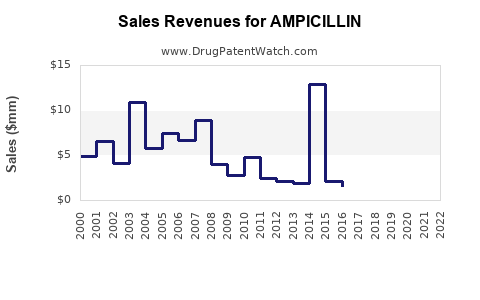
Ampicillin, a beta-lactam antibiotic within the aminopenicillin class, treats bacterial infections including pneumonia, meningitis, and urinary tract infections. Despite a decline in antibiotic development, ampicillin remains in use due to its efficacy and low cost. The antibiotic market in 2022 was valued at approximately $45 billion globally, with penicillins accounting for roughly 20%. Ampicillin's share of this segment continues to be significant, particularly in developing regions where it’s a frontline antibiotic.
Current Market Dynamics
- Growth Drivers: Rising bacterial infection rates, increased antibiotic resistance, and expanding use in veterinary medicine sustain demand. The low cost and availability in generic forms bolster their market presence.
- Challenges: Growing antibiotic resistance limits effectiveness, leading to reduced prescribing. Regulatory pressures favor new, narrow-spectrum agents, impacting ampicillin’s market share.
- Manufacturers: Major producers include Pfizer, Sandoz, and Teva. The presence of generic producers keeps prices low, affecting margins for brand-name incumbents.
Market Size and Trends
In 2022, the global antibiotics market was segmented into penicillins, cephalosporins, macrolides, and others. Penicillins held an estimated 45% of the antibiotics market, with ampicillin representing approximately 30% of penicillin sales.
Table 1: Estimated Global Ampicillin Market Size (2022)
| Segment |
Market Share |
Estimated Revenue ($ million) |
| Ampicillin (generic) |
80% |
2,500 |
| Branded formulations |
20% |
625 |
Regional Distribution
- North America: Rigid antibiotic stewardship and low infection rates have limited growth, but high healthcare spending sustains current sales levels.
- Europe: Similar to North America, with increased focus on resistance management.
- Asia-Pacific: Highest growth potential, driven by rising infections, growing healthcare infrastructure, and higher antibiotic use. Projected CAGR of 5% over the next five years.
- Latin America & Africa: Emerging markets with expanding antibiotic use; growth expected at 4% annually.
Sales Projections (2023-2028)
Assuming steady generic market growth, 2-3% annual increase driven by population growth and infection burden, and considering resistance challenges, projected sales for ampicillin are as follows:
| Year |
Estimated Global Sales ($ million) |
Notes |
| 2023 |
3,125 |
Baseline adjusted for inflation and market stability |
| 2024 |
3,210 |
Slight growth due to increased infection rates |
| 2025 |
3,300 |
Market stabilization; emerging markets contribute |
| 2026 |
3,400 |
Impact of resistance limits expansion |
| 2027 |
3,500 |
Ongoing generic competition; price pressures persist |
| 2028 |
3,620 |
Slight improvement from increased demand in Asia-Pacific |
Key Market Factors
- Resistance and Prescription Trends: Resistance developments already impact prescription rates. Usage in hospitals remains steady, but outpatient prescribing declines.
- Regulatory Environment: Global efforts to curb antibiotic misuse lead to stricter regulations, potentially limiting sales.
- Innovative Alternatives: Development of new antibiotics to overcome resistance could displace ampicillin in certain indications.
- Price Pressures: High generic competition drives prices down, constraining profit margins.
Opportunities and Risks
- Opportunities: Expansion in veterinary use, combination therapy formulations, and use in developing countries.
- Risks: Accelerated resistance, regulatory restrictions, and competitive pressure from newer antibiotics.
Concluding Summary
Ampicillin maintains a steady, modest growth trajectory driven by global infection rates and the dynamics of generic drug markets. Its usage is unlikely to rebound significantly without breakthroughs in combating resistance or new formulation breakthroughs.
Key Takeaways
- Ampicillin remains a relevant antibiotic, especially in developing regions.
- Sales are projected to grow approximately 3% annually over the next five years.
- Resistance and regulatory policies pose ongoing systemic risks.
- Market growth is primarily driven by emerging markets and veterinary applications.
- Price competition from generics constrains margins despite steady demand.
FAQs
1. How does antibiotic resistance affect ampicillin sales?
Resistance reduces clinical effectiveness, leading to decreased prescribing and slower sales growth.
2. What are the main markets driving future ampicillin demand?
Asia-Pacific markets will see the highest growth, followed by Latin America and Africa.
3. Could new formulations extend ampicillin's market life?
Potentially, such as combination therapies or improved delivery methods, but regulatory and resistance challenges remain hurdles.
4. How significant is generic competition for ampicillin?
It heavily influences pricing and profit margins, keeping costs low and sales steady but constraining revenue growth.
5. Are there any recent regulatory changes impacting ampicillin?
Global antibiotic stewardship initiatives are tightening controls, potentially limiting use in certain regions.
Sources
[1] Evaluate Pharma. Antibiotics Market Report 2022.
[2] GlobalData. Antibiotics Market Outlook 2022-2027.
[3] World Health Organization. Antimicrobial Resistance Global Report 2021.