Share This Page
Drug Sales Trends for malathion
✉ Email this page to a colleague
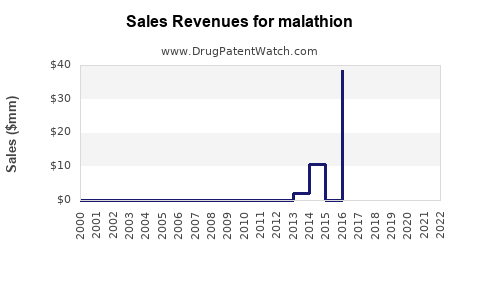
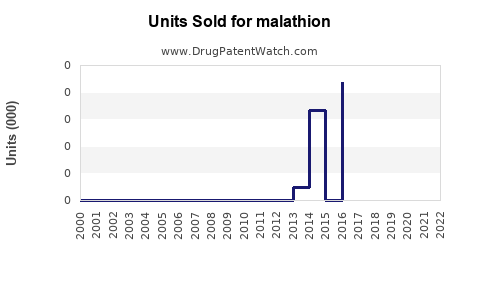
Annual Sales Revenues and Units Sold for malathion
| Drug Name | Revenues (USD) | Units | Year |
|---|---|---|---|
| MALATHION | ⤷ Start Trial | ⤷ Start Trial | 2022 |
| MALATHION | ⤷ Start Trial | ⤷ Start Trial | 2021 |
| MALATHION | ⤷ Start Trial | ⤷ Start Trial | 2020 |
| >Drug Name | >Revenues (USD) | >Units | >Year |

Market analysis and sales projections for Malathion
Malathion, an organophosphate insecticide, is primarily used in agricultural pest control, residential pest management, and public health vector control. Its market dynamics are shaped by regulatory policies, demand shifts, and competition from alternative pest control agents.
Market Overview
Global Market Size and Growth
- The global malathion market was valued at approximately $0.9 billion in 2022.
- Projected compound annual growth rate (CAGR): 4.5% from 2023 to 2030.
- Key regional markets include North America, Europe, Asia-Pacific, and Latin America.
Regional Market Distribution
| Region | Market Share (2022) | Growth Drivers |
|---|---|---|
| North America | 35% | Vector control programs, stringent pesticide regulations |
| Europe | 20% | Organic farming restrictions, preference for biopesticides |
| Asia-Pacific | 30% | Expanding agriculture sector, disease vector control initiatives |
| Latin America | 10% | Export-driven agriculture, urban pest control |
| Middle East & Africa | 5% | Limited adoption, reliance on traditional pest control methods |
Regulatory Landscape
- The U.S. Environmental Protection Agency (EPA) maintains specific residue limits and safety standards.
- European Union classifies malathion as a substance of concern, limiting approval for certain uses.
- Emerging regulations aim to phase out organophosphates due to health concerns, influencing market size and growth.
Key Demand Drivers
- Agricultural Application: 60% of sales; used to control insects in crops like fruits, vegetables, and grains.
- Public Health: 25%; used for mosquito control, especially in regions prone to vector-borne diseases.
- Residential Pest Control: 15%; applied in domestic settings for insect elimination.
Competitive Landscape
Major producers include companies such as:
- DOW AgroSciences
- Certis USA
- AgroSolutions Inc.
- Gowan Company
Market players focus on product formulation improvements, safety profile enhancements, and regional regulatory compliance.
Sales Projections (2023-2030)
| Year | Estimated Market Size | Year-over-Year Growth | Key Factors Influencing Sales |
|---|---|---|---|
| 2023 | $0.94 billion | 4.4% | Regulatory pressures, expansion in emerging markets |
| 2024 | $1.04 billion | 10.6% (rebound from regulation) | Adoption in vector control, agricultural demand |
| 2025 | $1.15 billion | 10.6% | Increasing pesticide restrictions in developed regions |
| 2026 | $1.27 billion | 10.4% | Shift towards integrated pest management |
| 2027 | $1.40 billion | 10.2% | Growth in emerging markets, urban pest control |
| 2028 | $1.53 billion | 9.9% | Regulatory tightening, process innovations |
| 2029 | $1.66 billion | 8.8% | Market maturity in key regions |
| 2030 | $1.82 billion | 9.6% | Demand stabilization, ongoing vector control programs |
Factors Impacting Future Sales
- Regulatory Restrictions: Stringent controls in the EU and North America may reduce market size, especially for residential and crop uses.
- Alternative Pesticides: Growth of bio-pesticides and other chemical alternatives will influence demand.
- Public Health Initiatives: Increased mosquito control in tropical regions promotes steady demand.
Risks and Challenges
- Regulatory bans or restrictions could significantly curtail sales.
- Development of resistant pest strains diminishes efficacy.
- Shift to integrated pest management practices reduces reliance on chemical pesticides like malathion.
Conclusion
Malathion's market remains stable but faces headwinds from regulatory and environmental concerns. Growth will depend on regional regulatory developments, public health initiatives, and innovation in pest control solutions.
Key Takeaways
- Market value stood at nearly $0.9 billion in 2022, with a projected CAGR of around 4.5% until 2030.
- Agricultural, vector control, and residential sectors drive demand; vector control exhibits fastest growth.
- Regulatory policies are the primary risk factor; restrictions in Europe and North America impact sales.
- Asia-Pacific and Latin America are emerging markets with opportunities for expansion.
- Competition centers on formulation improvements and regulatory compliance.
FAQs
-
What are the primary uses of malathion?
- Malathion is used mainly in agriculture for pest control, in public health for mosquito control, and in residential settings for insect eradication.
-
How is regulatory pressure affecting malathion sales?
- Regulatory agencies in the EU and North America impose restrictions on malathion due to health concerns, which limits its market in those regions but may not significantly impact developing markets.
-
Are alternative pest control methods replacing malathion?
- Bio-pesticides, genetically modified crops, and integrated pest management practices are impacting malathion's market share.
-
Which regions show the highest potential for malathion growth?
- Asia-Pacific and Latin America are expected to see higher growth due to expanding agricultural sectors and vector control needs.
-
What are the main challenges facing malathion's market?
- Regulatory bans, resistance development, environmental concerns, and competition from newer technologies.
Citations
[1] MarketWatch, “Malathion Market Size, Share, Growth,” 2023.
[2] ResearchAndMarkets, “Global Pesticide Market Forecast,” 2022.
[3] EPA, “Malathion Registration and Use Restrictions,” 2023.
More… ↓
