Share This Page
Drug Sales Trends for UNITHROID
✉ Email this page to a colleague
Payment Methods and Pharmacy Types for UNITHROID (2020)
Revenues by Pharmacy Type
Units Sold by Pharmacy Type
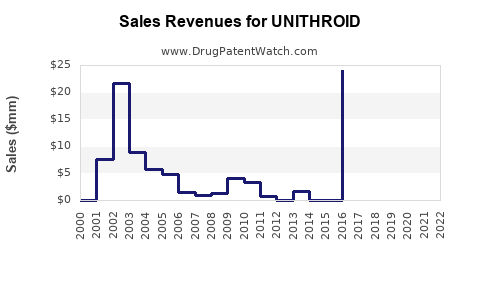
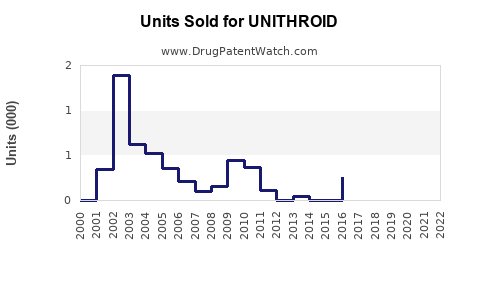
Annual Sales Revenues and Units Sold for UNITHROID
| Drug Name | Revenues (USD) | Units | Year |
|---|---|---|---|
| UNITHROID | ⤷ Start Trial | ⤷ Start Trial | 2022 |
| UNITHROID | ⤷ Start Trial | ⤷ Start Trial | 2021 |
| UNITHROID | ⤷ Start Trial | ⤷ Start Trial | 2020 |
| UNITHROID | ⤷ Start Trial | ⤷ Start Trial | 2019 |
| UNITHROID | ⤷ Start Trial | ⤷ Start Trial | 2018 |
| >Drug Name | >Revenues (USD) | >Units | >Year |
Unithroid Market Analysis, Sales Projections, Patent Position, and Generic Competition
Unithroid is a branded levothyroxine sodium tablet used for thyroid hormone replacement and thyroid-stimulating hormone suppression. Its market position is limited by extensive generic competition, low-cost substitution, and the long commercial history of Synthroid and generic levothyroxine. Unithroid sales are not separately disclosed in public manufacturer filings, so projections must be modeled from prescription volume, market share, and estimated net pricing.
The base-case estimate places U.S. Unithroid sales at approximately $35 million to $55 million annually, with modest nominal growth through 2029. The primary commercial risk is not a new generic launch. It is continued substitution into lower-priced generic levothyroxine and possible switching among branded and authorized-generic products.
What is Unithroid and who markets it?
Unithroid contains levothyroxine sodium, a synthetic form of thyroxine, or T4. It is approved for hypothyroidism and for suppression of thyrotropin in selected thyroid-related conditions. The product is available in multiple tablet strengths, allowing dose titration across a broad patient population (U.S. Food and Drug Administration [FDA], 2021).
Product profile
| Attribute | Unithroid |
|---|---|
| Active ingredient | Levothyroxine sodium |
| Dosage form | Oral tablet |
| Therapeutic class | Thyroid hormone replacement |
| Primary indication | Hypothyroidism |
| Other use | TSH suppression in selected patients |
| U.S. regulatory pathway | New Drug Application |
| Reference product in the category | Synthroid |
| Main substitutes | Generic levothyroxine, Synthroid, Levoxyl, Tirosint |
| Principal market | United States |
| Commercial concentration | Retail and mail-order pharmacy channels |
Unithroid is part of a mature, high-volume thyroid replacement market. Most patients require long-term or lifelong treatment, supporting predictable prescription demand. The product category is clinically sensitive to formulation consistency, dose changes, and administration timing, but these factors do not eliminate substitution pressure.
How large is the levothyroxine market?
Levothyroxine is one of the most frequently prescribed medicines in the United States. Demand is supported by the prevalence of hypothyroidism, thyroid cancer follow-up, post-surgical thyroid replacement, and aging-related diagnosis rates.
Public sources do not provide a separate, audited market-revenue figure for Unithroid. The overall U.S. levothyroxine market can be estimated using prescription volume and realized net price. A reasonable planning range is approximately $1.4 billion to $2.0 billion in annual U.S. manufacturer and channel revenue across branded and generic products. The range reflects differences in whether calculations include gross retail sales, manufacturer net sales, mail-order discounts, and hospital or institutional volume.
Major demand drivers
- Long-term treatment duration creates recurring prescriptions.
- Diagnosis and monitoring remain routine in primary care and endocrinology.
- The drug has no meaningful therapeutic replacement for most hypothyroid patients.
- Generic products maintain high volume because of low acquisition cost.
- Branded products retain demand among patients and prescribers concerned with product consistency.
Market constraints
- Levothyroxine is chemically old and widely manufactured.
- Generic substitution is routine.
- Payers often impose higher patient costs for branded products.
- Dose changes can occur after switching products, but this has not prevented broad generic use.
- New patient starts are more likely to enter through generic levothyroxine than Unithroid.
What are Unithroid sales and market-share estimates?
Unithroid revenue is not separately reported in the public financial disclosures of its commercial stakeholders. The following estimates use a modeled share of the U.S. levothyroxine market rather than reported company revenue.
| Scenario | Estimated Unithroid share of U.S. levothyroxine revenue | Estimated annual sales |
|---|---|---|
| Low | 1.5% | $21 million-$30 million |
| Base | 2.5% | $35 million-$50 million |
| High | 4.0% | $56 million-$80 million |
The base case assumes that Unithroid maintains a niche branded position without gaining material formulary access or physician-driven share. The product’s commercial value is more likely to come from stable repeat use than rapid prescription growth.
Unithroid may generate higher gross sales than its net sales because pharmacy rebates, wholesaler discounts, and payer concessions reduce realized revenue. A manufacturer or license holder evaluating the product should use net sales after rebates for valuation and royalty analysis.
What are the Unithroid sales projections through 2029?
The base-case forecast assumes low prescription growth, modest price increases, and continued erosion from generic substitution. The forecast does not assume a major regulatory event, supply disruption, acquisition, or new formulation launch.
| Fiscal year | Low case | Base case | High case |
|---|---|---|---|
| 2024A / baseline estimate | $25 million | $42 million | $68 million |
| 2025E | $24 million | $43 million | $69 million |
| 2026E | $24 million | $44 million | $71 million |
| 2027E | $23 million | $45 million | $73 million |
| 2028E | $22 million | $46 million | $75 million |
| 2029E | $21 million | $47 million | $77 million |
| 2024-2029 CAGR | -3.4% | 2.3% | 2.5% |
Forecast interpretation
The base case produces approximately $220 million of cumulative sales over 2025-2029. Growth is primarily price-led. Unit volume is expected to remain flat or decline slightly as generic substitution continues.
The high case requires several favorable conditions:
- Improved pharmacy stocking and distribution.
- Stable supply across all tablet strengths.
- Retention of patients who prefer a consistent branded product.
- Limited payer pressure against branded levothyroxine.
- No material loss of manufacturing capacity.
The low case reflects stronger generic substitution, payer exclusion, reduced promotional activity, or supply interruptions.
How does Unithroid compare with Synthroid, generic levothyroxine, and Tirosint?
| Product | Commercial position | Main advantage | Main weakness |
|---|---|---|---|
| Synthroid | Leading branded levothyroxine | Strong physician and patient recognition | Premium price and payer pressure |
| Generic levothyroxine | Dominant volume product | Lowest cost and broad availability | Multiple manufacturers and switching concerns |
| Unithroid | Secondary branded product | Brand consistency and broad tablet-strength coverage | Limited scale and lower market visibility |
| Levoxyl | Established branded levothyroxine | Recognized alternative brand | Smaller commercial footprint |
| Tirosint | Soft-gel/liquid formulation | Useful for selected absorption or tolerability cases | High price and narrower reimbursement |
Unithroid competes most directly with Synthroid and generic levothyroxine. Tirosint competes in a more specialized segment involving absorption issues, excipient sensitivity, or difficulty maintaining stable thyroid levels.
Unithroid’s differentiation is limited. Its commercial case depends on brand retention, reliable supply, prescriber familiarity, and pharmacy access rather than a clearly differentiated pharmacologic mechanism.
What is the FDA and Orange Book status of Unithroid?
Unithroid is an FDA-approved levothyroxine sodium product. FDA labeling identifies levothyroxine sodium tablets as a narrow-therapeutic-index product requiring careful dose adjustment and monitoring. The label instructs patients to take the medicine consistently and warns that switching products can require reassessment of thyroid function (FDA, 2021).
Regulatory considerations
- Levothyroxine products are subject to dose and bioequivalence scrutiny.
- FDA considers levothyroxine a narrow-therapeutic-index drug.
- Product switching can require monitoring of TSH levels.
- Tablet strengths and manufacturing consistency are commercially important.
- FDA approval does not prevent generic substitution where the applicable therapeutic-equivalence code permits it.
The Orange Book should be reviewed for the current listing, patent certifications, and therapeutic-equivalence information associated with the applicable Unithroid NDA. Because levothyroxine products have been marketed for decades, the commercial barrier is regulatory maintenance and supply reliability, not active composition-of-matter exclusivity.
What patents protect Unithroid?
The core levothyroxine molecule is long off patent. Any current Unithroid protection is more likely to involve manufacturing know-how, product specifications, trademarks, packaging, or formulation and process details than a new chemical entity patent.
Likely protection categories
| Protection type | Commercial relevance |
|---|---|
| Composition-of-matter patent | No meaningful current protection |
| Tablet formulation patent | Potentially limited and product-specific |
| Manufacturing process | May create practical supply barriers |
| Quality-control specifications | Important for consistency but not broad exclusivity |
| Trademark rights | Protect the Unithroid name |
| Regulatory exclusivity | No expected new-drug exclusivity benefit for a mature product |
Patent expiration is therefore unlikely to be the primary determinant of generic risk. The key issue is whether a competing levothyroxine product can obtain FDA approval, achieve therapeutic equivalence, and secure distribution.
Are there Paragraph IV challenges or active Unithroid litigation?
No major, publicly established Paragraph IV event should be assumed to drive the current Unithroid forecast without a current Orange Book and court-docket review. For a mature levothyroxine product, generic competition generally reflects expired rights and regulatory substitution rather than a pending first-filer patent challenge.
Litigation risk
Potential disputes could involve:
- ANDA approval and therapeutic-equivalence coding.
- Product labeling or substitution practices.
- Manufacturing deviations and FDA compliance.
- Trademark use involving "Unithroid."
- Supply or licensing arrangements.
- Product liability claims related to dose changes or switching.
A litigation-driven launch event is not included in the base-case forecast. The commercial model assumes ordinary generic competition.
What formulation and manufacturing factors protect Unithroid?
Levothyroxine is sensitive to manufacturing variation, tablet potency, dissolution, storage, and excipient differences. FDA has treated levothyroxine as a drug requiring tighter product control than many conventional oral medicines. These requirements can create practical barriers even when patent barriers are weak.
Manufacturing barriers
- Tight potency specifications.
- Stability requirements across multiple strengths.
- Need for reliable content uniformity.
- Validation of dissolution and bioequivalence.
- Consistent sourcing of active pharmaceutical ingredient.
- Risk of recalls if potency or stability specifications are not met.
These barriers support incumbent supply relationships but do not create durable monopoly pricing. Competitors can enter once they satisfy FDA requirements and establish reliable production.
How strong is the Unithroid patent estate?
The Unithroid patent estate is weak as a source of exclusivity and moderate as a manufacturing and brand-retention asset.
| Asset | Strength assessment |
|---|---|
| Active ingredient exclusivity | Very weak |
| Broad formulation exclusivity | Weak |
| Process know-how | Moderate |
| Manufacturing reliability | Moderate to strong if supply is consistent |
| Trademark and brand recognition | Moderate |
| Prescriber loyalty | Low to moderate |
| Payer protection | Weak |
| Generic-entry resistance | Low |
The brand has commercial durability because patients need chronic therapy, not because Unithroid has a powerful patent moat.
What generic-entry risks exist for Unithroid?
The largest risk is continued conversion to generic levothyroxine. Generic products can pressure Unithroid through lower pharmacy acquisition costs, payer mandates, preferred formulary placement, and automatic substitution where permitted.
Generic launch scenarios
| Scenario | Effect on Unithroid |
|---|---|
| Stable generic supply | Gradual volume erosion |
| Aggressive payer exclusion | Rapid loss of new prescriptions |
| Generic shortage | Temporary branded demand increase |
| Product recall by a generic supplier | Short-term share recovery |
| New low-cost supplier | Price and volume pressure |
| Supply interruption affecting Unithroid | Permanent pharmacy and patient switching risk |
A generic shortage could temporarily increase Unithroid demand, but such gains are generally difficult to retain after supply normalizes.
What licensing deals affect Unithroid?
The commercial structure has historically involved the separation of product ownership, manufacturing, and marketing rights. Publicly available product labeling identifies the manufacturer or labeler, but the full economics of any licensing, supply, or distribution agreement may not be disclosed in regulatory materials.
For valuation, analysts should distinguish:
- Gross product sales.
- Net sales after rebates.
- Manufacturing revenue.
- Royalty revenue.
- Transfer-price revenue.
- Sales retained by the brand owner.
- Distribution and wholesaler deductions.
Without contract-level data, Unithroid should be valued as a mature branded product with limited pricing power and recurring demand.
What revenue exposure does Unithroid create?
Unithroid revenue is exposed to four variables:
- Prescription volume.
- Net price per prescription.
- Product availability across strengths.
- Reimbursement and substitution policy.
A 10% decline in unit volume would likely reduce annual sales by approximately $3 million to $5 million under the base-case sales range, assuming price remains unchanged. A 10% increase in realized net price would produce a smaller volume-adjusted benefit because payers and pharmacies may respond through substitution.
The most material downside event is a sustained supply failure. Levothyroxine patients often remain on a stable product, but pharmacies can move patients to another available product when a branded product is unavailable.
Key Takeaways
- Unithroid is a mature branded levothyroxine product with recurring demand but limited differentiation.
- Estimated U.S. annual sales are approximately $35 million to $55 million in the base case.
- Base-case sales reach about $47 million by 2029, representing roughly 2.3% annual growth from the modeled 2024 baseline.
- Generic levothyroxine is the principal competitive threat.
- The core levothyroxine compound has no meaningful current patent exclusivity.
- Manufacturing quality, supply reliability, brand recognition, and pharmacy access matter more than patent protection.
- No major litigation or Paragraph IV event should be included in the forecast without current docket and Orange Book confirmation.
- The strongest upside scenario is temporary share capture during generic supply disruption.
- The strongest downside scenario is payer-driven substitution combined with a Unithroid supply interruption.
FAQs about Unithroid market prospects
Is Unithroid a high-revenue drug?
No. Unithroid is commercially established but is likely a secondary branded product with annual U.S. sales in the tens of millions, not hundreds of millions.
Will Unithroid lose market share to generic levothyroxine?
Yes, gradual share loss is the most likely long-term outcome unless the product gains stronger payer coverage, formulary preference, or supply-related demand.
Does Unithroid have patent protection through 2030?
There is no basis to assume meaningful composition-of-matter protection through 2030. Any remaining protection is more likely to involve formulation, manufacturing, trademark, or regulatory details.
Is Unithroid therapeutically equivalent to generic levothyroxine?
FDA-approved products may receive therapeutic-equivalence designations, but patients should maintain consistent use and have thyroid function monitored when switching products, particularly because levothyroxine has a narrow therapeutic index.
What would increase the value of Unithroid?
The most important value drivers would be stable supply, stronger pharmacy distribution, higher branded retention, improved reimbursement, and a commercial agreement that expands access without materially increasing rebates.
References
- U.S. Food and Drug Administration. (2021). Unithroid: Levothyroxine sodium tablets prescribing information.
- U.S. Food and Drug Administration. (2024). Approved drug products with therapeutic equivalence evaluations.
- U.S. Food and Drug Administration. (2024). Drugs@FDA: FDA-approved drugs database.
- American Thyroid Association. (2014). Guidelines for the treatment of hypothyroidism. Thyroid, 24(12), 1670-1751.
- IQVIA Institute for Human Data Science. (2024). The use of medicines in the U.S. 2024: Usage and spending trends and outlook to 2028.
More… ↓
