Share This Page
Drug Sales Trends for STAXYN
✉ Email this page to a colleague
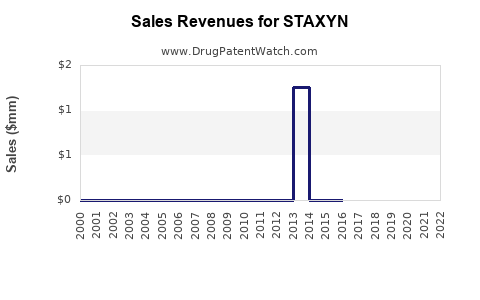
Annual Sales Revenues and Units Sold for STAXYN
| Drug Name | Revenues (USD) | Units | Year |
|---|---|---|---|
| STAXYN | ⤷ Start Trial | ⤷ Start Trial | 2022 |
| STAXYN | ⤷ Start Trial | ⤷ Start Trial | 2021 |
| STAXYN | ⤷ Start Trial | ⤷ Start Trial | 2020 |
| STAXYN | ⤷ Start Trial | ⤷ Start Trial | 2019 |
| STAXYN | ⤷ Start Trial | ⤷ Start Trial | 2018 |
| STAXYN | ⤷ Start Trial | ⤷ Start Trial | 2017 |
| >Drug Name | >Revenues (USD) | >Units | >Year |
STAXYN Market Analysis, Sales Projections, Patent Position, and Generic Entry Risk
STAXYN, Bayer’s orally disintegrating formulation of vardenafil hydrochloride, has limited commercial value because its U.S. brand presence has ended or become commercially inactive, while generic sildenafil, tadalafil, and conventional vardenafil tablets dominate erectile-dysfunction prescriptions. A defensible forward projection for U.S. STAXYN sales is approximately zero unless the product is relaunched. The remaining opportunity is a small, niche market based on convenience, prescription switching, and geographic availability rather than broad branded growth.
What is STAXYN and how does it compare with Levitra and other PDE5 inhibitors?
STAXYN is an orally disintegrating tablet containing vardenafil hydrochloride. It was developed as a more convenient alternative to conventional Levitra tablets and was approved by the U.S. Food and Drug Administration in 2010 under NDA 022275.[1]
STAXYN is pharmacologically similar to Levitra because both contain vardenafil. Its differentiating feature is the orally disintegrating dosage form, which dissolves on the tongue without requiring water. The formulation does not create a fundamentally different mechanism of action or a materially broader erectile-dysfunction indication.
| Product | Active ingredient | Dosage form | Primary commercial differentiator | Current market position |
|---|---|---|---|---|
| STAXYN | Vardenafil | Orally disintegrating tablet | Water-free administration | Niche or inactive branded product |
| Levitra | Vardenafil | Conventional tablet | Original branded vardenafil product | Brand largely displaced by generics |
| Viagra | Sildenafil | Conventional tablet and other forms | Established market recognition | Generic and branded competition |
| Cialis | Tadalafil | Conventional tablet | Long duration of action | Strong generic and branded competition |
| Generic vardenafil | Vardenafil | Conventional tablet | Lower price | Main competitive substitute for vardenafil |
STAXYN’s convenience advantage is narrow. Erectile-dysfunction patients can generally take conventional tablets with water, and most payers favor lower-cost generic products.
What is the FDA regulatory status of STAXYN?
FDA approved STAXYN on June 2, 2010, for the treatment of erectile dysfunction in adult men.[1] The product was approved as an orally disintegrating tablet in a 10-mg strength.
The product label instructed patients to place the tablet on the tongue, allow it to disintegrate, and swallow. STAXYN was not intended to be taken with liquid. Like other PDE5 inhibitors, it carried contraindications involving organic nitrates and warnings concerning cardiovascular conditions, priapism, sudden vision loss, and sudden hearing loss.[2]
The FDA approval did not provide a separate exclusivity platform capable of supporting long-term commercial protection. Any relevant new-drug exclusivity associated with the 2010 approval has expired.
What was STAXYN’s FDA exclusivity period?
The product’s five-year new chemical entity exclusivity was not available because vardenafil had already been approved in Levitra. Any three-year exclusivity associated with a qualifying new clinical investigation or formulation approval would have expired years ago. STAXYN therefore has no remaining FDA exclusivity that would block an abbreviated new drug application based on regulatory exclusivity alone.
What patents protected STAXYN and when did they expire?
The core vardenafil patent estate was associated primarily with the active pharmaceutical ingredient and PDE5-inhibitor technology rather than with a durable, standalone STAXYN monopoly. The principal U.S. vardenafil patent protection expired in the late 2010s, subject to patent-term adjustment, pediatric extensions, and the scope of individual claims.[3]
The commercial protection profile can be summarized as follows:
| Protection category | Relevance to STAXYN | Current impact |
|---|---|---|
| Vardenafil compound patents | Protected the active ingredient used in Levitra and STAXYN | Expired |
| PDE5-inhibitor use claims | Covered treatment of erectile dysfunction and related uses | Expired or commercially weak |
| Orally disintegrating formulation claims | Potentially protected the STAXYN dosage form | Any surviving claims would require claim-specific review |
| FDA exclusivity | Delayed certain generic approvals | Expired |
| Trademark protection | Protects the STAXYN brand name | Does not block generic vardenafil |
The key commercial distinction is between generic vardenafil tablets and a generic orally disintegrating vardenafil product. Expiration of the active-ingredient patents permits conventional generic vardenafil. It does not automatically guarantee that a competitor has an approved generic with the same orally disintegrating technology.
What is the Orange Book status of STAXYN?
STAXYN’s Orange Book position has limited current commercial relevance because the product has no meaningful remaining exclusivity barrier. The Orange Book identifies approved drug products and, where applicable, listed patents and exclusivity. The relevant patent listings for vardenafil products do not create a current barrier equivalent to an unexpired compound patent.[4]
A regulatory review should distinguish:
- The STAXYN NDA and its dosage form.
- The Levitra NDA and conventional vardenafil tablets.
- Generic vardenafil ANDAs.
- Any patent listed for formulation, method of use, or drug-delivery technology.
A generic applicant seeking approval for conventional vardenafil tablets would not need to reproduce STAXYN’s orally disintegrating formulation. A competitor targeting the same ODT format would face a more specific formulation and manufacturing review.
Which companies are challenging STAXYN exclusivity?
The primary challenge has been market substitution rather than high-profile STAXYN-specific patent litigation. Generic manufacturers have entered the vardenafil market after expiration of the principal active-ingredient patent protection. The principal competitive companies in the broader vardenafil market have included Teva Pharmaceuticals, Mylan, Dr. Reddy’s Laboratories, and other generic suppliers, depending on market and product availability.
Publicly documented high-value Paragraph IV litigation focused on the broader Levitra and vardenafil patent estate rather than a sustained, commercially significant STAXYN-specific dispute. A Paragraph IV certification would have been relevant only if an ANDA applicant challenged an unexpired Orange Book-listed patent. With the core patents expired, STAXYN’s litigation leverage is low.
What formulation patents protect orally disintegrating vardenafil?
The formulation value of STAXYN lies in the tablet’s disintegration, taste, stability, dose uniformity, and manufacturing process. Potential protection could cover:
- Rapidly disintegrating tablets.
- Taste-masking systems for vardenafil.
- Excipients and compression processes.
- Moisture-control packaging.
- Tablet hardness and dissolution profiles.
- Methods of administering vardenafil without water.
These claims are narrower than compound claims. They can delay an exact-format competitor if valid and enforceable, but they do not prevent sales of conventional vardenafil tablets. A generic applicant may design around specific excipient combinations or manufacturing steps.
The commercial weakness of formulation patents is that the product’s clinical benefit is primarily convenience. Payers and prescribers usually do not reimburse a large premium for a water-free PDE5 inhibitor when conventional generic tablets are available.
When did STAXYN lose market exclusivity?
STAXYN lost meaningful market exclusivity through a combination of expired regulatory exclusivity, expired core vardenafil patent protection, and generic substitution. The loss did not depend on a single event.
STAXYN exclusivity timeline
| Period | Event | Commercial effect |
|---|---|---|
| 2003 | Levitra approved in the U.S. | Established vardenafil regulatory platform |
| 2010 | STAXYN approved | Introduced orally disintegrating vardenafil |
| Late 2010s | Core vardenafil patent protection expired | Opened the market to generic vardenafil |
| 2020s | Generic PDE5 competition expanded | Reduced branded pricing power |
| Current | Brand availability is limited or inactive | U.S. revenue opportunity is minimal |
The market also shifted toward tadalafil because of its longer duration and toward sildenafil because of its low cost and high physician familiarity.
How strong is the STAXYN patent estate?
STAXYN has a weak-to-moderate residual patent position and a weak commercial position.
| Factor | Assessment |
|---|---|
| Active-ingredient protection | Weak; expired |
| FDA exclusivity | None of commercial significance |
| Dosage-form differentiation | Moderate technical distinction |
| Formulation enforceability | Requires claim-by-claim analysis |
| Generic substitution risk | High |
| Ability to sustain premium pricing | Low |
| Manufacturing complexity | Moderate |
| Litigation leverage | Low |
The ODT format can create a technical barrier, but it is not equivalent to a protected active ingredient. Any residual formulation claims would need to survive validity, infringement, and design-around challenges.
What are STAXYN’s market prospects and sales projections?
No reliable public disclosure provides current STAXYN-specific sales. Bayer’s public reporting historically aggregated products within broader pharmaceutical portfolios rather than reporting STAXYN revenue as a standalone line item. Prescription and sales data for the product are therefore insufficient to establish a verified historical peak or current run rate.
The most defensible forecast is scenario-based.
U.S. STAXYN sales projection
| Scenario | 2025 | 2026 | 2027 | 2028 | 2029 |
|---|---|---|---|---|---|
| No commercial relaunch | $0 | $0 | $0 | $0 | $0 |
| Limited specialty reintroduction | $0.5-$2 million | $0.5-$2 million | $0.5-$2 million | $0.5-$2 million | $0.5-$2 million |
| Successful branded relaunch | $2-$5 million | $3-$7 million | $4-$9 million | $4-$10 million | $4-$10 million |
These are strategic scenario ranges, not reported company guidance. The no-relaunch case is the base case because the product lacks active exclusivity, has strong generic substitutes, and has no demonstrated current commercial distribution.
The limited-relaunch case assumes online or specialty-pharmacy distribution, modest physician awareness, and a premium price justified by water-free administration. The successful-relaunch case would require a new commercial owner, reliable supply, payer access, consumer marketing, and evidence that patients value the dosage form enough to accept a premium.
What would drive a STAXYN relaunch?
A relaunch would require at least one of the following:
- A lower-cost manufacturing arrangement.
- A new licensee with specialty-pharmacy distribution.
- A cash-pay strategy outside restrictive insurance formularies.
- A reformulated product with improved stability or taste.
- A combination product or a differentiated delivery system.
- A branded-generic positioning strategy.
A conventional relaunch of the existing product would face weak economics. The active ingredient is available generically, and the ODT format alone is unlikely to support large sales.
How does STAXYN compare with competing PDE5 drugs?
STAXYN is commercially disadvantaged against tadalafil and sildenafil.
| Factor | STAXYN | Generic sildenafil | Generic tadalafil |
|---|---|---|---|
| Main benefit | Water-free dosing | Low price and familiarity | Long duration |
| Typical differentiation | Dosage form | Cost and broad availability | Duration and daily dosing |
| Generic competition | High at active-ingredient level | Very high | Very high |
| Brand pricing power | Low | Minimal | Low to moderate |
| Prescriber familiarity | Lower than sildenafil | Very high | High |
| Reimbursement outlook | Weak | Stronger because of cost | Stronger because of clinical duration |
STAXYN may retain a niche among patients who dislike swallowing tablets or cannot conveniently access water. That niche is too small to support a major branded franchise without additional differentiation.
What generic launch risks exist for STAXYN?
The main risks are:
- Generic vardenafil tablets can substitute for the same active ingredient.
- Prescribers can switch patients to sildenafil or tadalafil.
- Formulation patents, if any remain, may be designed around.
- A generic ODT entrant could eliminate the product’s only meaningful differentiation.
- Pharmacies may not stock a low-volume branded product.
- Payers may require generic-first treatment.
- The product may lack an active U.S. commercial supply chain.
Manufacturing is a moderate barrier because ODT products require controlled compression, taste masking, moisture protection, and packaging. It is not a high barrier comparable to sterile injectables, biologics, or complex drug-device combinations.
What licensing deals and litigation affect STAXYN?
Vardenafil was commercialized through partnerships involving Bayer and other pharmaceutical companies, including arrangements connected to the Levitra franchise. The key commercial rights related to vardenafil brands and territories have changed over time. Public disclosures do not establish a current, large-scale STAXYN licensing transaction that would support a material forecast.
The litigation environment is also low risk for generic entrants compared with products protected by active compound or biologic patents. Any remaining dispute would likely concern formulation claims, labeling, trademark, or distribution rather than the basic right to sell vardenafil.
What geographic markets remain relevant for STAXYN?
The United States offers limited upside because of generic substitution and uncertain brand availability. International markets may provide isolated opportunities where:
- The STAXYN trademark remains registered and commercially recognized.
- Vardenafil access is less commoditized.
- ODT products receive favorable pharmacy treatment.
- Local generic competition is less intense.
- Bayer or a licensee maintains distribution rights.
A country-by-country forecast cannot be validated from publicly reported product-level sales. The global opportunity should therefore be treated as fragmented and low scale rather than as a unified international franchise.
Key Takeaways
- STAXYN is an orally disintegrating vardenafil product approved by FDA in 2010.
- Its principal differentiation is convenience, not a new mechanism or broader indication.
- Core vardenafil patent protection and regulatory exclusivity have expired.
- Generic vardenafil, sildenafil, and tadalafil create high substitution risk.
- The U.S. base-case sales forecast is approximately zero without a commercial relaunch.
- A relaunch could produce a small specialty market, but a large branded recovery is unlikely.
- Residual formulation patents may affect an exact-format generic but do not block conventional vardenafil tablets.
- The product’s commercial value is higher as a niche asset or licensing opportunity than as a major branded pharmaceutical franchise.
FAQs About STAXYN Market Potential
Is STAXYN still available in the United States?
STAXYN has limited or inactive U.S. commercial availability. Conventional generic vardenafil is more broadly relevant to current prescribing.
Is there a generic version of STAXYN?
Generic vardenafil tablets are available, but a therapeutically equivalent orally disintegrating version is a separate regulatory and formulation question.
Can a company launch generic STAXYN without infringing Levitra patents?
Expired active-ingredient patents generally do not block generic vardenafil. An applicant targeting the ODT format must assess any surviving formulation or manufacturing claims.
Does STAXYN qualify as a biologic or face biosimilar competition?
No. STAXYN is a small-molecule pharmaceutical and is subject to the generic-drug pathway, not the biosimilar pathway.
What would make STAXYN commercially attractive to an acquirer?
The strongest acquisition case would involve low-cost manufacturing, rights in a market with limited generic competition, or a differentiated reformulation that commands cash-pay or specialty-pharmacy pricing.
References
- U.S. Food and Drug Administration. (2010). STAXYN (vardenafil hydrochloride) orally disintegrating tablets, NDA 022275: Approval information and prescribing information.
- U.S. Food and Drug Administration. (2023). Vardenafil hydrochloride prescribing information.
- U.S. Patent and Trademark Office. (n.d.). Patent term and patent protection records for vardenafil and PDE5-inhibitor technologies.
- U.S. Food and Drug Administration. (n.d.). Approved drug products with therapeutic equivalence evaluations: Orange Book.
More… ↓
