Share This Page
Drug Sales Trends for FLUNISOLIDE
✉ Email this page to a colleague
Payment Methods and Pharmacy Types for FLUNISOLIDE (2020)
Revenues by Pharmacy Type
Units Sold by Pharmacy Type
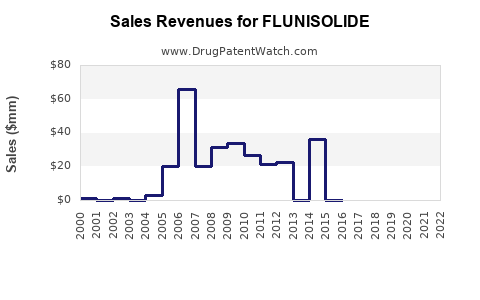
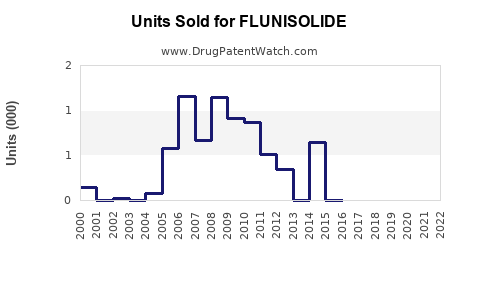
Annual Sales Revenues and Units Sold for FLUNISOLIDE
| Drug Name | Revenues (USD) | Units | Year |
|---|---|---|---|
| FLUNISOLIDE | ⤷ Start Trial | ⤷ Start Trial | 2022 |
| FLUNISOLIDE | ⤷ Start Trial | ⤷ Start Trial | 2021 |
| FLUNISOLIDE | ⤷ Start Trial | ⤷ Start Trial | 2020 |
| FLUNISOLIDE | ⤷ Start Trial | ⤷ Start Trial | 2019 |
| >Drug Name | >Revenues (USD) | >Units | >Year |
Flunisolide Market Analysis, Sales Projections, Patent Status, and Generic Outlook
Flunisolide is a mature, low-cost corticosteroid used primarily as a nasal spray for allergic rhinitis. Its commercial market is small and genericized, with limited differentiation, low pricing, and no meaningful remaining composition-of-matter exclusivity. The largest demand pool is prescription nasal flunisolide; inhaled pulmonary products have largely exited the U.S. market.
A reasonable base-case estimate places annual U.S. flunisolide product revenue below $25 million, with most value generated by generic nasal solution. Under current market conditions, U.S. sales are likely to remain flat to modestly declining through 2029. Growth is more likely in selected international markets than in the United States.
What is flunisolide used for?
Flunisolide is a synthetic glucocorticoid administered through nasal and inhaled respiratory products.
| Product type | Primary use | Current commercial position |
|---|---|---|
| Flunisolide nasal spray or nasal solution | Seasonal and perennial allergic rhinitis | Generic U.S. market |
| Flunisolide inhalation aerosol | Maintenance treatment of asthma | Historical product; limited or absent U.S. commercial availability |
| Flunisolide inhalation solution | Respiratory corticosteroid delivery | Limited commercial relevance |
The FDA-approved nasal product is indicated for the treatment of nasal symptoms associated with seasonal and perennial allergic rhinitis, including congestion, rhinorrhea, sneezing, and nasal itching.[1]
Flunisolide is not a rescue bronchodilator. It does not replace albuterol or other short-acting bronchodilators for acute bronchospasm. Its market competes primarily with other intranasal corticosteroids, including fluticasone propionate, fluticasone furoate, triamcinolone acetonide, budesonide, mometasone furoate, and beclomethasone dipropionate.
How large is the flunisolide market?
The U.S. flunisolide market is a small generic prescription market. Public companies generally do not report flunisolide sales separately, and publicly available commercial datasets do not provide a reliable audited revenue figure for the molecule.
The commercial market can be estimated from prescription volume, manufacturer participation, dosage-form availability, and generic pricing.
Estimated U.S. market size
| Metric | 2024 estimated range | Base case |
|---|---|---|
| Annual U.S. prescriptions | 0.5 million to 1.5 million | 0.9 million |
| Average gross prescription value | $15 to $35 | $22 |
| Estimated gross market value | $8 million to $53 million | $20 million |
| Estimated manufacturer net revenue | $4 million to $25 million | $10 million to $14 million |
| Five-year annual growth | -5% to +2% | -2% |
The distinction between gross prescription value and manufacturer revenue is material. Retail list prices can include pharmacy margins, wholesaler discounts, payer rebates, and dispensing fees. A generic manufacturer may receive a much lower net amount than the pharmacy-facing price.
Flunisolide has limited pricing power because prescribers can substitute other generic nasal corticosteroids. The market also faces competition from over-the-counter fluticasone, triamcinolone, and budesonide products.
What are the main commercial products and manufacturers?
The U.S. market has historically included generic flunisolide nasal products supplied by manufacturers such as:
- Apotex
- Bausch Health and legacy affiliated companies
- Mylan, now part of Viatris
- Perrigo
- Rising Pharmaceuticals
- Teva Pharmaceuticals
- Other contract and private-label suppliers
Availability varies by National Drug Code, wholesaler inventory, payer formulary, and manufacturer decision. A manufacturer may retain an FDA-approved product while limiting active commercial distribution.
Historical branded products
Nasalide, a branded flunisolide nasal product, was commercialized before generic substitution became dominant. Aerobid and Aerospan were associated with inhaled flunisolide respiratory products.
The inhaled market has deteriorated substantially because newer inhaled corticosteroids and combination products offer stronger commercial positioning. Products containing flunisolide have competed against:
- Beclomethasone dipropionate
- Budesonide
- Fluticasone propionate
- Fluticasone furoate
- Mometasone furoate
- Budesonide/formoterol
- Fluticasone/salmeterol
- Fluticasone/vilanterol
The strongest commercial decline has occurred in asthma maintenance products, where inhaled corticosteroid and long-acting beta agonist combinations have become standard in many treatment pathways.
What is the FDA regulatory status of flunisolide?
Flunisolide nasal products are FDA-approved prescription drugs under abbreviated or legacy approval pathways. The relevant product is generally a nasal solution or spray containing flunisolide at a concentration of 0.025%.
The FDA-approved labeling identifies intranasal flunisolide for allergic rhinitis. Dosage is administered into each nostril, with treatment adjusted according to age, severity, and clinical response.[1]
The product is not a biologic and does not face biosimilar competition. It is a small-molecule generic drug subject to the abbreviated new drug application system.
Regulatory market factors
| Factor | Effect on market |
|---|---|
| Generic approval pathway | Keeps development costs relatively low |
| Multiple therapeutic substitutes | Limits pricing power |
| OTC competition | Reduces prescription demand |
| Low clinical differentiation | Makes formulary access important |
| Established safety and efficacy record | Reduces regulatory risk |
| Small market size | Limits incentive for new entrants |
Flunisolide’s regulatory risk is low compared with a new molecular entity. The commercial risk is higher because market size may not support investment in manufacturing upgrades, device redesign, or large clinical programs.
What patents protect flunisolide?
The original composition-of-matter patent estate for flunisolide is expired. Flunisolide was discovered and commercialized decades ago, and no enforceable U.S. compound patent is expected to block generic entry.
Any remaining patent exposure would more likely involve:
- A specific nasal delivery device
- A formulation containing flunisolide and additional excipients
- A combination product
- A manufacturing process
- A particular dosing regimen
- A foreign jurisdiction with delayed or different patent history
These categories do not create a meaningful barrier to ordinary generic flunisolide nasal products.
Patent strength assessment
| Patent category | Current protection outlook | Commercial impact |
|---|---|---|
| Composition of matter | Expired | None |
| Basic nasal formulation | Expired or unlikely to block entry | Low |
| Standard nasal spray presentation | Weak | Low |
| Method of treating allergic rhinitis | Generally weak after generic entry | Low |
| Device-specific claims | Potentially relevant only to a particular device | Low to moderate |
| Manufacturing claims | Product-specific and narrow | Low |
| Combination-product claims | Relevant only to a new combination | Limited |
The overall flunisolide patent estate is weak from an exclusivity perspective. It does not support premium pricing or a branded-generic strategy based solely on patent protection.
When does flunisolide lose exclusivity?
Flunisolide has already lost market exclusivity in the United States. There is no meaningful remaining small-molecule exclusivity period comparable to the five-year new chemical entity period or three-year clinical-investigation exclusivity.
| Exclusivity type | Status |
|---|---|
| New chemical entity exclusivity | Expired |
| Orphan-drug exclusivity | Not applicable |
| Pediatric exclusivity | No material current protection |
| New indication exclusivity | Not commercially significant |
| Patent-based exclusivity | Expired or nonblocking for standard products |
| Generic substitution | Established |
The practical commercial question is therefore product availability, not the date of patent expiry.
What is the Orange Book status of flunisolide?
Flunisolide products may appear in the FDA Orange Book through approved prescription drug listings and reference-product designations, depending on the dosage form and current marketing status.[2]
Orange Book presence does not mean that a product has active patent protection. Generic products can be listed without providing meaningful patent exclusivity. For flunisolide, the relevant Orange Book issues are:
- Whether the reference product remains actively marketed.
- Whether a generic product has an active approval.
- Whether any listed patents remain unexpired.
- Whether therapeutic equivalence is established for the relevant dosage form.
Nasal flunisolide is a conventional generic product rather than an active Paragraph IV litigation platform. Orange Book patent listings do not appear to create a material barrier to current generic competition.
Which companies are challenging flunisolide patents?
No major current Paragraph IV challenge is central to the flunisolide market. The product is already genericized, and its principal patents expired long ago.
Paragraph IV risk is therefore low for the incumbent market. A future ANDA applicant would more likely rely on ordinary generic approval than on a high-value patent challenge. Any litigation would probably concern a specific formulation, device, manufacturing process, or product-quality issue rather than the flunisolide molecule itself.
What generic entry risks exist for flunisolide?
Generic entry is already established, but additional entrants can still affect incumbent revenue.
Key generic risks
- Price erosion from additional suppliers
- Loss of wholesaler shelf space
- Supply interruptions caused by low-margin manufacturing
- Product discontinuation by a low-volume supplier
- Substitution by OTC intranasal corticosteroids
- Payer preference for lower-cost alternatives
- Competition from newer nasal delivery systems
- Reduced prescribing of older corticosteroids
The market has an unusual balance: additional generic entry can lower prices, but manufacturer exits can create temporary supply constraints. A supplier with reliable inventory may capture share even without patent protection.
How does flunisolide compare with competing nasal corticosteroids?
Flunisolide is commercially weaker than the leading intranasal corticosteroids.
| Product | Prescription/OTC position | Commercial advantage |
|---|---|---|
| Flunisolide | Primarily prescription generic | Low price, established efficacy |
| Fluticasone propionate | Large OTC and prescription presence | Strong consumer recognition and broad availability |
| Fluticasone furoate | OTC and prescription presence | Once-daily dosing and modern branding |
| Triamcinolone acetonide | Large OTC presence | Low price and broad retail distribution |
| Budesonide | OTC and prescription presence | Established generic and OTC access |
| Mometasone furoate | Prescription and OTC presence | Once-daily dosing and strong clinical adoption |
| Beclomethasone dipropionate | Prescription or market-specific availability | Established corticosteroid option |
Flunisolide can compete on price but lacks a clear dosing, device, or brand advantage. It also has lower consumer visibility than OTC products.
What are the flunisolide sales projections through 2029?
The following projection is a scenario model for U.S. manufacturer net revenue, not a reported company forecast.
Base-case projection
| Year | Estimated U.S. net revenue | Annual change |
|---|---|---|
| 2024 | $12.0 million | Base year |
| 2025 | $11.8 million | -1.7% |
| 2026 | $11.5 million | -2.5% |
| 2027 | $11.3 million | -1.7% |
| 2028 | $11.0 million | -2.7% |
| 2029 | $10.8 million | -1.8% |
Scenario range
| Scenario | 2029 U.S. net revenue | Assumptions |
|---|---|---|
| Upside | $15 million to $20 million | Supply disruptions among competitors, stable prescription demand, improved distribution |
| Base case | $10 million to $12 million | Continued generic erosion and gradual substitution |
| Downside | $4 million to $8 million | Manufacturer exits, stronger OTC substitution, reduced prescription volume |
The base case assumes no major product reformulation and no new branded campaign. Revenue is likely to decline slowly rather than collapse because a portion of prescriptions will remain price-sensitive and physician familiarity is established.
What revenue exposure does flunisolide create for manufacturers?
Flunisolide is unlikely to be material to a diversified pharmaceutical company. It can be commercially relevant for a small generic manufacturer with a focused portfolio of low-cost nasal products.
Revenue exposure is most sensitive to:
- Number of active suppliers
- Contract manufacturing costs
- API availability
- Wholesaler stocking
- Medicaid and managed-care reimbursement
- Seasonal allergic-rhinitis demand
- OTC substitution
- Product discontinuation decisions
A company with a broad respiratory portfolio can use flunisolide as a low-cost portfolio product. A standalone investment in flunisolide would have limited strategic value unless the company has an existing nasal-spray manufacturing platform.
What manufacturing and intellectual-property barriers affect flunisolide?
The API is a mature corticosteroid, so the main barriers are operational rather than intellectual-property based.
Manufacturing considerations
- Consistent API potency and impurity control
- Uniform metered or pump delivery
- Container-closure compatibility
- Microbial control for nasal solutions
- Spray-pattern and plume-performance testing
- Stability under normal storage conditions
- FDA inspection readiness
- Reliable low-volume commercial production
Nasal products can require more device and performance testing than a simple oral solid. The technical barrier remains manageable, but small market volume can make production uneconomic.
International markets may apply different requirements for nasal devices, labeling, local bioequivalence, and manufacturing-site registration. Geographic expansion is therefore possible but requires country-specific regulatory work.
What litigation and settlement activity affects flunisolide?
Flunisolide does not have a significant current litigation profile comparable to newer branded respiratory products. No widely recognized settlement structure is driving market access.
Potential disputes would more likely involve:
- ANDA approval timing
- Product quality
- Manufacturing compliance
- Device performance
- Supply contracts
- Trademark or labeling issues
The absence of high-value patent litigation is consistent with the molecule’s age and generic status.
Key Takeaways
- Flunisolide is a mature generic corticosteroid with a small U.S. market.
- Nasal flunisolide is the commercially relevant U.S. dosage form.
- Inhaled flunisolide has limited current U.S. relevance.
- Composition-of-matter exclusivity and core patent protection have expired.
- No major current Paragraph IV challenge is central to the market.
- Orange Book status does not create meaningful exclusivity for standard products.
- OTC fluticasone, triamcinolone, and budesonide products are the principal commercial threats.
- Estimated U.S. manufacturer revenue is approximately $10 million to $14 million annually.
- Base-case U.S. net revenue is projected to decline to approximately $10.8 million by 2029.
- The strongest investment case is a low-cost, reliable generic supply platform rather than a patent-protected product.
FAQs About Flunisolide Market Opportunities
Is flunisolide still available in the United States?
Generic flunisolide nasal products remain the primary U.S. commercial opportunity, although availability can vary by manufacturer, pharmacy, and wholesaler inventory.
Is flunisolide more profitable than fluticasone?
Generally no. Fluticasone has greater demand and stronger retail distribution, while flunisolide competes mainly through low generic pricing.
Can a new company obtain exclusivity for flunisolide?
A company could pursue exclusivity for a genuinely novel device, formulation, or combination product, but ordinary nasal flunisolide would not create meaningful new exclusivity.
Does flunisolide have biosimilar competition?
No. Flunisolide is a small-molecule drug and is regulated through generic drug pathways, not the biosimilar pathway.
Is flunisolide a viable licensing target?
Only in limited circumstances. It may be relevant to a licensing transaction involving a broader nasal-product portfolio, regional distribution rights, or a differentiated delivery device. As a standalone molecule, its revenue and patent profile are weak.
References
-
U.S. Food and Drug Administration. (2023). Flunisolide nasal solution prescribing information. FDA-approved labeling.
-
U.S. Food and Drug Administration. (2024). Approved drug products with therapeutic equivalence evaluations: The Orange Book. FDA.
-
U.S. Food and Drug Administration. (2024). Drugs@FDA: FDA-approved drug database. FDA.
-
National Library of Medicine. (2024). DailyMed: Flunisolide nasal solution labeling. U.S. National Library of Medicine.
-
U.S. Food and Drug Administration. (2024). Approved drug products and generic drug information. FDA.
More… ↓
