Drug Sales Trends for FLECTOR
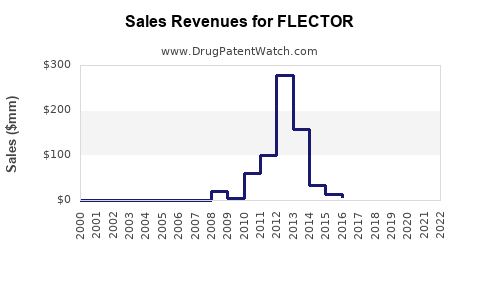
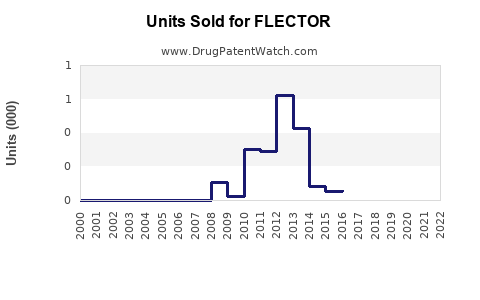
Annual Sales Revenues and Units Sold for FLECTOR
| Drug Name | Revenues (USD) | Units | Year |
|---|---|---|---|
| FLECTOR | ⤷ Start Trial | ⤷ Start Trial | 2022 |
| FLECTOR | ⤷ Start Trial | ⤷ Start Trial | 2021 |
| FLECTOR | ⤷ Start Trial | ⤷ Start Trial | 2020 |
| FLECTOR | ⤷ Start Trial | ⤷ Start Trial | 2019 |
| FLECTOR | ⤷ Start Trial | ⤷ Start Trial | 2018 |
| >Drug Name | >Revenues (USD) | >Units | >Year |
Flector Market Analysis, Patent Position, Sales Forecast, and Generic Entry Risk
Flector is a prescription topical diclofenac product with a declining but defensible U.S. niche in acute musculoskeletal pain. Its commercial base is concentrated in the Flector Patch, a 1.3% diclofenac epolamine topical system approved for acute pain from minor strains, sprains, and contusions. Brand revenue is constrained by generic competition, limited indication breadth, and substitution by oral NSAIDs, topical diclofenac gel, lidocaine products, and over-the-counter analgesics.
A reasonable U.S. base-case estimate places 2024 Flector-related prescription sales at approximately $50 million to $75 million, including brand and authorized or generic equivalents. Brand sales are estimated at $35 million to $55 million. Under a continued generic-erosion scenario, total U.S. sales could decline to $35 million to $50 million by 2029. Upside depends on payer coverage, prescriber preference for the patch delivery system, and commercial expansion into sports medicine, orthopedics, urgent care, and occupational health.
What is Flector and how does it generate revenue?
Flector Patch contains diclofenac epolamine, a nonsteroidal anti-inflammatory drug delivered through a topical adhesive system. The product is applied to the site of pain and is intended for short-duration treatment of acute soft-tissue injuries.
| Product | Active ingredient | Strength | Dosage form | Primary market | Regulatory status |
|---|---|---|---|---|---|
| Flector Patch | Diclofenac epolamine | 1.3% | Topical system | U.S. prescription market | FDA-approved |
| Flector-related generics | Diclofenac epolamine | 1.3% | Topical system | U.S. generic market | ANDA products marketed by multiple companies |
| Voltaren Gel | Diclofenac sodium | 1% | Topical gel | Prescription and OTC markets, depending on jurisdiction | FDA-approved prescription and OTC versions |
| Oral diclofenac | Diclofenac sodium or potassium | Various | Tablets/capsules | Systemic NSAID market | Generic |
IBSA Pharma markets Flector in the United States. Public company filings do not generally disclose a separate global revenue line for Flector, so product-specific revenue must be estimated from prescription volume, product pricing, payer mix, and generic share.
Flector’s value proposition is local delivery, ease of application, and avoidance of some systemic exposure associated with oral NSAIDs. The commercial limitation is that the product competes in a heavily genericized pain market where topical gels, oral NSAIDs, acetaminophen, lidocaine patches, and nonpharmacologic treatment are widely available.
How large is the Flector market?
The relevant market is the U.S. prescription topical NSAID market rather than the entire global diclofenac market. Global diclofenac sales are substantially larger because they include oral products, gels, creams, injections, suppositories, and non-U.S. brands.
Estimated U.S. Flector market
| Measure | 2024 estimate | 2025 base case | 2029 base case |
|---|---|---|---|
| Total Flector-equivalent sales | $50 million-$75 million | $48 million-$70 million | $35 million-$50 million |
| Brand Flector sales | $35 million-$55 million | $32 million-$50 million | $20 million-$32 million |
| Generic and authorized-equivalent sales | $15 million-$25 million | $16 million-$22 million | $15 million-$18 million |
| Estimated annual prescription volume | 0.8 million-1.2 million | 0.8 million-1.1 million | 0.7 million-0.9 million |
| Brand share by value | 65%-75% | 60%-72% | 45%-65% |
These figures are analytical estimates, not company-reported product sales. The range reflects uncertainty around confidential rebates, specialty-pharmacy discounts, payer mix, and the extent to which dispensed generic diclofenac epolamine products are substituted for branded Flector.
Flector is a niche product relative to oral NSAIDs and topical diclofenac gel. The patch’s economic value is more dependent on net price and formulary access than on broad patient volume.
What are the main sales drivers for Flector?
Flector demand is driven by acute injury treatment, particularly in settings where a localized, nonoral option is preferred.
Prescriber and channel drivers
The main prescribing channels are likely to include:
- Orthopedic and sports-medicine practices
- Urgent-care clinics
- Primary-care physicians
- Pain-management practices
- Occupational-medicine providers
- Emergency-department discharge prescriptions
- Workers’ compensation networks
The product is commercially stronger when prescribed at the point of injury. It is less competitive for chronic osteoarthritis, generalized musculoskeletal pain, or long-term inflammatory conditions, where topical diclofenac gel or oral medicines are more familiar and usually less expensive.
Product advantages
Flector has four commercial advantages:
- It provides a discrete patch-based delivery format.
- It is positioned for localized acute pain.
- It offers an alternative for patients who cannot or do not want to take oral NSAIDs.
- It can be prescribed directly after an injury, when adherence to a once- or twice-daily topical regimen is valuable.
The patch also creates a physical treatment cue. That can support adherence compared with creams or gels that require repeated application and may be removed by washing or clothing.
Commercial constraints
Flector faces several constraints:
- Generic diclofenac epolamine topical systems reduce net pricing.
- Topical diclofenac gel has broader patient and prescriber recognition.
- OTC analgesics reduce willingness to pay for branded topical products.
- Payers may require generic substitution or prior authorization.
- The approved indication is narrower than the broader pain market.
- Diclofenac class warnings limit use in certain cardiovascular, gastrointestinal, renal, and pregnancy-related populations.
What is Flector’s FDA regulatory status?
Flector Patch is FDA-approved as a prescription topical system containing diclofenac epolamine 1.3%. The labeled indication is treatment of acute pain due to minor strains, sprains, and contusions in adults and pediatric patients ages six years and older, according to the prescribing information. The product is not approved as a general chronic-pain treatment or for all osteoarthritis indications.
The FDA labeling identifies NSAID-related risks, including cardiovascular thrombotic events, gastrointestinal bleeding, renal toxicity, hypersensitivity, and local skin reactions. These warnings can limit use in older patients and those with cardiovascular, gastrointestinal, or renal risk factors. They also influence payer and prescriber selection against systemic NSAIDs but do not eliminate the need for class-level risk management.
Orange Book status
Flector is an approved small-molecule prescription product listed in FDA drug databases. The commercial importance of any Orange Book listing depends on whether patents remain listed, whether corresponding exclusivity has expired, and whether generic applicants have challenged listed patents.
Flector’s principal regulatory risk is no longer loss of FDA exclusivity. It is post-exclusivity competition from approved generic topical systems and therapeutic substitution by other diclofenac formulations.
When did Flector lose exclusivity?
Flector’s core market protection has effectively transitioned from branded exclusivity to post-exclusivity commercial protection. The product was approved in 2007, and the relevant new-drug exclusivity period expired years ago. Any remaining patent protection would have applied to specific formulation, delivery-system, or manufacturing claims rather than restoring broad product exclusivity.
The practical market timeline is:
| Period | Commercial event | Market impact |
|---|---|---|
| 2007 | FDA approval of Flector Patch | Launch of prescription diclofenac epolamine patch |
| 2010s | Brand expansion and payer contracting | Growth in acute localized pain |
| Late 2010s-early 2020s | Generic ANDA activity and approval | Increased substitution and price pressure |
| 2020s | Mature post-exclusivity market | Brand retention depends on coverage and prescriber loyalty |
| 2025-2029 | Continued generic and therapeutic competition | Low-single-digit to high-single-digit annual decline likely |
Exact patent expiration analysis requires matching each Orange Book-listed patent to its current listing status, patent-term adjustment, pediatric extension, and litigation history. The commercial conclusion is clear even without that reconciliation: Flector is exposed to generic competition and does not have the economics of a protected, high-growth branded product.
What patents protect Flector?
Flector’s patent estate historically centered on the topical delivery system, diclofenac epolamine formulation, adhesive matrix, and transdermal or topical administration technology. The product’s defensibility is therefore formulation-based rather than based on a novel active pharmaceutical ingredient.
Patent categories
| Patent category | Potentially protected subject matter | Commercial relevance |
|---|---|---|
| Active-form salt | Diclofenac epolamine composition | Limits direct substitution with chemically different diclofenac salts |
| Adhesive matrix | Polymer, adhesive, and drug-release architecture | Can complicate exact-copy generic development |
| Topical delivery | Local delivery of diclofenac through a patch | Supports product-specific formulation claims |
| Manufacturing process | Mixing, coating, drying, and lamination steps | Can create manufacturing barriers |
| Method of use | Treatment of acute pain from strains, sprains, and contusions | May affect labeling and generic carve-outs |
Formulation patents can delay or complicate generic approval, but they do not necessarily prevent an ANDA applicant from developing a noninfringing product. A generic company may use a different adhesive composition, release profile, backing layer, or manufacturing process while retaining the same active ingredient and strength.
Are there Paragraph IV challenges to Flector?
Flector is exposed to the standard ANDA and Paragraph IV framework applicable to listed small-molecule products. Publicly visible generic activity indicates that the market has moved beyond a purely patent-protected brand model. The commercial effect of any Paragraph IV filing depends on:
- The specific patent challenged
- Whether the applicant seeks a full label or a section viii carve-out
- The patent holder’s litigation response
- The timing of 30-month stays
- Any settlement or license agreement
- The generic applicant’s manufacturing capacity
A Paragraph IV challenge can create a period of litigation-driven delay, but approval of a generic topical system remains the more important long-term event. Once multiple products are approved, price erosion accelerates and brand retention depends on formulary positioning.
No reliable public basis supports assigning a specific current Flector launch date to every generic applicant. Generic entry should therefore be modeled as an active market condition rather than as a future binary event.
Which companies compete with Flector?
Flector competes with manufacturers across three product categories.
Direct generic competitors
Generic diclofenac epolamine 1.3% topical systems are the closest substitutes. Companies that obtain ANDA approval can compete directly on active ingredient, strength, dosage form, and indication, subject to labeling and therapeutic-equivalence requirements.
Formulation competitors
Voltaren Gel and other diclofenac topical products compete for the same prescriber and patient populations but use different dosage forms or diclofenac salts. Their broader familiarity and, in some markets, OTC availability increase substitution risk.
Non-diclofenac alternatives
| Competitor class | Examples | Competitive effect |
|---|---|---|
| Oral NSAIDs | Ibuprofen, naproxen, generic diclofenac | Lower-cost systemic treatment |
| Topical NSAIDs | Diclofenac gel, ketoprofen products | Direct local-therapy substitution |
| Topical anesthetics | Lidocaine patches and creams | Alternative for localized pain |
| OTC analgesics | Acetaminophen and NSAIDs | Reduces demand for branded prescriptions |
| Nonpharmacologic care | Ice, compression, physical therapy | Limits treatment duration and refill volume |
Flector has a stronger position against oral products when gastrointestinal or systemic exposure is a concern, but the product’s clinical differentiation is not sufficient to prevent substitution.
How strong is the Flector patent estate?
Flector’s patent estate is best characterized as moderate historically and weak to moderate commercially today.
| Patent-strength factor | Assessment |
|---|---|
| Active ingredient novelty | Weak, because diclofenac is an established NSAID |
| Salt-form differentiation | Moderate |
| Patch formulation complexity | Moderate to strong |
| Manufacturing know-how | Moderate |
| Method-of-use protection | Limited after generic label carve-outs |
| Remaining exclusivity value | Low to moderate |
| Litigation leverage | Dependent on unexpired claims and Orange Book status |
| Long-term barrier to entry | Limited |
The formulation can create real development and manufacturing friction. It does not create the same barrier as a complex biologic, sterile injectable, or highly regulated delivery device. Generic companies with topical-system experience can usually assess these products through formulation reverse engineering, comparative characterization, and ANDA development.
What is the Flector sales forecast through 2029?
The base case assumes continued generic substitution, stable acute-injury prescribing, modest price erosion, and no major new indication.
U.S. sales projections
| Year | Bear case | Base case | Bull case |
|---|---|---|---|
| 2024 | $45 million | $62 million | $75 million |
| 2025 | $40 million | $58 million | $74 million |
| 2026 | $36 million | $54 million | $72 million |
| 2027 | $32 million | $50 million | $70 million |
| 2028 | $29 million | $46 million | $68 million |
| 2029 | $26 million | $43 million | $66 million |
The base-case compound annual decline is approximately 7%. The bull case assumes stronger brand retention, limited additional generic discounting, and continued use in urgent-care and orthopedic settings. The bear case assumes faster payer conversion to generic products and broader substitution with diclofenac gel.
Revenue exposure
For the product owner, Flector is likely to remain a profitable mature-brand asset if manufacturing costs are controlled and promotional spending remains targeted. Its absolute revenue exposure is modest relative to major pharmaceutical products, but the margin profile can remain attractive because the product is established, manufacturing infrastructure is available, and clinical education requirements are limited.
The main value driver is not volume growth. It is the preservation of branded net price and formulary access.
What generic launch scenarios exist for Flector?
Scenario 1: One or two generic competitors
This scenario produces moderate price erosion. The brand retains some managed-care coverage, and pharmacies substitute generic products when available. Brand sales decline approximately 5% to 10% annually.
Scenario 2: Multiple generic competitors
Three or more approved suppliers can create sharper price competition. Brand sales may fall 10% to 20% annually, while total category volume remains relatively stable. Gross-to-net discounts increase as payers use preferred generic placement.
Scenario 3: Generic shortage or manufacturing disruption
A topical patch requires specialized coating, lamination, and packaging capabilities. A supplier interruption could temporarily restore some brand demand or increase generic prices. This is a supply event, not durable patent protection.
Scenario 4: Brand repositioning
A targeted strategy focused on urgent care, sports medicine, workers’ compensation, and samples could stabilize brand volume. The strategy would require disciplined contracting and evidence that the patch provides practical adherence or tolerability benefits over gels and oral agents.
Does Flector face biosimilar risk?
No. Flector is a small-molecule diclofenac product, not a biologic. Biosimilar regulation does not apply. Its competitive risk comes from ANDA-approved generics, formulation substitutes, and therapeutic alternatives.
What licensing deals affect Flector?
No major, publicly reported licensing transaction appears to define Flector’s current commercial outlook. The product has changed hands or commercial partners over its life, but its present value is primarily determined by U.S. brand operations, generic competition, and product-level profitability.
A licensing transaction involving Flector would likely be structured around one of four assets:
- U.S. commercial rights
- Regional rights outside the United States
- A broader topical pain portfolio
- Manufacturing or supply rights for the topical system
Because product-specific revenue is not separately reported by the relevant private commercial entities, transaction valuation should be based on audited net sales, prescription data, contribution margin, patent status, and remaining payer coverage rather than headline market estimates.
What litigation and settlement risks affect Flector?
Flector litigation risk is concentrated in three areas:
- Patent litigation involving formulation or delivery-system claims
- ANDA litigation after Paragraph IV certification
- Product-liability claims associated with NSAID warnings or dermatologic reactions
The economic importance of patent litigation is limited once multiple generic products are approved. A settlement could delay entry, but its value depends on the remaining life of the asserted patents and the number of potential generic entrants. A settlement that delays one applicant may not preserve price if another generic supplier enters.
How does Flector compare with Voltaren Gel?
| Factor | Flector Patch | Voltaren Gel |
|---|---|---|
| Active ingredient | Diclofenac epolamine | Diclofenac sodium |
| Delivery form | Adhesive topical system | Topical gel |
| Use profile | Acute localized injury | Broader topical pain use, depending on label |
| Application | Patch placement | Repeated rubbing into affected area |
| Generic risk | Direct generic patch competition | Generic and OTC product competition |
| Adherence advantage | Visible, fixed-dose application | Flexible dosing but messier application |
| Commercial scale | Niche prescription product | Larger topical diclofenac category |
| Long-term outlook | Mature and declining | More resilient because of broader use and consumer recognition |
Flector’s clearest differentiation is the patch format. Voltaren’s advantage is broader market familiarity and greater product availability.
Key Takeaways
- Flector is a mature prescription topical NSAID with estimated 2024 U.S. sales of $50 million to $75 million across brand and generic products.
- Brand Flector sales are estimated at $35 million to $55 million in 2024.
- The base-case U.S. market declines to approximately $43 million by 2029.
- Generic diclofenac epolamine topical systems are the primary commercial threat.
- Flector has no biosimilar risk because it is a small molecule.
- Its patent value is concentrated in patch formulation, adhesive technology, delivery, and manufacturing claims.
- The product’s strongest channels are urgent care, orthopedics, sports medicine, and occupational medicine.
- Voltaren Gel, oral NSAIDs, lidocaine products, and OTC analgesics are material substitutes.
- Future value depends more on net pricing, payer access, and manufacturing efficiency than on market expansion.
- A brand acquisition or licensing transaction should be underwritten as a cash-generating mature product, not as a growth asset.
FAQs
Is Flector still commercially viable after generic entry?
Yes, but primarily as a margin-focused mature brand. Viability depends on payer coverage, prescribing loyalty, and control of manufacturing and promotional costs.
Is Flector stronger than diclofenac gel for acute injuries?
The patch may offer practical adherence and localized application advantages. Diclofenac gel generally has broader familiarity, wider availability, and stronger substitution economics.
Can a generic company launch Flector without copying the exact patch formulation?
Yes. An ANDA applicant may develop a therapeutically equivalent topical system using a different adhesive, backing layer, release profile, or manufacturing process, provided it satisfies FDA requirements and avoids enforceable patent claims.
What would increase Flector’s sales beyond the base forecast?
The most credible drivers are stronger urgent-care adoption, improved payer coverage, expanded use in occupational injury networks, and evidence supporting adherence or tolerability advantages over gels and oral NSAIDs.
Is Flector a suitable licensing target?
It may be suitable for a company seeking a profitable mature topical product with established demand. It is less attractive for an investor seeking rapid growth, broad exclusivity, or a large untapped indication.
References
- U.S. Food and Drug Administration. (2007). Flector (diclofenac epolamine) topical system prescribing information.
- U.S. Food and Drug Administration. (2024). Drugs@FDA: FDA-approved drugs.
- U.S. Food and Drug Administration. (2024). Approved drug products with therapeutic equivalence evaluations.
- U.S. Food and Drug Administration. (2024). Orange Book: Approved drug products with therapeutic equivalence evaluations.
- U.S. Food and Drug Administration. (2024). Nonsteroidal anti-inflammatory drug product labeling and safety information.
- IBSA Pharma Inc. (2024). Flector product information.
- IQVIA. (2024). U.S. pharmaceutical prescription and market data. Subscription database.
More… ↓
