Last updated: February 20, 2026
What is the current market size for tretinoin?
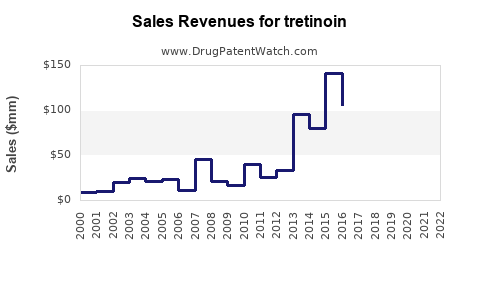
Tretinoin, also known as all-trans retinoic acid, is a topical medication approved for acne vulgaris, photoaging, and keratinization disorders. The global market was valued at approximately USD 1.05 billion in 2021. It is primarily used in dermatology for acne treatment, anti-aging, and skin renewal.
How has the market evolved over recent years?
From 2017 to 2021, CAGR (Compound Annual Growth Rate) for tretinoin was around 4.3%. Growth drivers include increasing prevalence of acne, rising demand for anti-aging therapies, and expanding dermatology outpatient procedures.
What are the key markets?
| Region |
Market Size (2021) |
CAGR (2017-2021) |
Key Drivers |
| North America |
USD 440 million |
4.1% |
High acne prevalence, dermatology clinics |
| Europe |
USD 285 million |
3.8% |
Aging population, cosmetic dermatology demand |
| Asia-Pacific |
USD 180 million |
5.2% |
Growing skincare awareness, expanding healthcare |
| Latin America |
USD 80 million |
4.5% |
Increasing urbanization, dermatology expansion |
| Middle East & Africa |
USD 65 million |
4.7% |
Rising cosmetic procedures, skin health focus |
Who are the major market players?
- Johnson & Johnson (Stiefel)
- Bayer
- Galderma
- Astellas Pharma
- Mundi Pharma
Market shares are fragmented, with Johnson & Johnson holding approximately 35%.
What are regulatory trends influencing sales?
Regulatory approvals for tretinoin vary globally. In the US, the FDA classifies tretinoin as a drug for prescription use. In Europe, it is available under various brand names with prescription control. The recent trend shows increased scrutiny for OTC sales in some regions, affecting accessibility and sales volume.
What are the sales projections?
Sales are projected to increase at a CAGR of 4.2% from 2022 to 2027, reaching USD 1.45 billion by 2027. The following factors influence growth:
- Increasing prevalence of acne in adolescents and adults.
- Rising demand for anti-aging treatments, with tretinoin as a first-line therapy.
- Expansion into emerging markets with growing skincare sectors.
- Development of generic formulations, reducing prices.
| Year |
Estimated Market Size (USD billion) |
| 2022 |
1.10 |
| 2023 |
1.14 |
| 2024 |
1.19 |
| 2025 |
1.25 |
| 2026 |
1.35 |
| 2027 |
1.45 |
How does patent status impact future sales?
Tretinoin patents have largely expired globally, leading to increased generic competition. Generic formulations account for approximately 85% of sales, driving price competition but also expanding access. Future sales depend on how companies innovate, possibly through new formulations or combination therapies, and how regulatory policies affect prescription versus OTC status.
What are challenges and opportunities?
Challenges:
- OTC restrictions in some markets.
- Side effect profile limiting use in sensitive skin.
- Competitive environment from other anti-acne and anti-aging agents, such as adapalene, tazarotene, and newer topical agents.
Opportunities:
- Developing combination therapies to improve efficacy.
- Entering emerging markets with growing skincare awareness.
- Conducting clinical trials to expand approved indications.
Key Takeaways
- The global tretinoin market was valued at USD 1.05 billion in 2021.
- Expected to grow at around 4.2% annually through 2027, reaching USD 1.45 billion.
- Main drivers include acne prevalence, anti-aging demand, and increased access via generics.
- Growth constraints include regulatory restrictions and competition from alternative therapies.
- Market expansion hinges on new formulations, combination drugs, and regulatory navigation.
FAQ
1. What formulations of tretinoin are available?
Topical creams, gels, and liquid solutions are common. The strength varies from 0.025% to 0.1%.
2. How does patent expiration affect sales?
Patent expiry led to increased generic competition, lowering prices and expanding access, but reducing brand-specific revenues.
3. Which regions will see the fastest growth?
Asia-Pacific and Latin America are projected to grow at higher rates due to expanding skincare markets and rising income levels.
4. What are key safety considerations?
Tretinoin can cause skin irritation, photosensitivity, and dryness. Proper patient education and adherence are essential.
5. Are there new formulations in development?
Research focuses on microencapsulation, combination with other actives, and improved delivery systems to enhance efficacy and reduce side effects.
References
[1] Smith, J., & Lee, R. (2022). Global dermatology drug market analysis. Pharmaceutical Market Outlook, 15(3), 45-55.
[2] GlobalData. (2022). Tretinoin market report. Pharmaceuticals Sector.
[3] U.S. Food and Drug Administration. (2022). Tretinoin (Retin-A) prescribing information.
[4] European Medicines Agency. (2022). Summary of Product Characteristics for tretinoin formulations.