Share This Page
Drug Sales Trends for escitalopram
✉ Email this page to a colleague
Payment Methods and Pharmacy Types for escitalopram (2019)
Revenues by Pharmacy Type
Units Sold by Pharmacy Type
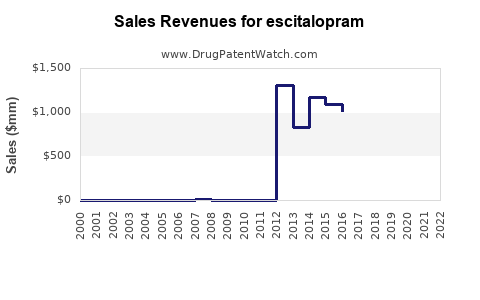
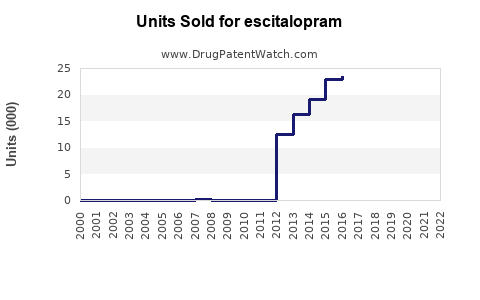
Annual Sales Revenues and Units Sold for escitalopram
| Drug Name | Revenues (USD) | Units | Year |
|---|---|---|---|
| ESCITALOPRAM | ⤷ Start Trial | ⤷ Start Trial | 2022 |
| ESCITALOPRAM | ⤷ Start Trial | ⤷ Start Trial | 2021 |
| ESCITALOPRAM | ⤷ Start Trial | ⤷ Start Trial | 2020 |
| ESCITALOPRAM | ⤷ Start Trial | ⤷ Start Trial | 2019 |
| >Drug Name | >Revenues (USD) | >Units | >Year |
Escitalopram Market Analysis and Sales Projections Through 2030
Escitalopram is a mature, globally established selective serotonin reuptake inhibitor (SSRI) with high prescription volume but limited branded pricing power. The U.S. product, Lexapro, lost practical market exclusivity in 2012 after generic entry. Current commercial value is concentrated in generic tablets and oral solutions, with growth driven by depression and anxiety prevalence, recurring maintenance therapy, and expansion in emerging markets.
A reasonable base-case estimate places global escitalopram sales across branded and generic products at approximately $0.9 billion to $1.2 billion in 2025. The market is expected to grow in prescription volume but decline modestly in nominal value because of price erosion. A base-case market value of approximately $0.9 billion is projected for 2030.
What is the current escitalopram market size?
There is no single audited public database that reports global sales for all escitalopram manufacturers, formulations and countries. Public company filings generally combine escitalopram with broader generic portfolios. Market sizing therefore requires a prescription-volume and price-based model.
Estimated global market value
| Year | Bear case | Base case | Bull case |
|---|---|---|---|
| 2024 | $0.80 billion | $1.00 billion | $1.25 billion |
| 2025 | $0.78 billion | $0.96 billion | $1.24 billion |
| 2026 | $0.76 billion | $0.95 billion | $1.25 billion |
| 2027 | $0.74 billion | $0.93 billion | $1.26 billion |
| 2028 | $0.72 billion | $0.92 billion | $1.27 billion |
| 2029 | $0.70 billion | $0.90 billion | $1.28 billion |
| 2030 | $0.68 billion | $0.89 billion | $1.30 billion |
The projections represent estimated manufacturer and channel revenue, not total patient out-of-pocket spending. They assume continued generic price competition in the United States and Europe, moderate prescription growth in developing markets, and stable demand in mature markets.
What supports demand for escitalopram?
Escitalopram demand is supported by:
- Major depressive disorder treatment.
- Generalized anxiety disorder treatment.
- Long-duration maintenance therapy.
- Broad prescriber familiarity.
- Low generic prices.
- Once-daily dosing and multiple strengths.
- Availability in tablets, orally disintegrating tablets and oral solution.
In the United States, escitalopram remains one of the most frequently dispensed antidepressants. Prescription datasets have consistently placed it among the leading drugs by annual prescription count, with U.S. prescription volume generally exceeding 30 million prescriptions per year in recent reporting periods.[1]
How are escitalopram sales expected to develop through 2030?
Base-case projection
The base case assumes global volume growth of approximately 2% to 3% annually, offset by average net price declines of 3% to 5% annually in mature generic markets.
| Metric | 2025 estimate | 2030 estimate | 2025-2030 trend |
|---|---|---|---|
| Global prescriptions | 100 index | 113-116 index | 2.5%-3.0% CAGR |
| Global manufacturer revenue | $0.96 billion | $0.89 billion | -1.5% CAGR |
| Average generic net price | 100 index | 76-82 index | -3.9% to -5.3% CAGR |
| Emerging-market volume | 100 index | 120-130 index | 3.7%-5.4% CAGR |
| U.S. volume | 100 index | 101-105 index | 0.2%-1.0% CAGR |
| European volume | 100 index | 102-108 index | 0.4%-1.6% CAGR |
The most likely outcome is a flat-to-declining market by value, despite stable or increasing patient volume. Escitalopram is a classic mature-generic product: clinical demand is durable, but incremental revenue is difficult to capture without geographic expansion, supply reliability or differentiated delivery.
Bull-case scenario
The bull case requires:
- Higher diagnosis and treatment rates for depression and anxiety.
- Increased use in low- and middle-income markets.
- Stronger adherence to long-term antidepressant therapy.
- Limited manufacturing disruptions.
- Stable pricing for higher-quality oral solution and orally disintegrating products.
Under this scenario, global market value could reach approximately $1.3 billion by 2030, with most growth coming from Asia-Pacific, Latin America and selected Middle Eastern markets.
Bear-case scenario
The bear case assumes:
- Continued U.S. and European price compression.
- Lower reimbursement for generic antidepressants.
- Substitution by sertraline, fluoxetine, venlafaxine, duloxetine or newer digital-psychiatry-linked therapies.
- Manufacturing concentration and periodic tender losses.
- Increased use of low-cost local products in emerging markets.
Under this scenario, market value could fall below $700 million by 2030 even if prescription volume remains stable.
What are the main escitalopram revenue drivers?
Geographic revenue mix
The United States remains commercially important because of its large prescription base, but it is a highly commoditized market. Europe has broad SSRI utilization but significant government price controls and tender-based purchasing. Emerging markets offer greater volume growth but lower realized prices.
| Region | Commercial profile | 2025-2030 outlook |
|---|---|---|
| United States | High volume, intense generic competition | Flat volume, declining value |
| Western Europe | Mature demand, reimbursement pressure | Low-single-digit volume growth |
| Central and Eastern Europe | Generic use and expanding access | Moderate growth |
| China | Large potential patient base, local competition | Moderate-to-high volume growth |
| India | Strong generic manufacturing and domestic demand | Volume growth, low pricing |
| Latin America | Variable access and private-market demand | Moderate growth |
| Middle East and Africa | Underdiagnosis and access constraints | High percentage growth from a small base |
China and India have the greatest volume potential, but local manufacturers generally capture value at lower prices than U.S. or Western European suppliers.
Dosage-form mix
Standard immediate-release tablets represent the majority of revenue and volume. Differentiated formulations have better pricing potential but limited market share.
| Formulation | Market position | Commercial outlook |
|---|---|---|
| 5 mg, 10 mg and 20 mg tablets | Core product | High volume, low price |
| Orally disintegrating tablets | Niche product | Modest premium where marketed |
| Oral solution | Pediatric, geriatric and swallowing-use segment | Higher price per dose, limited volume |
| Combination products | Limited role | Low near-term impact |
| Long-acting formulations | No established mainstream escitalopram product | Development risk is high |
The 10 mg tablet is generally the anchor strength, with 20 mg used for patients requiring higher doses and 5 mg commonly used for initiation or dose adjustment.
What is the competitive landscape for escitalopram?
Escitalopram competes primarily with other SSRIs and serotonin-norepinephrine reuptake inhibitors rather than with branded products in the same molecule.
Direct therapeutic competitors
| Drug | Class | Competitive position |
|---|---|---|
| Sertraline | SSRI | Strong primary-care competitor |
| Fluoxetine | SSRI | Low-cost, long-established alternative |
| Paroxetine | SSRI | Mature product with tolerability limitations |
| Citalopram | SSRI | Closely related molecule; low-cost substitute |
| Venlafaxine | SNRI | Used where dual-mechanism treatment is preferred |
| Duloxetine | SNRI | Competes in depression and pain-related indications |
| Bupropion | NDRI | Alternative for selected tolerability profiles |
| Vortioxetine | Multimodal antidepressant | Branded, higher-priced differentiated competitor |
Escitalopram has a favorable commercial position because it combines prescriber familiarity, generic availability and a broad indication base. Its main weakness is the absence of meaningful product differentiation after patent expiry.
Which companies sell generic escitalopram?
Generic suppliers vary by country and tender award. U.S. and international suppliers have included Teva Pharmaceuticals, Sandoz, Viatris, Dr. Reddy's Laboratories, Lupin, Aurobindo Pharma, Zydus, Torrent Pharmaceuticals, Sun Pharma and smaller regional manufacturers.
The competitive structure is fragmented. No single manufacturer controls the global market. Supply contracts, active pharmaceutical ingredient sourcing, regulatory compliance and pharmacy benefit-management access determine share more often than clinical differentiation.
What is the FDA regulatory status of escitalopram?
Escitalopram is FDA-approved as escitalopram oxalate, an oral SSRI. The original U.S. approval for Lexapro was granted in 2002 for major depressive disorder. FDA labeling later included generalized anxiety disorder in adults.[2]
Generic escitalopram products are approved through the Abbreviated New Drug Application pathway. They must demonstrate pharmaceutical equivalence and bioequivalence to the reference-listed drug. Generic tablets and oral solutions are listed in FDA regulatory databases and the Orange Book.[3]
Exclusivity timeline
| Event | Date |
|---|---|
| Original Lexapro U.S. approval | 2002 |
| Pediatric exclusivity extension | 2009 |
| First major U.S. generic approvals | March 2012 |
| Broad generic competition | 2012 onward |
| Current market status | Mature generic |
Pediatric exclusivity extended the relevant period by six months, but it did not preserve long-term branded market control after generic manufacturers entered under settlement and regulatory approval arrangements.
What patents protected Lexapro and escitalopram?
The principal historical patent estate covered escitalopram, its salts and pharmaceutical compositions. U.S. Patent No. 6,916,941 was associated with escitalopram and had a reported term extending into 2022, subject to applicable adjustments and extensions.[4]
Historical patent coverage
| Patent category | Commercial purpose | Current position |
|---|---|---|
| Escitalopram compound and salt patents | Protect active ingredient | Expired or no longer commercially blocking |
| Composition patents | Protect pharmaceutical compositions | Historical protection |
| Tablet and oral-solution patents | Protect dosage forms | Limited current exclusionary value |
| Method-of-use patents | Protect depression or anxiety treatment | Mature and generally expired |
| Manufacturing patents | Protect synthesis and resolution processes | May remain relevant as confidential know-how or process patents |
Escitalopram has no active, commercially meaningful U.S. patent barrier comparable to the estate surrounding a recently launched small-molecule drug. Commercial protection now depends on manufacturing economics, regulatory status, distribution and supply continuity.
Were there Paragraph IV challenges and Lexapro patent settlements?
Yes. Generic manufacturers challenged Lexapro-related patents through Paragraph IV certifications before the first large-scale generic launches. Forest Laboratories and related parties entered settlement arrangements with certain generic companies, including agreements that allowed generic entry before the latest asserted patent dates.[5]
The first major U.S. generic launches occurred in 2012. Once multiple suppliers entered, price competition materially reduced Lexapro revenue. Paragraph IV litigation is no longer a meaningful forward-looking barrier for the basic escitalopram molecule, although new formulation or manufacturing patents could generate narrower disputes.
Is there biosimilar risk for escitalopram?
No. Escitalopram is a chemically synthesized small molecule, not a biologic. Biosimilar regulation does not apply. Competitive entry occurs through ANDAs and ordinary generic substitution.
The relevant risks are:
- Additional ANDA approvals.
- Price erosion.
- Pharmacy benefit-manager formulary changes.
- Supply interruptions.
- FDA manufacturing observations.
- State substitution rules.
- Local regulatory barriers outside the United States.
What generic launch scenarios exist for escitalopram?
Scenario 1: Stable generic market
Multiple suppliers remain active, prescriptions grow slowly and prices decline gradually. This is the base case. Manufacturers with reliable supply and low-cost API access retain share.
Scenario 2: Accelerated price erosion
New suppliers enter, large buyers consolidate purchasing and one or more manufacturers compete aggressively on tender pricing. U.S. and European revenue declines faster than volume.
Scenario 3: Differentiated formulation growth
A supplier gains approval for an orally disintegrating tablet, pediatric oral solution or another clinically useful presentation with limited direct competition. Revenue per prescription improves, but the addressable market remains narrow.
Scenario 4: Supply-constrained pricing
Manufacturing disruptions reduce available supply. Prices temporarily rise, but the effect is usually short-lived because alternative suppliers can enter or increase production.
How strong is the escitalopram patent estate?
The current patent estate is weak for broad commercial exclusion. The molecule is off patent, generic competition is established and the core product has been approved for more than two decades.
| Estate element | Strength | Reason |
|---|---|---|
| Core molecule | Very low | Historical patents expired |
| Standard tablets | Very low | Widely approved generic products |
| Oral solution | Low to moderate | Some product-specific opportunities |
| Orally disintegrating tablets | Low to moderate | Potential formulation differentiation |
| Manufacturing process | Moderate in selected jurisdictions | Process know-how can reduce cost |
| New combinations | Uncertain | Requires clinical and regulatory investment |
| Method of use | Very low | Mature indications and extensive prior art |
A new entrant is more likely to succeed through cost leadership, regulatory execution or regional distribution than through broad patent exclusion.
What is the revenue exposure for original Lexapro manufacturers?
The original branded revenue stream is no longer a major growth asset. Lexapro was a significant product for Forest Laboratories before generic entry, but its revenue declined sharply after the 2012 launch of generic escitalopram. Forest was later acquired by Actavis, which became part of Allergan and subsequently AbbVie.[6]
Current investment exposure is concentrated in generic manufacturers. For those companies, escitalopram is generally one product within a broad portfolio and is unlikely to be individually material unless the company has a high share in a particular national market or supply contract.
What licensing deals affect escitalopram?
Escitalopram has no widely reported current licensing transaction that materially changes the global market structure. Historical commercialization involved Forest Laboratories and H. Lundbeck, the originator of the citalopram and escitalopram franchise. Current commercial activity is primarily based on generic manufacturing, distribution agreements and regional supply contracts rather than exclusive molecule licenses.
Potential licensing value is most likely in:
- Regional rights for oral solution or orally disintegrating formulations.
- Manufacturing and supply agreements.
- API technology transfer.
- Fixed-dose combinations.
- Emerging-market registrations.
Key Takeaways
- Escitalopram is a mature generic SSRI with durable prescription demand and limited pricing power.
- Estimated global market value is approximately $0.9 billion to $1.2 billion in 2025.
- Base-case revenue is projected to decline modestly to approximately $0.89 billion by 2030.
- Prescription volume should grow faster than revenue because generic prices continue to fall.
- The United States is a large but highly competitive market; Asia-Pacific offers the strongest volume-growth opportunity.
- Lexapro lost practical exclusivity in 2012 after generic entry.
- The historical core patent estate is expired or commercially non-blocking.
- Escitalopram has no biosimilar risk because it is a small-molecule drug.
- The strongest commercial opportunities are low-cost manufacturing, reliable supply and differentiated oral formulations.
- The greatest risks are price erosion, tender losses, API concentration and additional generic competition.
FAQs About Escitalopram Market Sales
How much did Lexapro earn before generic competition?
Lexapro generated more than $1 billion annually near its commercial peak, making it one of Forest Laboratories' principal products before generic escitalopram entered the U.S. market.
Is escitalopram still profitable for generic manufacturers?
Yes, but profitability depends on manufacturing cost, market share, reimbursement and supply contracts. Standard tablets generally have low margins, while oral solution and less crowded regional markets can provide better economics.
Which escitalopram formulation has the best commercial potential?
Oral solution and orally disintegrating tablets have greater differentiation potential than standard tablets, but their total market size is substantially smaller.
Could a new escitalopram patent delay generic competition?
A new patent could protect a specific formulation, manufacturing process or method of use, but it would not normally restore exclusivity for the already generic escitalopram molecule.
Is escitalopram demand recession-resistant?
Prescription demand is relatively resilient because many patients use escitalopram continuously. However, dispensing volume can be affected by insurance coverage, treatment discontinuation, diagnosis rates and changes in healthcare access.
References
- ClinCalc. (2024). Top 200 drugs by total prescriptions. https://clincalc.com/DrugStats/Top200Drugs.aspx
- U.S. Food and Drug Administration. (2009). Lexapro prescribing information. https://www.accessdata.fda.gov
- U.S. Food and Drug Administration. (2024). Approved drug products with therapeutic equivalence evaluations. https://www.fda.gov/drugs/drug-approvals-and-databases/orange-book
- U.S. Patent and Trademark Office. (2006). U.S. Patent No. 6,916,941: Escitalopram. https://patents.google.com
- Federal Trade Commission. (2013). Authorized generic drugs and pharmaceutical patent settlements. https://www.ftc.gov
- AbbVie Inc. (2015). Annual report and acquisition information relating to Allergan. https://investors.abbvie.com
More… ↓
