Share This Page
Drug Sales Trends for apixaban
✉ Email this page to a colleague
Payment Methods and Pharmacy Types for apixaban (2019)
Revenues by Pharmacy Type
Units Sold by Pharmacy Type
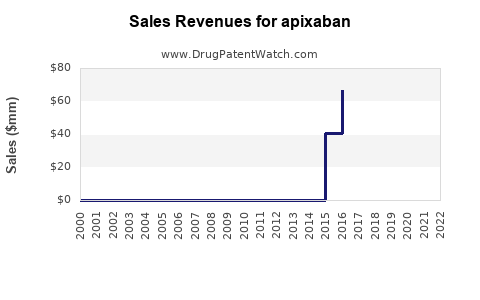
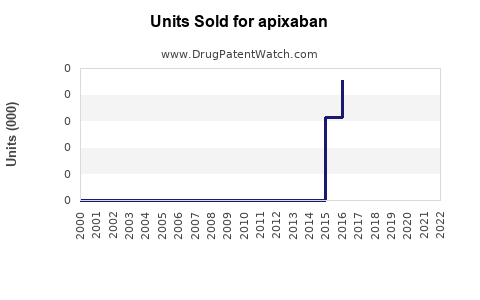
Annual Sales Revenues and Units Sold for apixaban
| Drug Name | Revenues (USD) | Units | Year |
|---|---|---|---|
| APIXABAN | ⤷ Start Trial | ⤷ Start Trial | 2022 |
| APIXABAN | ⤷ Start Trial | ⤷ Start Trial | 2021 |
| APIXABAN | ⤷ Start Trial | ⤷ Start Trial | 2020 |
| APIXABAN | ⤷ Start Trial | ⤷ Start Trial | 2019 |
| APIXABAN | ⤷ Start Trial | ⤷ Start Trial | 2018 |
| >Drug Name | >Revenues (USD) | >Units | >Year |
Apixaban Market Analysis, Eliquis Sales Forecast, Patent Expiry and Generic Entry Risk
Apixaban, marketed as Eliquis by Bristol Myers Squibb and Pfizer, is the leading direct oral anticoagulant by global revenue. Worldwide Eliquis sales were approximately $20 billion in 2023, supported by atrial fibrillation, venous thromboembolism and post-surgical thromboprophylaxis indications. The principal commercial risk is U.S. generic entry after the core patent estate expires and settlements permit launches beginning in 2028. A base-case forecast places branded Eliquis revenue at approximately $15.5 billion in 2028 and $8.5 billion in 2030, with total apixaban molecule sales remaining higher as generic volume replaces branded revenue.
What is the current market position of apixaban?
Apixaban is the largest commercial product in the direct oral anticoagulant, or DOAC, class. Its principal competitor products are rivaroxaban, marketed as Xarelto by Johnson & Johnson and Bayer, dabigatran, marketed as Pradaxa by Boehringer Ingelheim, and edoxaban, marketed as Savaysa or Lixiana by Daiichi Sankyo.
Eliquis benefits from:
- Broad use in nonvalvular atrial fibrillation.
- Strong clinical adoption for treatment and secondary prevention of deep-vein thrombosis and pulmonary embolism.
- A twice-daily dosing profile that is widely used in cardiology and anticoagulation practice.
- Extensive physician familiarity and guideline support.
- Pediatric labeling for selected venous thromboembolism indications.
- A large commercial infrastructure funded by two global pharmaceutical companies.
The product’s main structural weakness is the approaching loss of U.S. exclusivity. The U.S. market contributes a large share of Eliquis profit, even though international sales remain material.
How much revenue does Eliquis generate?
Bristol Myers Squibb reported Eliquis revenue of approximately $12.1 billion in 2023. Pfizer separately reported approximately $7.9 billion in alliance revenue from Eliquis for the same year. The combined figure was approximately $20.0 billion, although reported amounts reflect each company’s accounting treatment rather than a single consolidated product-sales line (Bristol Myers Squibb, 2024; Pfizer, 2024).
| Fiscal year | Estimated combined Eliquis sales | Approximate growth |
|---|---|---|
| 2021 | $16.0 billion | 14% |
| 2022 | $18.0 billion | 12% |
| 2023 | $20.0 billion | 11% |
| 2024 estimate | $20.3 billion | 2% |
| 2025 estimate | $20.5 billion | 1% |
| 2026 estimate | $20.2 billion | -1% |
| 2027 estimate | $19.3 billion | -4% |
| 2028 estimate | $15.5 billion | -20% |
| 2029 estimate | $11.5 billion | -26% |
| 2030 estimate | $8.5 billion | -26% |
The 2021-2023 figures are based on company-reported results and rounded for comparability. The 2024-2030 figures are an analytical forecast rather than company guidance. They assume stable underlying demand through 2026, modest pre-generic price pressure, U.S. generic launches beginning in late 2028, and faster erosion in the United States than in markets where patent protection or regulatory approvals differ.
What are the main growth drivers for apixaban?
Atrial fibrillation expansion
Atrial fibrillation remains the largest demand driver. Population aging, improved diagnosis and increased stroke-prevention treatment support continued unit growth. Apixaban has also benefited from broader use in older patients and those considered unsuitable for warfarin because of monitoring requirements or drug-interaction concerns.
Venous thromboembolism
Treatment and secondary prevention of deep-vein thrombosis and pulmonary embolism provide a second major demand base. Hospital discharge protocols increasingly favor oral anticoagulants over prolonged injectable therapy.
International penetration
Eliquis still has expansion opportunities in emerging markets, hospital channels and underdiagnosed atrial fibrillation populations. International growth will not fully offset U.S. generic erosion, but it can extend the product’s commercial life after U.S. loss of exclusivity.
Medicare and public-payer utilization
U.S. reimbursement changes create both volume support and price pressure. Medicare Part D redesign under the Inflation Reduction Act may reduce patient out-of-pocket costs for some beneficiaries, supporting adherence. At the manufacturer level, the same changes can compress net pricing and alter plan-level contracting economics.
When does apixaban lose exclusivity?
The key U.S. composition-of-matter protection for apixaban expires in the second half of the 2020s, with pediatric exclusivity and patent-term adjustments affecting the effective date. The practical U.S. generic-entry date is more important commercially than the nominal expiration date because Bristol Myers Squibb and Pfizer settled patent litigation with multiple generic manufacturers.
Publicly disclosed settlements have generally permitted generic apixaban entry beginning in 2028, subject to the terms applicable to each manufacturer and product. This creates a relatively defined erosion window rather than an immediate loss on the earliest nominal patent-expiry date.
| Milestone | Commercial significance |
|---|---|
| 2012 | FDA approval of Eliquis for stroke and systemic embolism risk reduction in nonvalvular atrial fibrillation |
| 2014 | FDA approval for treatment and recurrence reduction of DVT and PE |
| 2022 | Pediatric venous thromboembolism labeling expansion |
| 2026-2027 | Core U.S. patent and exclusivity issues become increasingly material |
| 2028 | Expected initial U.S. generic launches under settlement arrangements |
| 2029-2030 | Accelerating U.S. brand erosion and price competition |
| After 2030 | Generic volume likely dominates the U.S. apixaban market |
The Orange Book should be used for the current patent list, expiration dates, pediatric exclusivity and litigation certifications because listed patents and regulatory timing can change (U.S. Food and Drug Administration, 2024).
What patents protect Eliquis?
The core apixaban patent estate includes composition, pharmaceutical composition and formulation claims. The foundational U.S. patent family covers apixaban and related chemical matter. Later patents may cover solid-state forms, pharmaceutical compositions, manufacturing processes or specific dosage forms.
The commercial strength of the estate is uneven:
| Protection category | Strategic value | Expected durability |
|---|---|---|
| Apixaban composition claims | Highest | Core protection reaches the late 2020s |
| Tablet and pharmaceutical-composition claims | High if valid and enforceable | May delay some products but is exposed to invalidity and non-infringement attacks |
| Solid-state or polymorph claims | Variable | Depends on generic formulation and claim scope |
| Manufacturing-process patents | Moderate | Can raise development costs but often do not block alternative processes |
| Method-of-use patents | Limited to the claimed indication | More vulnerable to skinny-label or induced-infringement strategies |
| Pediatric exclusivity | Regulatory, not patent protection | Temporary and indication-specific |
The patent estate is strong enough to preserve significant branded revenue through the late 2020s, but it is unlikely to prevent broad generic competition after settlement-permitted entry. Apixaban is a small molecule, not a biologic, so biosimilar regulation does not apply. Generic manufacturers can use the ANDA pathway rather than the biosimilar pathway.
Which companies are challenging Eliquis?
The main challengers are generic drug companies that have filed or pursued abbreviated new drug applications and Paragraph IV patent certifications. Publicly reported litigation and settlement activity has involved major generic manufacturers, including Teva, Mylan, Sigmapharm, Micro Labs, Hetero, Zydus, Sun Pharma and others, depending on the patent and court action at issue.
A Paragraph IV filing alleges that a listed patent is invalid, unenforceable or will not be infringed by the proposed generic. It can trigger patent litigation and a 30-month FDA approval stay for the relevant application under the Hatch-Waxman framework.
The practical effect of the settlements has been to convert uncertain litigation outcomes into controlled launch rights. That reduces the probability of an immediate early generic launch but increases confidence that several manufacturers will enter around the agreed 2028 window.
What is the FDA regulatory status of apixaban?
Eliquis is FDA-approved for several anticoagulation uses:
- Reduction of stroke and systemic embolism risk in adults with nonvalvular atrial fibrillation.
- Treatment of DVT and PE.
- Reduction in the risk of recurrent DVT and PE.
- Prophylaxis of DVT after hip or knee replacement surgery.
- Selected pediatric venous thromboembolism indications.
The product carries important bleeding-risk warnings and has a boxed warning concerning premature discontinuation and spinal or epidural hematomas in certain settings. Safety monitoring, renal function, age, concomitant antiplatelet therapy and surgical timing remain central to prescribing decisions.
The breadth of the label supports commercial resilience because generic competition in one indication does not eliminate demand across all approved uses. It also creates method-of-use and labeling issues for ANDA applicants seeking approval for selected indications.
What generic-entry risks exist for apixaban?
The most likely U.S. launch pattern is staged but rapid:
First 12 months after generic entry
Multiple manufacturers are likely to launch near the first permitted date. Price discounts may initially be moderate if only a limited number of suppliers enter. Brand retention may remain meaningful in patients whose physicians or plans prefer the reference product.
Months 12 to 24
Additional suppliers would increase formulary pressure. Net branded price reductions and rebate increases would likely accelerate. Pharmacy benefit managers could shift preferred status to low-cost generic products.
Years three to five
Generic apixaban would likely obtain most U.S. prescription volume. Eliquis could retain a smaller share through brand loyalty, contracting, patient-support programs and limited payer coverage, but revenue would be disproportionately affected because price declines would accompany volume loss.
A reasonable base-case U.S. branded-revenue erosion profile is:
| Period after first generic entry | Estimated branded U.S. revenue decline |
|---|---|
| Year 1 | 25%-40% |
| Year 2 | 50%-70% |
| Year 3 | 70%-85% |
| Year 4 onward | 80%-95% |
Actual erosion will depend on the number of approved suppliers, authorized-generic strategy, payer substitution rules and the timing of international generic approvals.
How does apixaban compare with Xarelto and other anticoagulants?
| Product | Active ingredient | Sponsor | Key commercial issue |
|---|---|---|---|
| Eliquis | Apixaban | Bristol Myers Squibb/Pfizer | Largest revenue base; U.S. generic entry expected around 2028 |
| Xarelto | Rivaroxaban | Johnson & Johnson/Bayer | Competing DOAC with broad indications and its own patent cliff |
| Pradaxa | Dabigatran | Boehringer Ingelheim | Earlier generic competition in several markets |
| Savaysa/Lixiana | Edoxaban | Daiichi Sankyo | Smaller commercial base and regional variation |
| Warfarin | Warfarin | Multiple manufacturers | Low cost, monitoring burden and greater management complexity |
Apixaban’s commercial advantage is the combination of efficacy perception, broad guideline use and strong adoption in older patients. Its principal disadvantage is exposure to a concentrated patent cliff after a period of very high sales.
What is the apixaban sales outlook through 2030?
Base case
The base case assumes:
- Continued unit growth through 2025.
- Flat to modestly declining branded revenue before U.S. generic entry.
- U.S. generic launches in late 2028.
- Rapid U.S. price and share erosion from 2029.
- Continued international Eliquis revenue from markets with later or different patent timing.
- No major safety signal or regulatory restriction.
Under these assumptions, combined Eliquis revenue declines from roughly $20 billion in 2023-2024 to $8.5 billion in 2030.
Upside case
The upside case reaches approximately $10 billion to $11 billion in 2030 if:
- U.S. launches are delayed.
- Fewer generic suppliers enter initially.
- International sales continue growing.
- Medicare-related affordability improvements increase treated patients.
- Brand contracting preserves a larger share of commercial lives.
Downside case
The downside case reaches approximately $5 billion to $6 billion in 2030 if:
- Several generics launch simultaneously.
- Payers impose rapid mandatory substitution.
- U.S. generic price discounts exceed expectations.
- International generic approvals occur before 2030.
- Competitive pricing from rivaroxaban and other DOACs intensifies.
These figures concern branded Eliquis revenue. Total apixaban molecule sales could remain substantially higher because generic volume would replace part of the lost branded volume, although the value of those sales would be much lower.
What is the revenue exposure for Bristol Myers Squibb and Pfizer?
Eliquis is a major revenue and cash-flow asset for both companies. The product’s importance is greater than its percentage of total corporate revenue suggests because it has historically generated high operating margins and recurring demand.
The exposure has three dimensions:
- Revenue exposure: approximately $20 billion in annual global product sales.
- Profit exposure: high-margin branded sales are difficult to replace with generic-volume economics.
- Portfolio timing: the Eliquis patent cliff arrives while both companies must manage other major exclusivity losses and pipeline investment demands.
Bristol Myers Squibb and Pfizer can limit the impact through pipeline launches, label expansion, international commercialization and disciplined expense control. None of these measures is likely to replace the full annual profit contribution of Eliquis after U.S. generic entry.
Key Takeaways
- Eliquis is the leading apixaban brand and the largest DOAC franchise by revenue.
- Combined Eliquis sales were approximately $20 billion in 2023.
- The product’s commercial base remains strong through 2026-2027.
- U.S. generic entry is expected around 2028 under settlement arrangements with generic manufacturers.
- Branded revenue could decline to approximately $8.5 billion by 2030 in a base-case forecast.
- Total apixaban prescription volume will remain large after patent expiry, but generic pricing will reduce market value.
- Apixaban is a small molecule, so biosimilar risk does not apply.
- The main investment issue is the timing and speed of U.S. generic substitution, not demand erosion from clinical obsolescence.
FAQs
Is apixaban still growing before generic entry?
Yes. Underlying demand can continue growing through 2025 as atrial fibrillation diagnosis, anticoagulation treatment and venous thromboembolism use expand. Revenue growth should slow because of price pressure and market maturity.
Will generic apixaban be cheaper than Eliquis?
Yes. Generic apixaban should enter at a discount to Eliquis, with larger discounts expected as additional ANDA holders launch. The magnitude will depend on supplier concentration and payer substitution.
Does apixaban have biosimilar competition?
No. Apixaban is a chemically synthesized small molecule. Competitors enter through the ANDA generic-drug pathway, not the FDA biosimilar pathway.
Could Eliquis retain significant sales after 2030?
Yes, but most retained revenue would likely come from markets with later generic entry, limited substitution, favorable reimbursement or continued brand preference. U.S. revenue is expected to decline much more sharply.
Which company is most exposed to the Eliquis patent cliff?
Both Bristol Myers Squibb and Pfizer have substantial exposure because Eliquis is commercialized through their alliance. The effect on each company differs according to revenue recognition, profit-sharing arrangements and the strength of replacement products.
References
-
Bristol Myers Squibb. (2024). 2023 annual report. Bristol Myers Squibb.
-
Pfizer Inc. (2024). 2023 annual report. Pfizer Inc.
-
U.S. Food and Drug Administration. (2024). Orange Book: Approved drug products with therapeutic equivalence evaluations. U.S. Department of Health and Human Services.
-
U.S. Food and Drug Administration. (2022). FDA approves Eliquis for pediatric patients with venous thromboembolism. U.S. Department of Health and Human Services.
-
Bristol Myers Squibb and Pfizer. (2024). Eliquis prescribing information. U.S. Food and Drug Administration.
More… ↓
