Share This Page
Drug Sales Trends for VIAGRA
✉ Email this page to a colleague
Payment Methods and Pharmacy Types for VIAGRA (2019)
Revenues by Pharmacy Type
Units Sold by Pharmacy Type
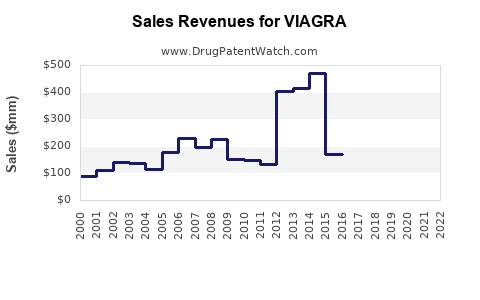
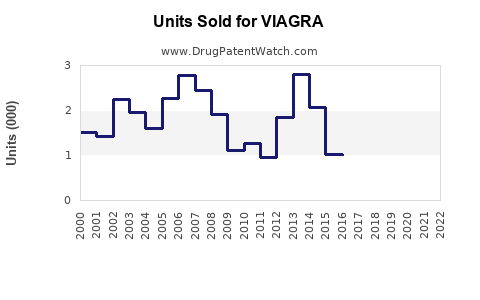
Annual Sales Revenues and Units Sold for VIAGRA
| Drug Name | Revenues (USD) | Units | Year |
|---|---|---|---|
| VIAGRA | ⤷ Start Trial | ⤷ Start Trial | 2022 |
| VIAGRA | ⤷ Start Trial | ⤷ Start Trial | 2021 |
| VIAGRA | ⤷ Start Trial | ⤷ Start Trial | 2020 |
| VIAGRA | ⤷ Start Trial | ⤷ Start Trial | 2019 |
| >Drug Name | >Revenues (USD) | >Units | >Year |
Viagra Market Analysis, Patent Status, Competitive Landscape and Sales Projections
Viagra, Pfizer’s branded sildenafil citrate product, is a mature erectile dysfunction therapy facing extensive generic competition. The commercial opportunity has shifted from branded Viagra to the broader sildenafil market, where lower-cost tablets, telehealth distribution, online pharmacies and alternative PDE5 inhibitors drive volume. Viagra brand sales are likely to continue declining through 2028, while total sildenafil sales should grow modestly with the erectile dysfunction drug market.
What is the current market position of Viagra?
Viagra is an oral phosphodiesterase type 5 inhibitor approved by the U.S. Food and Drug Administration in March 1998 for the treatment of erectile dysfunction in adult men. Its active ingredient is sildenafil citrate. The standard strengths are 25 mg, 50 mg and 100 mg tablets.[1]
The product remains clinically important but has limited pricing power. Generic sildenafil is widely available in the United States and other major markets. Patients, prescribers and digital-health platforms often select generic sildenafil because it has the same active ingredient as Viagra at a substantially lower acquisition cost.
Pfizer’s Viagra revenue declined sharply after generic entry. Historical revenue also reflects changes in Pfizer’s reporting structure and the separation of Upjohn, which transferred several established products and commercial rights to Viatris in 2020.[2][3]
Viagra compared with generic sildenafil
| Market factor | Branded Viagra | Generic sildenafil |
|---|---|---|
| Active ingredient | Sildenafil citrate | Sildenafil citrate |
| U.S. FDA approval | 1998 | First U.S. generic approvals in the 2010s |
| Prescription requirement | Yes | Yes |
| Typical retail price | High relative to generic | Low |
| Insurance positioning | Often limited or excluded | More favorable where covered |
| Main customers | Brand-loyal patients, cash-pay users | Price-sensitive patients, telehealth users |
| Competitive risk | Very high | Moderate from other PDE5 inhibitors |
| Patent barrier | No material historical barrier to generic tablets | Not applicable |
The commercially relevant market is therefore not only “Viagra.” It includes generic sildenafil, tadalafil, vardenafil, avanafil and compounded or telehealth-dispensed erectile dysfunction products.
How large is the erectile dysfunction drug market?
Global erectile dysfunction drug sales are generally estimated in the low-single-digit billions of dollars annually, depending on whether estimates include only prescription products or also online, compounded and nonprescription channels. Sildenafil remains one of the largest individual drug franchises in the category, but tadalafil has gained share because of its longer duration of action.
The market has four principal growth drivers:
- Increasing diagnosis and treatment of erectile dysfunction.
- Expansion of online prescribing and telehealth.
- Wider generic access and lower treatment cost.
- Aging male populations and higher prevalence of diabetes, cardiovascular disease and obesity.
The principal constraints are generic price erosion, limited insurance coverage, competition among PDE5 inhibitors and the availability of unregulated online products.
Major competitors to Viagra
| Product | Active ingredient | Key commercial advantage | Principal weakness |
|---|---|---|---|
| Viagra | Sildenafil | Highest brand recognition | Short duration and generic substitution |
| Cialis | Tadalafil | Long duration, daily-use option | Higher branded cost |
| Levitra/Staxyn | Vardenafil | Established PDE5 profile | Limited commercial momentum |
| Stendra | Avanafil | Faster onset claims and tolerability positioning | Smaller commercial scale |
| Generic sildenafil | Sildenafil | Lowest cost and broad availability | Limited brand differentiation |
| Generic tadalafil | Tadalafil | Longer duration at low cost | Increasing price competition |
Cialis and generic tadalafil are the strongest direct commercial alternatives. Tadalafil can remain effective for up to 36 hours, compared with the shorter effective window generally associated with sildenafil. That difference supports patient switching even when sildenafil is less expensive.[4]
What are Viagra sales projections through 2028?
The following projection separates Viagra brand revenue from the total sildenafil market. It is an analyst model based on generic substitution, continued category growth, brand price erosion and increased digital distribution. Figures are global, nominal, and stated in U.S. dollars.
| Year | Viagra brand sales | Total sildenafil market | Global erectile dysfunction drug market |
|---|---|---|---|
| 2023A | $0.45 billion | $1.30 billion | $3.40 billion |
| 2024E | $0.39 billion | $1.36 billion | $3.60 billion |
| 2025E | $0.34 billion | $1.43 billion | $3.82 billion |
| 2026E | $0.30 billion | $1.50 billion | $4.06 billion |
| 2027E | $0.27 billion | $1.57 billion | $4.30 billion |
| 2028E | $0.24 billion | $1.65 billion | $4.56 billion |
This model implies:
- Viagra brand revenue declines at approximately 11% annually from 2023 to 2028.
- Total sildenafil revenue grows at approximately 5% annually.
- The broader erectile dysfunction drug market grows at approximately 6% annually.
- Viagra’s share of the total sildenafil market falls as generic and private-label products expand.
The brand is unlikely to regain its pre-generic sales profile without a new formulation, a major distribution partnership or a materially differentiated indication.
Base, upside and downside cases
| Scenario | 2028 Viagra sales | Main assumptions |
|---|---|---|
| Downside | $0.15 billion | Faster generic substitution, weaker brand retention and continued channel discounting |
| Base case | $0.24 billion | Stable brand recognition with gradual price and volume erosion |
| Upside | $0.35 billion | Strong direct-to-consumer retention, improved telehealth distribution and slower brand substitution |
The upside case does not depend on patent protection. It depends on marketing, patient acquisition, adherence and distribution economics.
When did Viagra lose exclusivity?
Viagra’s core composition patent was U.S. Patent No. 5,250,534, assigned to Pfizer and covering sildenafil compounds and related pharmaceutical applications. The patent expired in the United States in 2012.[5]
A later patent, U.S. Patent No. 6,469,012, covered methods of treating erectile dysfunction using sildenafil and was listed in connection with Viagra. Its effective protection extended beyond the core composition patent but did not prevent eventual generic entry.[6]
Viagra received five-year new chemical entity exclusivity after its 1998 FDA approval. That regulatory exclusivity ended in 2003. The remaining commercial protection came from listed patents, litigation settlements, manufacturing know-how and brand recognition rather than active regulatory exclusivity.
U.S. patent and exclusivity timeline
| Event | Date |
|---|---|
| FDA approval of Viagra | March 27, 1998 |
| New chemical entity exclusivity | Expired in 2003 |
| Core sildenafil patent expiration | 2012 |
| U.S. generic approvals and settlement activity | 2016-2017 |
| Broad generic commercial availability | December 2017 onward |
| Current U.S. exclusivity position | No meaningful barrier to generic sildenafil tablets |
Patent status differs by country because filing dates, supplementary protection certificates, pediatric extensions and litigation settlements vary by jurisdiction. The U.S. market has the clearest generic precedent and the most advanced erosion.
What is the Orange Book status of Viagra?
The FDA Orange Book historically listed Viagra-related patents, including the composition and method-of-use patents associated with sildenafil. Those patents supported litigation and delayed unrestricted generic entry. Once the relevant patents expired or became commercially ineffective through settlement arrangements, FDA-approved generic sildenafil products entered the market.[6][7]
The Orange Book is commercially relevant for three reasons:
- It identifies patents that an abbreviated new drug application applicant must address.
- It supports Paragraph IV certification litigation.
- It indicates whether a listed patent may delay approval or commercial launch.
For present market analysis, the decisive fact is that multiple FDA-approved generic sildenafil products are available. The brand does not have a practical Orange Book barrier comparable to a newly launched protected medicine.
Which companies challenged Viagra patents?
Teva Pharmaceuticals was the most visible challenger associated with generic Viagra entry. Pfizer and Teva reached a settlement that permitted Teva to launch an authorized generic version of Viagra in the United States in December 2017, ahead of the expiration of certain remaining patent rights.[8]
The U.S. generic pathway involved the standard Hatch-Waxman framework. A Paragraph IV certification allows an applicant to assert that a listed patent is invalid, unenforceable or not infringed. The filing can trigger patent litigation and a potential 30-month stay of FDA approval, subject to statutory conditions.[9]
The commercial effect of the settlement was substantial. Pfizer retained some brand economics through an authorized generic structure while accepting broad erosion of Viagra’s exclusivity. Other generic manufacturers subsequently expanded competitive pressure.
What formulation patents protect Viagra?
The main Viagra product is an immediate-release oral tablet containing sildenafil citrate. Its protection historically centered on the active pharmaceutical ingredient and method of use rather than a highly differentiated delivery technology.
Formulation and manufacturing barriers
The remaining barriers are primarily operational:
- Pharmaceutical-grade sildenafil sourcing.
- Tablet compression and coating consistency.
- Stability and dissolution performance.
- Regulatory bioequivalence.
- Controlled manufacturing and quality systems.
- Global registration and pharmacovigilance.
These are meaningful compliance requirements but do not create a durable commercial moat. Generic manufacturers can reproduce the immediate-release tablet through standard pharmaceutical processes.
Pfizer has also marketed Viagra in different pack sizes and distribution channels, but packaging, tablet color and brand presentation generally do not create material patent protection. A new formulation, such as an orally dissolving, faster-onset or combination product, could support new intellectual property if it demonstrated technical and clinical differentiation.
What regulatory risks affect Viagra and sildenafil?
Viagra is an FDA-approved prescription product, but the category has elevated regulatory and public-health risks because erectile dysfunction drugs are heavily promoted through online channels.
Key risks include:
- Counterfeit products sold through unauthorized websites.
- Misbranded or adulterated sildenafil.
- Unapproved compounded formulations.
- Use with nitrates, which can cause dangerous hypotension.
- Use with alpha-blockers and certain cardiovascular medicines.
- Illegal or misleading digital-health advertising.
- Prescription issuance without adequate clinical evaluation.
The FDA has repeatedly warned consumers about counterfeit or illegally marketed sexual-enhancement products.[10] These enforcement actions can affect legitimate manufacturers by increasing scrutiny of online pharmacies and telehealth platforms.
How strong is the Viagra patent estate?
Viagra’s patent estate is commercially weak for new investment purposes.
| Patent-estate factor | Assessment |
|---|---|
| Core composition protection | Expired |
| U.S. method-of-use protection | Expired or commercially ineffective |
| Regulatory exclusivity | Expired |
| Immediate-release formulation protection | Limited practical value |
| Generic competition | Extensive |
| Manufacturing know-how | Moderate but reproducible |
| Brand recognition | Strong |
| Ability to support premium pricing | Weak |
| Litigation leverage | Low in the U.S. tablet market |
The brand’s strongest remaining assets are recognition, physician familiarity, global trademark value and patient trust. Those assets are commercial rather than patent-based.
What generic launch scenarios exist for Viagra?
The U.S. generic launch phase is complete. Future commercial scenarios concern market share and channel displacement rather than first entry.
Base scenario
Generic sildenafil continues to capture volume. Viagra retains a smaller cash-pay segment composed of patients who prefer the original brand or receive it through branded digital-health programs. Brand sales decline approximately 8% to 13% annually.
Downside scenario
Online pharmacies and telehealth providers shift patients almost entirely to generic sildenafil or generic tadalafil. Pharmacy benefit managers increase substitution. Viagra brand revenue falls below $200 million globally by 2028.
Upside scenario
Pfizer or a commercial partner improves direct-to-consumer access, bundles the product with telehealth services or introduces a differentiated dosage form. The brand stabilizes at approximately $300 million to $350 million in annual global sales, but it does not recover historical peak revenue.
What licensing deals and partnerships affect Viagra?
The most important strategic transaction was Pfizer’s 2020 separation of Upjohn and combination with Mylan to create Viatris. The transaction transferred a large portfolio of established medicines and related commercial operations, although product rights and regional responsibilities can vary by market.[3]
For Viagra, licensing value is more likely to arise from:
- Regional commercialization rights.
- Authorized generic arrangements.
- Telehealth distribution.
- Private-label pharmacy supply.
- New delivery technologies.
- Combination therapies.
A license for the existing immediate-release tablet has limited value because generic sildenafil is widely available. The stronger deal opportunity would involve a differentiated formulation or a proprietary patient-acquisition platform.
How does Viagra compare with Cialis?
| Metric | Viagra | Cialis |
|---|---|---|
| Active ingredient | Sildenafil | Tadalafil |
| Typical onset | About 30 to 60 minutes | About 30 minutes, depending on patient |
| Duration | Several hours | Up to 36 hours |
| Dosing pattern | Primarily on demand | On demand or once daily |
| Generic competition | Extensive | Extensive |
| Brand differentiation | High recognition | Longer-duration positioning |
| Main commercial threat | Generic sildenafil and tadalafil | Generic tadalafil and sildenafil |
Viagra remains attractive for episodic use and low-cost generic substitution. Cialis and generic tadalafil have stronger differentiation because of duration and daily dosing. In a mature category, tadalafil is better positioned for patients who value spontaneity, while sildenafil retains an advantage in familiarity and price.
What revenue exposure does Viagra create for Pfizer?
Viagra is no longer a major growth driver for Pfizer. Its revenue exposure is limited relative to Pfizer’s larger medicines and vaccines portfolio. The relevant financial issue is margin preservation rather than franchise expansion.
The principal value drivers are:
- Brand price realization.
- Direct-to-consumer acquisition cost.
- Retention among brand-preferring patients.
- Authorized generic economics.
- Regional rights and royalty flows.
- Marketing expenditure discipline.
Each additional percentage point of U.S. volume transferred from branded Viagra to generic sildenafil has a disproportionate effect on brand revenue because generic substitution reduces both price and brand share.
Key Takeaways
- Viagra is a mature branded sildenafil product with extensive generic competition.
- The core U.S. sildenafil patent expired in 2012, and broad generic commercial entry followed in 2017.
- Viagra’s regulatory exclusivity has expired, and no material U.S. patent barrier protects the standard tablet market.
- The broader sildenafil market should grow modestly, but branded Viagra sales should continue to decline.
- Base-case Viagra global sales fall from approximately $450 million in 2023 to $240 million in 2028.
- Generic sildenafil, generic tadalafil and telehealth distribution are the main competitive forces.
- The strongest future licensing opportunity is a differentiated formulation or distribution platform, not the existing immediate-release tablet.
- Viagra’s remaining commercial moat is brand recognition and patient familiarity rather than patent protection.
FAQs About Viagra Market Size and Exclusivity
Is Viagra still patent-protected in the United States?
The core U.S. sildenafil patent expired in 2012. FDA-approved generic sildenafil is widely available, so the standard Viagra tablet does not have a meaningful remaining U.S. patent barrier.
What is the difference between Viagra and generic sildenafil?
Both contain sildenafil citrate as the active ingredient. The principal differences are manufacturer, branding, price, packaging and commercial distribution.
Can generic Viagra be launched through a Paragraph IV filing today?
A new Paragraph IV filing would not recreate the original market-entry opportunity because the principal U.S. Viagra patents have expired or no longer create a practical barrier for standard sildenafil tablets.
Which drug is the biggest threat to Viagra?
Generic sildenafil is the largest direct threat because it has the same active ingredient and a lower price. Generic tadalafil is the strongest therapeutic competitor because it offers a substantially longer duration of action.
Could a new Viagra formulation regain exclusivity?
A new formulation could receive patent protection if it demonstrates a novel and non-obvious technical design. Any regulatory exclusivity would depend on the specific product, clinical data and FDA approval pathway.
References
- U.S. Food and Drug Administration. (1998). Viagra prescribing information.
- Pfizer Inc. (2019). 2018 annual report.
- Viatris Inc. (2021). 2020 annual report.
- U.S. Food and Drug Administration. (2011). Cialis prescribing information.
- U.S. Patent No. 5,250,534. (1993). Pyrazolopyrimidinone antianginal agents. United States Patent and Trademark Office.
- U.S. Patent No. 6,469,012. (2002). Treatment of erectile dysfunction. United States Patent and Trademark Office.
- U.S. Food and Drug Administration. (n.d.). Approved drug products with therapeutic equivalence evaluations, Orange Book.
- Teva Pharmaceutical Industries Ltd. (2017, December 11). Teva launches generic Viagra in the United States.
- U.S. Food and Drug Administration. (n.d.). Hatch-Waxman Amendments and abbreviated new drug applications.
- U.S. Food and Drug Administration. (n.d.). Tainted sexual enhancement and energy products.
More… ↓
