Share This Page
Drug Sales Trends for SYMBICORT
✉ Email this page to a colleague
Payment Methods and Pharmacy Types for SYMBICORT (2019)
Revenues by Pharmacy Type
Units Sold by Pharmacy Type
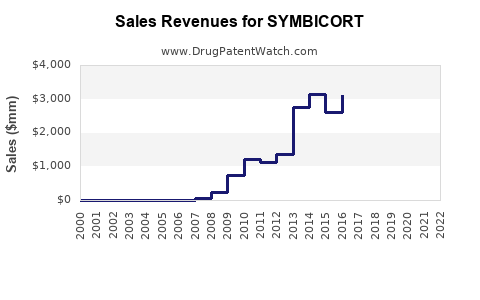
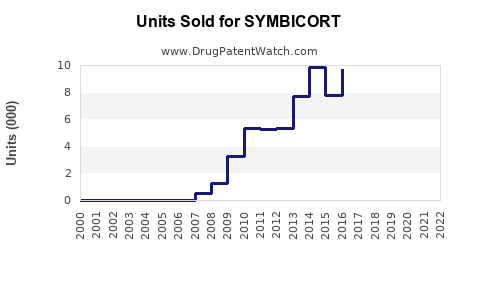
Annual Sales Revenues and Units Sold for SYMBICORT
| Drug Name | Revenues (USD) | Units | Year |
|---|---|---|---|
| SYMBICORT | ⤷ Start Trial | ⤷ Start Trial | 2022 |
| SYMBICORT | ⤷ Start Trial | ⤷ Start Trial | 2021 |
| SYMBICORT | ⤷ Start Trial | ⤷ Start Trial | 2020 |
| >Drug Name | >Revenues (USD) | >Units | >Year |
Symbicort Market Analysis, Sales Projections, Patent Exclusivity, and Generic Competition
Symbicort, AstraZeneca’s budesonide/formoterol inhaler, remains one of the largest inhaled respiratory products globally. Its commercial base is supported by asthma and chronic obstructive pulmonary disease, but U.S. sales face sustained generic erosion following the launch of authorized and abbreviated new drug application products. Global revenue is likely to remain resilient through 2026 because of international sales, branded prescribing, and growing use of inhaled corticosteroid/long-acting beta agonist combinations. A reasonable base-case forecast places the total Symbicort-related market at approximately $4.0 billion to $5.0 billion in 2029, compared with an estimated $5.0 billion to $6.0 billion in 2024, with AstraZeneca retaining a declining but material share.
What is Symbicort and which markets does it serve?
Symbicort combines budesonide, an inhaled corticosteroid, with formoterol fumarate, a long-acting beta-2 agonist. The product is delivered through a metered-dose inhaler and is marketed principally for:
- Maintenance treatment of asthma
- Maintenance treatment of COPD
- In some markets, maintenance-and-reliever therapy under the SMART or MART treatment approach
The principal strengths are 80/4.5 mcg and 160/4.5 mcg per actuation in the United States. AstraZeneca markets Symbicort globally, while authorized generics and independent generic products have entered selected markets.
The product competes with Advair and its generic equivalents, Breo Ellipta, Dulera, Trelegy Ellipta, AirDuo, Wixela Inhub, and other inhaled corticosteroid/long-acting bronchodilator products. Trelegy has increased competitive pressure in COPD because it adds a long-acting muscarinic antagonist to the inhaled corticosteroid/long-acting beta agonist combination.
How large is the Symbicort market?
Public company revenue is the most reliable measure for the branded product, but it does not capture generic manufacturer sales. AstraZeneca reported Symbicort revenue of approximately $3.0 billion in 2023, according to its annual reporting. The figure includes sales across multiple geographies and reflects both continuing demand and U.S. generic pressure (AstraZeneca, 2024).
| Metric | Estimated or reported level |
|---|---|
| AstraZeneca Symbicort revenue, 2023 | Approximately $3.0 billion |
| Estimated global Symbicort-related market, 2024 | $5.0 billion-$6.0 billion |
| Estimated generic share of U.S. volume, 2024 | Approximately 25%-40% |
| Expected global market, 2029 base case | $4.0 billion-$5.0 billion |
| Expected annual market decline, 2025-2029 | Approximately 3%-7% |
The gap between AstraZeneca’s reported sales and the estimated total market reflects generic sales, licensing arrangements, distributor revenue, and differences in reporting scope.
Which regions generate the most value?
The United States remains the highest-value market because of higher net pricing and large commercial insurance coverage. Europe has lower prices but broad use of budesonide/formoterol and strong guideline support. Emerging markets contribute substantial volume, particularly where combination inhalers are prescribed widely and local manufacturing lowers the price.
AstraZeneca’s revenue mix is shifting toward markets with later generic penetration and less aggressive price substitution. That shift can slow revenue decline but cannot fully offset U.S. and European price erosion.
What are the Symbicort sales projections through 2029?
The following forecast estimates the total commercial market associated with Symbicort, including branded and generic products. It is a scenario model rather than AstraZeneca guidance.
| Year | Bear case | Base case | Bull case |
|---|---|---|---|
| 2024 | $5.0B | $5.5B | $6.0B |
| 2025 | $4.6B | $5.2B | $5.8B |
| 2026 | $4.3B | $5.0B | $5.7B |
| 2027 | $4.0B | $4.7B | $5.5B |
| 2028 | $3.7B | $4.5B | $5.3B |
| 2029 | $3.4B | $4.3B | $5.1B |
The base case assumes:
- U.S. generic substitution continues to increase.
- International markets experience slower erosion.
- The asthma and COPD inhaled combination segment grows at low single-digit rates by volume.
- Trelegy and other triple therapies capture a larger share of COPD maintenance treatment.
- AstraZeneca preserves meaningful branded demand through device familiarity, physician preference, and payer contracting.
AstraZeneca’s own Symbicort revenue is expected to decline faster than the total market. Under the base case, branded AstraZeneca sales could fall from approximately $3.0 billion in 2023 to $1.8 billion-$2.3 billion by 2029. The result depends on U.S. net pricing, generic contracting, and the timing of further international substitution.
When did Symbicort lose U.S. exclusivity?
Symbicort’s U.S. exclusivity began to weaken before complete commercial generic penetration because AstraZeneca reached agreements with generic manufacturers and authorized generic partners. The FDA approved Breyna, a budesonide/formoterol fumarate inhalation aerosol developed by Viatris and Kindeva Drug Delivery, in 2022 (U.S. Food and Drug Administration, 2022).
The commercial exclusivity timeline is therefore different from a single patent-expiration date:
| Event | Timing |
|---|---|
| FDA approval of Symbicort | 2006 |
| U.S. pediatric exclusivity period | Expired in the early 2020s |
| First U.S. generic approval, Breyna | 2022 |
| Broad generic substitution pressure | 2022 onward |
| Expected U.S. price erosion | Accelerating through 2025-2027 |
An authorized generic can reduce the economic impact of third-party entry because the branded company or its commercial partner retains part of the generic value chain. This arrangement also can moderate the speed of price collapse compared with an uncontrolled multi-player launch.
What patents protect Symbicort?
Symbicort protection has historically included patents covering the drug combination, aerosol formulation, particle characteristics, device operation, and methods of treating asthma or COPD. The relevant rights differ by strength, dosage form, jurisdiction, and product presentation.
The FDA Orange Book identifies listed patents for approved Symbicort strengths and related products. Some core patents expired before generic launch, while later formulation and device patents extended the practical enforcement period into the 2020s. Patent listings should be evaluated separately from FDA exclusivity because Orange Book patents do not guarantee uninterrupted market exclusivity (FDA, 2024a).
What formulation patents are important?
The commercially important formulation claims generally address:
- Budesonide and formoterol in a single inhalation aerosol
- Propellant systems
- Particle-size distribution
- Suspension stability
- Uniform dose delivery
- Device and canister interaction
Inhaler patents can have greater practical value than an active-ingredient patent after the underlying chemical claims expire. Generic applicants must show pharmaceutical equivalence and comparable delivery performance, while a branded patent owner can challenge formulation, device, or manufacturing claims.
What method-of-use patents apply?
Method-of-use claims cover treatment of asthma, COPD, airway obstruction, and dosing regimens involving maintenance treatment or maintenance-and-reliever use. These patents can create litigation exposure, but their commercial effect is usually narrower than composition or device claims because generic companies may use labeling strategies that omit protected indications or dosing instructions.
Which companies are challenging Symbicort?
The U.S. competitive field includes Viatris, Kindeva Drug Delivery, Teva Pharmaceutical Industries, and other inhaler manufacturers pursuing abbreviated new drug application or equivalent regulatory pathways. Competition is complicated by device manufacturing requirements, production capacity, and the need to demonstrate equivalent emitted dose and particle performance.
The most important competitive products include:
| Product | Company or companies | Competitive position |
|---|---|---|
| Symbicort | AstraZeneca | Originator product |
| Breyna | Viatris and Kindeva | U.S. generic or authorized-generic competitor |
| Advair and Wixela Inhub | GSK, Viatris | Major alternative ICS/LABA franchise |
| Dulera | Organon and AstraZeneca legacy rights | Alternative ICS/LABA |
| Breo Ellipta | GSK | Once-daily ICS/LABA |
| Trelegy Ellipta | GSK | Triple therapy, primarily COPD |
| AirDuo Digihaler | Teva | Digital and inhaler-based alternative |
Paragraph IV litigation and settlement terms have played an important role in determining generic entry timing. Publicly available litigation records show that Symbicort competition has involved patent challenges and settlement-based launches rather than a simple end-of-term patent cliff. The economic result is staged entry, with one or several early generic entrants followed by additional price competition.
What is the FDA regulatory status of Symbicort?
Symbicort is an FDA-approved prescription inhalation aerosol for asthma and COPD indications. Breyna received FDA approval through the abbreviated new drug application pathway in 2022. The product is not a biologic, so biosimilar regulation does not apply. The relevant pathway is generic drug approval, combined with complex inhalation-product equivalence requirements.
FDA review focuses on delivered dose, aerodynamic particle-size distribution, device performance, formulation, and manufacturing controls. These requirements create higher barriers than those associated with conventional oral solid generics.
How strong is the Symbicort patent estate?
Symbicort has a medium-strength residual patent estate rather than a fully protected one.
| Patent factor | Assessment |
|---|---|
| Active ingredient protection | Largely exhausted |
| Combination-product protection | Partly expired or challenged |
| Formulation protection | Still commercially relevant in some jurisdictions |
| Device protection | Important for product-specific entry |
| Method-of-use protection | Relevant but easier to design around |
| Manufacturing barriers | Meaningful |
| Generic entry risk | High in the United States |
| International protection | Highly variable by country |
The estate is strongest where patents cover specific inhaler architecture, suspension formulation, or manufacturing parameters that are difficult to design around. It is weaker where claims are broad, expired, or vulnerable to invalidity challenges.
What generic launch risks exist for Symbicort?
The main risk to AstraZeneca is not a single generic launch. It is cumulative substitution across pharmacy benefit managers, Medicaid programs, hospital systems, and government tenders.
Key risks include:
- Lower net price from payer-preferred generic contracts
- Formulary exclusion of branded Symbicort
- Multiple generic suppliers entering the same market
- Reduced physician control over product selection
- International tender-driven price compression
- Switching to once-daily products or triple therapy
- Lower refill persistence after formulary changes
U.S. generic penetration could exceed 50% of total volume in a high-competition scenario by 2026 or 2027. AstraZeneca may preserve a higher revenue share than its unit share through authorized-generic economics, but branded net sales would still decline.
How does Symbicort compare with Trelegy and Advair?
Symbicort has a strong position in asthma and a durable COPD franchise, but Trelegy has a structural advantage in patients requiring triple therapy. Advair remains a major competitor because of its long-established prescriber base and generic alternatives.
| Product | Main advantage | Main risk |
|---|---|---|
| Symbicort | Established twice-daily combination; broad asthma and COPD use | Generic entry and Trelegy substitution |
| Trelegy | Triple therapy and once-daily dosing | Higher cost and narrower suitability |
| Advair/Wixela | Large historical installed base | Mature franchise and generic erosion |
| Breo Ellipta | Once-daily dosing | Less flexibility for some patients |
| Dulera | Established ICS/LABA alternative | Smaller commercial scale |
Symbicort is most defensible in patients who respond well to budesonide/formoterol and in treatment systems that use formoterol-based maintenance-and-reliever therapy.
What licensing and settlement arrangements affect Symbicort?
The U.S. market has been shaped by commercial agreements involving AstraZeneca, generic applicants, and inhaler manufacturing partners. These arrangements can authorize entry before the latest asserted patent expiration, distribute generic economics, and control the number of early suppliers.
The most consequential commercial structure is the authorized-generic model. It lets the originator participate in lower-priced demand while limiting the loss of all revenue to independent competitors. Settlement agreements can also create staggered entry dates, geographic restrictions, or supply obligations, although the exact terms are often confidential.
What is the revenue exposure for AstraZeneca?
Symbicort is strategically important but no longer one of AstraZeneca’s fastest-growing assets. The key exposure is the gap between current branded sales and post-generic steady-state revenue.
Under three scenarios:
| Scenario | AstraZeneca Symbicort revenue in 2029 |
|---|---|
| Bear | $1.2B-$1.6B |
| Base | $1.8B-$2.3B |
| Bull | $2.4B-$2.8B |
The base case assumes continued international demand and partial retention through authorized-generic economics. The bear case assumes faster U.S. switching, additional generic approvals, and greater migration to triple therapy. The bull case requires slower international substitution, limited generic capacity, and durable physician preference for the branded product.
Key Takeaways
- Symbicort generated approximately $3.0 billion in AstraZeneca revenue in 2023.
- The total global Symbicort-related market is estimated at $5.0 billion-$6.0 billion in 2024.
- U.S. generic competition began with Breyna approval in 2022.
- The product has lost effective U.S. exclusivity even though formulation, device, and method-of-use patents remain relevant.
- Total market revenue is likely to decline gradually, while AstraZeneca’s branded revenue should decline faster.
- The base-case 2029 total market is approximately $4.3 billion, with AstraZeneca revenue of $1.8 billion-$2.3 billion.
- Manufacturing complexity and device equivalence remain the main barriers to additional generic entry.
- Trelegy is the most important branded threat in COPD, while generic budesonide/formoterol is the most important pricing threat.
FAQs
Is Symbicort still a blockbuster drug?
Yes. Symbicort remains a multibillion-dollar global product, although its branded revenue is declining because of U.S. generic competition and broader inhaler substitution.
Is Breyna the same as Symbicort?
Breyna is an FDA-approved generic version of budesonide/formoterol inhalation aerosol. It is designed to be therapeutically equivalent to the corresponding Symbicort product, subject to FDA labeling and product requirements.
Does Symbicort have biosimilar competition?
No. Symbicort is a small-molecule inhaled drug, not a biologic. Competition proceeds through generic drug pathways rather than biosimilar applications.
Will Symbicort sales decline after 2025?
Branded sales are likely to decline, but total market demand should remain substantial because asthma and COPD prevalence, guideline use, and inhaler treatment volume continue to support the category.
What is the largest threat to Symbicort revenue?
The largest threat is cumulative generic substitution in the United States, followed by migration of COPD patients to once-daily triple therapy such as Trelegy.
References
-
AstraZeneca. (2024). Annual report and form 20-F 2023. AstraZeneca PLC.
-
U.S. Food and Drug Administration. (2022). FDA approves first generic of Symbicort to treat asthma and COPD. U.S. Department of Health and Human Services.
-
U.S. Food and Drug Administration. (2024a). Approved drug products with therapeutic equivalence evaluations: Orange Book. U.S. Department of Health and Human Services.
-
U.S. Food and Drug Administration. (2024b). Product-specific guidances for generic drug development. U.S. Department of Health and Human Services.
-
Global Initiative for Asthma. (2024). Global strategy for asthma management and prevention. GINA.
-
Global Initiative for Chronic Obstructive Lung Disease. (2024). Global strategy for the prevention, diagnosis and management of COPD. GOLD.
More… ↓
