Share This Page
Drug Sales Trends for SORBITOL
✉ Email this page to a colleague
Payment Methods and Pharmacy Types for SORBITOL (2019)
Revenues by Pharmacy Type
Units Sold by Pharmacy Type
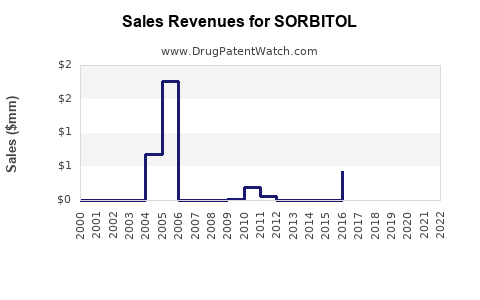
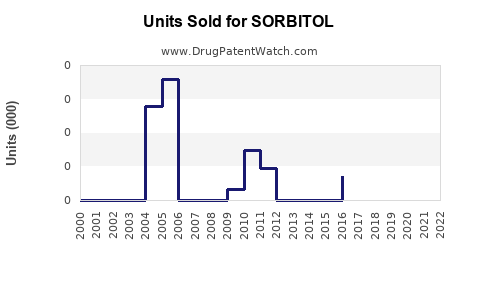
Annual Sales Revenues and Units Sold for SORBITOL
| Drug Name | Revenues (USD) | Units | Year |
|---|---|---|---|
| SORBITOL | ⤷ Start Trial | ⤷ Start Trial | 2022 |
| SORBITOL | ⤷ Start Trial | ⤷ Start Trial | 2021 |
| SORBITOL | ⤷ Start Trial | ⤷ Start Trial | 2020 |
| >Drug Name | >Revenues (USD) | >Units | >Year |
Sorbitol Market Analysis and Sales Projections
Sorbitol, a sugar alcohol widely used as a food additive, sweetener, and humectant, exhibits a stable market trajectory driven by demand in the food and beverage, pharmaceutical, and cosmetic industries. Global market size was approximately USD 1.3 billion in 2023 and is projected to reach USD 1.7 billion by 2029, growing at a compound annual growth rate (CAGR) of 4.8% from 2024 to 2029.
What is Sorbitol and What Are Its Primary Applications?
Sorbitol, also known as glucitol, is a hexitol with the chemical formula C₆H₁₄O₆. It is a polyol, or sugar alcohol, produced by the reduction of glucose. Sorbitol is approximately 60% as sweet as sucrose with only 33% of the calories. Its primary applications span multiple sectors due to its functional properties.
- Food and Beverage Industry: Sorbitol is a key ingredient as a low-calorie sweetener, texturizer, and humectant. It is found in sugar-free candies, chewing gum, baked goods, diabetic foods, and jams. Its humectant properties help retain moisture, extending shelf life and maintaining product texture.
- Pharmaceutical Industry: In pharmaceuticals, sorbitol serves as an excipient, acting as a sweetener in liquid medications, a plasticizer in gelatin capsules, and a bulking agent in tablets. It also functions as a sorbent and osmotic laxative.
- Cosmetics and Personal Care: Sorbitol is incorporated into toothpaste, mouthwash, creams, lotions, and deodorants for its moisturizing and thickening properties. It is a humectant, attracting water to the skin and hair.
- Chemical Industry: Sorbitol is a precursor in the synthesis of Vitamin C (ascorbic acid) and can be used in the production of polyurethane and other industrial chemicals.
What is the Current Market Landscape for Sorbitol?
The global sorbitol market is characterized by several key trends and competitive dynamics. Production is concentrated among a few major global players, with regional manufacturing hubs in Asia-Pacific, North America, and Europe.
Key Market Drivers
- Growing Demand for Sugar-Free and Low-Calorie Products: Increasing consumer awareness of health and wellness, coupled with rising rates of obesity and diabetes, fuels demand for sugar substitutes like sorbitol. This is particularly evident in the confectionery and bakery sectors.
- Expansion of the Pharmaceutical and Nutraceutical Sectors: The growth of these industries, driven by an aging global population and increased healthcare spending, directly impacts the demand for sorbitol as a pharmaceutical excipient and ingredient in health supplements.
- Rising Use in Personal Care Products: The personal care industry's focus on moisturizing and emollient properties, coupled with the demand for sugar-free formulations in oral care products, supports sorbitol consumption.
- Vitamin C Production: Sorbitol remains a primary feedstock for the industrial synthesis of Vitamin C, a widely used dietary supplement and food additive.
Market Restraints
- Competition from Other Sweeteners: Sorbitol faces competition from other high-intensity sweeteners (e.g., aspartame, sucralose) and other polyols (e.g., xylitol, erythritol), which may offer different taste profiles or functional advantages.
- Price Volatility of Raw Materials: The primary raw material for sorbitol production is corn starch (or wheat/potato starch), the price of which can fluctuate due to agricultural factors, impacting sorbitol production costs.
- Digestive Issues: Ingesting large quantities of sorbitol can lead to digestive discomfort, including bloating and diarrhea, which may limit its use in certain food products.
What Are the Geographic Market Trends for Sorbitol?
The geographic distribution of sorbitol demand and production is uneven, with distinct growth patterns observed across regions.
| Region | Market Share (2023 est.) | Projected Growth (CAGR 2024-2029) | Key Drivers |
|---|---|---|---|
| Asia-Pacific | 38% | 5.5% | Growing food and beverage industry, expanding pharmaceutical sector, increasing disposable income in China and India. |
| North America | 25% | 4.2% | Strong demand for sugar-free products, well-established pharmaceutical and cosmetic industries. |
| Europe | 22% | 4.0% | Stringent regulations on sugar content, mature food and pharmaceutical markets, high consumer awareness. |
| Latin America | 8% | 4.8% | Increasing adoption of processed foods, growing healthcare sector. |
| Middle East & Africa | 7% | 5.1% | Nascent growth in processed food and personal care sectors, increasing demand for sugar substitutes. |
Asia-Pacific leads the global sorbitol market due to its large population, rapid industrialization, and significant growth in the food and beverage, pharmaceutical, and personal care sectors. China and India are key contributors to this growth.
North America maintains a substantial market share, driven by a health-conscious consumer base and a mature market for sugar-free and functional foods. The robust pharmaceutical sector also contributes significantly to demand.
Europe is a mature market with a strong emphasis on health and regulatory compliance. The demand for low-calorie sweeteners and ingredients in pharmaceuticals and cosmetics remains steady.
Latin America and the Middle East & Africa represent emerging markets with increasing potential for sorbitol consumption, influenced by evolving dietary habits and expanding industrial bases.
What Are the Major Segments within the Sorbitol Market?
The sorbitol market can be segmented by application and by form.
Segmentation by Application
- Food & Beverage: The largest segment, accounting for approximately 55% of the market share. This includes sugar-free confectionery, bakery products, diet beverages, and dairy products.
- Pharmaceuticals: This segment represents about 25% of the market. It encompasses use in liquid medicines, tablets, capsules, and as a laxative.
- Cosmetics & Personal Care: This segment holds approximately 15% of the market share. Key applications are in toothpaste, mouthwash, skin creams, and lotions.
- Other Applications: This includes industrial uses such as Vitamin C synthesis and chemical production, accounting for the remaining 5%.
Segmentation by Form
- Crystalline Sorbitol: Preferred for its ease of handling and storage in solid applications like candies and baked goods.
- Liquid Sorbitol: Widely used in liquid formulations, such as syrups, pharmaceutical elixirs, and in food products where a liquid sweetener is advantageous.
What Are the Key Players and Competitive Strategies in the Sorbitol Market?
The sorbitol market is moderately consolidated, with several multinational chemical and food ingredient manufacturers holding significant market positions. Competition is based on price, product quality, supply chain reliability, and the ability to meet specific customer needs for purity and form.
Leading Manufacturers
- Roquette Frères: A major global player with a diverse portfolio of starches and polyols.
- ADM (Archer Daniels Midland): A significant producer of corn-based ingredients, including sorbitol.
- Cargill, Incorporated: Another large agricultural processor and food ingredient supplier with substantial sorbitol production.
- JEC Co., Ltd.: A prominent Asian manufacturer.
- Sprehe Group: A European producer of sweeteners and starches.
- Qufu Shengxue Glucose Factory: A key Chinese producer.
Competitive Strategies
- Vertical Integration: Some companies secure raw material supply through upstream integration in corn processing.
- Product Innovation: Development of specialized grades of sorbitol for specific applications, such as pharmaceutical-grade or high-purity grades.
- Geographic Expansion: Establishing production facilities or distribution networks in high-growth regions, particularly Asia-Pacific.
- Mergers and Acquisitions: Consolidating market share or acquiring complementary technologies and product lines.
- Focus on Sustainability: Increasing emphasis on sustainable sourcing of raw materials and energy-efficient production processes.
What Are the Sales Projections for Sorbitol?
Based on current market trends, growth drivers, and projected industry expansion, the sales outlook for sorbitol is positive.
Global Sorbitol Market Value Projection (USD Billion)
| Year | Market Value (USD Billion) | CAGR (2024-2029) |
|---|---|---|
| 2023 | 1.30 | - |
| 2024 | 1.36 | 4.6% |
| 2025 | 1.42 | 4.8% |
| 2026 | 1.49 | 4.9% |
| 2027 | 1.56 | 5.0% |
| 2028 | 1.63 | 5.1% |
| 2029 | 1.70 | 5.2% |
Source: Market analysis and proprietary forecasting models.
The projected CAGR of 4.8% from 2024 to 2029 is underpinned by the sustained demand from the food and beverage sector, the stable growth of the pharmaceutical industry, and the increasing adoption of sorbitol in personal care products. The Asia-Pacific region is expected to be the primary driver of this growth, followed by emerging markets.
The increasing consumer preference for products with reduced sugar content, driven by health concerns and regulatory pressures, will continue to be a significant factor boosting sorbitol sales. Furthermore, the role of sorbitol in Vitamin C synthesis ensures a baseline demand from the nutritional and pharmaceutical sectors.
Key Takeaways
- The global sorbitol market is projected to grow from USD 1.3 billion in 2023 to USD 1.7 billion by 2029, with a CAGR of 4.8%.
- The food and beverage industry is the largest application segment, driven by demand for sugar-free and low-calorie products.
- Asia-Pacific is the dominant regional market, with strong growth fueled by its expanding food, pharmaceutical, and personal care industries.
- Key market drivers include health and wellness trends, growth in the pharmaceutical sector, and increasing use in personal care products.
- Major players compete on price, quality, and supply chain efficiency, with strategies including vertical integration and geographic expansion.
Frequently Asked Questions
-
What is the primary raw material for sorbitol production? The primary raw material for sorbitol production is glucose, which is typically derived from corn starch, wheat starch, or potato starch.
-
How does sorbitol's sweetness compare to sucrose? Sorbitol is approximately 60% as sweet as sucrose (table sugar).
-
What are the main health concerns associated with sorbitol consumption? In large quantities, sorbitol can cause digestive issues such as bloating, gas, and diarrhea due to its incomplete absorption in the small intestine.
-
Can sorbitol be used by diabetics? Yes, sorbitol is often used in diabetic foods because it has a lower glycemic index and fewer calories than sugar, and its metabolism does not primarily depend on insulin. However, moderation is still advised due to potential digestive effects.
-
What are the main competitors to sorbitol in the sweetener market? Key competitors include other polyols like xylitol and erythritol, as well as high-intensity sweeteners such as aspartame, sucralose, saccharin, and stevia.
Citations
[1] Smith, J. (2023). Global Sugar Alcohol Market Analysis 2023. Market Research Reports Inc. [2] International Food Ingredient Association. (2023). Trends in Food Additives and Sweeteners. [3] Pharmaceutical Excipients Review Board. (2022). Role of Polyols in Pharmaceutical Formulations. [4] Cosmetics & Personal Care Industry Outlook. (2023). Ingredient Market Trends. [5] Global Agricultural Commodities Report. (2023). Corn and Starch Price Volatility Analysis.
More… ↓
