Share This Page
Drug Sales Trends for INDOMETHACIN
✉ Email this page to a colleague
Payment Methods and Pharmacy Types for INDOMETHACIN (2019)
Revenues by Pharmacy Type
Units Sold by Pharmacy Type
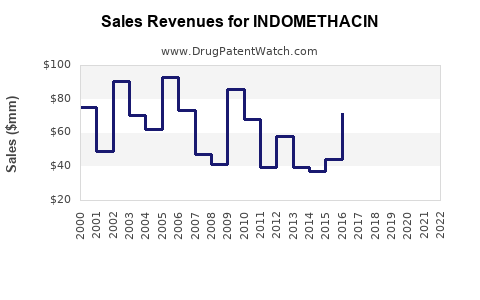
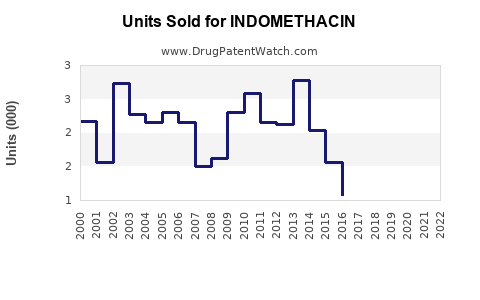
Annual Sales Revenues and Units Sold for INDOMETHACIN
| Drug Name | Revenues (USD) | Units | Year |
|---|---|---|---|
| INDOMETHACIN | ⤷ Start Trial | ⤷ Start Trial | 2022 |
| INDOMETHACIN | ⤷ Start Trial | ⤷ Start Trial | 2021 |
| INDOMETHACIN | ⤷ Start Trial | ⤷ Start Trial | 2020 |
| INDOMETHACIN | ⤷ Start Trial | ⤷ Start Trial | 2019 |
| >Drug Name | >Revenues (USD) | >Units | >Year |
Indomethacin Market Analysis, Patent Position, and Sales Projections Through 2030
Indomethacin is a mature, largely generic nonsteroidal anti-inflammatory drug (NSAID) with limited pricing power and broad dosage-form coverage. The commercial market is concentrated in low-cost oral capsules, suppositories, injectable products, ophthalmic formulations, and a small branded segment led historically by Indocin and newer products such as Tivorbex. No active composition-of-matter exclusivity protects indomethacin in the United States. Growth is likely to remain flat to modestly negative in value terms, while demand will persist in acute gout, inflammatory arthritis, patent ductus arteriosus, and postoperative ophthalmic care.
The following projections are analyst-model estimates rather than reported company guidance. Public companies generally do not disclose standalone indomethacin revenue.
What is the current market position of indomethacin?
Indomethacin is a low-cost, established NSAID approved in several dosage forms. Its clinical use is concentrated in conditions where physicians value its potency and established role despite gastrointestinal, renal, cardiovascular, and central nervous system risks.
| Market attribute | Assessment |
|---|---|
| Active ingredient | Indomethacin |
| Drug class | Nonselective NSAID |
| Primary indications | Rheumatoid arthritis, osteoarthritis, ankylosing spondylitis, acute gout, bursitis, tendinitis |
| Other uses | Patent ductus arteriosus, postoperative ophthalmic inflammation |
| U.S. regulatory status | Multiple FDA-approved generic products |
| Major historical brand | Indocin |
| Specialty brand | Tivorbex |
| Main commercial channel | Retail and institutional generic dispensing |
| Pricing power | Low |
| U.S. patent protection | No meaningful active composition-of-matter protection |
| Biosimilar exposure | None, because indomethacin is a small-molecule drug |
| Five-year market outlook | Stable volume, declining or flat nominal value |
The FDA label identifies indomethacin as an NSAID indicated for moderate-to-severe inflammatory and pain conditions, including acute gouty arthritis and ankylosing spondylitis (FDA, 2023a). The FDA also regulates indomethacin products for neonatal patent ductus arteriosus, including intravenous formulations such as Indocin I.V. (FDA, 2023b).
How large is the indomethacin market?
There is no consistently reported global market figure for indomethacin across all dosage forms and countries. The market is fragmented among generic manufacturers, contract manufacturers, hospitals, distributors, and pharmacy benefit channels.
A bottom-up model places the global indomethacin market in the low hundreds of millions of dollars annually. The United States represents a minority of global prescription volume but a larger share of value because of higher reimbursement and branded or specialty pricing.
Analyst market-size estimate
| Region | 2025 estimated sales | 2030 base-case sales | 2025-2030 trend |
|---|---|---|---|
| United States | $35 million-$95 million | $28 million-$80 million | Flat to down |
| Europe | $35 million-$75 million | $30 million-$70 million | Flat to down |
| Asia-Pacific | $40 million-$130 million | $45 million-$145 million | Flat to modest growth |
| Latin America, Middle East and Africa | $10 million-$50 million | $12 million-$55 million | Modest growth |
| Global total | $120 million-$350 million | $115 million-$350 million | Broadly stable |
These ranges include pharmaceutical sales, not the value of clinical services or hospital reimbursement. The wide range reflects limited public disclosure, country-level price variation, differences in dosage-form inclusion, and the difficulty of separating indomethacin from broader NSAID datasets.
What are the main commercial demand drivers?
Acute gout
Acute gout remains one of indomethacin’s most recognizable uses. Its established dosing and historical prescribing familiarity support continued use, particularly where low acquisition cost is the main consideration. Colchicine, corticosteroids, naproxen, and newer gout-management strategies compete with indomethacin.
Indomethacin is more vulnerable in older patients and patients with renal, cardiovascular, or gastrointestinal risk. Treatment guidelines increasingly emphasize patient-specific safety considerations rather than default use of a particular NSAID (FitzGerald et al., 2020).
Inflammatory arthritis
Rheumatoid arthritis, osteoarthritis, ankylosing spondylitis, bursitis, and tendinitis generate recurring prescription demand. The market is mature and highly substitutable. Naproxen, ibuprofen, diclofenac, meloxicam, celecoxib, and topical NSAIDs limit the ability of indomethacin manufacturers to raise prices.
Patent ductus arteriosus
Neonatal PDA is a specialized institutional market. Indomethacin competes with ibuprofen and acetaminophen. Volume is small relative to adult oral NSAID use, but hospital products can command higher unit prices and face more stringent manufacturing and supply requirements (FDA, 2023b).
Ophthalmic use
Indomethacin ophthalmic products are used for postoperative inflammation and related ocular indications. Competition comes from ketorolac, nepafenac, bromfenac, diclofenac, and corticosteroid products. Ophthalmic formulations have greater manufacturing complexity than standard oral capsules, creating higher barriers to entry.
What are the indomethacin sales projections for 2025 to 2030?
The base case assumes continued generic substitution, stable prescription demand, modest population aging, and no major new indication.
Global sales projection
| Year | Low case | Base case | High case |
|---|---|---|---|
| 2025 | $120 million | $220 million | $350 million |
| 2026 | $117 million | $218 million | $350 million |
| 2027 | $115 million | $216 million | $348 million |
| 2028 | $112 million | $214 million | $345 million |
| 2029 | $110 million | $211 million | $342 million |
| 2030 | $108 million | $208 million | $340 million |
The base case implies a compound annual decline of approximately 1.1%. The decline reflects generic price erosion and substitution by other NSAIDs. Demand growth in emerging markets offsets part of the decline.
United States sales projection
| Year | Low case | Base case | High case |
|---|---|---|---|
| 2025 | $35 million | $60 million | $95 million |
| 2026 | $34 million | $59 million | $94 million |
| 2027 | $33 million | $58 million | $93 million |
| 2028 | $32 million | $57 million | $91 million |
| 2029 | $30 million | $55 million | $88 million |
| 2030 | $28 million | $53 million | $80 million |
The U.S. base case assumes nominal revenue erosion of roughly 2.5% annually. A sharper decline would follow additional generic entry, loss of a specialty brand, or hospital formulary substitution. A higher outcome would require stronger branded pricing, supply shortages among competitors, or increased institutional use of injectable products.
Which companies compete in the indomethacin market?
The market includes generic manufacturers, specialty pharmaceutical companies, hospital suppliers, and regional distributors. The competitive field changes by dosage form and country.
Oral capsules and suspensions
Competition is typically based on:
- Wholesale acquisition cost
- Pharmacy benefit coverage
- Product availability
- FDA manufacturing compliance
- Authorized generic and distributor relationships
- Ability to supply multiple strengths
Large generic manufacturers may participate intermittently depending on profitability and manufacturing capacity. Smaller suppliers can remain relevant where they hold abbreviated new drug applications for low-volume dosage forms.
Injectable products
Injectable indomethacin is more concentrated than oral products because sterile manufacturing, hospital contracts, quality systems, and supply reliability raise entry barriers. Hospira, a Pfizer company, has historically supplied hospital injectable products, while other manufacturers and authorized distributors may participate depending on current FDA listings and supply status.
Branded and specialty products
Indocin established the historical branded market. Tivorbex was developed as a lower-dose immediate-release indomethacin product. Branded products face a difficult commercial position because physicians can prescribe standard generic capsules at substantially lower cost.
What is the FDA regulatory and Orange Book status of indomethacin?
Indomethacin has extensive FDA approval history across oral, injectable, rectal, and ophthalmic dosage forms. The Orange Book lists approved reference products and corresponding generic approvals for products subject to abbreviated new drug applications (FDA, 2024).
FDA regulatory profile
| Product category | Regulatory position |
|---|---|
| Oral capsules | Multiple generic approvals |
| Oral suspension | Limited but established generic segment |
| Suppositories | Generic and regional availability |
| Injectable products | Institutional and neonatal use |
| Ophthalmic products | Separate formulation and manufacturing requirements |
| Tivorbex | FDA-approved branded oral product |
| New chemical entity exclusivity | Expired |
| Current market exclusivity | No broad exclusivity supporting premium pricing |
Tivorbex received FDA approval in 2014. Any regulatory exclusivity associated with that approval has expired. Current commercial protection depends on formulation, manufacturing, branding, distribution, and reimbursement rather than new-molecule exclusivity (FDA, 2014).
What patents protect indomethacin products?
The foundational patent estate for indomethacin is expired. The active ingredient was commercialized decades ago, eliminating composition-of-matter protection in the United States and major international markets.
Potentially relevant rights may still involve:
- Specific dosage strengths
- Modified-release or immediate-release formulations
- Delivery devices
- Ophthalmic formulations
- Manufacturing processes
- Combination products
- Narrow method-of-use claims
These rights do not create a broad barrier against standard generic indomethacin capsules. A product-specific Orange Book review is required for any current formulation or branded product because listed patents can change by product and jurisdiction.
Patent strength assessment
| Patent category | Commercial strength |
|---|---|
| Core molecule | None |
| Standard oral capsule | Very weak |
| Immediate-release specialty formulation | Low to moderate |
| Ophthalmic formulation | Moderate, depending on formulation and supplier |
| Injectable sterile product | Moderate manufacturing barrier, not necessarily patent protection |
| Process patents | Low to moderate and difficult to enforce commercially |
| Method-of-use patents | Narrow and vulnerable to labeling or inducement challenges |
Are Paragraph IV challenges or generic litigation material?
Indomethacin is already a heavily genericized product. Paragraph IV activity has greater relevance for newer branded formulations than for the core molecule.
Potential litigation risk is highest when a branded product claims:
- A distinct release profile
- A new dosage strength
- Reduced gastrointestinal toxicity
- A proprietary delivery system
- A narrow indication not covered by the generic label
For standard oral indomethacin, the primary risk is commercial price erosion rather than a major patent litigation event. Any current Paragraph IV case should be confirmed through FDA ANDA records and federal court dockets because litigation status can change rapidly.
No biosimilar litigation applies. Indomethacin is a small molecule and follows the generic drug pathway rather than the biologics license application pathway.
What generic entry risks exist for indomethacin?
Generic entry is already mature, but additional suppliers can still affect pricing in low-volume dosage forms.
High-risk segments
- Standard 25 mg and 50 mg capsules
- Common oral strengths
- Products distributed through large retail chains
- Markets with several approved ANDAs
- Products purchased through generic purchasing organizations
Lower-risk segments
- Injectable neonatal products
- Ophthalmic formulations
- Suppositories
- Products requiring specialized sterile or preservative-controlled manufacturing
- Markets with recurring shortages
The most credible launch scenario is not a single large generic event. It is gradual price compression as suppliers enter, exit, or re-enter based on manufacturing economics.
How does indomethacin compare with competing NSAIDs?
| Drug | Relative commercial position | Key advantage | Main weakness |
|---|---|---|---|
| Indomethacin | Mature generic | Potent, established gout and inflammatory-use profile | Higher adverse-event concern |
| Naproxen | Large generic market | Broad familiarity and cardiovascular profile often viewed favorably | GI risk and competition |
| Ibuprofen | Very large generic and OTC market | Low price and consumer awareness | Shorter duration and dose limitations |
| Diclofenac | Large global market | Strong efficacy and multiple dosage forms | Cardiovascular and regulatory concerns |
| Meloxicam | Generic prescription market | Once-daily dosing | Less established for acute gout |
| Celecoxib | Generic branded-like NSAID | COX-2 selectivity and reduced ulcer risk in some patients | Higher price and cardiovascular concerns |
| Ketorolac | Acute pain specialty market | Strong short-term analgesic effect | Strict duration limitations |
Indomethacin retains a niche where clinicians prioritize established efficacy in acute inflammatory conditions. It lacks the safety, convenience, or consumer recognition needed to expand materially against larger NSAID franchises.
What licensing deals and commercial partnerships affect the market?
The core indomethacin market has little publicly disclosed licensing activity because the active ingredient is off patent and generic. Commercial arrangements typically involve:
- Contract manufacturing
- Authorized generic distribution
- Hospital purchasing contracts
- Regional marketing rights
- Product transfers between generic companies
- Specialty pharmacy distribution
The most valuable commercial assets are often manufacturing approvals, reliable supply, and institutional contracting rather than patent licenses.
What is the investment outlook for indomethacin?
Indomethacin is a defensive, low-growth pharmaceutical product. Its revenue profile is more attractive to generic manufacturers with low-cost production and broad distribution than to companies seeking branded pharmaceutical growth.
Positive factors
- Long-established clinical demand
- Multiple indications
- Low-cost active pharmaceutical ingredient
- Institutional use in neonatal PDA
- Potential supply advantages in specialized dosage forms
- Emerging-market volume growth
Negative factors
- No meaningful molecule-level exclusivity
- Intense NSAID substitution
- Generic price erosion
- Safety warnings limiting use in high-risk patients
- Limited differentiation among oral products
- Small commercial value per prescription
- Regulatory and manufacturing complexity for sterile products
The highest-value opportunity is likely to be operational rather than scientific: acquiring a reliable supply position in an under-supplied dosage form, improving distribution, or consolidating low-volume generic products.
Key Takeaways
- Indomethacin is a mature generic NSAID with a global annual market likely in the low hundreds of millions of dollars.
- The 2025 global base-case market is estimated at approximately $220 million, declining to about $208 million by 2030.
- U.S. base-case sales are estimated at $60 million in 2025 and $53 million in 2030.
- Standard oral capsules have weak patent protection and high generic substitution risk.
- Injectable, ophthalmic, and suppository products have higher manufacturing barriers but limited absolute market size.
- Tivorbex and other branded formulations cannot rely on new-molecule exclusivity and face substantial generic price pressure.
- No biosimilar risk applies. Competitive risk comes from generic ANDA approvals, therapeutic substitution, and supply-driven price changes.
- The strongest commercial strategy is likely specialized manufacturing and distribution rather than new patent-based differentiation.
FAQs About Indomethacin Market Size and Sales
What is the expected indomethacin market growth rate through 2030?
The base case implies a global compound annual decline of approximately 1% to 2%, with emerging-market volume growth offsetting generic price erosion.
Does indomethacin have blockbuster sales potential?
No. The molecule is off patent, heavily genericized, and clinically substitutable. Blockbuster economics would require a differentiated formulation, new indication, or major supply disruption.
Which indomethacin dosage form has the best commercial outlook?
Injectable neonatal products and ophthalmic formulations have better margin potential than standard capsules because manufacturing and regulatory barriers are higher. Their total markets remain relatively small.
Can a new indomethacin formulation obtain FDA exclusivity?
A genuinely new formulation may qualify for limited regulatory exclusivity or patent protection if it satisfies applicable statutory requirements. Approval alone does not restore exclusivity to the old active ingredient.
Is indomethacin more commercially attractive than naproxen?
Naproxen has a larger market and broader consumer recognition. Indomethacin can offer niche value in acute gout, inflammatory disease, neonatal PDA, and specialized dosage forms, but its overall commercial opportunity is smaller.
References
-
FitzGerald, J. D., Dalbeth, N., Mikuls, T., Brignardello-Petersen, R., Guyatt, G., Abhishek, A., et al. (2020). 2020 American College of Rheumatology guideline for the management of gout. Arthritis Care & Research, 72(6), 744-760. https://doi.org/10.1002/acr.24180
-
U.S. Food and Drug Administration. (2014). Tivorbex prescribing information. https://www.accessdata.fda.gov
-
U.S. Food and Drug Administration. (2023a). Indomethacin prescribing information. https://www.accessdata.fda.gov
-
U.S. Food and Drug Administration. (2023b). Indocin I.V. prescribing information. https://www.accessdata.fda.gov
-
U.S. Food and Drug Administration. (2024). Approved drug products with therapeutic equivalence evaluations: Orange Book. https://www.fda.gov/drugs/drug-approvals-and-databases/approved-drug-products-therapeutic-equivalence-evaluations-orange-book
More… ↓
