Share This Page
Drug Sales Trends for FLUOXETINE
✉ Email this page to a colleague
Payment Methods and Pharmacy Types for FLUOXETINE (2019)
Revenues by Pharmacy Type
Units Sold by Pharmacy Type
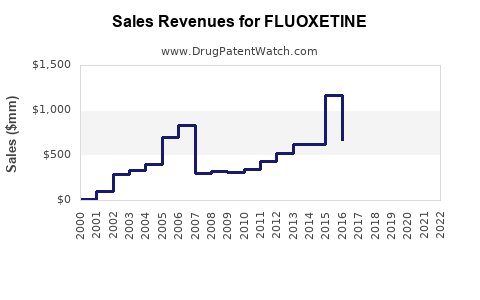
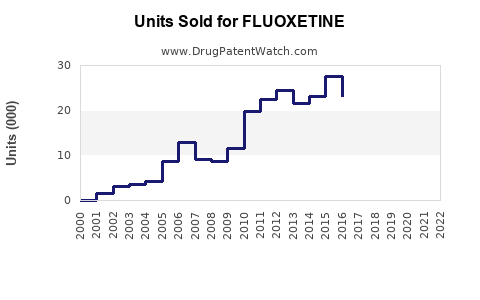
Annual Sales Revenues and Units Sold for FLUOXETINE
| Drug Name | Revenues (USD) | Units | Year |
|---|---|---|---|
| FLUOXETINE | ⤷ Start Trial | ⤷ Start Trial | 2022 |
| FLUOXETINE | ⤷ Start Trial | ⤷ Start Trial | 2021 |
| FLUOXETINE | ⤷ Start Trial | ⤷ Start Trial | 2020 |
| FLUOXETINE | ⤷ Start Trial | ⤷ Start Trial | 2019 |
| FLUOXETINE | ⤷ Start Trial | ⤷ Start Trial | 2018 |
| FLUOXETINE | ⤷ Start Trial | ⤷ Start Trial | 2017 |
| >Drug Name | >Revenues (USD) | >Units | >Year |
Fluoxetine Market Analysis and Sales Projections: Generic Competition, Demand Trends, and Commercial Outlook
Fluoxetine is a mature, off-patent selective serotonin reuptake inhibitor (SSRI) with broad FDA-approved use in major depressive disorder, obsessive-compulsive disorder, bulimia nervosa, panic disorder, and premenstrual dysphoric disorder. The U.S. market is dominated by low-cost generics, while branded Prozac and Sarafem have limited commercial relevance. Volume demand should remain stable because of chronic use, established clinical guidelines, and global access needs. Revenue growth will depend mainly on prescription volume, dosage-form mix, geographic expansion, and price changes rather than exclusivity.
A reasonable base-case outlook is for global fluoxetine product sales to remain broadly stable to modestly grow through 2030, with low single-digit annual unit growth and flat-to-negative pricing in mature markets. Branded-drug revenue is unlikely to recover without a differentiated delivery system or new indication.
What is fluoxetine and how is it used?
Fluoxetine is an oral SSRI marketed originally by Eli Lilly as Prozac. It inhibits serotonin reuptake and is used across psychiatric and behavioral-health indications.
FDA-approved fluoxetine indications
| Indication | FDA-recognized product use | Commercial relevance |
|---|---|---|
| Major depressive disorder | Prozac and generic fluoxetine | Highest |
| Obsessive-compulsive disorder | Prozac and generic fluoxetine | High |
| Bulimia nervosa | Prozac and generic fluoxetine | Moderate |
| Panic disorder | Prozac and generic fluoxetine | Moderate |
| Premenstrual dysphoric disorder | Sarafem and generic fluoxetine | Moderate |
The FDA-approved adult dosage range commonly begins at 20 mg daily, with dose adjustments based on response and tolerability. Available formulations include capsules, tablets, oral solution, delayed-release capsules, and combination products such as olanzapine/fluoxetine under the Symbyax brand and generic equivalents where approved.[1]
Fluoxetine has a long half-life relative to many other SSRIs. Its active metabolite, norfluoxetine, contributes to prolonged pharmacologic exposure. That characteristic supports once-daily dosing but can extend the period required for clearance after discontinuation or dose changes.
How large is the fluoxetine market?
The fluoxetine market is large in prescription volume but fragmented in revenue. Public sources do not provide one standardized, molecule-specific global sales figure because fluoxetine is sold by numerous generic manufacturers across different dosage forms and countries.
Market structure
| Segment | Current market position | Revenue outlook |
|---|---|---|
| U.S. generic fluoxetine capsules and tablets | Dominant | Stable volume, declining or flat price |
| U.S. oral solution | Smaller, less commoditized | Stable niche demand |
| U.S. delayed-release fluoxetine | Limited volume | Higher price per unit but small base |
| European generic market | Mature | Stable to modest volume growth |
| Emerging markets | Expanding access | Highest unit-growth potential |
| Branded Prozac | Minimal versus historical peak | Continued decline |
| Branded Sarafem | Limited | Low and declining |
| Olanzapine/fluoxetine combinations | Separate commercial market | Dependent on bipolar-depression and treatment-resistant-depression use |
Fluoxetine remains one of the most widely recognized antidepressants globally. Its low cost, long clinical history, inclusion in national formularies, and use in public-health systems support recurring demand. The principal commercial constraint is substitution by other generic SSRIs, especially sertraline, escitalopram, citalopram, and paroxetine.
What are the historical fluoxetine sales trends?
Prozac was one of the largest pharmaceutical brands before generic entry. Eli Lilly reported Prozac sales of approximately $2.6 billion in 2001, before the full effect of generic competition. Revenue declined sharply after loss of U.S. exclusivity and generic entry.[2]
| Period | Commercial event | Market effect |
|---|---|---|
| 1987 | FDA approval of Prozac for depression | Launch of the original branded market |
| 1990s | Expansion into OCD, bulimia, panic disorder, and other uses | Prescription and revenue growth |
| 2000-2001 | U.S. patent and exclusivity disputes | Delayed but did not prevent generic entry |
| 2001 onward | Generic fluoxetine launches | Rapid price erosion |
| 2000s | Expansion of generic manufacturing | Brand revenue collapse |
| 2010s-2020s | Mature generic market | Stable demand with limited pricing power |
The key economic event was not a decline in clinical use. It was the conversion of a high-price branded market into a multisupplier generic market. A molecule can retain large prescription volume while producing relatively little manufacturer revenue after patent expiry.
When did fluoxetine lose exclusivity?
Fluoxetine lost practical U.S. brand exclusivity in the early 2000s. Eli Lilly faced patent litigation involving the Prozac active ingredient and later formulations. Barr Laboratories obtained a major position in the U.S. generic market after patent litigation and regulatory developments, while other manufacturers entered after applicable exclusivity periods ended.[3]
The principal composition-of-matter protection for fluoxetine was no longer a commercial barrier by the early 2000s. Later formulation and method patents did not preserve broad exclusivity for conventional fluoxetine capsules and tablets.
Exclusivity timeline
| Milestone | Approximate timing | Impact |
|---|---|---|
| Original Prozac approval | 1987 | Brand launch |
| Additional indication approvals | 1990s-2000s | Expanded addressable market |
| U.S. patent litigation over Prozac | Late 1990s-early 2000s | Delayed and structured generic entry |
| Generic fluoxetine launch | 2001 | Beginning of major price erosion |
| Broad generic competition | 2002 onward | Loss of branded pricing power |
| Mature multisupplier market | 2000s onward | Low-cost supply and limited margins |
What patents protect fluoxetine products today?
Conventional fluoxetine is generally an off-patent active pharmaceutical ingredient. The commercial product is protected primarily by manufacturing know-how, regulatory approvals, supplier qualification, quality systems, and distribution scale rather than by an active composition patent.
Patent categories relevant to fluoxetine
| Patent category | Historical or current relevance |
|---|---|
| Fluoxetine compound patents | Expired or no longer commercially blocking |
| Conventional capsule and tablet patents | Expired or non-blocking |
| Delayed-release formulations | Historically relevant to Prozac Weekly |
| Combination-product patents | Relevant to olanzapine/fluoxetine products |
| Manufacturing-process patents | May protect specific routes or impurity controls |
| Method-of-use patents | Mostly historical or narrow in scope |
| Packaging and device patents | Limited relevance for standard oral products |
Prozac Weekly used a delayed-release formulation intended for once-weekly administration. That product represented a formulation-based differentiation strategy, but it did not restore the economic position of the original Prozac franchise.
The main current IP risk for a new fluoxetine entrant is not infringement of the core molecule. It is potential exposure to formulation patents, combination-product patents, manufacturing patents, or regulatory exclusivity attached to a specific product. Standard immediate-release fluoxetine capsules and tablets face substantially lower patent risk.
What is the FDA and Orange Book status of fluoxetine?
Fluoxetine is FDA-approved and marketed through multiple abbreviated new drug applications (ANDAs) and approved new drug applications. The FDA Orange Book lists approved fluoxetine products and reference products, but the active ingredient itself does not have the type of live broad patent protection associated with a newly launched branded medicine.[4]
Regulatory status
| Regulatory issue | Assessment |
|---|---|
| FDA approval | Established |
| ANDA pathway | Widely used |
| Reference product | Prozac |
| Generic availability | Extensive |
| Orange Book relevance | Product-specific patents and exclusivity |
| New chemical entity exclusivity | Expired |
| Paragraph IV risk for standard capsules | Generally limited |
| Regulatory barrier | Low to moderate |
| Manufacturing barrier | Moderate for reliable, compliant supply |
For a conventional generic, the principal regulatory requirements are bioequivalence, chemistry and manufacturing controls, stability, and compliance with current good manufacturing practices. Oral solution and delayed-release products can require more complex formulation and bioequivalence demonstrations than standard capsules.
How many companies compete in the fluoxetine market?
The market has numerous generic suppliers, but supplier counts vary by dosage form, strength, country, and product availability. U.S. competition has historically included Teva, Barr Pharmaceuticals, Mylan, Sandoz, Dr. Reddy's Laboratories, Aurobindo, and other approved manufacturers or distributors.
Generic competition is strongest in 10 mg, 20 mg, and 40 mg capsules. Competition is less uniform in oral solution, delayed-release capsules, pediatric presentations, and lower-volume strengths.
Competitive drivers
Manufacturers compete on:
- Wholesale acquisition cost and contract pricing
- Reliable active pharmaceutical ingredient supply
- FDA inspection history
- Back-order performance
- Formulation breadth
- Pharmacy benefit manager access
- Hospital and government contracts
- Ability to maintain low-cost production at scale
The market has low differentiation for standard capsules. A supplier with two or three approved competitors can still face severe price pressure if purchasing is concentrated among large wholesalers, pharmacy chains, and managed-care organizations.
What are fluoxetine sales projections through 2030?
A molecule-specific revenue forecast requires assumptions because public industry datasets often combine products, dosage forms, geographies, and combination therapies differently. The following scenario model separates mature-market pricing from emerging-market volume growth.
Base-case projection
| Year | Global unit demand index | Revenue index | Expected market condition |
|---|---|---|---|
| 2024 | 100 | 100 | Mature generic market |
| 2025 | 102 | 99-101 | Stable prescriptions, competitive pricing |
| 2026 | 104 | 98-101 | Modest volume growth |
| 2027 | 106 | 98-102 | Emerging-market expansion |
| 2028 | 108 | 98-103 | Stable mature-market demand |
| 2029 | 110 | 98-104 | Continued generic penetration |
| 2030 | 112-115 | 98-105 | Low single-digit annual unit growth |
The base case assumes approximately 1.5% to 2.5% annual unit growth and roughly flat nominal revenue. Volume gains in lower-income markets offset continued price erosion in the United States and Western Europe.
Scenario analysis
| Scenario | Unit growth through 2030 | Revenue outcome | Main drivers |
|---|---|---|---|
| Bear case | 0% to 1% annually | Decline of 10% to 20% | Substitution by newer SSRIs, procurement pressure |
| Base case | 1.5% to 2.5% annually | Flat to up 5% | Stable chronic use and emerging-market access |
| Bull case | 3% to 5% annually | Up 5% to 15% | Increased diagnosis, public-health procurement, new formulations |
The bull case does not depend on a return of Prozac-style pricing. It requires higher prescription volume, expansion of low-cost access, or a differentiated formulation that captures a premium.
What generic entry risks exist for fluoxetine manufacturers?
Generic-entry risk is already realized for conventional fluoxetine. The relevant risk for current manufacturers is further price compression and product substitution, not an initial Paragraph IV shock.
Paragraph IV and litigation exposure
A new applicant could historically challenge listed patents through a Paragraph IV certification. For standard immediate-release fluoxetine, broad composition patents are no longer the central barrier. Litigation risk is more relevant when the product includes:
- Delayed or extended release
- New dosing schedules
- Pediatric delivery systems
- Combination therapy
- Proprietary excipients
- Specific impurity-control or manufacturing claims
A generic manufacturer entering a standard fluoxetine capsule market would normally face a low patent litigation risk but a high commercial risk. The market may not support adequate margins after launch, especially if several approved suppliers already compete in the same strength.
Which formulations are commercially attractive?
Standard capsules have the largest volume but the weakest pricing. Less common formulations can offer better economics if the sponsor achieves reliable regulatory differentiation.
Formulation opportunities
| Formulation | Commercial potential | Key barrier |
|---|---|---|
| 10 mg, 20 mg, 40 mg capsules | High volume, low margin | Severe competition |
| 90 mg delayed-release capsule | Niche | Bioequivalence and limited demand |
| Oral solution | Moderate niche | Stability, taste, packaging |
| Pediatric liquid | Targeted opportunity | Dosing and palatability |
| Orally disintegrating tablet | Potential differentiation | Limited demonstrated demand |
| Combination product | Higher value potential | Separate patent and regulatory analysis |
| Long-acting formulation | High theoretical value | Development and clinical complexity |
A reformulated product would need to solve a recognized adherence, tolerability, dosing, or access problem. A minor change in dosage form alone would be unlikely to justify significant price premium in a generic-heavy category.
How does fluoxetine compare with competing SSRIs?
Fluoxetine has strong brand recognition and a long evidence base, but it competes in a crowded class.
| Drug | Commercial position | Key distinction |
|---|---|---|
| Fluoxetine | Mature, low-cost generic | Long half-life and broad historical use |
| Sertraline | Major generic competitor | Strong use in depression, anxiety, and public formularies |
| Escitalopram | Major generic competitor | Common first-line prescribing and perceived tolerability |
| Citalopram | Mature generic | Low cost and broad availability |
| Paroxetine | Mature generic | Efficacy offset by tolerability and discontinuation concerns |
| Fluvoxamine | Smaller niche | OCD and selected other uses |
| Vortioxetine | Branded or differentiated market | Newer mechanism and higher pricing |
Fluoxetine is most exposed to sertraline and escitalopram in first-line depression prescribing. Its long half-life can support use where missed doses or discontinuation concerns matter, but that advantage has limited pricing impact because prescribers can select among multiple low-cost SSRIs.
What is the revenue exposure for pharmaceutical companies?
The major historical revenue exposure was Eli Lilly's Prozac franchise. That exposure largely ended after generic entry. Current exposure is distributed across generic manufacturers and wholesalers.
Commercial exposure by participant
| Participant | Exposure |
|---|---|
| Eli Lilly | Historical Prozac revenue; limited conventional fluoxetine exposure today |
| Generic manufacturers | Volume-driven, low-margin revenue |
| API producers | Commodity and supply-chain exposure |
| Distributors and wholesalers | High transaction volume, low unit margins |
| Retail pharmacies | Dispensing and reimbursement exposure |
| Payers | Low drug cost but high utilization exposure |
| Combination-product manufacturers | Higher-value exposure where olanzapine/fluoxetine is differentiated |
The main financial risk is supply interruption or reimbursement compression. A manufacturer with a concentrated fluoxetine portfolio may experience margin deterioration even if unit demand remains stable.
What licensing deals and settlements affected fluoxetine?
The most commercially important historical agreements involved Eli Lilly's patent litigation with generic companies, including Barr Laboratories. These arrangements shaped the timing of generic entry and the allocation of market opportunity during the transition from branded to generic Prozac.[3]
Current licensing value in conventional fluoxetine is limited. Potentially valuable transactions would more likely involve:
- A novel delivery system
- A combination therapy
- A pediatric formulation
- A digital adherence program bundled with treatment
- Geographic rights in markets with restricted supplier access
- A manufacturing process that reduces impurities or cost
Settlement agreements related to historical Prozac patents no longer create a meaningful barrier to ordinary generic entry. A current deal based solely on conventional fluoxetine capsules would likely be evaluated as a supply or distribution transaction rather than an innovation-license opportunity.
How strong is the fluoxetine patent estate?
The patent estate is weak for the core molecule and standard oral products, but it can be meaningful for narrow formulations or combinations.
| IP dimension | Strength |
|---|---|
| Core active ingredient | Very weak |
| Standard capsules and tablets | Weak |
| Oral solution | Weak to moderate, depending on claims |
| Delayed-release formulation | Historically moderate |
| Combination products | Product-specific |
| Manufacturing process | Narrow but potentially useful |
| Brand recognition | Low legal strength, residual commercial value |
| Regulatory know-how | Moderate operational value |
The principal barriers to entry are manufacturing economics, regulatory execution, quality consistency, and channel access. Patent exclusivity is not the primary barrier for standard fluoxetine.
What generic launch scenarios are most likely?
A new entrant has three realistic pathways:
- Enter standard 10 mg, 20 mg, or 40 mg capsules with a low-cost supply strategy.
- Target an under-supplied dosage form such as oral solution or a specific delayed-release presentation.
- Develop a differentiated combination or delivery product that can support regulatory and commercial segmentation.
The first pathway has the lowest technical risk and the highest pricing risk. The second may offer better margins but has a smaller addressable market. The third has the greatest potential value and the highest development burden.
Key Takeaways
- Fluoxetine is an established, FDA-approved SSRI with extensive generic availability.
- Prozac generated approximately $2.6 billion in annual sales around 2001 before generic erosion.[2]
- The core fluoxetine molecule and conventional oral products no longer provide meaningful broad patent protection.
- Standard capsules and tablets are low-margin products with high competition.
- Global unit demand should remain stable to modestly grow through 2030.
- Base-case revenue is likely to remain approximately flat because volume growth will be offset by generic price pressure.
- Emerging markets offer the strongest unit-growth opportunity.
- Delayed-release, pediatric, liquid, and combination products offer more commercial differentiation than standard capsules.
- Current litigation risk is low for ordinary fluoxetine generics and higher for narrow formulations or combination products.
- The main investment variables are supplier concentration, reimbursement, manufacturing cost, product availability, and formulation differentiation.
FAQs
Is fluoxetine still commercially profitable?
It can be profitable at scale, but standard fluoxetine is generally a low-margin generic product. Profitability depends on manufacturing cost, supply reliability, procurement contracts, and the number of competing suppliers.
Does Prozac still generate significant sales?
Prozac retains brand recognition and some sales, but its commercial position is far smaller than during its pre-generic peak. Generic fluoxetine accounts for most prescription volume.
Can a company patent a new fluoxetine formulation?
A new formulation may receive patent protection if it satisfies novelty, non-obviousness, and written-description requirements. Patent strength depends on the formulation claims and the ability to show a meaningful technical or clinical benefit.
Is fluoxetine included in government essential-medicine formularies?
Fluoxetine is included in many national and institutional formularies. Inclusion varies by jurisdiction, procurement policy, and the availability of competing antidepressants.
Is fluoxetine a good target for pharmaceutical licensing?
Conventional fluoxetine is generally a weak licensing target because the molecule is off patent and heavily genericized. A differentiated delivery system, combination product, or underdeveloped geographic market would provide a stronger licensing rationale.
References
- U.S. Food and Drug Administration. (2023). Prozac (fluoxetine hydrochloride) prescribing information.
- Eli Lilly and Company. (2001-2003). Annual reports and Form 10-K filings.
- U.S. Court of Appeals for the Federal Circuit. (2000). Eli Lilly and Company v. Barr Laboratories, Inc., 251 F.3d 955.
- U.S. Food and Drug Administration. (2024). Approved drug products with therapeutic equivalence evaluations: Orange Book.
More… ↓
