Drug Sales Trends for COLCRYS
Payment Methods and Pharmacy Types for COLCRYS (2019)
Revenues by Pharmacy Type
Units Sold by Pharmacy Type
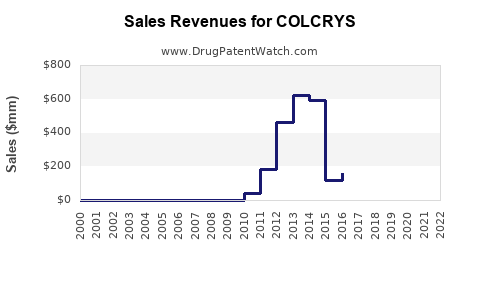
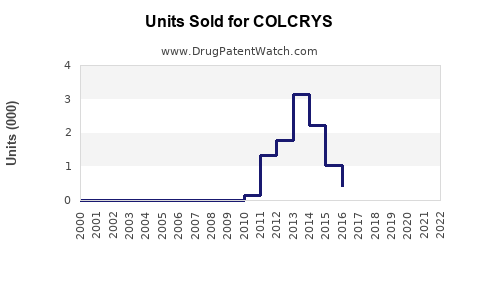
Annual Sales Revenues and Units Sold for COLCRYS
| Drug Name | Revenues (USD) | Units | Year |
|---|---|---|---|
| COLCRYS | ⤷ Start Trial | ⤷ Start Trial | 2022 |
| COLCRYS | ⤷ Start Trial | ⤷ Start Trial | 2021 |
| COLCRYS | ⤷ Start Trial | ⤷ Start Trial | 2020 |
| COLCRYS | ⤷ Start Trial | ⤷ Start Trial | 2019 |
| >Drug Name | >Revenues (USD) | >Units | >Year |
Colcrys Market Analysis, Sales Forecast, Patent Protection, and Generic Competition
Colcrys is Takeda’s branded colchicine product for acute gout flares, gout prophylaxis, and familial Mediterranean fever (FMF). Its commercial position is mature and declining because FDA-approved generic colchicine is widely available. The brand retains value through physician familiarity, payer coverage, product consistency, and protection from direct substitution in some formularies, but generic price competition limits long-term growth.
The U.S. Colcrys market is estimated at approximately $100 million to $150 million in annual net sales in 2024. Base-case sales are projected to decline to approximately $80 million to $115 million by 2029. The broader U.S. colchicine market is substantially larger because generics account for most prescription volume.
What is the current market position of Colcrys?
Colcrys is a prescription oral colchicine product marketed in 0.6 mg tablets. It competes primarily with generic colchicine rather than with another branded colchicine product.
| Market attribute | Colcrys position |
|---|---|
| Active ingredient | Colchicine |
| Dosage form | 0.6 mg oral tablet |
| U.S. sponsor | Takeda Pharmaceuticals |
| FDA application | NDA 022352 |
| Initial U.S. approval | July 29, 2009 |
| Main indications | Gout flares, gout-flare prophylaxis, FMF |
| Primary competitors | Generic colchicine tablets |
| Regulatory category | Small-molecule prescription drug |
| Biosimilar exposure | None |
| Main commercial risk | Generic substitution and reimbursement pressure |
FDA approved Colcrys after requiring a modern clinical and manufacturing record for colchicine, an older active ingredient that had been used in the United States without a prior FDA-approved product. The approval created a period of market exclusivity and enabled Takeda and its predecessor, URL Pharma, to establish an FDA-approved branded product.[1]
How large is the Colcrys and colchicine market?
The branded Colcrys market is much smaller than the total colchicine market. Most U.S. colchicine prescriptions are now filled with generic products.
U.S. market structure
The relevant market has three layers:
- Colcrys branded prescriptions.
- Authorized or conventional generic colchicine prescriptions.
- Cash-pay, discount-card, and government-insured prescriptions with highly variable net pricing.
Colchicine demand is supported by the large prevalence of gout. The Centers for Disease Control and Prevention estimates that gout affects more than 9 million U.S. adults, while hyperuricemia and related metabolic conditions create a broad treatment population.[2] Colchicine is used for acute flares and prophylaxis when urate-lowering therapy is initiated.
Demand is comparatively stable because gout is chronic and recurrent. Volume growth does not translate directly into Colcrys revenue because generic substitution is strong.
Commercial drivers
| Driver | Effect on Colcrys |
|---|---|
| Rising gout prevalence | Supports prescription volume |
| Increased use of urate-lowering therapy | Supports prophylactic colchicine use |
| Generic colchicine availability | Reduces branded share |
| Low manufacturing complexity | Limits entry barriers |
| Payer substitution policies | Pressures net price |
| FMF orphan indication | Preserves a specialized patient segment |
| Physician familiarity | Supports residual brand demand |
What are the sales projections for Colcrys?
The following forecast is an independent market model rather than Takeda guidance. It assumes continued generic availability, stable gout prevalence, no major new Colcrys indication, and gradual erosion in branded volume and net price.
Colcrys U.S. net-sales forecast
| Year | Base-case sales | Low case | High case |
|---|---|---|---|
| 2024A/estimate | $100 million-$150 million | $90 million | $155 million |
| 2025 | $98 million-$145 million | $82 million | $155 million |
| 2026 | $94 million-$140 million | $75 million | $154 million |
| 2027 | $90 million-$135 million | $68 million | $153 million |
| 2028 | $86 million-$125 million | $62 million | $151 million |
| 2029 | $80 million-$115 million | $55 million | $148 million |
The base case implies a compound annual decline of approximately 4% to 7%. The high case assumes stronger brand retention in commercial and Medicare formularies, limited price discounting, and sustained FMF prescribing. The low case assumes increased generic substitution, additional discounting, and tighter payer controls.
Takeda does not generally report Colcrys as a separately disclosed material revenue line in its consolidated public filings. This limits direct verification of product-level sales and requires a prescription-volume and pricing model.[3]
Revenue exposure
Colcrys is unlikely to be material to Takeda’s overall revenue base, which is driven by larger products such as Entyvio, Vyvanse, Takhzyro, and other specialty medicines. Its value is more relevant at the product-franchise level than at the consolidated-company level.
For a potential acquirer or licensing partner, the asset offers recurring cash flow but limited growth. The main valuation variables are:
- Net price after rebates and discounts.
- Brand prescription retention.
- FMF patient share.
- Generic acquisition cost and supply reliability.
- Litigation or regulatory changes affecting substitution.
- Takeda’s manufacturing and commercialization overhead.
When did Colcrys lose exclusivity?
Colcrys lost practical market exclusivity when generic colchicine products entered the U.S. market. FDA-approved generic colchicine became available after the initial Colcrys exclusivity periods and patent disputes.
Regulatory exclusivity timeline
| Date | Event |
|---|---|
| July 29, 2009 | FDA approved Colcrys under NDA 022352 |
| 2009-2012 | New-drug clinical-data exclusivity period applied to approved uses |
| 2009-2016 | Orphan-drug exclusivity applied to FMF |
| 2014 | FDA-approved generic colchicine products began entering the market |
| 2014 onward | Brand-generic price and formulary competition intensified |
The most important commercial loss was not the expiration of a single patent. It was the launch of generic colchicine after FDA approval and litigation-related barriers were resolved.
What patents protect Colcrys?
Colcrys protection has involved patents covering colchicine formulations, dosing, and methods of treatment rather than a new chemical entity. The active ingredient itself is old and cannot support modern composition-of-matter exclusivity.
Patent categories
| Patent category | Commercial relevance |
|---|---|
| Dose and administration patents | May cover lower-dose regimens or treatment schedules |
| Method-of-use patents | May cover acute gout, prophylaxis, or FMF use |
| Formulation patents | May protect tablet composition or manufacturing characteristics |
| Manufacturing patents | May affect process economics but usually do not block ordinary generic use |
| Product-by-process claims | Can create narrower enforcement positions |
A principal patent associated with Colcrys is U.S. Patent No. 7,582,621, which has been cited in connection with colchicine compositions and methods of treatment. Orange Book-listed patent coverage and expiration dates must be assessed by patent number, use code, terminal disclaimer, and any patent-term adjustment. The patent estate does not create the same barrier as a composition-of-matter patent because generic applicants can challenge narrower method and formulation claims.[4]
What is the Orange Book status of Colcrys?
Colcrys is listed in FDA’s Orange Book as an approved prescription drug under NDA 022352. The Orange Book is the controlling source for listed patents, use codes, dosage-form information, and therapeutic-equivalence evaluations.[5]
Generic colchicine applicants typically pursue an abbreviated new drug application rather than a biosimilar application. The relevant certification may be Paragraph IV when an applicant asserts that a listed patent is invalid, unenforceable, or not infringed.
Orange Book implications
- Colcrys is a small-molecule drug.
- Generic applicants use the ANDA pathway.
- Patent disputes focus on listed claims and use codes.
- A generic may enter for non-patented uses while carving out protected indications.
- A product can be therapeutically equivalent while remaining commercially differentiated by price, supply, or formulary position.
Which companies challenge Colcrys through generic competition?
Generic colchicine competition has included manufacturers such as Hikma Pharmaceuticals, West-Ward, Rising Pharmaceuticals, and other ANDA sponsors over time. The competitive field can change as approvals, supply contracts, and product discontinuations change.
The relevant competitive threat is not a single challenger. It is the cumulative effect of multiple generic suppliers with lower prices and interchangeable tablets.
Generic entry economics
Colchicine is a relatively simple oral solid dosage product. Manufacturing barriers are lower than for sterile injectables, complex biologics, or controlled-release delivery systems. Key barriers include:
- Demonstrating bioequivalence.
- Establishing a reliable active pharmaceutical ingredient supply.
- Managing narrow therapeutic-index concerns.
- Meeting current good manufacturing practice requirements.
- Avoiding or resolving Orange Book patent claims.
- Securing payer and wholesaler access.
The product’s narrow therapeutic index can increase quality-control requirements, but it does not eliminate generic competition.
Are biosimilars a risk to Colcrys?
No. Biosimilars are not a relevant competitive pathway because colchicine is a chemically synthesized small molecule. Colcrys faces generic substitution under the ANDA framework, not biosimilar substitution under the Biologics Price Competition and Innovation Act.
This distinction matters commercially. Generic approval can produce rapid price erosion and direct pharmacy substitution. Biosimilar uptake is usually slower and depends more heavily on interchangeability, prescriber behavior, and biologic contracting.
What litigation and Paragraph IV risks affect Colcrys?
Historical patent litigation involving generic colchicine applicants centered on the validity, infringement, and enforceability of patents covering Colcrys dosing and use. Paragraph IV litigation can delay approval through the Hatch-Waxman 30-month stay, but it does not guarantee long-term protection if generic claims are narrowed, invalidated, or carved out.[6]
The current risk profile is moderate to low for a complete market blockade because:
- Generic colchicine is already commercially available.
- The active ingredient is old.
- Core commercial uses are difficult to protect broadly.
- Formulation and dosing claims are narrower than composition claims.
- Multiple generic suppliers reduce dependence on any single challenger.
How strong is the Colcrys patent estate?
The Colcrys patent estate is moderate for targeted claims and weak for broad market exclusivity.
Strength assessment
| Patent factor | Assessment |
|---|---|
| Chemical composition protection | Weak or unavailable because colchicine is an old molecule |
| Method-of-use protection | Moderate for specific dosing or indication claims |
| Formulation protection | Moderate if claims are narrowly drafted and technically distinct |
| Manufacturing protection | Limited unless the process creates a meaningful cost or quality advantage |
| Generic blocking power | Low to moderate |
| Litigation leverage | Higher before generic launch than after multiple generics enter |
| Residual commercial value | Driven more by brand and formulary position than patents |
A patent estate can retain value after generic entry if it supports an indication carve-out, protects a differentiated dosage regimen, or creates settlement leverage. It is unlikely to restore broad branded exclusivity.
What formulations and indications are protected?
Colcrys is an immediate-release 0.6 mg tablet. The commercial protection strategy has focused on dosing and therapeutic use rather than a technically complex delivery system.
The principal use areas are:
- Treatment of acute gout flares.
- Prophylaxis of gout flares.
- Treatment of FMF in adults and children.
- Dose-specific regimens intended to reduce toxicity compared with older colchicine practices.
The FMF indication is commercially specialized. It supports a smaller but more concentrated patient population and may generate stronger brand retention where clinicians value an FDA-approved product and predictable dosing.
How does Colcrys compare with generic colchicine?
| Factor | Colcrys | Generic colchicine |
|---|---|---|
| FDA approval | Yes | Yes, for approved generic products |
| Active ingredient | Colchicine | Colchicine |
| Dosage strength | 0.6 mg | Commonly 0.6 mg |
| Price | Higher | Lower |
| Pharmacy substitution | Often disadvantaged | Usually favored |
| Brand recognition | Strong | Fragmented |
| Payer position | Depends on formulary | Generally preferred |
| Patent dependence | Residual | Entry depends on patent certifications |
| Growth potential | Low | Volume growth possible with price pressure |
Colcrys can preserve a premium where a payer excludes substitution, a physician specifies the brand, or a patient receives favorable copay support. Those conditions are insufficient to offset broad generic pressure across the market.
What generic launch scenarios exist?
Base case
Generic colchicine remains broadly available. Colcrys sales decline gradually, while total colchicine volume grows modestly with the gout population. No new product materially changes treatment patterns.
Downside case
Additional generic suppliers improve availability and lower acquisition costs. Payers move Colcrys to non-preferred tiers or require generic failure first. Branded sales fall at approximately 8% to 12% annually.
Upside case
Generic shortages, manufacturing withdrawals, or payer-specific brand coverage temporarily improve Colcrys demand. Sales stabilize, but a sustained return to growth is unlikely without a new indication or differentiated formulation.
What are the main investment and licensing implications?
Colcrys is a cash-generating mature product, not a growth asset. Its value depends on operational execution rather than discovery-stage innovation.
Potential buyers or licensees would focus on:
- Net sales after rebates.
- Gross-to-net deductions.
- Generic share by payer segment.
- FMF prescription concentration.
- Manufacturing cost per tablet.
- Inventory and supply-chain reliability.
- Remaining Orange Book-listed claims.
- Pending or threatened ANDA litigation.
- Contractual rights retained by Takeda or prior licensors.
A transaction premium would require evidence of unusually strong brand retention, protected reimbursement, supply shortages favoring the brand, or a new colchicine-based formulation.
Key Takeaways
- Colcrys is a mature branded colchicine product with declining U.S. sales.
- Estimated 2024 U.S. net sales are approximately $100 million to $150 million.
- Base-case sales are projected at $80 million to $115 million by 2029.
- Generic colchicine, not biosimilars, is the central competitive threat.
- Colcrys lost practical exclusivity after generic colchicine entered the U.S. market around 2014.
- The patent estate is strongest for narrow dosing, formulation, and method-of-use claims.
- Broad composition-of-matter protection is unavailable because colchicine is an old active ingredient.
- FMF remains the most defensible specialized use, but it is not large enough to support major growth.
- Colcrys has residual cash-flow value but limited strategic value without new formulations, indications, or reimbursement advantages.
FAQs
Is Colcrys still a profitable drug?
Yes. Colcrys can remain profitable because manufacturing costs for an oral tablet are relatively low, but its profitability is constrained by generic price competition, rebates, and payer substitution.
Does Colcrys have orphan-drug protection for familial Mediterranean fever?
Yes. FDA granted orphan-drug exclusivity for the FMF indication after the 2009 approval. That period expired years before the current commercial period, so it no longer blocks generic colchicine broadly.
Can a generic colchicine product substitute for Colcrys automatically?
Substitution depends on the FDA therapeutic-equivalence designation, state pharmacy law, payer policy, and the specific product. FDA-approved therapeutically equivalent products generally receive favorable substitution treatment.
Is colchicine a high-risk generic manufacturing product?
It has more dosing and quality-control sensitivity than many routine tablets because colchicine has a narrow therapeutic range. It is still materially easier to manufacture and commercialize than sterile drugs, controlled-release products, or biologics.
What would increase Colcrys sales?
A differentiated formulation, a new FDA-approved indication, stronger brand-only formulary coverage, generic supply disruptions, or evidence supporting superior adherence or tolerability could increase sales. Without one of these changes, the expected trajectory is gradual decline.
References
- U.S. Food and Drug Administration. (2009). Colcrys approval letter and prescribing information, NDA 022352. https://www.accessdata.fda.gov
- Centers for Disease Control and Prevention. (2023). Gout and other crystal arthropathies. https://www.cdc.gov
- Takeda Pharmaceutical Company Limited. (2024). Annual report 2024. https://www.takeda.com/investors/financial-results/annual-reports/
- United States Patent and Trademark Office. (2009). U.S. Patent No. 7,582,621. https://patents.google.com/patent/US7582621
- U.S. Food and Drug Administration. (2024). Approved drug products with therapeutic equivalence evaluations: Orange Book. https://www.accessdata.fda.gov/scripts/cder/ob/
- U.S. Food and Drug Administration. (2024). Abbreviated new drug application approvals and patent certifications. https://www.fda.gov/drugs/abbreviated-new-drug-application-anda/ાન્ય
More… ↓
