Share This Page
Drug Sales Trends for CHANTIX
✉ Email this page to a colleague
Payment Methods and Pharmacy Types for CHANTIX (2019)
Revenues by Pharmacy Type
Units Sold by Pharmacy Type
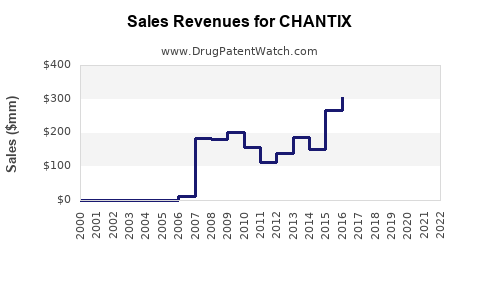
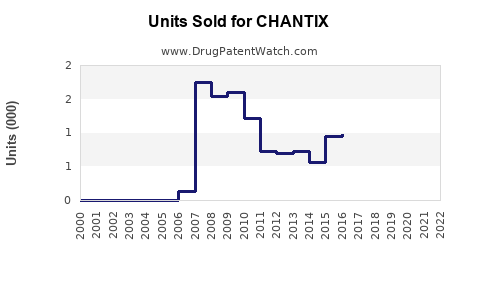
Annual Sales Revenues and Units Sold for CHANTIX
| Drug Name | Revenues (USD) | Units | Year |
|---|---|---|---|
| CHANTIX | ⤷ Start Trial | ⤷ Start Trial | 2022 |
| CHANTIX | ⤷ Start Trial | ⤷ Start Trial | 2021 |
| CHANTIX | ⤷ Start Trial | ⤷ Start Trial | 2020 |
| CHANTIX | ⤷ Start Trial | ⤷ Start Trial | 2019 |
| CHANTIX | ⤷ Start Trial | ⤷ Start Trial | 2018 |
| CHANTIX | ⤷ Start Trial | ⤷ Start Trial | 2017 |
| CHANTIX | ⤷ Start Trial | ⤷ Start Trial | 2016 |
| >Drug Name | >Revenues (USD) | >Units | >Year |
CHANTIX Market Analysis, Patent Status, Competitive Landscape, and Sales Projections
CHANTIX, Pfizer's brand of varenicline, has lost its U.S. exclusivity and now competes with low-priced generic varenicline, nicotine-replacement therapy, and bupropion. Pfizer generated approximately $919 million in CHANTIX revenue in 2020, but sales declined after the 2021 nitrosamine recall and generic entry. The commercial opportunity has shifted from the branded product to generic varenicline, contract manufacturing, and international smoking-cessation markets.
A base-case forecast estimates global varenicline sales of approximately $400 million in 2024, rising to $500 million-$550 million by 2028. Growth is expected to come mainly from higher treatment volumes, while generic pricing limits revenue expansion. Pfizer's direct CHANTIX revenue is likely to remain immaterial relative to its pre-generic peak.
What is CHANTIX and how does varenicline work?
CHANTIX is the brand name for varenicline tartrate, an oral prescription medicine approved by the U.S. Food and Drug Administration for smoking cessation.
Varenicline is a partial agonist at the alpha4beta2 nicotinic acetylcholine receptor. It reduces nicotine withdrawal symptoms and decreases the rewarding effects of smoking. The product was approved in the United States in May 2006 and was initially marketed as a twice-daily tablet in 0.5 mg and 1 mg strengths.[1]
The primary commercial alternatives are:
| Product or category | Active ingredient | U.S. status | Commercial position |
|---|---|---|---|
| CHANTIX | Varenicline tartrate | Prescription brand | Pfizer originator product |
| Generic varenicline | Varenicline tartrate | Prescription generic | Primary post-exclusivity competitor |
| Zyban and generic bupropion SR | Bupropion | Prescription | Alternative prescription therapy |
| Nicorette, NicoDerm CQ and others | Nicotine | Over the counter | Largest accessible cessation category |
| Nicotine lozenges, gum and patches | Nicotine | Over the counter | Combination use is common |
| Cytisine products | Cytisine | Not broadly FDA-approved in the U.S. | International and emerging competitor |
The market is driven by smoking prevalence, quit attempts, insurance coverage, public-health programs and employer-sponsored cessation benefits. CDC data indicate that millions of U.S. adults attempt to quit smoking each year, creating a large treatment pool even as cigarette prevalence declines.[2]
How much revenue did CHANTIX generate?
CHANTIX reached peak commercial scale before generic competition. Pfizer reported approximately $919 million in worldwide CHANTIX revenue in 2020. Revenue fell to approximately $663 million in 2021, reflecting supply disruption, the nitrosamine recall, reduced availability and generic competition.[3]
| Year | Approximate Pfizer CHANTIX revenue | Key commercial event |
|---|---|---|
| 2017 | $919 million | Mature branded market |
| 2018 | $919 million | Stable global demand |
| 2019 | $919 million | Pre-recall peak period |
| 2020 | $919 million | Final full year before major disruption |
| 2021 | $663 million | Recall and generic entry |
| 2022 onward | Not separately reported at prior detail | Brand economics materially reduced |
Pfizer's reporting structure after 2021 does not provide the same level of standalone CHANTIX visibility. The brand's historical revenue should therefore not be used as a forward proxy for the current varenicline market. Generic substitution has reduced average selling prices and shifted value from Pfizer to generic manufacturers, wholesalers, pharmacies and payers.
What are the CHANTIX sales projections through 2028?
The forecast below estimates the total varenicline market, including branded and generic products. It is not a forecast of Pfizer's CHANTIX brand revenue.
| Calendar year | U.S. varenicline sales | International varenicline sales | Global total | Main assumption |
|---|---|---|---|---|
| 2024 | $140 million-$170 million | $220 million-$260 million | $360 million-$430 million | Generic-dominated U.S. market |
| 2025 | $150 million-$180 million | $230 million-$275 million | $380 million-$455 million | Volume growth offsets price erosion |
| 2026 | $160 million-$195 million | $240 million-$290 million | $400 million-$485 million | Expanded payer access |
| 2027 | $170 million-$210 million | $250 million-$305 million | $420 million-$515 million | Stable treatment demand |
| 2028 | $180 million-$225 million | $265 million-$325 million | $445 million-$550 million | Moderate global market expansion |
The base case implies a 4%-7% annual increase in global varenicline revenue. Unit demand should grow faster than market value because generic prices remain under pressure.
Pfizer's branded CHANTIX revenue is expected to remain a small portion of total varenicline revenue. A reasonable base-case range for Pfizer's direct CHANTIX revenue is $0 million-$25 million annually in the United States, with a higher but declining contribution in selected international markets. Generic manufacturers will capture most prescription volume.
What could cause the forecast to outperform?
Upside drivers include:
- Expanded smoking-cessation coverage by Medicaid, commercial insurers and national health systems.
- Higher quit attempts caused by tobacco-price increases or regulatory restrictions.
- Increased use of prescription therapy after unsuccessful over-the-counter nicotine-replacement attempts.
- Re-entry or expansion by manufacturers after prior varenicline supply shortages.
- Additional international approvals and public-health procurement programs.
What could cause the forecast to underperform?
Downside risks include:
- Continued decline in cigarette smoking prevalence.
- Competition from over-the-counter nicotine products.
- Wider availability of cytisine outside the United States.
- Safety-related manufacturing interruptions.
- Low generic prices that reduce manufacturer participation.
- Reduced physician prescribing because of the availability of nonprescription alternatives.
When did CHANTIX lose patent and regulatory exclusivity?
CHANTIX lost the central U.S. patent barrier in 2020, followed by generic approvals and commercial launches in 2021.
| Milestone | Date | Commercial effect |
|---|---|---|
| FDA approval of CHANTIX | May 11, 2006 | U.S. market entry |
| Pediatric exclusivity period | Extended the effective protection period | Delayed some generic timing |
| Principal U.S. patent expiration | November 11, 2020 | Core composition protection ended |
| FDA approval of generic varenicline | August 2021 | Generic competition authorized |
| Pfizer nitrosamine recall | 2021 | Brand supply and prescribing disruption |
| Generic expansion | 2021-2023 | Rapid price and share erosion |
The FDA approved generic versions of varenicline in 2021 after manufacturers resolved regulatory and patent-related timing issues.[4] The loss of exclusivity was accelerated commercially by the recall of CHANTIX and the availability of generic alternatives.
CHANTIX does not have biologic exclusivity. Varenicline is a small-molecule drug, so biosimilar regulation does not apply.
What patents protect CHANTIX?
The principal U.S. patent associated with CHANTIX was U.S. Patent No. 6,410,550, covering varenicline and related chemical subject matter. The Orange Book identified the relevant patent with an effective expiration date of November 11, 2020, including applicable term adjustments or pediatric exclusivity.[5]
| Patent or protection | Subject matter | Effective U.S. end date | Current status |
|---|---|---|---|
| U.S. Patent No. 6,410,550 | Varenicline chemical and pharmaceutical subject matter | November 11, 2020 | Expired |
| Pediatric exclusivity | FDA regulatory extension | Applied to generic timing | Expired |
| CHANTIX labeling protection | Approved smoking-cessation labeling | Historical | No longer a meaningful barrier |
| Generic drug exclusivity | ANDA-specific, if granted | Product-dependent | Does not restore brand exclusivity |
The commercial patent estate was not broad enough to preserve branded pricing after 2020. The key protection covered the active pharmaceutical ingredient and its use in the approved product rather than a durable, multi-layered platform of device, formulation and manufacturing patents.
What formulations are protected by CHANTIX patents?
CHANTIX was marketed primarily as immediate-release oral tablets containing varenicline tartrate. There is no current, commercially significant U.S. formulation barrier comparable to the patent estates surrounding long-acting injectables, inhaled products or complex drug-delivery systems.
The relevant formulation characteristics are:
- Oral tablet dosage form.
- 0.5 mg and 1 mg strengths.
- Titration schedule intended to reduce nausea.
- Varenicline tartrate as the active ingredient.
- Generic products formulated to meet the applicable ANDA requirements.
Generic applicants were able to develop tablets that met the reference product's quality and bioequivalence requirements. This limited the ability of Pfizer to use formulation differentiation to sustain a premium price after composition-patent expiry.
What method-of-use patents cover CHANTIX?
CHANTIX's core commercial use is smoking cessation. The FDA-approved use does not create a continuing exclusivity barrier after the underlying patent and regulatory protections expire.
Method-of-use protection can remain relevant in a Paragraph IV dispute if a patent claims a specific dosing regimen, patient population or treatment method. For CHANTIX, the principal commercial loss came from expiration of the core patent and the approval of generic varenicline. There is no widely recognized, currently active U.S. Orange Book method-of-use patent that prevents generic substitution for ordinary smoking-cessation treatment.
Generic labeling may omit protected indications or instructions when required under the FDA's skinny-label framework. That mechanism is more important for products with multiple patented indications than for varenicline, whose primary commercial indication is smoking cessation.
Which companies are challenging or competing with CHANTIX?
The competitive field includes generic pharmaceutical companies, nicotine-replacement manufacturers and prescription-drug manufacturers.
Generic varenicline competitors
FDA-approved generic varenicline manufacturers have included companies such as Teva Pharmaceuticals, Apotex and other ANDA sponsors. Availability has varied by manufacturer, strength, wholesaler inventory and manufacturing capacity.[4]
The generic competitive structure has several effects:
- Retail prices fall rapidly after multiple approvals.
- Pharmacy benefit managers prefer generic substitution.
- Brand prescribing becomes difficult without a material clinical or access advantage.
- Manufacturers compete on supply reliability rather than product differentiation.
- Market value grows more slowly than prescription volume.
Non-varenicline competitors
Nicotine-replacement therapy remains the largest competitive category because products are available without a prescription and include patches, gum, lozenges, sprays and inhaled formats. Bupropion remains an established prescription alternative. Behavioral counseling, digital cessation services and combination therapy also compete for the same treatment population.
Cytisine is a potential long-term competitor. It has been used internationally for smoking cessation and has attracted interest because of its low cost and nicotine-receptor activity, but it has not displaced varenicline in the U.S. prescription market.
What is the FDA and Orange Book status of CHANTIX?
CHANTIX was FDA-approved in 2006 and remains the reference product for generic varenicline. The product's regulatory risk profile changed after FDA-required action related to nitrosamine contamination.
In 2021, Pfizer recalled CHANTIX lots after detecting N-nitroso-varenicline, a nitrosamine impurity. The FDA stated that the risk from the impurity was weighed against the health risks of continued smoking, but the recall caused product shortages and disrupted prescriptions.[6]
The current commercial regulatory position is:
| Regulatory issue | Status |
|---|---|
| Original NDA | Approved |
| Reference listed drug | CHANTIX |
| Generic ANDAs | Approved |
| Principal Orange Book patent | Expired |
| Biosimilar pathway | Not applicable |
| Nitrosamine controls | Ongoing manufacturing requirement |
| Brand exclusivity | Expired |
| Paragraph IV barrier | No longer commercially decisive |
The nitrosamine episode created a manufacturing and quality-control barrier rather than a durable patent barrier. Any manufacturer seeking to supply varenicline must control nitrosamine formation, test finished product and manage changes to active-ingredient and tablet manufacturing processes.
What patent litigation and Paragraph IV challenges affected CHANTIX?
Generic manufacturers filed ANDAs challenging the patents covering CHANTIX before the principal patent expired. Such challenges typically used Paragraph IV certifications, asserting that the listed patent was invalid, unenforceable or would not be infringed by the proposed generic product.
The litigation strategy was commercially significant because an early generic launch could create substantial value before patent expiry. The settlement and regulatory timing ultimately allowed generic varenicline to enter the U.S. market after the principal protection period ended.
The current litigation risk is substantially lower than it was before 2020. The central patent has expired, and the market has moved from originator-versus-generic patent litigation to ordinary generic competition, product-quality compliance and supply disputes.
How strong is the CHANTIX patent estate?
The CHANTIX patent estate was commercially strong before expiry but is weak as a current exclusivity asset.
| Strength factor | Assessment |
|---|---|
| Active-ingredient protection | Strong historically |
| Remaining U.S. patent life | None on the principal patent |
| Formulation differentiation | Limited |
| Device protection | Not material |
| Manufacturing patents | Potential process value, but not a broad market barrier |
| Method-of-use protection | Limited current commercial effect |
| International coverage | Historically meaningful, now largely expired or weakened |
| Generic substitution resistance | Low |
| Litigation leverage | Low after patent expiry |
The main residual intellectual-property value lies in manufacturing know-how, impurity control, supplier qualification, process validation and regulatory dossiers. These assets can delay or complicate supply, but they do not recreate the pricing power of a live composition patent.
What licensing deals affect CHANTIX?
CHANTIX was developed and commercialized by Pfizer. No major current third-party license is widely associated with the core CHANTIX commercial franchise. The principal value chain is Pfizer's originator product, generic ANDA holders, active-ingredient suppliers, contract manufacturers, wholesalers and payers.
Any commercial opportunity is therefore more likely to involve generic supply, contract manufacturing, regional distribution or regulatory support than a license to Pfizer's expired core patent estate.
What generic entry risks exist for CHANTIX?
Generic entry has already occurred, so the principal risk is no longer potential entry. It is sustained generic erosion.
The key risks are:
- Further price compression as additional suppliers enter.
- Shortages caused by limited active-ingredient capacity.
- Nitrosamine-related recalls or manufacturing holds.
- Pharmacy-level substitution away from CHANTIX.
- Formulary exclusion of the brand.
- Low margins that cause manufacturers to exit.
- International price controls and tender-based procurement.
A generic manufacturer can still achieve attractive returns if it has low-cost API access, reliable quality systems and sufficient scale. The opportunity is less attractive for a high-cost manufacturer dependent on premium pricing.
How does CHANTIX compare with other smoking-cessation drugs?
| Attribute | CHANTIX or generic varenicline | Bupropion | Nicotine replacement |
|---|---|---|---|
| Prescription required | Yes | Yes | Usually no |
| Mechanism | Partial nicotinic receptor agonist | Dopamine and norepinephrine reuptake inhibition | Replaces nicotine |
| Brand patent status | Expired | Expired for core products | Mature generic and OTC market |
| Pricing power | Low after generic entry | Low | Low to moderate by format |
| Main advantage | Direct reduction of nicotine reward and craving | Non-nicotine prescription option | Accessibility and broad consumer familiarity |
| Main commercial constraint | Generic price erosion and supply controls | Generic competition and contraindications | Lower persistence and OTC self-selection |
Varenicline remains clinically relevant because it provides a prescription option with a mechanism distinct from nicotine replacement. Its commercial challenge is that clinical differentiation has not translated into post-expiry pricing power.
What is the revenue exposure for Pfizer and generic manufacturers?
Pfizer's revenue exposure is modest compared with the product's pre-2021 contribution. CHANTIX was once a near-billion-dollar annual product, but Pfizer no longer controls the economics of the U.S. market. The brand's remaining revenue depends on international availability, physician preference, brand recognition and supply continuity.
Generic manufacturers have a different exposure profile:
- Revenue is volume-driven.
- Gross margins depend on API and manufacturing costs.
- Multiple suppliers limit pricing power.
- Shortages can create temporary pricing opportunities.
- Regulatory compliance is a central competitive asset.
For investors, CHANTIX should be analyzed as a mature generic market rather than as a branded-growth pharmaceutical asset.
What are the likely generic launch scenarios?
Three scenarios define the market outlook:
| Scenario | Market result | Probability assessment |
|---|---|---|
| Base case | Generic volume rises gradually; global sales reach $445 million-$550 million by 2028 | Most likely |
| Upside case | Public-health programs expand and supply stabilizes; sales exceed $600 million by 2028 | Requires stronger treatment adoption |
| Downside case | OTC substitution, weak margins and supply exits reduce market value below $400 million by 2028 | Material risk |
The upside case depends more on increased treatment volume than on price. The downside case could occur even with stable prescription demand if generic prices decline faster than units grow.
Key Takeaways
- CHANTIX is Pfizer's varenicline product for smoking cessation.
- Pfizer generated approximately $919 million in CHANTIX revenue in 2020.
- Revenue fell to approximately $663 million in 2021 after the recall and generic entry.
- The principal U.S. patent, U.S. Patent No. 6,410,550, expired in November 2020.
- FDA-approved generic varenicline entered the U.S. market in 2021.
- There is no biosimilar risk because varenicline is a small molecule.
- The current market is driven by generic volume, supply reliability and payer access.
- Global varenicline sales could reach approximately $445 million-$550 million by 2028 in the base case.
- Pfizer's remaining CHANTIX revenue is expected to be small relative to historical levels.
- Manufacturing controls, particularly nitrosamine management, are more important than patent barriers.
FAQs
Is CHANTIX still available in the United States?
Generic varenicline is available in the United States, while branded CHANTIX availability has been affected by recall, manufacturing and commercial-distribution decisions.
Can a generic manufacturer launch varenicline without a new clinical trial?
An ANDA applicant generally relies on the reference product's safety and efficacy findings and must demonstrate pharmaceutical equivalence and bioequivalence under the FDA's generic-drug pathway.[4]
Does Pfizer still own the CHANTIX patent?
Pfizer owned the principal CHANTIX patent, but the primary U.S. patent protection expired in 2020. Pfizer may retain trademarks, regulatory assets and manufacturing know-how.
Is varenicline more commercially attractive than bupropion?
Varenicline has a distinct mechanism and substantial clinical recognition, but its commercial value is constrained by generic competition. Both products have limited branded pricing power after patent expiry.
Could cytisine replace varenicline in the U.S.?
Cytisine could become a competitor if it receives broader regulatory approval and achieves reliable distribution. Its current U.S. impact remains limited compared with generic varenicline and nicotine replacement.
References
- U.S. Food and Drug Administration. (2006). FDA approves new prescription medication for smoking cessation.
- Centers for Disease Control and Prevention. (2024). Smoking cessation: Fast facts.
- Pfizer Inc. (2021). Annual report 2021.
- U.S. Food and Drug Administration. (2021). FDA approves first generic versions of Chantix to help adults quit smoking.
- U.S. Food and Drug Administration. (2024). Approved drug products with therapeutic equivalence evaluations: Orange Book.
- U.S. Food and Drug Administration. (2021). Pfizer expands voluntary recall of Chantix due to N-nitroso-varenicline.
More… ↓
