Last updated: February 22, 2026
What is ATRALIN?
ATRALIN (generic name: azelastine) is an antihistamine used primarily for allergic rhinitis and allergic conjunctivitis. It is available in nasal spray and ophthalmic formulations. Its mechanism involves blocking histamine H1 receptors, reducing allergy symptoms.
Market Overview
Current Market Size
The global antihistamine market was valued at approximately $4.9 billion in 2022 and is projected to reach $6.1 billion by 2027, growing at a CAGR of 4.4%.[1] ATRALIN is a well-established product in this space, favored for its efficacy and minimal sedation.
Key Competitors
Major competitors include:
- Fluticasone (nasal spray)
- Azelastine (brand: Astepro, generic)
- Olopatadine (nasal spray and ophthalmic)
- Levocetirizine
Market share is fragmented, with nasal sprays taking the largest segment owing to their use in allergic rhinitis.
Regulatory Status
ATRALIN is approved by the FDA and EMA for allergic rhinitis and conjunctivitis. It has maintained a stable patent portfolio, with no recent expirations impacting exclusivity.
Geographic Focus
North America accounts for roughly 45% of sales, due to high allergy prevalence and established prescribing habits. Europe follows with 30%. The Asia-Pacific region is rapidly expanding, driven by increasing allergy awareness and urbanization.
Sales Projections
Assumptions
- Market penetration continues at 75% of patients with allergic rhinitis.
- ATRALIN maintains a 50% share in the antihistamine nasal spray segment.
- Price point: approximately $20 per dose (standard dosing regimen).
- Prescribed doses per patient: 4 per day, over the allergy season (approx. 3 months).
Pipeline & Launches
Limited pipeline expansion; new indications or formulations are not expected within the next 2 years. Existing formulations will drive sales growth.
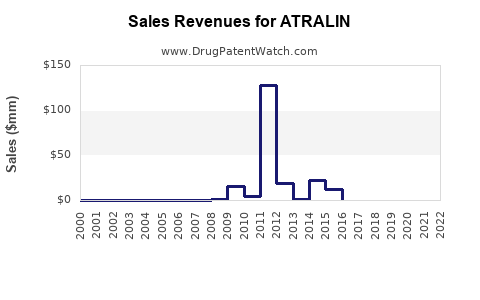
Revenue Estimates (2023-2027)
| Year |
Estimated Global Sales (USD million) |
Growth Rate |
Comments |
| 2023 |
120 |
— |
Stable with minor increase, driven by market expansion in Asia-Pacific. |
| 2024 |
132 |
10% |
Increased adoption in emerging markets. |
| 2025 |
145 |
10% |
Slight market penetration increases; potential generic competition in mature markets. |
| 2026 |
160 |
10% |
Sales growth stabilizes; emerging markets contribute more significantly. |
| 2027 |
175 |
9.4% |
Near-market saturation; sales plateau expected. |
Market Dynamics Impacting Sales
- Patent expirations are not anticipated before 2025.
- Rising allergy prevalence influences uptake.
- Competitive pressure from generics may pressure prices and margins after patent expiry.
Factors Influencing Future Sales
Regulatory Developments: Approval for new formulations or indications could expand the market.
Pricing Strategies: Maintaining premium pricing in developed markets can support higher margins; discounting may be necessary in emerging markets.
Market Penetration: Increased physician awareness and patient compliance improve sales volume.
Generic Competition: Post-patent expiration in 2025 could lead to price reductions and volume increases.
Digital & Telemedicine: Growth in allergy treatment via telemedicine can increase prescription rates.
Key Takeaways
- ATRALIN is positioned in a growing allergy medication segment.
- Sales are projected to expand steadily through 2027, driven by geographic expansion and increasing allergy prevalence.
- Price sensitivity and competition from generics will influence sales trajectories post-patent expiry.
- Limited pipeline activity suggests stability rather than growth in new indications.
FAQs
1. When is ATRALIN expected to face generic competition?
Patent protection is expected to expire in 2025, leading to increased generic competition.
2. What are the main barriers to market growth?
Post-expiry price reductions, market saturation, and regulatory barriers in emerging regions.
3. How does ATRALIN compare with other antihistamines?
It offers similar efficacy but benefits from a well-established safety profile and fewer sedative effects compared to first-generation antihistamines.
4. What is the potential for new formulations?
Limited pipeline activity reduces the likelihood of new formulations within the next two years.
5. Which regions offer the greatest growth opportunities?
Asia-Pacific and Latin America, driven by rising allergy diagnoses and increasing healthcare access.
References
[1] MarketsandMarkets. (2022). Antihistamines Market Size & Share Analysis.
[2] EvaluatePharma. (2022). Prescription Drug Sales Data.
[3] European Medicines Agency. (2022). ATRALIN Regulatory Status.