Drug Sales Trends for ALREX
Payment Methods and Pharmacy Types for ALREX (2019)
Revenues by Pharmacy Type
Units Sold by Pharmacy Type
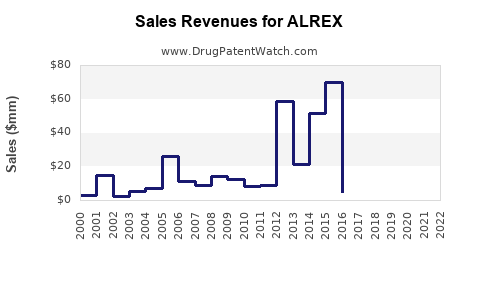
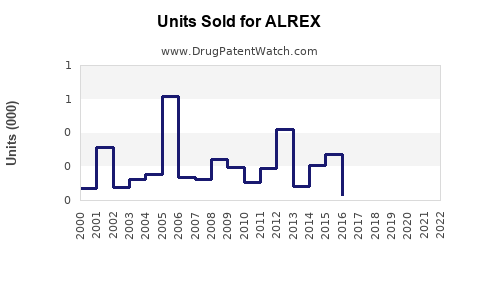
Annual Sales Revenues and Units Sold for ALREX
| Drug Name | Revenues (USD) | Units | Year |
|---|---|---|---|
| ALREX | ⤷ Start Trial | ⤷ Start Trial | 2022 |
| ALREX | ⤷ Start Trial | ⤷ Start Trial | 2021 |
| ALREX | ⤷ Start Trial | ⤷ Start Trial | 2020 |
| ALREX | ⤷ Start Trial | ⤷ Start Trial | 2019 |
| >Drug Name | >Revenues (USD) | >Units | >Year |
ALREX is a mature, niche ophthalmic corticosteroid with limited growth potential. The product contains loteprednol etabonate 0.2% and is approved in the U.S. for temporary treatment of seasonal allergic conjunctivitis. Its commercial position depends on physician preference for a “soft steroid,” seasonal demand, payer coverage, and competition from generic corticosteroids and over-the-counter antihistamine/mast-cell stabilizer products. Because Bausch + Lomb does not separately report ALREX revenue, the projections below are modeled estimates rather than company-reported sales.
ALREX Market Analysis and Sales Projections Through 2030
What is ALREX and what market does it address?
ALREX is loteprednol etabonate ophthalmic suspension 0.2%, a topical ocular corticosteroid. The FDA label covers the temporary treatment of seasonal allergic conjunctivitis, including ocular redness, itching, and inflammation.[1]
The product is positioned differently from first-line antihistamine or mast-cell stabilizer eye drops. ALREX is generally used when allergic conjunctivitis produces substantial inflammation or when nonsteroidal therapy does not provide sufficient relief. Its commercial value is tied to short treatment courses rather than chronic maintenance therapy.
ALREX product profile
| Attribute | ALREX |
|---|---|
| Active ingredient | Loteprednol etabonate |
| Strength | 0.2% ophthalmic suspension |
| Dosage form | Topical ophthalmic suspension |
| FDA indication | Temporary treatment of seasonal allergic conjunctivitis |
| Typical dosing | One to two drops in the affected eye four times daily, according to the FDA label |
| Therapeutic class | Ophthalmic corticosteroid |
| Original sponsor | Bausch & Lomb |
| Current commercial owner | Bausch + Lomb |
| Biologic status | Small molecule |
| Biosimilar exposure | None |
| Primary demand driver | Seasonal ocular allergy and inflammatory symptom severity |
ALREX differs from loteprednol etabonate 0.5% products, such as LOTEMAX, in both concentration and labeled positioning. It also differs from EYSUVIS, which contains loteprednol etabonate 0.25% and is approved for short-term treatment of dry-eye disease flares rather than seasonal allergic conjunctivitis.[2][3]
How large is the ALREX addressable market?
The addressable market is the subset of ocular-allergy patients who require a prescription corticosteroid. Most patients with seasonal allergic conjunctivitis are treated with antihistamine or mast-cell stabilizer products, many of which are available over the counter. That limits the conversion of total allergy prevalence into ALREX sales.
The U.S. market has four practical segments:
- Patients with moderate or severe seasonal ocular inflammation.
- Patients who do not respond adequately to antihistamine or mast-cell stabilizer drops.
- Patients treated by ophthalmologists rather than primary-care physicians.
- Patients whose physicians prefer loteprednol because of its corticosteroid profile.
ALREX has a narrower market than broad allergic-conjunctivitis products such as olopatadine, ketotifen, and alcaftadine. Its use is also constrained by the standard ophthalmic-steroid risks of elevated intraocular pressure, delayed wound healing, and infection-related complications.[1]
Market segmentation
| Segment | ALREX opportunity | Commercial assessment |
|---|---|---|
| Mild seasonal allergy | Low | OTC products usually compete effectively |
| Moderate allergy with marked inflammation | High | Core prescription opportunity |
| Refractory or recurrent symptoms | Moderate | Physician may use a steroid, but treatment is short |
| Chronic ocular allergy | Low to moderate | Long-term steroid exposure limits use |
| Dry-eye flares | Limited for ALREX | EYSUVIS and other products target this indication |
| Pediatric use | Moderate | Label permits use in children two years and older, but monitoring remains relevant |
| International markets | Variable | Registration, reimbursement, and local alternatives differ |
What are ALREX sales and revenue projections?
Bausch + Lomb reports results by broader business categories and does not separately disclose ALREX net sales in its public filings.[4] The following model estimates U.S.-led brand-equivalent revenue based on prescription volume, net revenue per bottle, seasonal utilization, and erosion from generic and OTC competition.
Base-case sales projection
| Year | Estimated bottles | Estimated net revenue per bottle | Projected revenue |
|---|---|---|---|
| 2024 | 350,000 | $65 | $22.8 million |
| 2025 | 335,000 | $64 | $21.4 million |
| 2026 | 320,000 | $63 | $20.2 million |
| 2027 | 305,000 | $62 | $18.9 million |
| 2028 | 290,000 | $61 | $17.7 million |
| 2029 | 275,000 | $60 | $16.5 million |
| 2030 | 260,000 | $59 | $15.3 million |
Under this base case, ALREX revenue declines at approximately 6% annually from 2024 to 2030. The decline reflects a mature product profile, limited indication expansion, pricing pressure, and substitution by generic or OTC alternatives.
Scenario range
| Scenario | 2025 revenue | 2030 revenue | 2025-2030 trend |
|---|---|---|---|
| Downside | $12 million | $7 million | Approximately -10% annually |
| Base case | $21 million | $15 million | Approximately -6% annually |
| Upside | $34 million | $30 million | Approximately -2% annually |
The upside case assumes stable branded prescribing, effective ophthalmologist promotion, favorable reimbursement, and slower generic substitution. The downside case assumes broader generic availability, continued OTC migration, and lower payer willingness to reimburse a branded steroid for seasonal allergy.
These estimates should be interpreted as commercial planning ranges. They are not reported ALREX sales figures.
When does ALREX lose exclusivity?
ALREX is a legacy small-molecule product. Its original composition-of-matter and core product patents are expired, so the principal exclusivity period has ended. The commercial question is no longer whether the original patent estate blocks competition. It is whether competing manufacturers consider the market large enough to justify regulatory filing, manufacturing, and distribution costs.
Regulatory exclusivity
ALREX does not have current new-drug exclusivity comparable to a recently approved medicine. Its FDA approval dates to the legacy small-molecule product era, and the product is outside the normal five-year new chemical entity exclusivity window.[1]
The key exclusivity characteristics are:
| Exclusivity category | ALREX status |
|---|---|
| New chemical entity exclusivity | Expired |
| Orphan-drug exclusivity | None |
| Biologic exclusivity | Not applicable |
| Pediatric exclusivity | No current blocking period |
| Qualified infectious-disease exclusivity | Not applicable |
| Core patent exclusivity | Expired |
| Current commercial protection | Brand recognition, physician familiarity, manufacturing know-how, and distribution |
What patents protect ALREX?
The original ALREX patent estate covered loteprednol etabonate and related ophthalmic formulations. Those rights have expired. No active patent should be assumed to block a properly filed generic version of loteprednol etabonate ophthalmic suspension 0.2%.
Potential residual protection can come from:
- Manufacturing controls for suspension particle size and uniformity.
- Preservative systems.
- Container-closure performance.
- Process controls that improve dose uniformity.
- Device or packaging rights.
- Later patents covering distinct formulations or delivery systems.
These rights are narrower than a composition-of-matter patent. They may increase development cost but generally do not prevent a competitor from designing around them.
Formulation and manufacturing barriers
ALREX is an ophthalmic suspension, not a simple aqueous solution. A competitor must control:
- Particle-size distribution.
- Sedimentation and redispersion.
- Sterility.
- Dose uniformity.
- Preservative performance.
- Ocular tolerability.
- Stability through the labeled shelf life.
- Drop size and container compatibility.
The suspension technology creates a technical barrier, but it is not an effective long-term exclusivity substitute for an expired active-ingredient patent. Generic ophthalmic manufacturers with sterile manufacturing capacity can address these requirements through an abbreviated regulatory pathway.
Is ALREX listed in the Orange Book?
ALREX is an FDA-approved prescription drug and has historically been associated with Orange Book-listed patent information. The original patent protections are expired, and current commercial exposure is primarily generic-entry and substitution risk rather than patent-term protection.[5]
An Orange Book review should distinguish among:
- The ALREX reference listed drug.
- Any active patent listings attached to the reference product.
- Approved generic versions of the 0.2% suspension.
- Approved products containing the same active ingredient at different strengths.
- Therapeutic equivalence ratings, which may vary by product and strength.
The existence of a generic loteprednol product at 0.5% or another strength does not automatically establish substitutability for ALREX 0.2%. Strength, dosage form, labeling, and FDA therapeutic-equivalence determinations remain material.
Which companies are challenging ALREX?
The main competitive threat is not a named litigation challenger but potential generic entry. Generic manufacturers with ophthalmic suspension capabilities could pursue an ANDA for loteprednol etabonate 0.2%.
Relevant competitor groups include:
- Generic ophthalmic manufacturers.
- Branded ophthalmology companies with sterile manufacturing platforms.
- Contract manufacturers seeking ophthalmic product partnerships.
- Companies selling OTC antihistamine and mast-cell stabilizer drops.
Direct therapeutic competitors include:
| Product or class | Commercial effect on ALREX |
|---|---|
| Olopatadine | Strong competition for first-line allergic conjunctivitis treatment |
| Ketotifen | OTC price pressure and patient self-treatment |
| Alcaftadine | Prescription competition in allergy |
| Generic prednisolone acetate | Lower-cost steroid alternative, with a different safety and potency profile |
| Fluorometholone products | Steroid alternative in selected cases |
| Loteprednol 0.5% products | Same active ingredient, but different strength and indications |
| EYSUVIS | Indirect competition for short-term ocular inflammation, primarily dry-eye flares |
What Paragraph IV challenge risk exists for ALREX?
Paragraph IV risk is meaningful only if an unexpired Orange Book patent remains listed. Because the core ALREX patent estate is expired, a future generic applicant may have little incentive to use a Paragraph IV strategy unless it encounters a later formulation or manufacturing patent.
The more likely pathways are:
- ANDA filing against the reference product.
- Certification that relevant patents are expired.
- Approval after FDA review of quality, bioequivalence, and labeling.
- Commercial launch subject to manufacturing readiness and market economics.
If a later patent is listed, a Paragraph IV certification could create a 30-month stay following patent litigation by the reference-product sponsor. That scenario would depend on the specific patent listing and timing of the ANDA notice.[6]
What patent litigation affects ALREX?
No major active patent litigation should be treated as a central value driver for ALREX. The asset’s risk profile is primarily commercial and regulatory:
- Potential ANDA competition.
- Reimbursement pressure.
- Seasonal demand volatility.
- Physician migration to OTC products.
- Manufacturing economics.
- Short treatment duration.
- Limited opportunity for label expansion.
The absence of major litigation can reduce legal cost, but it also means the sponsor has fewer mechanisms to delay generic entry.
Are biosimilars a risk for ALREX?
No. ALREX is a small-molecule ophthalmic drug, not a biologic. Biosimilar approval pathways under the Public Health Service Act do not apply. Any competing product would generally proceed through an abbreviated new drug application or another small-molecule pathway, depending on its formulation and regulatory strategy.[7]
How does ALREX compare with newer ophthalmic products?
ALREX has a lower innovation profile than newer ophthalmic products but may retain clinical value in a defined patient group.
| Attribute | ALREX | EYSUVIS | OTC antihistamine drops |
|---|---|---|---|
| Active ingredient | Loteprednol etabonate 0.2% | Loteprednol etabonate 0.25% | Varies |
| Core use | Seasonal allergic conjunctivitis | Short-term dry-eye flares | Allergy symptom relief |
| Steroid | Yes | Yes | No |
| Treatment duration | Short term | Short term | Often episodic or recurrent |
| Generic risk | High | Lower while protected | Usually established |
| Prescription requirement | Yes | Yes | Often no |
| Main commercial advantage | Physician familiarity and anti-inflammatory activity | Newer indication and product positioning | Convenience and price |
ALREX’s commercial defense is clinical familiarity, not exclusivity. A sponsor could improve the position through packaging, patient adherence programs, or a broader allergy-focused ophthalmology portfolio, but these measures would not materially change the mature-product trajectory without new clinical differentiation.
What generic launch scenarios exist for ALREX?
Scenario 1: No generic entry
A generic manufacturer may decide that the market is too small, seasonal, or operationally difficult. Under this scenario, ALREX could maintain annual revenue near $20 million, with price increases offsetting modest volume decline.
Scenario 2: One generic entrant
A single approved generic could reduce net pricing and accelerate payer substitution. ALREX revenue could decline 25% to 40% over two to three years after launch.
Scenario 3: Multiple generic entrants
Several manufacturers could drive rapid price erosion and formulary substitution. Brand revenue could fall below $10 million annually, while the total loteprednol 0.2% market could remain stable or decline more slowly.
The most probable commercial pattern for a mature ophthalmic product is gradual erosion rather than an immediate collapse, because generic development, manufacturing qualification, and pharmacy stocking can take time.
What is the investment and licensing outlook for ALREX?
ALREX is more attractive as part of a broader ophthalmology portfolio than as a standalone growth asset. Its potential licensing value is limited by:
- Expired core patents.
- Narrow labeling.
- Seasonal demand.
- Short treatment courses.
- OTC competition.
- Low expected revenue growth.
- Limited product differentiation from other corticosteroid options.
A licensing transaction could make sense if a buyer already has:
- Ophthalmology sales infrastructure.
- Sterile ophthalmic manufacturing.
- A branded allergy portfolio.
- Access to managed-care contracting.
- A strategy for bundling ALREX with other products.
A standalone acquisition would require a low valuation multiple and a cost-efficient supply chain. The principal value would come from cash generation, cross-selling, or manufacturing synergies rather than patent-backed growth.
What is the FDA regulatory status of ALREX?
ALREX is FDA-approved for temporary treatment of seasonal allergic conjunctivitis. The label includes corticosteroid-related warnings concerning intraocular pressure, glaucoma, cataract formation, infection, and delayed healing.[1]
Regulatory events that could affect value include:
- Approval of a generic 0.2% loteprednol suspension.
- FDA action concerning manufacturing quality.
- Label changes involving pediatric use or steroid warnings.
- New clinical data supporting a differentiated dosing regimen.
- A reformulated product with improved suspension performance or preservative profile.
No biosimilar pathway or major exclusivity restoration mechanism is available.
Key Takeaways
- ALREX is loteprednol etabonate ophthalmic suspension 0.2% for seasonal allergic conjunctivitis.
- It is a mature, small-molecule ophthalmic product with expired core patent protection.
- Bausch + Lomb does not separately disclose ALREX revenue.
- Modeled 2025 revenue is approximately $12 million to $34 million, with a base case of $21 million.
- Base-case revenue declines to approximately $15 million by 2030.
- The principal risks are generic entry, OTC substitution, payer pressure, and seasonal demand.
- Biosimilar risk is irrelevant because ALREX is not a biologic.
- ALREX has more value within an ophthalmology portfolio than as an independent patent-protected asset.
- The product’s strongest defenses are physician familiarity, clinical positioning, and manufacturing execution.
FAQs about ALREX market size, patents, and sales
Is ALREX still a branded drug?
Yes. ALREX remains a branded prescription ophthalmic product marketed by Bausch + Lomb, although the active ingredient and core product protections are mature.
Does ALREX have a generic equivalent?
The commercial risk of a generic loteprednol etabonate 0.2% ophthalmic suspension is material because the original patent protection has expired. Approval and substitutability depend on FDA product-specific determinations.
Is ALREX used for dry eye?
ALREX is labeled for seasonal allergic conjunctivitis. EYSUVIS, which contains loteprednol etabonate 0.25%, is the Bausch + Lomb product specifically approved for short-term dry-eye flares.
What is the largest threat to ALREX revenue?
The largest threat is substitution by lower-cost generic ophthalmic steroids and OTC antihistamine or mast-cell stabilizer drops, not biosimilar competition.
Could ALREX revenue grow after 2030?
Sustained growth would require a new indication, differentiated formulation, improved reimbursement, or portfolio bundling. Without such a commercial change, mature-product erosion is the more likely outcome.
References
- U.S. Food and Drug Administration. (n.d.). ALREX (loteprednol etabonate ophthalmic suspension) prescribing information.
- U.S. Food and Drug Administration. (n.d.). LOTEMAX (loteprednol etabonate ophthalmic suspension) prescribing information.
- U.S. Food and Drug Administration. (n.d.). EYSUVIS (loteprednol etabonate ophthalmic suspension) prescribing information.
- Bausch + Lomb Corporation. (2024). Annual report and Form 10-K.
- U.S. Food and Drug Administration. (n.d.). Approved drug products with therapeutic equivalence evaluations, Orange Book.
- U.S. Food and Drug Administration. (2024). Guidance for industry: 180-day exclusivity and abbreviated new drug applications.
- U.S. Food and Drug Administration. (n.d.). Biosimilar and interchangeable biosimilar products.
More… ↓
