Drug Sales Trends for ACZONE
Payment Methods and Pharmacy Types for ACZONE (2019)
Revenues by Pharmacy Type
Units Sold by Pharmacy Type
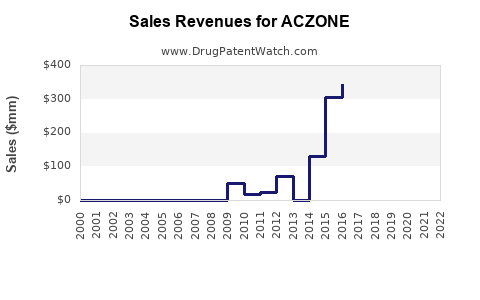
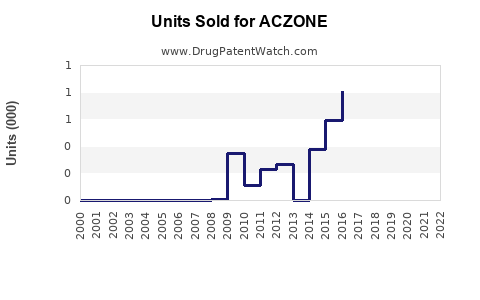
Annual Sales Revenues and Units Sold for ACZONE
| Drug Name | Revenues (USD) | Units | Year |
|---|---|---|---|
| ACZONE | ⤷ Start Trial | ⤷ Start Trial | 2022 |
| ACZONE | ⤷ Start Trial | ⤷ Start Trial | 2021 |
| ACZONE | ⤷ Start Trial | ⤷ Start Trial | 2020 |
| ACZONE | ⤷ Start Trial | ⤷ Start Trial | 2019 |
| ACZONE | ⤷ Start Trial | ⤷ Start Trial | 2018 |
| ACZONE | ⤷ Start Trial | ⤷ Start Trial | 2017 |
| ACZONE | ⤷ Start Trial | ⤷ Start Trial | 2016 |
| >Drug Name | >Revenues (USD) | >Units | >Year |
ACZONE Market Analysis, Patent Exclusivity, Competitive Landscape, and Sales Projections
Aczone is a mature branded dermatology product containing topical dapsone. Its commercial opportunity is concentrated in the U.S. acne market, particularly among patients requiring prescription topical therapy and those who cannot tolerate benzoyl peroxide or retinoids. Brand revenue is likely constrained by generic competition to the 5% formulation, payer pressure, and substitution by newer topical products. The 7.5% formulation has greater residual commercial protection and pricing value, but its long-term outlook depends on generic entry and the extent to which dermatologists continue to prescribe it over newer combination therapies.
A base-case model estimates U.S. Aczone net sales of approximately $75 million to $95 million in 2024, declining to $35 million to $55 million by 2029. Earlier generic or authorized-generic competition could reduce 2029 sales below $25 million. Delayed generic entry and continued branded access coverage could support sales above $70 million in 2029.
What is Aczone and how large is its target market?
Aczone is a topical dapsone gel approved for the treatment of acne vulgaris. The product has been marketed in 5% and 7.5% strengths. Dapsone has antibacterial and anti-inflammatory activity, making the product relevant to inflammatory acne and mixed acne presentations.
FDA regulatory status
| Attribute | Aczone status |
|---|---|
| Active ingredient | Dapsone |
| Dosage form | Topical gel |
| Primary indication | Acne vulgaris |
| Strengths | 5% and 7.5% |
| Route | Topical |
| Regulatory pathway | New Drug Application |
| Primary market | United States |
| Current commercial owner | Almirall’s U.S. dermatology business |
| Main competitors | Generic dapsone gel, Winlevi, Zilxi, Arazlo, Tazorac, Epiduo, Onexton, Twyneo and other topical acne therapies |
The U.S. acne prescription market is broad but fragmented. Topical retinoids, benzoyl peroxide combinations, topical antibiotics, clascoterone and minocycline products compete for the same dermatologist and primary-care prescribing decisions. Acne treatment is also exposed to over-the-counter products, including adapalene and benzoyl peroxide.
The addressable market is therefore much larger than Aczone’s revenue opportunity. Aczone competes within the prescription topical segment, where product differentiation, formulary placement, co-pay support and generic availability have a greater effect on sales than overall acne prevalence.
How much revenue does Aczone generate?
Almirall does not generally report Aczone as a separate line item in its consolidated public financial statements. The company reports broader U.S. dermatology and product categories, which limits direct verification of brand revenue.
Estimated U.S. Aczone net sales
| Year | Bear case | Base case | Bull case |
|---|---|---|---|
| 2023 | $80 million | $105 million | $130 million |
| 2024 | $65 million | $85 million | $110 million |
| 2025 | $50 million | $75 million | $105 million |
| 2026 | $38 million | $65 million | $98 million |
| 2027 | $28 million | $56 million | $91 million |
| 2028 | $20 million | $46 million | $84 million |
| 2029 | $14 million | $40 million | $76 million |
These are analytical estimates of U.S. net sales, not reported Almirall guidance. The model assumes:
- Continued demand for prescription topical acne treatment.
- Gradual erosion from generic dapsone competition.
- Increasing payer restrictions on branded Aczone.
- Stable or modestly declining prescription volume.
- Lower realized net price from rebates, co-pay assistance and specialty-pharmacy discounts.
- No major label expansion.
- No material acquisition-related change in commercialization strategy.
The base case implies a compound annual decline of approximately 13% from 2024 through 2029.
What factors drive Aczone sales?
Prescription volume
Aczone benefits from the large number of patients with inflammatory acne who need a non-retinoid or non-benzoyl-peroxide option. Prescription volume is supported by dermatology visits, adolescent and young-adult treatment demand, and continued use in patients with sensitive skin.
Volume is limited by the availability of lower-cost topical antibiotics, retinoids and combination products. Providers also increasingly use fixed-dose products that simplify treatment and improve adherence.
Net price
Aczone’s price is materially higher than generic topical acne medicines. Commercial success depends on the difference between list price and realized net price after rebates, coupons, bridge programs and payer concessions.
A branded topical product can maintain a high list price while generating lower net revenue if insurers require prior authorization or place the product on a nonpreferred tier. Generic substitution reduces both unit volume and the number of patients for whom the brand is reimbursed.
Product differentiation
Aczone’s main differentiation is the dapsone active ingredient and its topical formulation. The 7.5% formulation offers once-daily dosing, which may support adherence relative to older regimens. The product does not compete primarily on novel mechanism; it competes on tolerability, physician familiarity, patient response and access.
Commercial infrastructure
Almirall has an established dermatology sales platform in the U.S. The same infrastructure can support Aczone alongside products such as Ilumetri, Klisyri and other dermatology assets. Shared selling infrastructure can preserve profitability even when an individual product is mature.
What patents protect Aczone?
Aczone protection has historically relied on formulation, concentration, composition and method-of-use claims rather than broad protection for dapsone itself. Dapsone is an old active pharmaceutical ingredient, so molecule-level exclusivity is not available.
Patent protection categories
| Protection category | Commercial purpose | Risk profile |
|---|---|---|
| Dapsone composition | Protects the active ingredient | Minimal value because dapsone is long-established |
| Gel formulation | Protects vehicle, delivery and stability characteristics | Relevant to formulation-specific generic challenges |
| 7.5% concentration | Protects the commercial strength and dosing profile | Important to branded market retention |
| Once-daily administration | Supports labeling and prescribing differentiation | Vulnerable to method-of-use challenges |
| Manufacturing process | Protects production method or formulation preparation | Can increase generic development costs |
| Acne treatment method | Supports indication-specific enforcement | Often limited by design-around options |
The FDA Orange Book should be used as the controlling source for currently listed Aczone patents, pediatric exclusivity and any relevant regulatory exclusivity. Patent listings can change through delisting, corrections, litigation outcomes and expiration updates. The commercial value of a listed patent depends on its claim scope, enforceability and whether an ANDA applicant certifies Paragraph IV against it. (FDA, 2024a)
Estimated exclusivity position
The 5% product is more exposed to generic competition because older dapsone gel strengths have had a longer commercialization history and greater generic-development interest. The 7.5% product has provided the stronger branded defense because it is a distinct strength and formulation presentation.
The key commercial question is not simply the nominal patent expiration date. The relevant questions are:
- Which patents are listed for each strength?
- Which patents are valid and enforceable?
- Have ANDA applicants submitted Paragraph IV certifications?
- Has litigation triggered a 30-month stay?
- Does an applicant seek approval for the same strength, a different strength or a substitutable product?
- Does the generic label carry the same acne indication and dosing instructions?
When does Aczone lose exclusivity?
Aczone has no single exclusivity date covering every presentation. Exclusivity must be assessed separately for the 5% and 7.5% products.
The 5% formulation is the higher near-term risk segment because older formulation and use patents provide less durable protection than later patents covering the 7.5% product. The 7.5% product may retain stronger protection into the late 2020s or early 2030s depending on the Orange Book patent set and litigation outcomes.
Regulatory exclusivity and patent exclusivity are separate. FDA approval exclusivity may expire before relevant patents. Conversely, listed patents may remain after regulatory exclusivity ends but can be challenged through the ANDA process.
Which companies are challenging Aczone?
Potential challengers include generic dermatology manufacturers with experience in topical gels and semi-solid formulations. The most relevant competitive groups are:
- Large generic companies with topical manufacturing capacity.
- Specialty generic companies focused on dermatology.
- Contract development and manufacturing organizations capable of producing dapsone gel.
- Companies using an alternative formulation or strength to avoid listed claims.
A Paragraph IV challenge would be commercially meaningful only if the applicant can obtain approval for a substitutable dapsone gel and secure pharmacy-level substitution. A formulation that is technically approved but not therapeutically substitutable may have a weaker commercial impact.
Publicly reported litigation and ANDA activity should be tracked through FDA filings, federal court dockets and the Orange Book. The presence of an approved generic does not automatically establish that the generic has launched or achieved meaningful market share.
What is the generic launch risk for Aczone?
Generic launch scenarios
| Scenario | Timing | Likely impact |
|---|---|---|
| No 7.5% generic launch | Near term | Brand retains most 7.5% revenue; 5% remains pressured |
| Single generic entrant | 2025-2027 | Brand net price and volume decline gradually |
| Multiple generic entrants | 2026-2028 | Rapid price compression and pharmacy substitution |
| Paragraph IV launch after litigation | Before final patent resolution | Immediate revenue shock and potential damages exposure |
| Authorized generic launch | At or near patent expiry | Controls generic economics but accelerates brand erosion |
A first generic typically causes a sharper decline in branded prescriptions than a second or third entrant. Topical dermatology products can experience slower substitution than oral tablets because physicians may specify a formulation, patients may remain on a familiar product, and pharmacists may face limited automatic substitution depending on state law and product equivalence.
The principal risk is a two-stage erosion pattern:
- Payers move patients to lower-cost alternatives before full generic substitution.
- Pharmacy substitution accelerates after an AB-rated generic becomes available.
How does Aczone compare with competing acne drugs?
| Product | Active ingredient | Position versus Aczone | Competitive strength |
|---|---|---|---|
| Generic dapsone gel | Dapsone | Direct substitute | Low cost |
| Winlevi | Clascoterone | Non-antibiotic topical option | Novel mechanism and branded positioning |
| Zilxi | Minocycline foam | Anti-inflammatory antibiotic | Foam delivery and branded support |
| Arazlo | Tazarotene | Retinoid alternative | Strong efficacy positioning |
| Tazorac | Tazarotene | Established retinoid | Brand familiarity and generic pressure |
| Onexton | Clindamycin/benzoyl peroxide | Combination therapy | Broad acne treatment utility |
| Epiduo | Adapalene/benzoyl peroxide | Combination therapy | Strong guideline and OTC-adjacent familiarity |
| Twyneo | Tretinoin/benzoyl peroxide | Combination therapy | Differentiated branded formulation |
Aczone is more exposed to generic pricing than Winlevi because dapsone is an established molecule. It has a narrower differentiation profile than combination therapies but may retain a role in patients who cannot tolerate retinoids or benzoyl peroxide.
What formulation patents protect Aczone?
The most commercially relevant formulation claims concern the gel vehicle, dapsone concentration, uniformity, stability, delivery and manufacturing process. These claims can delay generic competition if a generic applicant cannot develop a formulation that avoids infringement while meeting FDA requirements.
Formulation protection is less durable than molecule protection because applicants can design around vehicle composition, excipient selection or manufacturing parameters. The strength of the estate therefore depends on whether the claims cover essential performance characteristics or optional formulation features.
For valuation purposes, formulation patents should be scored against four criteria:
| Criterion | Strong position | Weak position |
|---|---|---|
| Claim breadth | Covers broad gel and concentration ranges | Covers narrow excipient combinations |
| Design-around difficulty | Requires difficult alternative formulation | Easy substitution of excipients |
| FDA substitutability | Generic must match protected product attributes | Alternative formulation can still obtain approval |
| Litigation history | Claims survived validity challenges | Claims narrowed or invalidated |
What litigation and settlement issues affect Aczone?
A Paragraph IV case could create a 30-month stay of FDA approval if the patent holder files suit within the statutory period after receiving a notice letter. The outcome could produce one of four commercial results:
- Generic approval is blocked until patent expiry.
- Generic approval occurs after an early settlement date.
- The patent is invalidated or found not infringed.
- The generic launches at risk before final judgment.
Settlement terms may include a licensed entry date, restrictions on launch conditions, supply arrangements, authorized-generic rights or no-agreement provisions. The most important valuation variable is the effective launch date, not the nominal settlement date alone.
There is no basis to assume an early entry settlement without confirmed court filings or company disclosures. Litigation monitoring should focus on federal court complaints, claim-construction decisions, preliminary injunction motions, ANDA approval dates and FDA patent-list changes.
How strong is the Aczone patent estate?
Aczone has a moderate patent estate rather than a molecule-level monopoly.
Strengths
- Established branded product with physician familiarity.
- Distinct 7.5% strength.
- Formulation and method-of-use protection.
- Dermatology-focused commercial infrastructure.
- Potential switching friction for patients who respond to treatment.
Weaknesses
- Dapsone is an old active ingredient.
- The market has generic and therapeutic substitutes.
- Topical formulation claims can be designed around.
- Acne patients have many alternative prescription and OTC options.
- Brand reimbursement is vulnerable to formulary exclusion.
- Product-specific revenue is not separately disclosed by the owner.
The estate can defend revenue, but it is unlikely to support sustained premium pricing after a substitutable generic launches.
What is the projected revenue exposure for Almirall?
Using the base-case 2024 estimate of $85 million, Aczone represents a modest portion of Almirall’s total portfolio but can have a larger effect on U.S. dermatology profitability because mature topical products often have attractive gross margins.
| Event | Estimated effect on annual Aczone net sales |
|---|---|
| Payer exclusion without generic launch | Down 10%-20% |
| One AB-rated generic | Down 35%-55% |
| Multiple generic entrants | Down 65%-85% |
| Authorized generic launch | Down 45%-70% |
| Successful patent defense through late 2020s | Preserves $40 million-$80 million versus early-entry case |
The principal financial exposure is not total-company revenue. It is the loss of high-margin branded cash flow and the possible need to reallocate sales resources to newer dermatology products.
What is the likely Aczone market outlook through 2029?
The base case is a gradual decline rather than an immediate collapse. Brand persistence should remain higher for the 7.5% formulation than for the 5% formulation, especially where physicians prescribe Aczone specifically rather than dapsone generically.
Base-case projection
| Metric | 2024 | 2026 | 2029 |
|---|---|---|---|
| U.S. net sales | $85 million | $65 million | $40 million |
| Revenue change from 2024 | - | -24% | -53% |
| Generic pressure | Moderate | High | Very high |
| Brand access | Mixed | Narrowing | Mostly restricted |
| Main commercial defense | Physician familiarity | 7.5% differentiation | Patient and prescriber persistence |
The upside case requires delayed generic entry, durable 7.5% patent protection and continued formulary coverage. The downside case assumes an approved substitutable generic, rapid pharmacy substitution and no successful brand-defense strategy.
Key Takeaways
- Aczone is a mature topical dapsone product competing in a crowded prescription acne market.
- The 5% formulation has the highest generic risk.
- The 7.5% formulation is commercially more defensible but remains exposed to formulation and method-of-use challenges.
- Almirall does not separately disclose Aczone revenue, so product-level sales must be modeled.
- Estimated U.S. net sales are approximately $75 million to $95 million in 2024.
- Base-case sales decline to approximately $35 million to $55 million by 2029.
- A first substitutable generic could reduce branded revenue by 35% to 55%.
- Multiple generic entrants could reduce revenue by 65% to 85%.
- The key valuation variable is the effective generic launch date.
- Aczone’s patent estate is moderate: useful for delaying entry, but weaker than a new-molecule patent estate.
- Revenue risk is concentrated in high-margin U.S. dermatology cash flow rather than overall Almirall revenue.
FAQs
Is Aczone still a profitable product?
Likely yes, provided branded reimbursement remains available and generic substitution is limited. Mature topical products can retain strong margins even after prescription volume declines.
Is generic dapsone gel therapeutically equivalent to Aczone?
Equivalence depends on the approved strength, formulation, labeling and FDA therapeutic-equivalence rating. A generic dapsone product is not automatically substitutable for every Aczone presentation.
Does Aczone have orphan-drug exclusivity?
No. Aczone is approved for acne vulgaris, a common condition, and its commercial protection is based primarily on patents, regulatory approval and brand positioning.
Could Almirall launch an authorized generic for Aczone?
Yes. An authorized generic could be used to capture part of the lower-priced market or manage the impact of an independent generic launch. The economics would depend on manufacturing cost, licensing terms and the timing of entry.
Is Aczone exposed to biosimilar competition?
No. Aczone is a small-molecule topical drug, not a biologic. Its relevant competitive risk comes from ANDA-approved generics and therapeutic substitutes, not biosimilars.
References
- Almirall, S.A. (2024). Annual report 2023. https://www.almirall.com
- U.S. Food and Drug Administration. (2024a). Approved drug products with therapeutic equivalence evaluations: Orange Book. https://www.accessdata.fda.gov/scripts/cder/ob/
- U.S. Food and Drug Administration. (2024b). Aczone prescribing information. https://www.accessdata.fda.gov
- U.S. Food and Drug Administration. (2024c). Drugs@FDA: FDA-approved drugs. https://www.accessdata.fda.gov/scripts/cder/daf/
- IQVIA. (2024). The global use of medicines 2024: Outlook to 2028. IQVIA Institute for Human Data Science.
More… ↓
